There is no direct pharmacological interaction between Ozempic and alcohol, but drinking on treatment is less predictable, less pleasant and carries a handful of indirect risks worth understanding first. The practical picture of Ozempic and alcohol is that most people find they want less of it, tolerate less of it, and feel worse afterwards.
Semaglutide is a peptide degraded by proteolysis rather than metabolised through the cytochrome P450 system, so the classic competition for liver enzymes does not apply. Alcohol does not appear in the drug interactions section of the label. The problems are downstream.
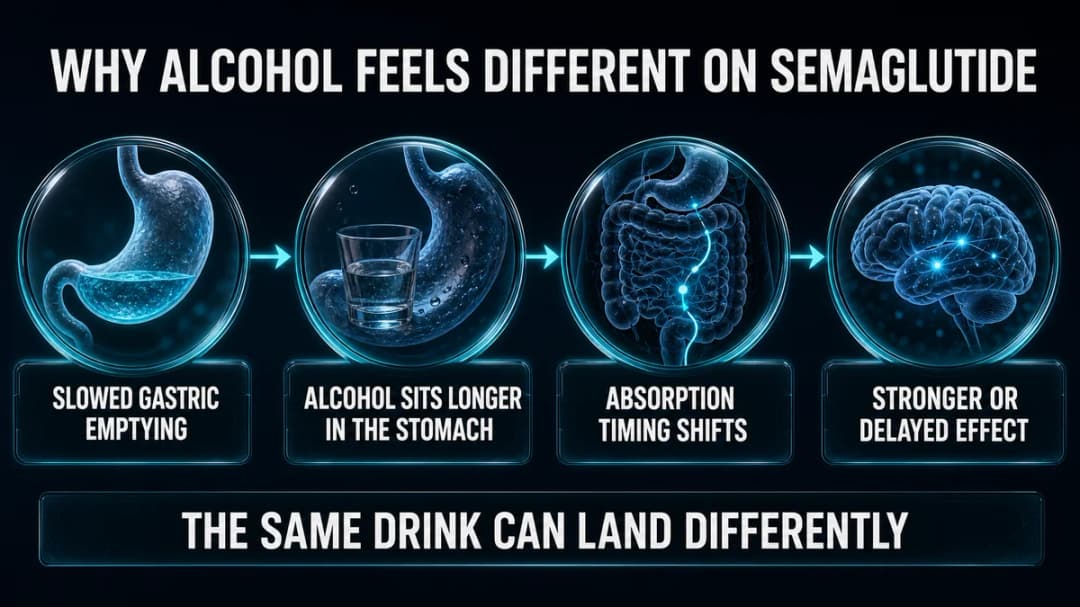
Why Alcohol Feels Different on Semaglutide
Four mechanisms explain most of what people report.
Gastric emptying is slower. Alcohol absorption depends heavily on how quickly stomach contents reach the small intestine. Slowing that step stretches and flattens the absorption curve, so intoxication arrives later than expected and lasts longer. The usual internal calibration of how one drink feels after twenty minutes stops being reliable.
Total food intake is lower. Less food in the stomach means that when emptying does occur, alcohol reaches the bloodstream faster. Drinking on an effectively empty stomach is common on GLP-1 treatment simply because appetite is suppressed.
Reward signalling is dampened. GLP-1 receptors in the mesolimbic reward pathway are involved in more than food. Many people describe alcohol as flat, or the pleasant part of the first drink going missing. This is the same mechanism that drives the reduction in food preoccupation.
Gastrointestinal side effects stack. Nausea is already the commonest side effect of semaglutide, reported by a large minority of people at higher doses. Alcohol is an independent gastric irritant. Combining them during a titration week is how mild queasiness becomes a night of vomiting.
Ozempic and Alcohol: The Specific Risks
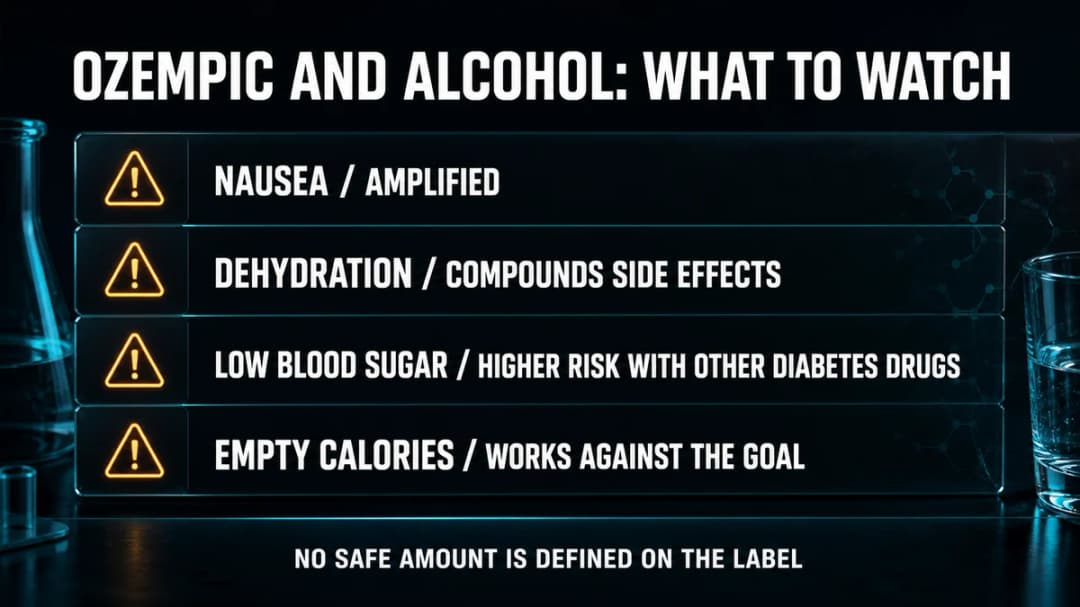
Most of these are not dramatic in isolation. They matter because they overlap with effects the drug is already producing, so the margin for error is narrower than it was before treatment.
| Risk | Who it matters most for | Sensible precaution |
|---|---|---|
| Hypoglycaemia | People also taking insulin or a sulfonylurea | Eat carbohydrate with alcohol, monitor glucose, keep fast acting glucose to hand |
| Severe nausea and vomiting | Anyone in the first weeks of a new dose | Avoid alcohol entirely during titration |
| Dehydration | Anyone with reduced fluid intake or ongoing GI symptoms | Alternate alcoholic drinks with water |
| Pancreatitis | Anyone with a history of it, or heavy chronic drinking | Avoid alcohol. Seek urgent care for severe, persistent upper abdominal pain radiating to the back |
| Reflux | Anyone already experiencing heartburn on treatment | Avoid late drinking, stay upright afterwards, skip carbonated mixers |
| Misjudged intoxication | Everyone | Assume your tolerance is lower than it was and do not drive |
Pancreatitis deserves the strongest wording. Both GLP-1 receptor agonists and heavy alcohol use are independent risk factors, and the combination in someone with prior pancreatitis is a genuinely poor idea rather than a theoretical concern.
Does Ozempic Reduce Alcohol Cravings?
This is the more interesting half of the question, and the evidence is real but early.
A small randomised trial published in JAMA Psychiatry in 2025 tested low dose semaglutide in adults with alcohol use disorder over a short treatment period. It found reductions in the amount consumed per drinking occasion and in craving measured under laboratory conditions, without a clear reduction in the number of days on which participants drank. The trial enrolled fewer than fifty people and was designed to test a signal, not to support approval.
That is the honest state of it: a mechanistically plausible effect, a positive early trial, and larger studies still running. Semaglutide is not an approved treatment for alcohol use disorder in any jurisdiction, and nobody should start or continue a GLP-1 medicine for that purpose outside a trial or a specialist's care.
Observationally, a large share of people on GLP-1 drugs report drinking less without intending to. Survey data of that kind is self selected and should be read as a description of a common experience rather than a measured effect size.
If drinking is a problem in its own right, the established treatments for alcohol use disorder have far better evidence than an off label appetite drug, and they are worth pursuing first. Our GLP-1 and addiction piece covers what the reward pathway evidence does and does not show.
Practical Rules If You Do Drink
- Skip alcohol completely for the first two to four weeks after any dose increase
- Eat protein containing food beforehand rather than drinking on an empty stomach
- Choose dry wine, spirits with soda water, or light beer over cream liqueurs, cocktails and sweet mixers
- Match each alcoholic drink with a glass of water
- Assume roughly half your previous tolerance, and give yourself longer before judging the effect
- Stay upright for a couple of hours afterwards if reflux is an issue
- Do not drink at all if you have any history of pancreatitis
Liquid calories also matter more when total intake is low. A couple of glasses of wine can account for a fifth of a day's energy at the intake most people settle into on treatment, without contributing protein, fibre or micronutrients. When appetite is suppressed and total intake is already near a floor, displacing food with alcohol is a straightforward route to under eating on protein without noticing.
The social side is worth naming too. A good number of people find that drinking simply stops being appealing, and that this creates awkwardness in situations built around it. That is a real adjustment rather than a side effect, and it usually resolves once the pattern settles.
For the class wide picture, see GLP-1 drugs and alcohol.
FAQ
Can you drink alcohol while taking Ozempic?
There is no direct interaction and the label does not prohibit it. Most clinicians advise moderation, avoiding alcohol during dose escalation, and complete avoidance if you have a history of pancreatitis or are on insulin or a sulfonylurea.
Why does alcohol hit harder on Ozempic?
Slowed gastric emptying changes the absorption curve, and reduced food intake means alcohol often meets an empty stomach. The result is intoxication that arrives at an unexpected time and lasts longer. Most people find their usual limit no longer applies.
Does Ozempic stop alcohol cravings?
Many people report wanting to drink less, and early trial evidence supports a reduction in how much is consumed per occasion. The evidence is limited to small studies, semaglutide is not approved for alcohol use disorder, and it should not be used for that reason outside specialist care.
Will drinking stop me losing weight on Ozempic?
Not by itself, but alcohol contributes energy without satiety at a time when total intake is already low. It also tends to loosen food choices later in the evening. Occasional drinking is unlikely to derail progress; regular drinking often does.
How long should I wait after my injection before drinking?
There is no pharmacological reason to time drinking around the injection, since semaglutide concentrations stay fairly flat across the week. The more useful rule is to avoid alcohol during the weeks after any dose increase, when nausea risk is highest.