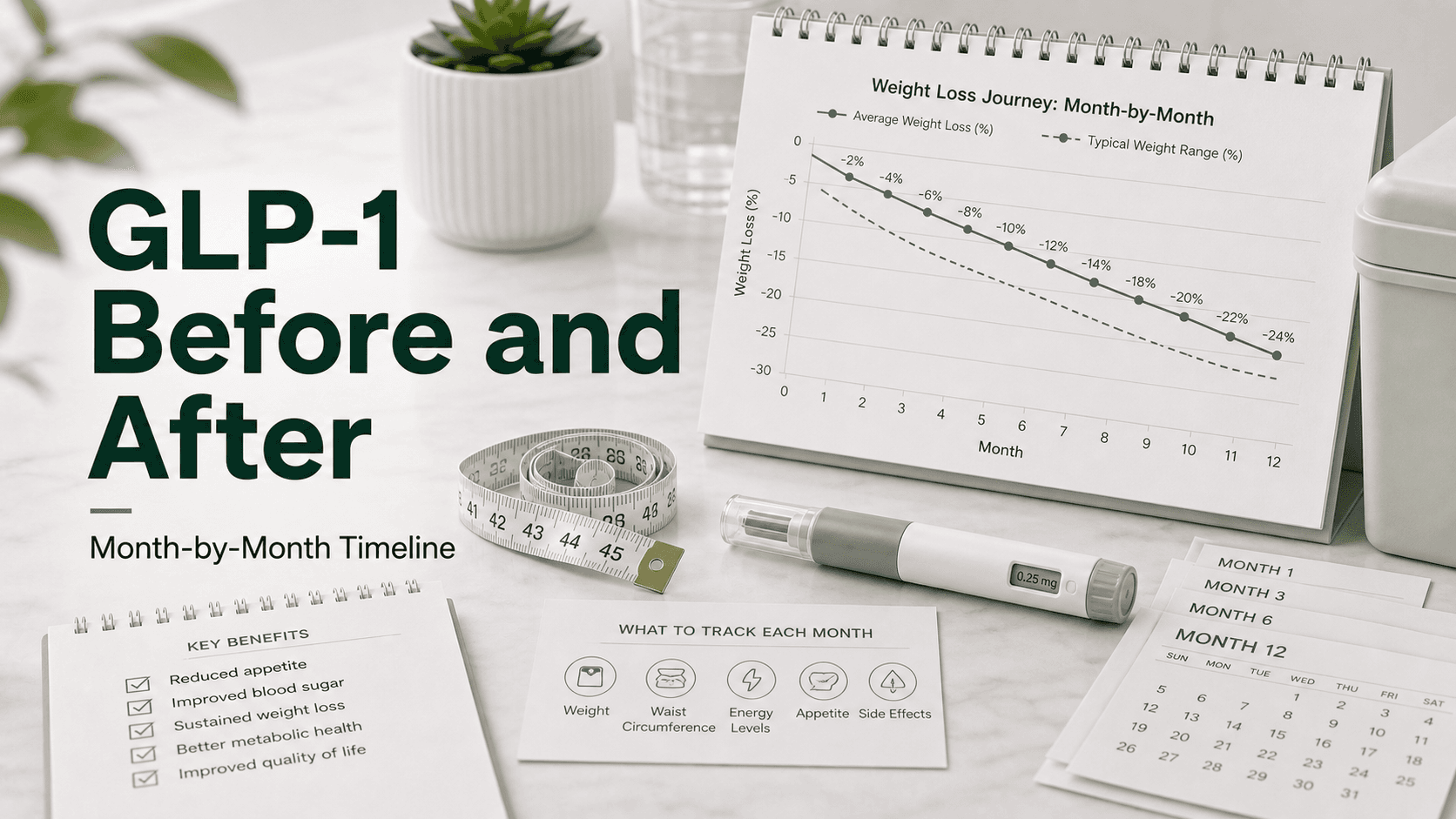
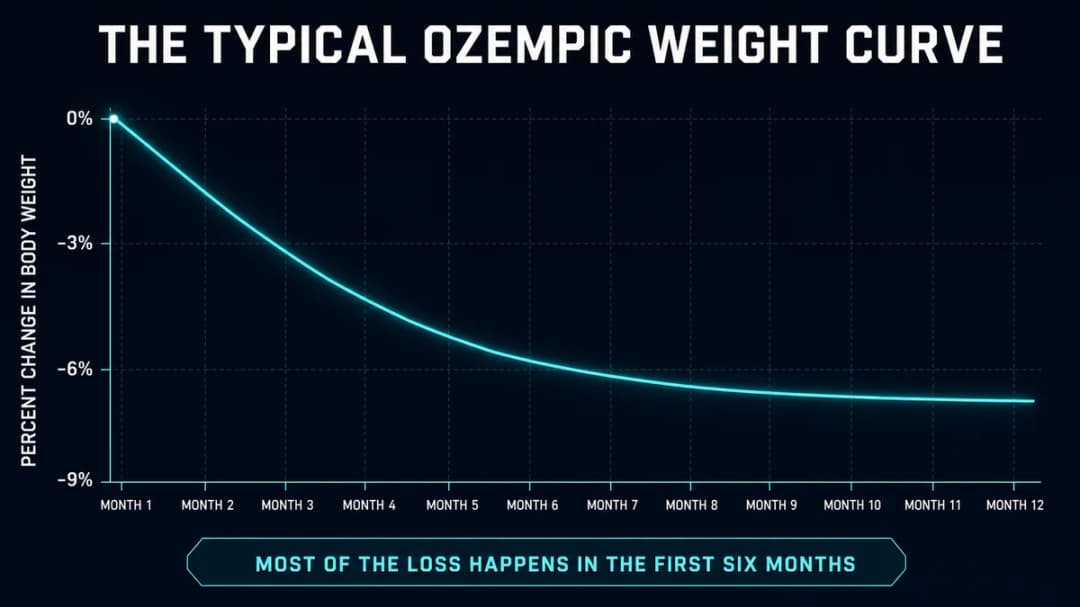
A realistic Ozempic before and after arc runs roughly 3 to 5 percent of body weight lost in the first month, around 6 percent by month three, 10 to 12 percent by month six, and close to 15 percent at a year on the 2.4 mg dose used in the obesity trials. Ozempic before and after photos circulate widely, but they select for the best outcomes and tell you nothing about how long it took or what dose was involved, so this piece uses the trial numbers instead.
We do not publish transformation photos. A photograph cannot show the starting weight, the dose, the trial duration, or whether the person was one of the responders or one of the people for whom the drug did very little. The distribution matters more than any single image in it.
Ozempic Before and After: The Month by Month Curve
The figures below come from the semaglutide obesity trial programme, where the dose was 2.4 mg weekly. Ozempic itself is licensed to a maximum of 2 mg, so results at labelled Ozempic doses land somewhat below these.
| Timepoint | Mean total body weight lost | What is usually visible |
|---|---|---|
| Month 1 | Roughly 3 to 5 percent | Little visible change. Appetite change is the main signal |
| Month 3 | Roughly 6 percent | Clothing fits differently. Face and waist start to change |
| Month 6 | Roughly 10 to 12 percent | Clearly visible. This is where most before and after photos are taken |
| Month 12 | Around 15 percent on 2.4 mg | Close to the plateau for this dose |
| Month 24 | Similar to month 12 with continued treatment | Maintenance rather than further loss |
STEP 1 followed adults with obesity and without diabetes for 68 weeks and found a mean loss near 15 percent of body weight on semaglutide 2.4 mg. Longer follow up in the same programme showed that the loss achieved by around week 60 was broadly held rather than extended, provided treatment continued.

Higher dose work has since pushed the ceiling further. A 7.2 mg weekly dose has been studied and produced larger mean losses than 2.4 mg, at the cost of more gastrointestinal side effects. That dose is not what Ozempic delivers.
Why Ozempic Results Trail Wegovy Results
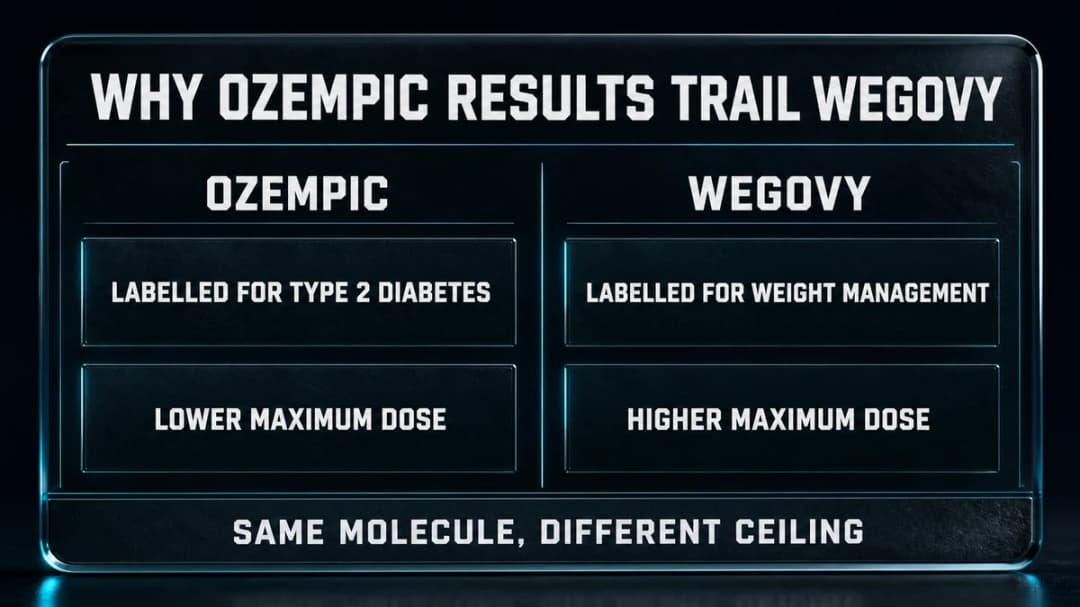
Same molecule, different maximum dose. Ozempic tops out at 2 mg weekly and is licensed for type 2 diabetes. Wegovy goes to 2.4 mg and is licensed for weight management.
There is a second reason the numbers differ, and it is often missed: people with type 2 diabetes lose less weight on GLP-1 drugs than people without it, consistently, across the whole class. Comparing a diabetes trial result to an obesity trial result overstates the effect of the dose difference. Some of the gap is the population, not the milligrams.
The Part the Photo Grids Leave Out
Around one in seven participants on semaglutide in the pivotal obesity trial did not reach 5 percent weight loss. That is not a small minority, and there is currently no test that identifies these people in advance.
If you are three months in at a therapeutic dose and the scale has barely moved, the useful checks are whether the dose is actually at a therapeutic level rather than still in titration, whether intake has crept back up as nausea faded, and whether weight is being measured under consistent conditions. Our GLP-1 plateau guide works through this in order.
Body composition is the other omission. A meaningful share of the weight lost during a large deficit is lean tissue, which is why two people at the same weight loss percentage can look quite different. Resistance training and adequate protein are the two interventions with real evidence behind them. See how much protein to aim for for specifics.
Facial volume loss, widely called Ozempic face, follows the same logic. It is a consequence of losing fat quickly at any age, not a distinct drug effect, and slower loss tends to produce less of it.
What Happens to Before and After Results After Stopping
This is the single most reproducible finding in the field and the least represented in photo galleries. Semaglutide has a half life of about a week and clears over roughly five weeks. Appetite returns across that window.
In follow up after the pivotal trial, participants regained the large majority of the weight they had lost within a year of stopping, and blood pressure, lipids and glycaemic markers drifted back toward baseline with it. A minority hold their loss, generally the people who built durable eating and training habits during treatment rather than relying on appetite suppression alone.
Any before and after image without a date attached is a snapshot of the treatment phase. It says nothing about month eighteen.
A Reasonable Way to Track Your Own Results
- Weigh at the same time of day, ideally weekly rather than daily, and read the trend not the point
- Take waist measurements. They often move when the scale stalls, particularly during the first three months
- Photograph yourself under the same lighting and posture monthly, for your own reference, not for comparison against strangers
- Track protein intake for one week per month as a spot check rather than continuously
- Record side effects against dose, which makes the titration conversation with your prescriber far more productive
FAQ
How much weight will I lose on Ozempic in one month?
Most people lose 3 to 5 percent of body weight in the first month, and a good part of the first fortnight is at the 0.25 mg adaptation dose where little happens. For someone starting at 100 kg that is roughly 3 to 5 kg. Slower than that is common and not a sign of failure.
When do Ozempic before and after results become visible?
Usually around month three, and clearly by month six. The first month is mostly an internal change in appetite rather than a visible one. Waist measurements often shift before the mirror does.
Are Ozempic before and after photos reliable?
As evidence, no. They select for the strongest outcomes, rarely state the dose or duration, and never show the people who lost under 5 percent. The trial distributions are a far better guide to what to expect.
Do results keep improving after a year?
Generally not by much. The curve flattens somewhere between months nine and twelve at a stable dose, and continued treatment maintains the loss rather than extending it. A higher dose or a different agent is the usual route to further loss, and that is a prescriber decision.
Will I regain the weight if I stop?
Most people regain a large majority of it within a year of stopping. Appetite returns as the drug clears over about five weeks. Sustained changes to eating and training reduce regain but do not reliably prevent it.