
Most semaglutide side effects are gastrointestinal, front-loaded, and dose dependent, which means they arrive with each dose increase and settle within a few weeks at a steady dose. The single most useful fact about semaglutide side effects is that they are worst during escalation rather than at any particular dose, so rushing the titration schedule is what turns a manageable first month into an unbearable one.
The rates below come from the STEP 1 trial, which followed 1,961 adults on 2.4 mg weekly semaglutide against placebo for 68 weeks. They cover the entire trial including the titration period, so they overstate what someone at a stable dose experiences in month six.
Semaglutide Side Effects by Rate
| Side effect | Semaglutide 2.4 mg | Placebo |
|---|---|---|
| Nausea | 44% | 16% |
| Diarrhoea | 30% | 16% |
| Vomiting | 24% | 6% |
| Constipation | 24% | 11% |
| Abdominal pain | 20% | 13% |
| Headache | 14% | 11% |
| Fatigue | 11% | 7% |
| Dizziness | 8% | 5% |
The placebo column is worth reading alongside the drug column. A meaningful share of what people attribute to semaglutide happens to people on a dummy injection who are also eating less.
Nausea
The one people worry about, and the one with the clearest mechanism.
Semaglutide slows gastric emptying. Food sits in the stomach longer than the brain expects, and the brain reads an unusually full stomach as a reason to feel sick. That is the whole explanation. It is not a toxic reaction, it is the drug doing exactly what it does.
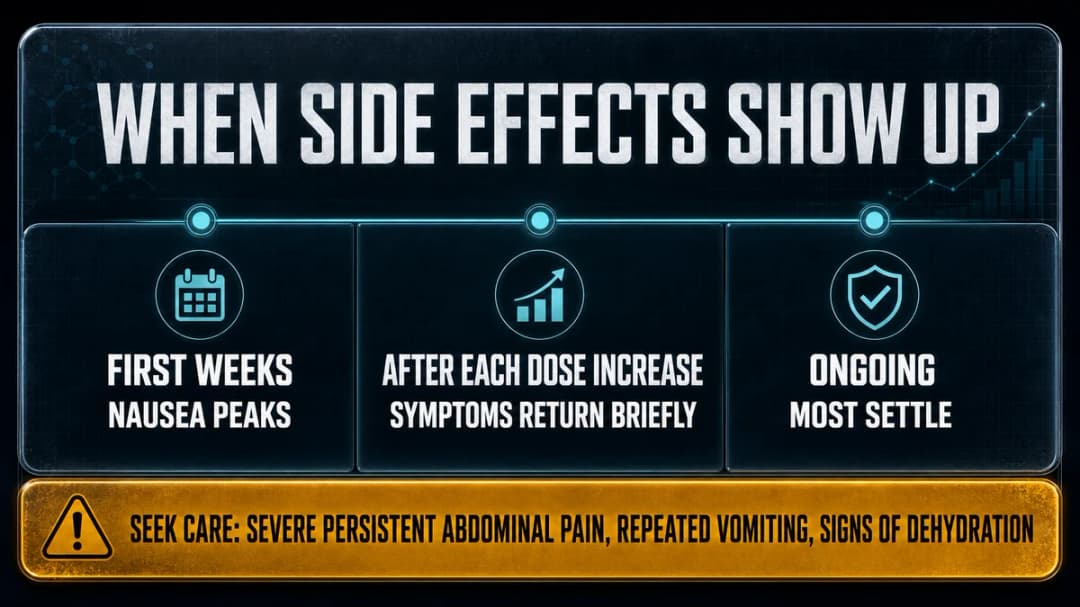
When it happens. Worst in the first two to four weeks at any new dose, easing from around week six. Most people describe background queasiness rather than acute sickness.

What makes it worse. Fatty meals above all, since fat leaves the stomach slowest. Then large portions, eating quickly, and lying down afterwards.
What helps.
- Smaller meals, more often. Four or five small ones rather than three normal ones during a bad stretch
- Low-fat food, especially in the hours around the injection
- Staying upright for a couple of hours after eating
- Ginger, in tea or capsules, which genuinely helps a lot of people
- Injecting in the evening, so the worst window happens during sleep
- Not rushing the next dose increase
If nausea is severe enough to prevent eating or drinking, that is a call to the prescriber rather than something to push through. Anti-sickness medication can be added for the adaptation period. See our GLP-1 nausea guide.
Constipation
Under-discussed relative to how common it is. Roughly a quarter of people in the trial, and it persists longer than the nausea does. The mechanism is the same slowing applied to the whole gut rather than just the stomach.
What helps: more water than feels necessary, fibre increased gradually over a week or two rather than overnight, gentle movement after meals, and magnesium glycinate in the evening, which is better tolerated than the citrate form. See our GLP-1 constipation guide.
Diarrhoea
Usually front-loaded and often alternating unpredictably with constipation in the first couple of months while the gut adjusts. Typically settles by weeks eight to twelve.
Plain low-residue food for acute episodes, plus fluids and electrolytes. Artificial sweeteners and large amounts of lactose make it worse for some people, which is worth testing before assuming the drug is the whole story.

Fatigue
Common early and rarely discussed properly. It is mostly not the drug directly. It is eating substantially less, adapting to a new metabolic state, and being uncomfortable, all at once.
Protein and electrolytes address it better than anything else. Sodium in particular is easy to lose when food intake drops sharply. For most people energy returns to baseline or better by month three or four as weight loss accumulates and sleep improves.
If fatigue is severe or comes with mood changes, thyroid function is worth checking rather than assuming.
Hair Shedding
This alarms people and it is worth being precise about.
Semaglutide does not damage hair follicles. What happens is telogen effluvium, a temporary shift in the hair cycle where an unusually large number of follicles enter the resting phase at once, triggered by rapid weight loss and reduced intake. It is the same thing that happens after any significant physiological stress.
Timeline. Starts roughly three to four months after intake drops substantially, peaks around months five to six, and resolves on its own by around months nine to twelve.
What reduces it. Hitting protein targets is the main lever anyone controls. Iron, zinc and vitamin D are worth checking if shedding is significant, since deficiency makes it worse. See our page on GLP-1 hair loss.
Reflux, Facial Changes and Muscle Loss
Reflux. Slowed emptying means acid has more time to cause irritation. Nothing within three hours of lying down, smaller meals, and raising the head of the bed.
Facial volume loss. The thing people call Ozempic face. Not a drug effect in any meaningful sense, just what subcutaneous fat loss looks like in the face. Slower weight loss reduces it.
Muscle loss. A consequence of any energy deficit rather than something specific to this drug, made worse here because appetite suppression makes under-eating protein easy and fatigue makes skipping training easy. Resistance training and protein are the only two levers that matter.
The Rare but Serious Ones
Pancreatitis. Uncommon, and on the label. The presentation is different from ordinary drug nausea: severe abdominal pain, often radiating through to the back, that does not improve and does not respond to the usual measures. Stop and seek urgent medical care. Prior pancreatitis, heavy alcohol use, gallstones and high triglycerides all raise baseline risk.
Thyroid C-cell tumours. A boxed warning based on rodent studies. Human relevance remains uncertain and no excess has appeared in trial data so far. It is an absolute contraindication for anyone with a personal or family history of medullary thyroid carcinoma or multiple endocrine neoplasia type 2.
Gallbladder disease. Rapid weight loss of any kind raises gallstone risk, and this drug produces rapid weight loss.
Retinopathy changes. Relevant to people with existing diabetic eye disease, who need monitoring, and not a general concern otherwise.
Hypoglycaemia, in anyone also taking insulin or a sulfonylurea, whose doses may need reducing.
When to Stop and Get Help
- Severe, persistent abdominal pain, particularly radiating to the back
- Vomiting that prevents keeping fluids down
- Signs of low blood sugar, if you take other diabetes medication
- A new neck lump, hoarseness or difficulty swallowing
- Rash, swelling of the face or lips, or difficulty breathing
- Severe eye pain or sudden vision change
The Timeline
| Effect | Peaks | Usually improves by |
|---|---|---|
| Nausea | Weeks 2 to 4 at each dose | Weeks 8 to 12 |
| Vomiting | Weeks 2 to 6 | Weeks 8 to 12 |
| Diarrhoea | Weeks 1 to 4 | Weeks 6 to 8 |
| Constipation | Persistent rather than peaking | Manageable with diet, does not fully resolve for many |
| Fatigue | Weeks 1 to 4 | Around week 6 |
| Hair shedding | Months 4 to 6 | Months 9 to 12 |
How to Minimise All of It
The single most effective intervention is not a supplement or a food. It is titrating slowly.
The escalation schedule from 0.25 mg through 0.5, 1, 1.7 and 2.4 mg exists because rapid increases produce dramatically worse gastrointestinal effects. Nothing requires escalating on schedule. If a dose is uncomfortable, staying there an extra four weeks is a legitimate choice, and the goal is the highest dose someone can maintain comfortably rather than the label maximum.
Other things that help:
- Inject on the same day each week, so blood levels stay predictable
- Evening injections, so the worst window is spent asleep
- Stay hydrated, since dehydration worsens both nausea and constipation
- Keep meals small and low in fat
- Avoid NSAIDs where possible, since they add gastric irritation to a gut that already has some
How It Compares With Tirzepatide
| Side effect | Semaglutide | Tirzepatide |
|---|---|---|
| Nausea | Around 44% | Around 33% |
| Vomiting | Around 24% | Around 22% |
| Diarrhoea | Around 30% | Around 17% |
| Constipation | Around 24% | Around 39% |
An important caveat: these come from separate trials with different populations and designs, not a head-to-head comparison, so the numbers should be read as a rough shape rather than a precise ranking.
The shape is still useful. Tirzepatide appears to produce less nausea and diarrhoea and considerably more constipation. Overall gastrointestinal burden is broadly comparable, with the distribution shifted. Someone whose main problem is nausea might do better on tirzepatide, and someone already prone to constipation might not. See our tirzepatide vs semaglutide comparison.
FAQ
How long do semaglutide side effects last?
The gastrointestinal effects peak within two to six weeks of each dose increase and improve substantially by around week twelve at a stable dose. Constipation is the one most likely to persist and needs ongoing dietary management rather than waiting out.
Does everyone get nausea on semaglutide?
Around 44 percent reported it in the main trial, against 16 percent on placebo. Most describe it as mild to moderate. Slow titration and low-fat meals are what separate people who manage it from people who stop.
Does semaglutide cause hair loss?
Not directly. Rapid weight loss and reduced intake trigger a temporary shift in the hair growth cycle, which shows up as increased shedding a few months later and resolves on its own. Adequate protein reduces the severity.
Why am I so tired on semaglutide?
Mostly because you are eating considerably less while your body adapts, not because of a direct drug effect. Protein and electrolytes help most. If it is severe or persistent past the first couple of months, get thyroid function checked.
Can I drink alcohol on semaglutide?
Many people find they no longer want to, which is itself an effect of the drug. For those who do drink, alcohol worsens nausea and reflux, adds calories that displace protein, and raises pancreatitis risk in heavy use. Moderate use is generally tolerated, heavy use is genuinely unwise on this drug.
What if side effects are still bad after three months?
That is the point to have a conversation about dose reduction or switching, rather than continuing to endure it. A lower maintained dose that someone actually stays on beats a higher dose they abandon.