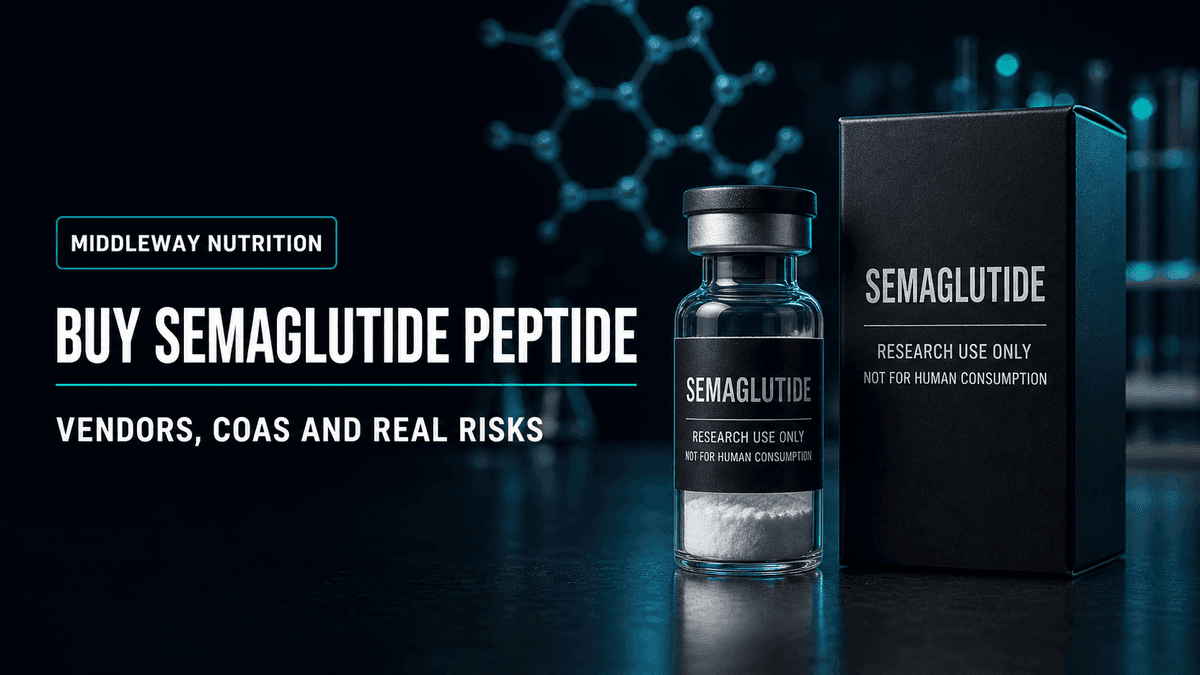
Semaglutide sold as a "research peptide" is not an FDA-approved drug, is not pharmaceutical grade by default, and is not legal to sell for human use in the United States. The FDA has issued warning letters to sellers whose vials say "research use only" precisely because the sellers' own marketing showed the product was meant for people, and when researchers bought these vials and tested them, measured purity came back between 7.7% and 14.37% against a 99% label claim.
The word "peptide" in this search is doing real work. Nobody typing it is looking for a pharmacy counter. They are looking at lyophilized vials from research-chemical suppliers priced well under pen prices. This page stays in that lane: what the label means legally, what testing has found inside the vials, how to read a certificate of analysis worth reading, and what the legal routes cost as of August 2026. For the wider map of prescription routes, semaglutide online covers those separately.
"Semaglutide peptide" and semaglutide the drug are two different claims
Semaglutide the molecule has the formula C187H291N45O59 and a molecular weight near 4,114 g/mol (PubChem CID 56843331). A vial labelled "semaglutide" from a research supplier is a claim that the powder inside matches that structure at some stated purity. Nothing verifies the claim except paperwork the seller produced or paid for.
Salt forms are not the same active ingredient. The FDA states that semaglutide sodium and semaglutide acetate "are different active ingredients than are used in the approved drugs," that it has no information on whether those salts share the same properties, and that it is "not aware of any lawful basis for their use in compounding." Listings often name a salt form in the specifications while the product title just says "semaglutide."
There is no legal generic for this to be a cheap version of. Every approved semaglutide product sits under a Novo Nordisk NDA. The one generic application, Apotex ANDA 220314, holds tentative approval only, meaning it cannot be marketed. Contrast liraglutide, where a dozen ANDAs are approved and sold. See semaglutide generic.
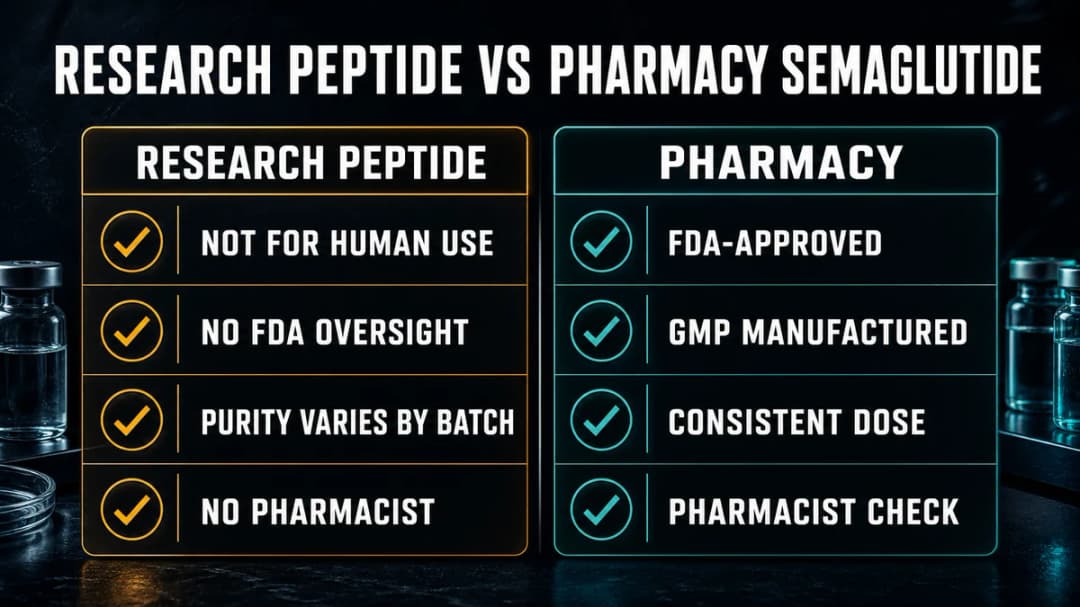
A "research use only" label does not make the sale legal
The disclaimer protects the seller's marketing copy, not the transaction, and the FDA has said so in writing repeatedly.
In a December 10, 2024 warning letter to Summit Research Peptides, the agency wrote: "Despite statements on your product labeling marketing your products as 'RESEARCH USE ONLY' and 'INTENDED AS A RESEARCH CHEMICAL ONLY,' evidence obtained from your websites establish that your products are intended to be drugs for human use." It classed the products as unapproved new drugs under sections 505(a) and 301(d) of the FD&C Act.
A March 31, 2026 letter to Gram Peptides went further: because the firm sold "Bacteriostatic Water for Injection" alongside peptides requiring reconstitution, the FDA concluded the water was itself being sold as a drug.
The FDA's consumer position, current as of June 15, 2026, is blunt. The agency "has warned companies that have illegally sold unapproved drugs containing semaglutide, tirzepatide or retatrutide that are falsely labeled 'for research purposes' or 'not for human consumption,'" sold "directly to consumers for human use with dosing instructions."
The compounding fallback has also narrowed. Semaglutide left the FDA shortage list on February 21, 2025, 503B enforcement discretion ended May 22, 2025, and as of the FDA's April 1, 2026 update semaglutide appears on neither the 503B bulks list nor the shortage list. On April 30, 2026 the agency proposed excluding it from that list outright, finding no clinical need. Patient-specific 503A compounding survives, but it is narrow and contested.
What testing found inside vials bought online without a prescription
The best public dataset is a 2024 study in the Journal of Medical Internet Research (Ashraf, Mackey, Vida et al., November 7, 2024). The team screened 1,080 search-result links, identified 59 unique illegal online pharmacy sites, then test-purchased from six.
| What they measured | Result |
|---|---|
| Orders that arrived | 3 of 6 (all three Ozempic pen orders were non-delivery scams) |
| Visual packaging compliance | Failed 59%–63% of inspection criteria |
| Semaglutide content vs. label | 28.56%–38.69% above the labelled amount |
| Measured purity | 7.7%–14.37% (label claimed 99%) |
| Endotoxin | Detected in all samples, 2.1645–8.9511 EU/mg |
| Viable microorganisms | None detected at time of testing |
Read the last three rows together. The vials were not empty and not underdosed. They held more mass than the label promised, and most of that mass was not semaglutide. Measuring by volume would reveal none of this.
A companion analysis in Annals of Pharmacotherapy (Belcourt, Ly and White, 2025;59:485-490) added the operational point: these products ship "for research purposes only" but "frequently without the supplies and knowledge" needed to dissolve the powder, draw it up, and inject it. The FDA had logged 990 adverse event reports tied to compounded semaglutide as of May 31, 2026, many of them dosing errors serious enough to require hospitalisation.
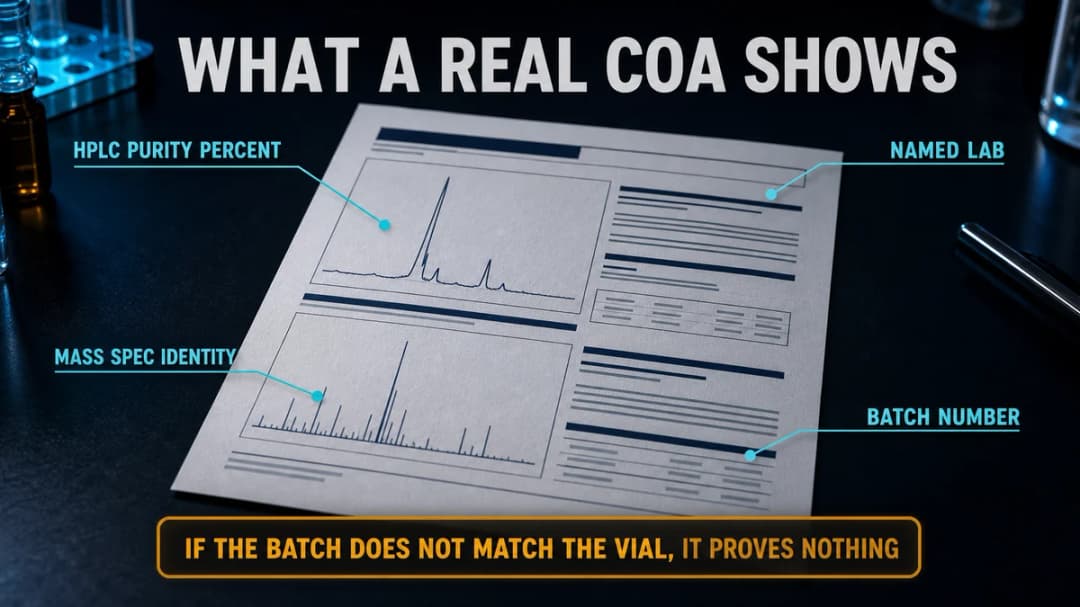
How to read a batch-specific COA, and what makes one worthless
A certificate of analysis is evidence only if it ties to the vial in your hand. The commonest failure is a generic product certificate: one PDF, no lot number, reused across every order for a year.
| COA element | What a real one shows | Red flag |
|---|---|---|
| Batch / lot number | Matches the number printed on your vial exactly | Absent, or a lot that never changes |
| Test date | After the manufacture date of that lot | Predates the lot, or missing |
| Testing laboratory | Named lab, address, signatory, contact | Logo only, "third-party verified," or the vendor's own name |
| Identity | Mass spectrometry, observed mass against theoretical (~4,114 Da) | Purity quoted with no identity test |
| Purity | RP-HPLC % area with the chromatogram attached | A bare "≥99%" line, no chromatogram |
| Largest single impurity | Reported individually with a % figure | Only total purity given |
| Net peptide content | Peptide content stated separately from gross vial weight | Silence: "5 mg" may be gross powder |
| Water and counterion | Karl Fischer water, acetate or TFA content | Not reported, which inflates apparent purity |
| Endotoxin / sterility | Reported in EU/mg | Almost never present on research COAs |
Two structural limits. A COA describes one sample one lab received, not the vial shipped to you; only the vendor's own records link them. And an HPLC number is not an identity test, since a clean single peak can be a clean peak of something else. Identity by mass spec and purity by HPLC answer separate questions.
For scale: on July 28, 2026 the FDA published 17 revised draft product-specific guidances, including ones for Ozempic and Wegovy, covering impurity thresholds, innate immune response testing, higher order structure and biological activity. "98% by HPLC" answers roughly one fifth of that.
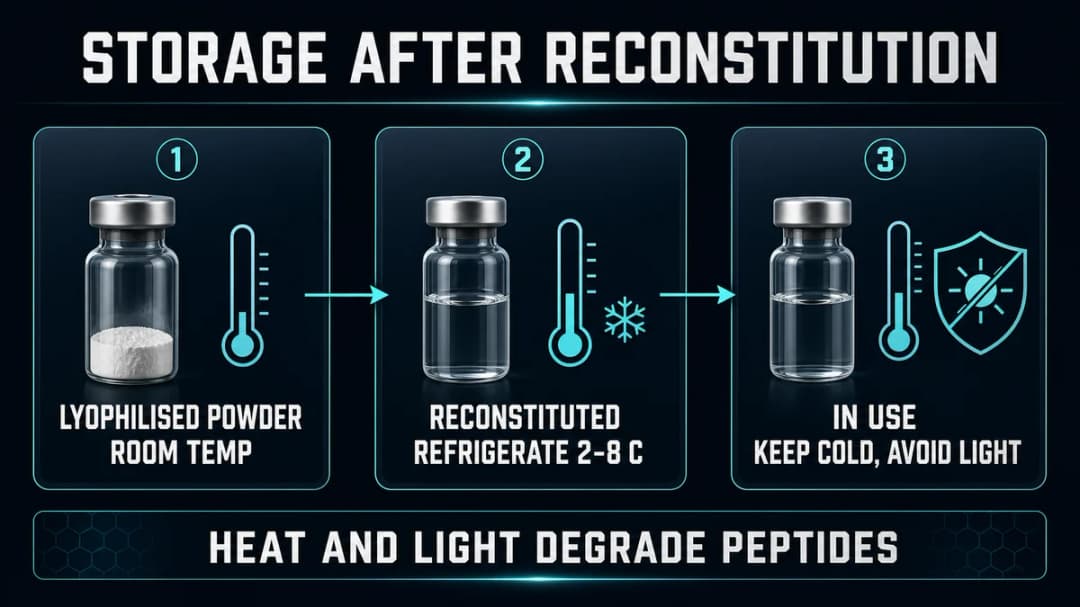
Reconstitution and storage decide what actually reaches you
Approved semaglutide arrives as sterile solution in a sealed pen. Per the Ozempic label, unused pens sit at 2°C to 8°C until expiry, and a pen in use lasts 56 days at 15°C to 30°C or refrigerated. The patient mixes nothing.
A research vial is lyophilized powder with no diluent, no instructions for use, and no cold-chain guarantee.
- The diluent is itself a prescription drug. Bacteriostatic Water for Injection, USP is labelled "Rx only," carries benzyl alcohol as a preservative, is contraindicated in neonates, and is indicated only for dissolving drugs "according to instructions of the manufacturer of the drug to be administered." For a research vial, no such instructions exist.
- Concentration is whatever you make it. Add 1 mL to a "5 mg" vial and every syringe unit means something different than at 2 mL. Check against real figures first in the semaglutide dosage chart.
- Shipping is a quality variable. The FDA recommends not using any injectable GLP-1 that arrives warm or with insufficient refrigeration. No research shipment carries a temperature log.
What the legal routes cost, as of August 2026
| Route | Price | Terms |
|---|---|---|
| Wegovy pen, self-pay | $199/mo for 0.25 and 0.5 mg, 2 fills through Dec 31, 2026; then $349/mo for 0.25–2.4 mg | NovoCare Pharmacy; month = 1 box of 4 pens |
| Wegovy HD 7.2 mg pen | $399/mo | NovoCare Pharmacy |
| Wegovy pill | $149/mo for 1.5 mg and 4 mg; 4 mg offer ends Aug 31, 2026, then $199/mo | NovoCare; month = 1 bottle of 30 tablets |
| Ozempic pen, self-pay | $199/mo for 0.25 and 0.5 mg, 2 fills through Dec 31, 2026; then $349/mo (0.25–1 mg), $499/mo (2 mg) | NovoCare; month = 1 box of 1 pen |
| Zepbound (tirzepatide) | $299 (2.5 mg), $399 (5 mg), $449 (7.5–15 mg with refill inside 45 days); else $499–$699 | Eli Lilly self-pay |
| Research-chemical vial | Advertised far below the above | No approval, no prescription, no recourse |
Figures verified on the manufacturers' own pages in August 2026 and subject to change. Cheapest semaglutide and semaglutide price track them monthly; Wegovy savings card covers the commercial-insurance path, and GLP-1s at pharmacies the counter route.
Frequently Asked Questions
Is it legal to buy semaglutide peptide for research use?
The sale is what the FDA pursues, not possession. It has classed these products as unapproved new drugs and warned sellers including Summit Research Peptides in December 2024 and Gram Peptides in March 2026, on the basis that their own marketing established human intended use despite the labels. Buying does not make you an enforcement target, but the product has no standing as a medicine and no recourse if it is wrong.
What purity should a semaglutide COA show?
Suppliers usually publish 98% or higher by RP-HPLC, and the number alone tells you very little. The JMIR test purchases carried labels claiming 99% and measured 7.7%–14.37%. Purity means something only alongside a matching lot number, a named laboratory, an attached chromatogram, a separately reported largest impurity, and a mass-spec identity result.
Is semaglutide sodium or semaglutide acetate the same as semaglutide?
No. The FDA states these salt forms are different active ingredients from the base semaglutide in approved drugs, that it lacks information on whether they behave the same way, and that it knows of no lawful basis for using them in compounding. A listing naming a salt form is not offering the same substance as an approved pen.
How many milligrams are actually in a 5 mg research vial?
Often fewer than five. Lyophilized peptide powder includes water and counterion salts such as acetate or TFA, so gross vial weight and net peptide content differ. A COA reporting peptide content separately answers this; one reporting only purity does not, and the gap can run 10% to 20% of the stated mass.
Is compounded semaglutide a safer middle ground?
It is a different risk profile, not a clearly safer one, and much harder to access than in 2024. Semaglutide left the shortage list in February 2025, 503B enforcement discretion ended May 22, 2025, and the FDA proposed excluding semaglutide from the 503B bulks list on April 30, 2026. The agency has also documented fraudulent compounded products bearing the names of pharmacies that never made them.
What is the cheapest fully legal way to get semaglutide now?
As of August 2026, the Wegovy pill at $149 per month through NovoCare Pharmacy is the lowest self-pay entry point, followed by $199 introductory pen pricing on the two starting doses. Eligibility limits are covered in semaglutide tablets price.
Sources
- FDA's Concerns with Unapproved GLP-1 Drugs Used for Weight Loss — FDA
- Warning Letter, Summit Research Peptides — FDA
- Warning Letter, Gram Peptides — FDA
- Quality and Safety Analysis of Semaglutide Sold by Online Sellers Without a Prescription — Journal of Medical Internet Research
- Bypassing Prescribers and Pharmacists — Annals of Pharmacotherapy
- FDA Clarifies Policies for Compounders — FDA
- FDA Proposes to Exclude Semaglutide, Tirzepatide, and Liraglutide on 503B Bulks List — FDA
- Revised Draft Product-Specific Guidances for Generic Peptide Products — FDA
- Ozempic prescribing information — DailyMed
- Bacteriostatic Water for Injection, USP — DailyMed
- Ozempic Self-Pay Pricing — NovoCare Pharmacy
- Wegovy Self-Pay Pricing — NovoCare Pharmacy
- Zepbound Coverage and Savings — Eli Lilly
- Semaglutide, CID 56843331 — PubChem