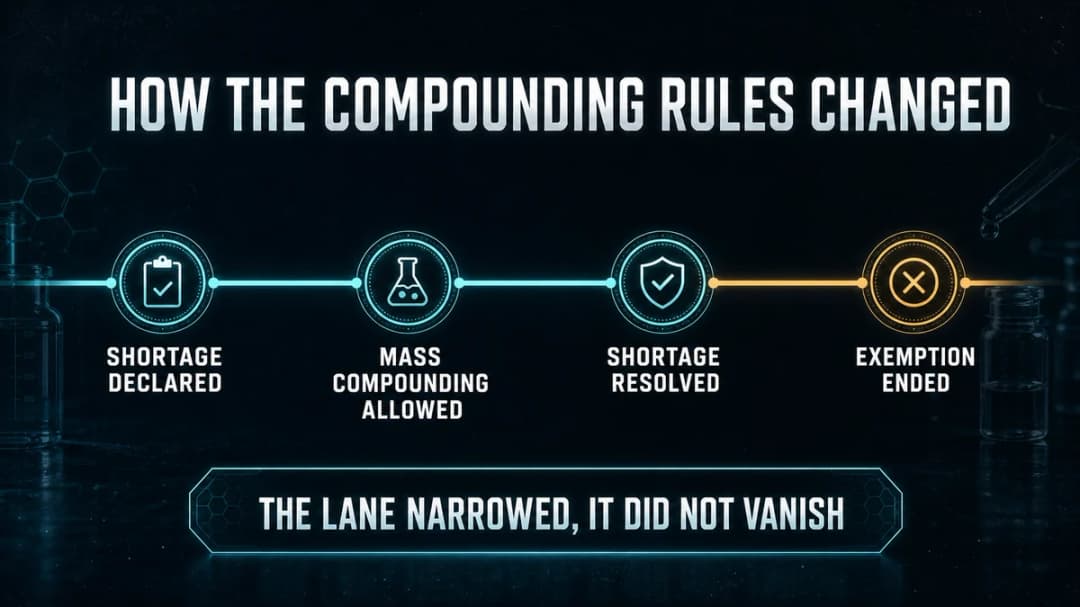
Buying compounded semaglutide is no longer a general option in the United States. The FDA declared the semaglutide injection shortage resolved on February 21, 2025, and the enforcement discretion that let pharmacies compound it at scale ended on April 22, 2025 for state-licensed 503A pharmacies and May 22, 2025 for 503B outsourcing facilities. What remains is one narrow lane: a 503A pharmacy compounding for a single patient whose prescriber has documented a clinically significant difference from the approved drug.
That lane is still narrowing. On April 30, 2026 the FDA proposed to keep semaglutide, tirzepatide and liraglutide off the 503B bulks list, finding no clinical need for outsourcing facilities to compound them from bulk. Comments closed July 30, 2026, with no final determination yet.
How the legal position changed, date by date
| Date | What happened |
|---|---|
| Mar 2022 | Wegovy added to FDA's shortage list; Ozempic follows Aug 2022 |
| Feb 21, 2025 | FDA declaratory order finds the semaglutide injection shortage resolved |
| Apr 22, 2025 | Enforcement discretion ends for 503A pharmacies and physicians |
| Apr 24, 2025 | N.D. Texas denies the compounders' injunction in OFA v. FDA, 4:25-cv-00174 |
| May 22, 2025 | Enforcement discretion ends for 503B outsourcing facilities |
| Feb 6, 2026 | FDA moves to restrict GLP-1 ingredients bound for non-approved compounded drugs |
| Apr 30, 2026 | FDA proposes excluding semaglutide from the 503B bulks list |
| Jul 30, 2026 | Extended comment period closes; no final determination yet |
Semaglutide is on neither the 503B bulks list nor the shortage list. Both doors that made mass compounding lawful are shut.
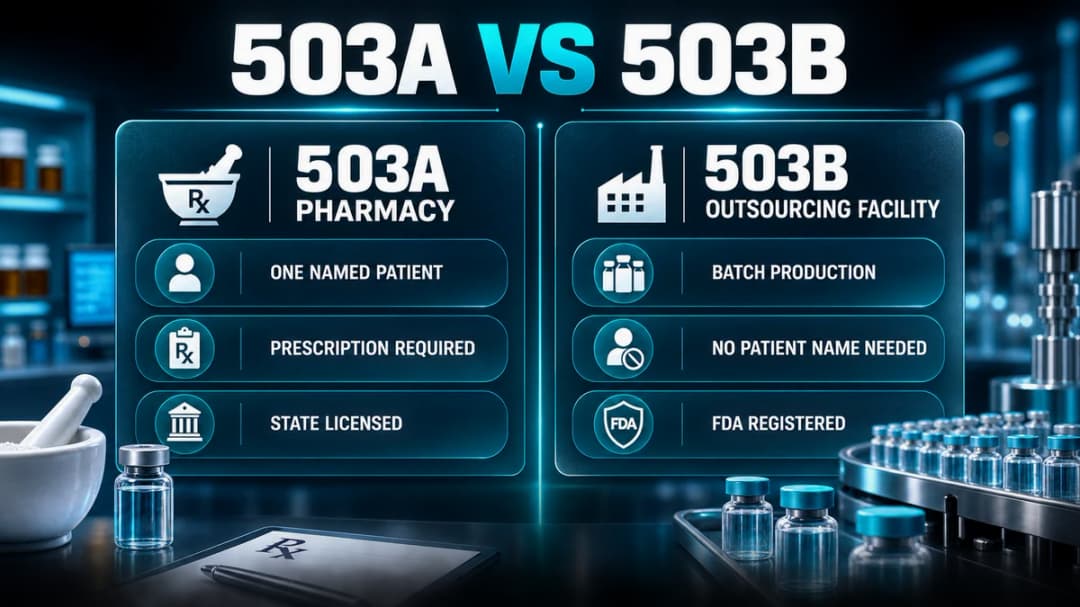
503A and 503B are different lanes that closed for different reasons
Federal law treats it as two things, each bound by a different rule.
| 503A state-licensed pharmacy | 503B outsourcing facility | |
|---|---|---|
| Compounds for | One identified patient, against a prescription | Batches, no patient-specific prescription needed |
| Binding rule | No copies of a commercially available drug "regularly or in inordinate amounts" | No compounding from bulk unless it is on the 503B bulks list or the drug is in shortage |
| Semaglutide, Aug 2026 | Narrow. Only with a documented difference for a named patient | Effectively closed. On neither list |
| Reports adverse events to FDA | Not required by federal law | Required |
| FDA publishes inspection record | No | Yes: registrations, inspections, Form 483s, warning letters |
What "personalised dosing" claims actually rest on
The 503A lane hangs on one term: whether the product is "essentially a copy" of a commercially available drug. It is a copy when it has the same active ingredient, at the same, similar or easily substitutable strength, by the same route. Compounded injectable semaglutide near a Wegovy strength is, on its face, a copy.
The exception is specific: unless a prescriber determines and documents a change producing a significant difference for an identified individual patient. That is a clinical finding about you, in your chart, not a tier on an intake form.
Two details show how tight it is. The FDA uses semaglutide plus vitamin B12 as its worked example: that combination still counts as a copy when the route matches and each ingredient falls within 10% of the approved strengths. And the FDA does not intend to act on the "regularly or in inordinate amounts" condition where a compounder fills four or fewer prescriptions of that product in a calendar month. Four. That is an accommodation for a local pharmacy, not a business model for a national platform.
So "personalised dosing" offered to everyone who fills in the same questionnaire is marketing, not law. The FDA's February 2026 statement added that companies cannot claim a compounded product is a generic version of, or the same as, an approved drug, cannot claim it uses the same active ingredient, and cannot claim it is clinically proven. It named Hims & Hers and warned that unresolved violations may bring seizure and injunction.
The appeal that could reopen the lane, and why it does not help you today
The Outsourcing Facilities Association and compounder FarmaKeio sued over both delistings, arguing the FDA rushed the call and made what was really a rule without notice and comment. The district court denied their injunctions in 2025, and a Fifth Circuit panel heard argument on March 30, 2026. No decision has issued.
A win would not retroactively legalise a purchase you make now, nor touch the separate bulks list proceeding. Tirzepatide ran the same track earlier: see compounded tirzepatide and tirzepatide compounding pharmacy.
Who is still selling, and what they are selling
The visible telehealth market has largely exited. Novo Nordisk sued Hims & Hers on February 9, 2026 over compounded semaglutide, then dismissed on March 9, 2026 under an agreement where Hims sells branded Ozempic and Wegovy and stops advertising compounded GLP-1s except where medically necessary.
What is left splits in two. Some 503A pharmacies still compound for individual patients under the documented-difference exception. That can be legitimate, but it is low volume by definition: if a site sells to anyone who lands on the page, volume alone tells you the exception is not what is happening.
The rest is the research-peptide market: vials labelled "for research use only", no prescription, no licence, no reporting. That material is not approved for human use and is not compounded under 503A or 503B at all.
The FDA has documented the failure modes: fraudulent compounded semaglutide with false labels, including some naming pharmacies that do not exist, and dosing errors serious enough to require hospitalisation. As of May 31, 2026 it had 990 adverse event reports tied to compounded semaglutide, likely undercounted because 503A pharmacies need not report.
Semaglutide acetate and semaglutide sodium are the clearest red flag
The FDA's position is unambiguous: salt forms including semaglutide sodium and semaglutide acetate "are different active ingredients than are used in the approved drugs." The agency says it lacks information on whether those salts share the chemical and pharmacologic properties of the approved ingredient, and that it is not aware of any lawful basis for their use in compounding.
A product listing semaglutide acetate or sodium is not a cheaper Wegovy. Research-vendor material is almost always a salt, because that is what the grey supply chain sells. Check the certificate of analysis as well as the label, and confirm both name the same thing. Two related checks: retatrutide and cagrilintide cannot be used in compounding at all, and there is no oral tirzepatide of any kind.
How to check a compounding pharmacy before you pay
- FDA's registered outsourcing facilities list, updated weekly and current as of 8/18/2026. For each 503B facility it shows registration dates, last inspection date, whether a Form 483 was issued or a recall happened, and any warning letter with its date. If a seller claims 503B status and is not on that list, the claim is false.
- Your state board of pharmacy licensee search. Check the pharmacy in the state it ships from, and whether it holds a non-resident licence in yours. A 503A pharmacy has no federal inspection record, so this is it.
- NABP's accredited digital pharmacy list and FDA's BeSafeRx tool for state-licensed online pharmacies.
- The FDA's telehealth warning signs: claims the drug is the same as an approved one; discounts too good to be true; medicine that looks different from previous fills or arrives damaged; no screening by a licensed doctor; none reachable afterwards; spelling errors or a wrong pharmacy address on the label.
The FDA advises not using any injectable GLP-1 that arrives warm or with inadequate ice.
What a legitimate prescription flow looks like
- An evaluation with a prescriber licensed in your state, covering weight, BMI, comorbidities and current medicines. Our GLP-1 qualifications page covers the criteria.
- A prescription in your name, sent to a named pharmacy whose licence you can look up before it ships.
- For a compounded product, a documented reason in your record why the approved drug will not work for you.
- A label with the pharmacy's real name and address, the ingredient stated as semaglutide rather than a salt, a concentration and a beyond-use date.
What it costs now, and why the price gap has mostly closed
The strongest argument against compounded semaglutide in 2026 is arithmetic, not law. Prices below are from NovoCare Pharmacy, checked August 2026.
| Product | Self-pay price | Notes |
|---|---|---|
| Wegovy pill (oral semaglutide) | $149/mo at 1.5 mg, $199 at 4 mg, $299 at 9 mg and 25 mg | One month is one bottle of 30 tablets |
| Wegovy pen | $199/mo for the first 2 fills at 0.25 mg and 0.5 mg for new patients, through Dec 31, 2026, then $349/mo for 0.25 mg to 2.4 mg | Wegovy HD 7.2 mg is $399/mo |
| Ozempic pill | From $149/mo, dose dependent | Bottle of 30 tablets |
| Ozempic pen | $199/mo for the first 2 fills at 0.25 mg and 0.5 mg, then $349/mo for 0.25 mg to 1 mg | 2 mg is $499/mo |
With commercial insurance, NovoCare advertises as little as $25 a month for up to 3 months, capped at $100. Eligibility applies and terms can change.
Compounded programs advertising semaglutide have generally sat in a $150 to $300 band, though we could not verify a current price from any seller's own page this session, since those figures sit behind an intake questionnaire. The branded floor is confirmed, and at $149 to $199 for a first month it now sits at or below what the compounded market charged.
More at semaglutide price, cheapest semaglutide, semaglutide tablets price, semaglutide online and the Wegovy savings card.
Frequently Asked Questions
Is it legal to buy compounded semaglutide in 2026?
Not as a general consumer purchase. The shortage exemption ended in April and May 2025, and semaglutide is on neither the shortage list nor the 503B bulks list. It is permitted only where a 503A pharmacy compounds for one patient whose prescriber has documented a clinically significant difference from the approved drug.
Can I still get compounded semaglutide with a prescription?
A prescription alone is not enough. The exception turns on a documented prescriber determination that the product differs significantly from the commercial drug for you specifically. A prescription reading "compounded semaglutide" does not create that record, so ask what your chart says.
Why do some websites still sell compounded semaglutide?
Some are genuine 503A pharmacies filling a few patient-specific prescriptions. Others are trading on the fact that enforcement takes time. In February 2026 the FDA said it intends to use seizure and injunction against companies mass-marketing these products. Still selling is not evidence of lawful selling.
Is semaglutide acetate the same thing as Wegovy?
No. The FDA states that semaglutide acetate and semaglutide sodium are different active ingredients from the one in the approved drugs, lacks information on whether they behave the same way, and knows of no lawful basis for using them in compounding.
Is compounded semaglutide still cheaper than branded semaglutide?
Often not. NovoCare self-pay pricing checked in August 2026 starts at $149 a month for the Wegovy pill at 1.5 mg and $199 for a first fill of the pen.
Can I buy semaglutide from a research peptide vendor instead?
Research-grade material is not approved for human use, is not made under compounding rules, and is usually a salt form. There is no prescription, no pharmacist and no recourse. If you evaluate a vendor at all, demand a batch-specific third-party certificate of analysis and check the ingredient name, not only purity. We do not recommend this route.
Sources
- FDA clarifies policies for compounders as national GLP-1 supply begins to stabilize — U.S. Food and Drug Administration
- Declaratory Order: Resolution of Shortages of Semaglutide Injection Products — U.S. Food and Drug Administration
- FDA Intends to Take Action Against Non-FDA-Approved GLP-1 Drugs — U.S. Food and Drug Administration
- FDA Proposes to Exclude Semaglutide, Tirzepatide, and Liraglutide on 503B Bulks List — U.S. Food and Drug Administration
- List of Bulk Drug Substances for Which There Is a Clinical Need Under Section 503B; Extension of Comment Period — Federal Register
- FDA's concerns with unapproved GLP-1 drugs used for weight loss — U.S. Food and Drug Administration
- Compounding when Drugs are on FDA's Drug Shortages List — U.S. Food and Drug Administration
- Registered Outsourcing Facilities under Section 503B — U.S. Food and Drug Administration
- BeSafeRx: Your Source for Online Pharmacy Information — U.S. Food and Drug Administration
- Get Your GLP-1 Medications Delivered with NovoCare Pharmacy — Novo Nordisk
- Fifth Circuit probes FDA ban on compounded GLP-1s — Courthouse News Service
- Novo Nordisk drops patent infringement case against Hims & Hers — CNBC