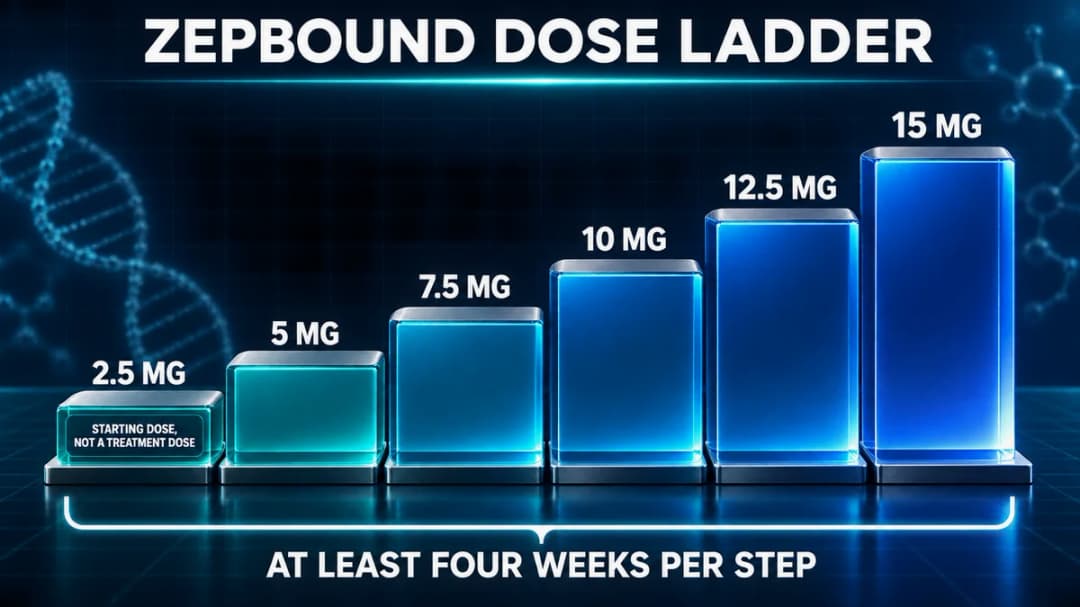
The Zepbound Dosage Chart 2026 starts at 2.5 mg once weekly for four weeks, moves to 5 mg, and can then increase by 2.5 mg at a time no faster than every four weeks, up to a maximum of 15 mg weekly. The Zepbound Dosage Chart 2026 below covers all six strengths, but the important rule is the interval rather than the numbers: nearly every avoidable problem on this drug comes from moving up too quickly.
Tirzepatide is the active ingredient in both Zepbound and Mounjaro. The dosing structure is the same; the approved indication is what differs.
The Zepbound Dosage Chart 2026
| Strength | Typical role | Earliest week | Notes |
|---|---|---|---|
| 2.5 mg | Initiation only | Weeks 1 to 4 | Not intended as a treatment dose on its own |
| 5 mg | First maintenance dose | Week 5 | Many people do well and stay here |
| 7.5 mg | Transition step | Week 9 | Used when 5 mg is no longer enough |
| 10 mg | Maintenance dose | Week 13 | A common long-term dose |
| 12.5 mg | Transition step | Week 17 | Used on the way to 15 mg |
| 15 mg | Maximum maintenance dose | Week 21 | No approved dose above this |
The earliest week column assumes a straight four-week progression with no holds. Real titration is frequently slower, and slower is not worse.
Why Four Weeks
Nausea, vomiting and diarrhoea cluster around dose increases rather than being spread evenly across treatment. Four weeks gives the gut time to adapt to each new level before the next step.
The starting dose exists purely for that adaptation. It is described on the label as a treatment initiation dose and is not intended for chronic weight management on its own, which is why nobody is expected to stay there.
Moving faster than the four-week interval does not accelerate results in any meaningful way. It reliably increases side effects.

Which Doses Are Maintenance and Which Are Transitions
This distinction is useful and often missed.
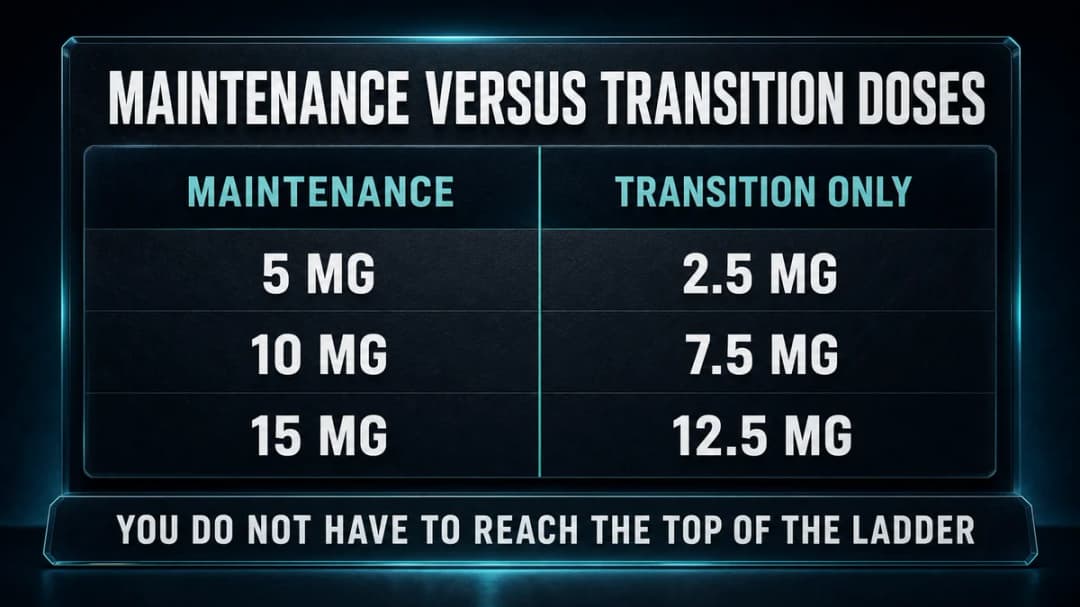
Three strengths function as long-term doses in weight management: 5 mg, 10 mg and 15 mg. The two in between, 7.5 mg and 12.5 mg, exist mainly as stepping stones for people who cannot move straight from one long-term dose to the next.
That said, staying at 7.5 mg or 12.5 mg long term is perfectly reasonable if it is working and tolerated. There is no requirement to keep climbing.
For obstructive sleep apnoea in adults with obesity, which Zepbound is also approved for, the maintenance doses are the higher ones, 10 mg or 15 mg.
You Do Not Have to Reach 15 mg
This is worth stating directly, because a lot of people assume the maximum is the goal.
The right dose is the lowest one that produces adequate results with tolerable side effects. Someone losing weight steadily at 5 mg with no nausea has no reason to increase. Dose escalation is a response to a plateau or an inadequate response, not a schedule to complete.
Higher doses also mean more side effects and, depending on coverage, sometimes more cost. If cost is the constraint, see Zepbound cost without insurance.
Missed Doses
If fewer than four days have passed since the missed dose, take it as soon as you remember, then return to your regular weekly day.
If more than four days have passed, skip it entirely and take the next dose on your normal schedule. Do not double up.
For longer gaps, contact your prescriber. Gastrointestinal tolerance fades within a few weeks, and restarting at a full maintenance dose after an extended break commonly causes significant nausea. Restarting lower and re-titrating is the usual approach. Our missed tirzepatide dose guide covers this in more detail.
Dose Units and Volume
Zepbound single-dose pens and vials each deliver one fixed dose, so there are no units to calculate with the pen. Vials require drawing the dose with a syringe, which is where confusion between milligrams and syringe units arises.
Our tirzepatide units to mg guide covers the conversion, and the tirzepatide dosage chart covers the equivalent structure under the Mounjaro label.
Managing the Increases
Time the increase for a quiet week. The days after a step up are when symptoms peak, so scheduling it against a busy period is asking for trouble.
Eat smaller and slower. Portion size drives nausea more than food choice does.
Reduce fat and fried food temporarily around each increase.
Stay ahead on fluids and electrolytes, especially if there has been any vomiting or diarrhoea.
Hold rather than push. If a dose is difficult, staying at the current level for an extra four weeks is a normal adjustment. Tell the prescriber rather than quietly suffering or stopping.
Our GLP-1 side effects guide and the Zepbound side effects overview cover management in depth.
Stopping and Tapering
There is no required taper on the label. In practice, prescribers often step down rather than stop abruptly, mainly to make the return of appetite less abrupt rather than for any pharmacological withdrawal reason.
What is well established is that appetite returns and weight regain is common after stopping. Planning for that is part of the treatment decision rather than an afterthought. Our guide on stopping GLP-1 without regaining weight covers the practical side.
Frequently Asked Questions
What is the maximum Zepbound dose?
15 mg once weekly. There is no approved dose above that, and the escalation to it moves in 2.5 mg steps no more often than every four weeks. Many people reach an effective, tolerable dose well below the maximum and stay there.
How long should I stay on each Zepbound dose?
At least four weeks before any increase. This applies at every step, and it exists because nausea, vomiting and diarrhoea cluster around dose changes. Staying longer at a dose is common and entirely acceptable when it is working.
What happens if I miss a Zepbound dose?
Take it if fewer than four days have passed, then resume your usual weekly day. If more than four days have passed, skip it and take the next scheduled dose without doubling up. For gaps of several weeks, speak to your prescriber before restarting at your previous dose.
Do I need to go up to 15 mg for it to work?
No. 5 mg and 10 mg are both maintenance doses in their own right, and the right dose is the lowest that gives an adequate result with tolerable side effects. Escalation is a response to an inadequate response, not a schedule to complete.
Are Zepbound and Mounjaro dosed the same way?
Both contain tirzepatide and use the same strengths and the same four-week escalation structure. The difference is the approved indication and therefore the label they are prescribed under, which mainly affects insurance rather than the dosing itself.