Are peptides legal? In the United States, the honest answer is that it depends entirely on which peptide you mean and what it is being sold for. Approved peptide medicines are legal with a prescription, research peptides are legal to sell and buy for laboratory use, and almost nothing in the category is a controlled substance.
That three-way split is the whole story, and most of the confusion around whether peptides are legal comes from collapsing it into one answer. The molecule is rarely the thing being regulated. What gets regulated is the claim attached to it, the channel it moves through, and whether a licensed prescriber is involved.
Are Peptides Legal? The Three Categories in US Law
Every peptide you are likely to read about falls into one of three regulatory buckets. Knowing which bucket a compound sits in tells you almost everything about how it can legally be obtained.
| Category | Examples | Legal status | How you get it |
|---|---|---|---|
| Approved peptide drugs | Semaglutide, tirzepatide, liraglutide, tesamorelin, bremelanotide, insulin | Legal as prescription medicines | Prescription plus a licensed pharmacy |
| Compounded peptides | Preparations made by a 503A or 503B pharmacy | Legal when a prescriber orders them and the substance is permitted for compounding | Prescription plus a compounding pharmacy |
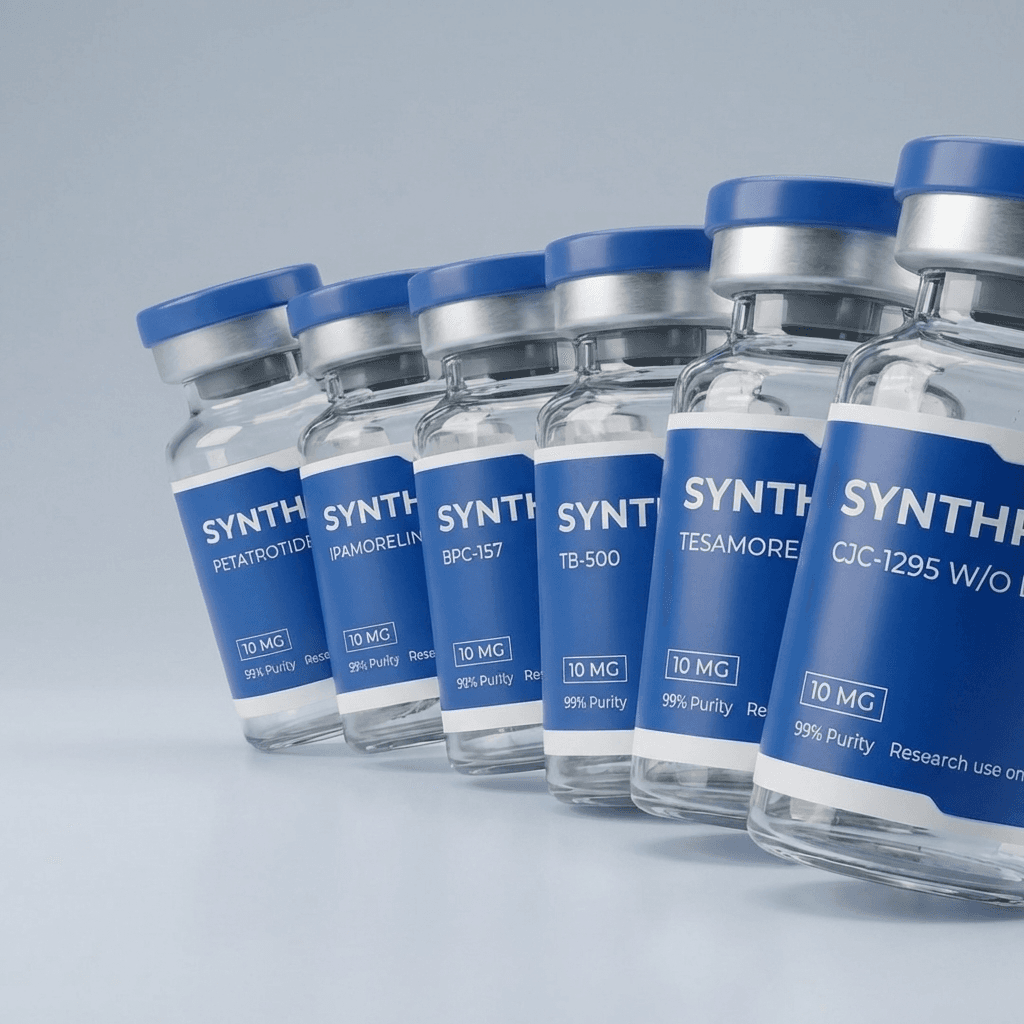
| Unapproved research peptides | BPC-157, TB-500, ipamorelin, CJC-1295, epithalon, GHK-Cu, MOTS-c | Sold lawfully for research use, not approved for human use | Direct from a research supplier, no prescription |
None of the compounds in the third row are scheduled under the Controlled Substances Act. That distinction matters because people often assume research peptides carry the same legal weight as anabolic steroids, which are Schedule III. They do not. Human growth hormone itself is the notable exception in the wider category and is tightly controlled.
The Rule That Explains Everything: Marketing, Not Molecules
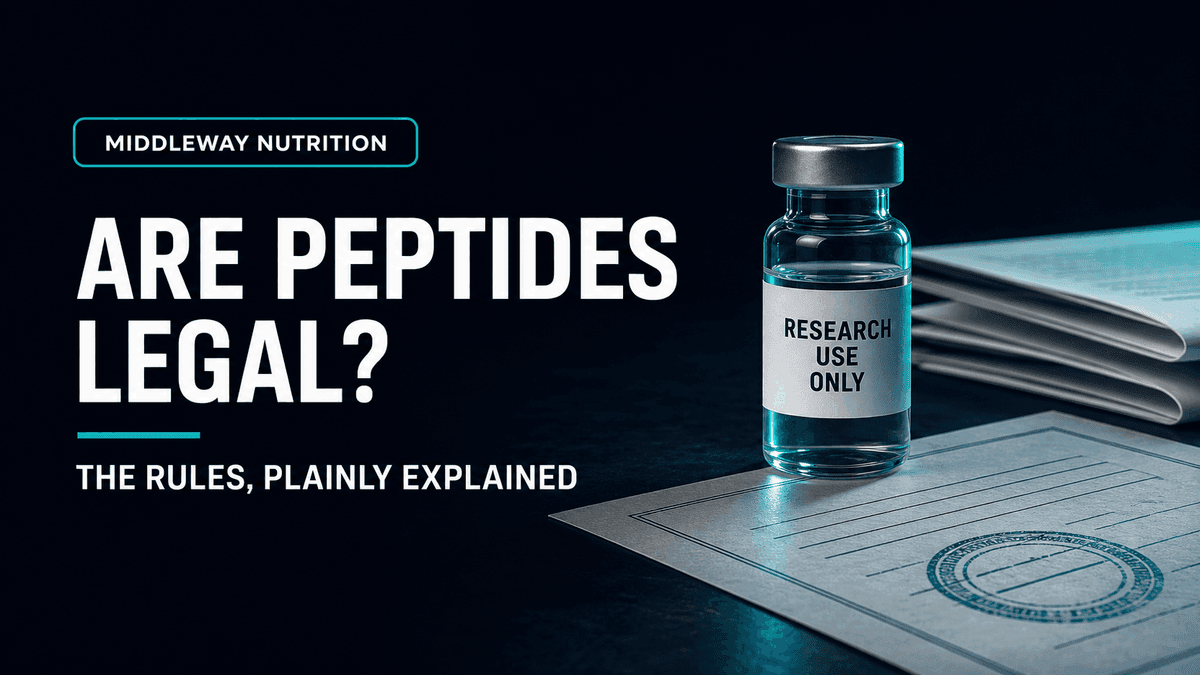
The Food, Drug and Cosmetic Act regulates products by what they are intended to treat. A vendor who sells a vial of lyophilised powder labelled for laboratory research is selling a chemical. The same vendor selling the same vial with a claim that it repairs tendons in people is selling an unapproved new drug, which is a violation.
This is why legitimate suppliers write so carefully. The disclaimers on research peptide sites are not decoration. They are the legal basis on which the sale is allowed to happen at all.
For the buyer, the practical consequence is that no research peptide comes with the assurances a medicine carries. There is no approved label, no dosing instruction backed by a regulator, no adverse event reporting system standing behind it, and no manufacturing inspection you can rely on. Everything you would normally get from an approval process, you have to reconstruct yourself from third-party testing documents.
What the FDA Did in 2023 and What It Did Not Do
In 2023 the FDA placed a group of peptides, including BPC-157 and AOD-9604, into Category 2 of its bulk drug substances review, the bin for substances with significant safety questions. The practical effect was to shut down the compounding route for those specific compounds. Clinicians who had been writing prescriptions filled by compounding pharmacies lost that pathway.
What that action did not do is make the compounds illegal to own or to sell for research. Research suppliers operate under a different framework from compounding pharmacies, and they continued to trade. The two channels get conflated constantly, including by people selling into them.
Compounding policy has stayed unsettled since, with active lobbying to restore access to several of the restricted peptides and periodic announcements about reviewing the list. Because this is exactly the sort of detail that changes between one month and the next, treat any specific claim about what a pharmacy can currently compound as something to verify directly with a licensed pharmacy rather than something to take from an article. That includes this one.
Are Peptides Legal Outside the United States?
The US has one of the more permissive frameworks. Several comparable countries are considerably stricter, and the difference usually shows up at customs.
| Country | Buying research peptides | Notes |
|---|---|---|
| United States | Lawful for research use | Personal use sits in an unaddressed grey area; enforcement targets sellers making therapeutic claims |
| United Kingdom | Possession and personal import generally tolerated | Selling for human consumption without an MHRA licence is unlawful |
| Canada | Broadly similar to the US | Approved peptide drugs are prescription only |
| Australia | Restricted | The TGA schedules most peptides as prescription only and border enforcement is active |
| New Zealand | Restricted | Prescription required for most peptides |
| European Union | Varies by member state | Several states restrict personal importation |
If you are ordering across a border, the receiving country's rules are the ones that apply on arrival. A US vendor being fully compliant at the point of sale does not protect a package landing in Sydney.
Tested Athletes Play by a Different Rulebook
Anti-doping rules are not law, but for anyone in a tested sport they function like it. The World Anti-Doping Agency prohibits growth hormone secretagogues, GHRH analogues, growth factors, and IGF-1 analogues across the board. BPC-157 has been formally addressed by WADA rather than left ambiguous, and several other repair peptides fall under broad growth factor language.
The practical rule for a tested athlete is simple: assume any injectable peptide is prohibited unless you have checked the current prohibited list yourself and confirmed otherwise. A compound being legal to buy tells you nothing about whether it will cost you a sanction.
The Legal Routes to Getting Peptides
Through a prescriber. For approved peptide medicines this is straightforward. A physician can also prescribe an approved peptide off label, which is legal and routine in medicine. If you are looking at the GLP-1 family specifically, our overview of GLP-1 medications covers what is approved and for what.
Through a compounding pharmacy. Legal when a prescriber orders it and the substance is currently permitted for compounding. Ask whether the pharmacy is PCAB accredited and which facility actually prepares the product.
Through a research supplier. This is where most non-approved peptides are bought. The sale is lawful; what you do with the material afterwards is your responsibility and outside anything the vendor can advise on. Since there is no regulator standing behind quality here, vendor selection carries the entire burden. Our guide to peptide vendors sets out the documentation to demand, and peptide therapy covers the clinical route in more depth.
What Legal Risk Actually Looks Like
For individuals buying research peptides for personal use in the US, documented prosecutions are effectively absent. Enforcement attention goes to sellers, and specifically to sellers who make therapeutic claims, ship material labelled for human use, or handle genuinely controlled substances such as human growth hormone.
That does not make personal use legally endorsed. It sits in a gap the law has not addressed rather than in a space the law has approved, and the two are not the same thing. The realistic risks for a buyer are not criminal. They are a seized international package, a product that is not what the label says, or a preparation that is not sterile.
FAQ
Are peptides legal to buy without a prescription?
Research peptides such as BPC-157 and ipamorelin can be bought without a prescription because they are sold for laboratory use rather than as medicines. Approved peptide drugs such as semaglutide and tirzepatide require a prescription, and buying them without one is not lawful.
Are peptides controlled substances?
Almost none of them are. BPC-157, TB-500, ipamorelin, CJC-1295, epithalon and GHK-Cu are not scheduled under the Controlled Substances Act. Human growth hormone is the significant exception and is treated far more strictly.
Is it legal for a doctor to prescribe peptides?
Yes for approved peptide medicines, including off label use, which is a normal part of medical practice. For non-approved peptides a physician depends on the compounding pathway, and that pathway is restricted for several compounds and subject to change.
Can customs seize a peptide order?
Yes, particularly on international shipments. Domestic orders inside the US move through ordinary carriers without difficulty. Packages crossing into countries with prescription-only frameworks, Australia being the clearest example, are the ones most likely to be stopped.
Does buying peptides for research use protect me legally?
The research framing protects the transaction, not what happens afterwards. It is the basis on which the vendor is permitted to sell. It is not a licence, and it does not convert an unapproved compound into something cleared for human use.