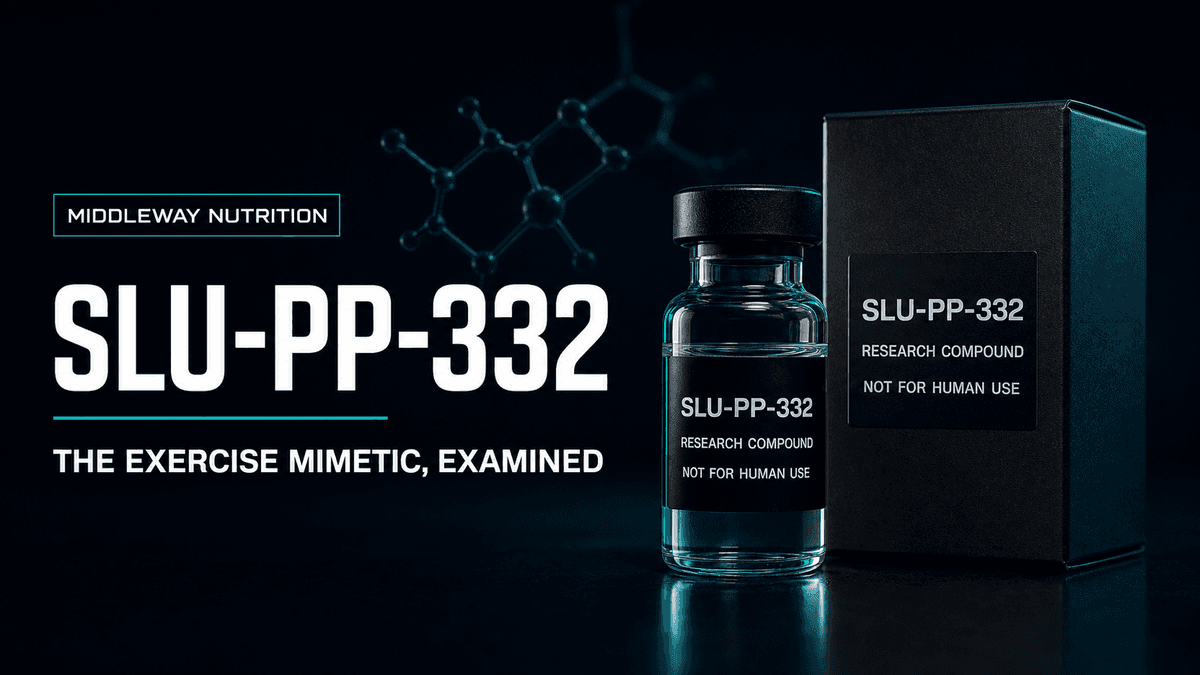
SLU-PP-332 is a synthetic small molecule, not a peptide, and every published finding attached to it comes from rodents or cell culture. Those two facts explain most of the confusion around it. It is sold on the same price lists as research peptides and shipped in the same style of vial, which leads people to apply peptide logic to a molecule with nothing structurally in common with one.
Key Takeaways
- SLU-PP-332 is a small organic molecule of under 300 daltons that activates the estrogen-related receptors ERR alpha, beta, and gamma. It contains no amino acids.
- It was designed at Saint Louis University as a laboratory probe for ERR biology. The label "exercise mimetic" comes from the gene program it switches on in mouse muscle.
- The rodent work is genuinely interesting: more mitochondrial respiration, more oxidative muscle fiber, better treadmill endurance, less fat mass in obese mice, and effects that depend on the receptor being present.
- There are no published human trials, no human pharmacokinetics, and no human safety data. Half-life figures circulating online contradict each other and trace to no human study.
- Standard peptide handling advice does not transfer. Solubility, storage, and route all behave differently for a small molecule.
What Is SLU-PP-332?
SLU-PP-332 is a single small organic structure made by ordinary chemical synthesis. It acts as a pan-agonist at the three estrogen-related receptors, nuclear receptors that govern how cells build and run mitochondria. It came out of a medicinal chemistry program at Saint Louis University, where the name originates, and was described in the peer-reviewed literature in the early 2020s.
| Property | Detail |
|---|---|
| Compound class | Synthetic small molecule |
| Target | Estrogen-related receptors alpha, beta, and gamma |
| Structure | One organic ring system, no amino acids and no peptide bonds |
| Approximate size | Under 300 daltons |
| Reported potency | Sub-micromolar at all three subtypes in cell-based reporter assays |
| Regulatory status | Not approved by any regulator, sold as a research chemical |
| Human evidence | None published |
That size is the fastest way to see the category difference. MOTS-c, the peptide most often named in the same sentence, is a 16-amino-acid chain many times heavier.
Why It Gets Sold Beside Peptides Without Being One
Peptides are chains of amino acids joined by peptide bonds. SLU-PP-332 has neither. It sits in peptide catalogs for commercial reasons rather than chemical ones: the same gray-market suppliers that sell unapproved research peptides sell unapproved research small molecules, and the customer base overlaps almost perfectly.
The mislabeling has consequences beyond pedantry.
Solubility works differently. Lyophilized peptides are usually reconstituted with bacteriostatic water. A small aromatic molecule of this type is handled in organic solvent rather than water, which is why supplier documentation points to vehicles like DMSO instead of the bacteriostatic water a peptide would use. Applying peptide reconstitution instructions here tends to leave undissolved material and no idea how much is really in solution.
Stability rules differ. Peptides degrade by hydrolysis and enzymatic breakdown, which is why cold chain matters for them. A small aromatic molecule follows different degradation chemistry.
Route assumptions differ. Peptides are injected largely because digestive enzymes destroy them. SLU-PP-332 is not a protease target, so oral formats are chemically plausible in a way they are not for most injectables. Plausible is not established: no human absorption data exists.
The other small molecule that ends up in the same aisle is 5-Amino-1MQ, an NNMT inhibitor. Where a vendor groups the two under a peptide heading, that heading is a marketing category rather than a chemical one.
How SLU-PP-332 Works: The ERR Pathway
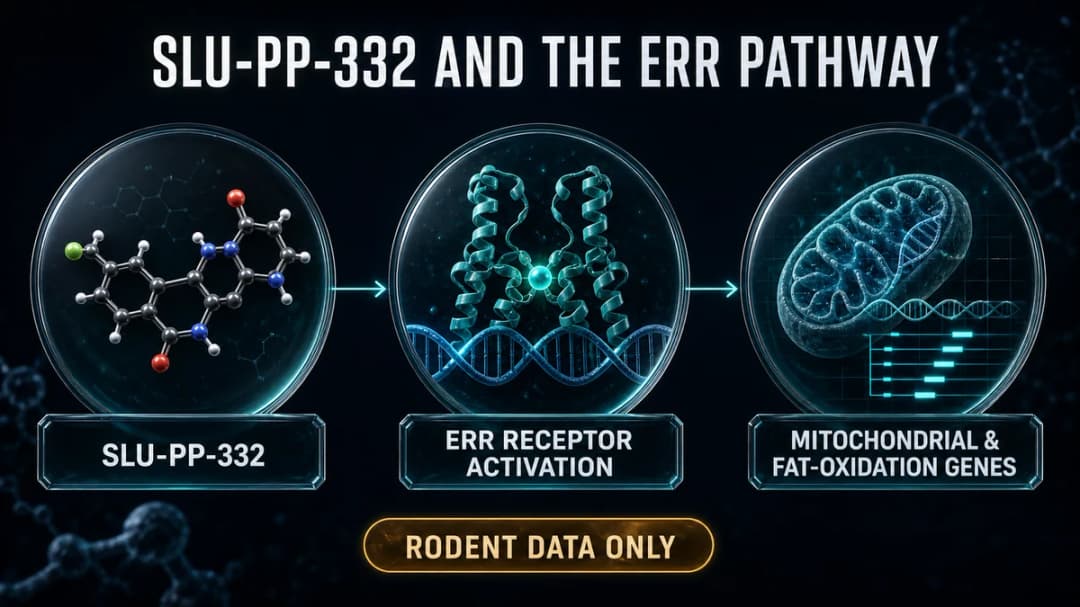
Estrogen-related receptors are transcription factors. Despite the name they are not estrogen receptors and are not activated by estrogen. They are classed as orphan receptors because no natural ligand has been identified, and their activity is normally governed by how much coactivator protein is around, particularly PGC-1 alpha.
That is the link to exercise. Endurance training raises PGC-1 alpha in skeletal muscle, and PGC-1 alpha works partly through ERR to turn on genes that build new mitochondria, increase oxidative phosphorylation, and push cells toward burning fatty acids. SLU-PP-332 skips the upstream signal and binds the receptor directly, activating part of that program without the mechanical loading, neural drive, or cardiovascular stimulus training supplies.
This is why "exercise mimetic" is both useful shorthand and misleading. The compound reproduces a slice of the gene expression response to aerobic exercise in mouse muscle. It does not reproduce exercise, and nothing in the mechanism touches tendon adaptation or bone density.
What the Preclinical Research Actually Found
The published record is consistent and, within its limits, convincing. The problem is one of species.
| Finding | Where the evidence comes from | Honest grade |
|---|---|---|
| Increases mitochondrial respiration | Mouse muscle cell culture | Shown in vitro |
| Switches on an aerobic exercise gene program | Mouse muscle, receptor-dependent | Strong in rodents |
| Increases oxidative muscle fiber | Mouse muscle tissue | Rodent only |
| Improves running endurance | Treadmill testing in mice | Rodent only |
| Raises energy expenditure and fat oxidation | Mouse metabolic studies | Rodent only |
| Cuts fat mass, improves insulin sensitivity | Obese mouse models | Rodent only |
| Improves cardiac measures | Mouse models of cardiac stress | Early and narrow |
| Any effect in a human being | Nothing published | No evidence |
Two caveats deserve mention. First, the receptor-dependence is the strongest item in the file: the endurance effect does not appear when the target receptor is absent, which is real evidence the compound acts through the mechanism claimed rather than some unrelated route. That is better mechanistic grounding than most compounds in this market have.
Second, most of the work traces to one research group and its collaborators, and independent replication remains thin. The last molecule to carry the exercise mimetic label into public attention, the PPAR-delta agonist GW501516, was abandoned after rodent carcinogenicity findings and is now a banned doping agent. That history is not an argument that SLU-PP-332 will fail. It is an argument that a compelling rodent story is where a drug program starts, not where it ends.
The Human Data Gap
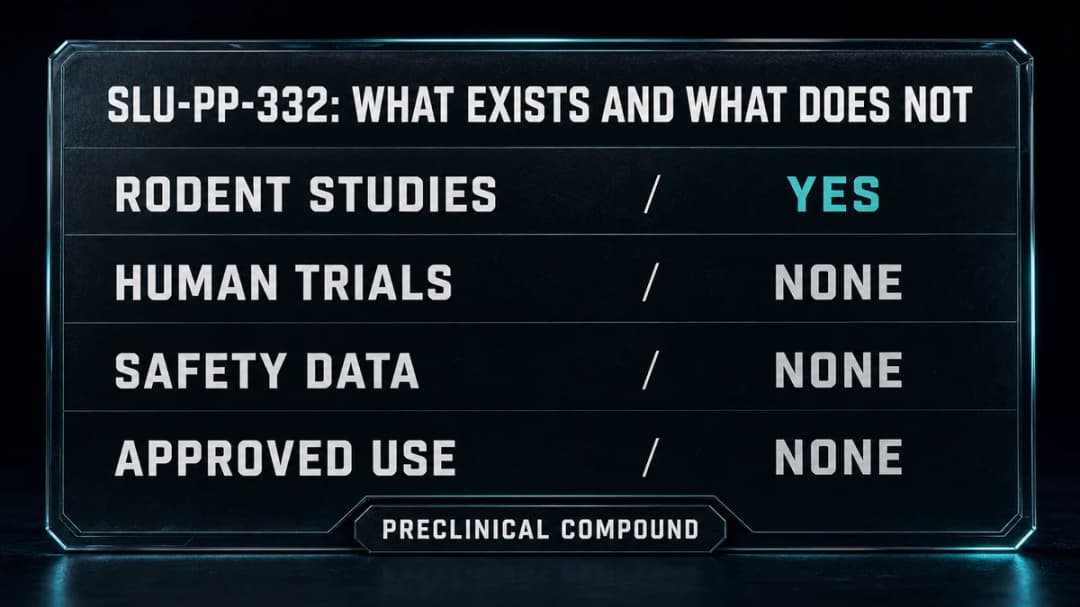
There is no completed human trial, no published Phase 1 readout, and no registered clinical study. No human pharmacokinetic work exists either, which is a bigger practical problem than it sounds.
Without it, nobody knows what dose produces receptor-relevant concentrations in muscle, how long exposure lasts, what it becomes once metabolized, or whether it accumulates. The half-life figures repeated across vendor pages illustrate the problem: some describe it as clearing within a couple of hours, others as lasting most of a day, and none of them trace back to a published human measurement. When sources disagree that widely on a basic parameter, the honest reading is that nobody has measured it in a person.
The rodent work used injection routes standard in laboratory animals and not used in people, so even the animal exposure data does not describe what would happen with any format a consumer would encounter. A molecule optimized to answer a receptor biology question is not the same thing as a molecule optimized to behave predictably in a body, and nothing published establishes that this one clears that bar.
Reported Dosing and Why the Numbers Circulating Online Are Unreliable
Rodent studies administered SLU-PP-332 by body weight, scaled per kilogram of animal, across dosing schedules that ran from a single acute dose up to several weeks. Those figures describe experiments, not protocols.
Converting an animal mg/kg dose into a human amount by simple multiplication is a well-known error. Formal allometric scaling exists, but it assumes knowledge of how a compound is absorbed, distributed, and cleared in both species. That does not exist on the human side here, so the conversion has no foundation. Amounts quoted on vendor pages and forums are self-reported user practice, often split across the day on the theory that clearance is fast, and come from no trial.
None of this is guidance. It describes what has been reported, so the numbers you meet elsewhere can be read for what they are: experiments and anecdotes, not doses.
Safety Questions Nobody Can Answer Yet
This section is short because the data is absent, not because the record is clean.
The three ERR subtypes are expressed across heart, kidney, brain, skeletal muscle, and brown fat, and a pan-agonist activates all three wherever they occur, with no tissue selectivity. Broad activation of a metabolic transcription program in every tissue expressing the receptor is what toxicology studies exist to characterize, and no such characterization has been published for humans.
ERR alpha in particular has been studied in tumor biology, where its activity is associated with the metabolic reprogramming some cancers depend on. That is an open question rather than a demonstrated risk from this compound, but it is the sort of question a development program answers before anyone takes a drug for months.
There is also no data on drug interactions, none on reproductive effects, and none on people with existing cardiac, kidney, or metabolic disease. Add a supply-chain risk: research chemicals sold outside a regulated system vary in identity and purity, and an independent certificate of analysis is the only real check.
How It Compares With the Compounds It Gets Grouped With
MOTS-c is the closest conceptual neighbor and the clearest contrast. It carries the same exercise mimetic label and the same rodent-heavy evidence base, but it is a genuine peptide encoded in mitochondrial DNA, and it converges on AMPK rather than a nuclear receptor. One flips a metabolic switch at the enzyme level, the other changes which genes are transcribed.
AOD-9604 matters for a different reason. It is a growth hormone fragment marketed for fat loss that reached human trials, where the weight-loss results did not hold up against placebo. That is the cautionary case here: a plausible mechanism plus real rodent fat-loss data still produced a null human result. SLU-PP-332 has not yet had the chance to fail that test, which is not the same as passing it.
Legal Status and Anti-Doping
SLU-PP-332 is not approved as a medicine by the FDA, the EMA, or any comparable regulator. Chemical suppliers label it for laboratory research only and state explicitly that it is not for human or veterinary use. It cannot lawfully be marketed with therapeutic or performance claims, whatever disclaimer sits in the page footer.
Competitive athletes should treat it as prohibited. Anti-doping rules cover both non-approved substances and metabolic modulators as open-ended categories, which is enough on its own, and testing laboratories actively develop methods for emerging compounds in this class. Assuming a new molecule is invisible to screening is how athletes get caught.
What Would Change the Assessment
Four things would move this from laboratory probe toward serious attention: published human pharmacokinetics, a Phase 1 safety study, independent replication outside the originating group, and long-term toxicology on chronic pan-ERR activation. None exist today. Until the first two do, the accurate description of SLU-PP-332 is a well-designed research tool with an interesting mechanism and an empty human file.
Frequently Asked Questions
Is SLU-PP-332 a peptide?
No. It is a synthetic small molecule of under 300 daltons with no amino acids and no peptide bonds. Peptide suppliers stock it and list it under peptide headings, which is a commercial convention rather than a chemical one. The distinction matters because solubility, storage, and handling follow different rules.
Does SLU-PP-332 work in humans?
Nobody knows. There are no completed human trials, no published human pharmacokinetics, and no human safety data. Every efficacy finding comes from mice or muscle cell culture. The animal mechanism is well characterized, including evidence that the effects require ERR alpha to be present, but that is a reason to study it in people rather than evidence about people.
What does SLU-PP-332 do in animal studies?
It activates the estrogen-related receptors, turning on a transcriptional program that overlaps with the one aerobic exercise produces. Mouse studies report more mitochondrial respiration, a shift toward oxidative fiber types, better treadmill endurance, higher energy expenditure, and less fat mass in obese models.
Is SLU-PP-332 safe?
That cannot be answered from the available evidence. No human toxicology, interaction, or long-term safety data has been published, and the compound activates receptors expressed throughout heart, kidney, brain, and muscle with no selectivity. Absence of reported harm in something almost nobody has studied is not a safety profile.
Is SLU-PP-332 legal or banned in sport?
It is not an approved drug anywhere and is sold legally in most places only as a research chemical, explicitly not for human consumption. Marketing it with therapeutic claims is not lawful. Tested athletes should assume it is prohibited: anti-doping rules cover non-approved substances and metabolic modulators as open-ended categories, and testing laboratories build methods for emerging compounds in this class.