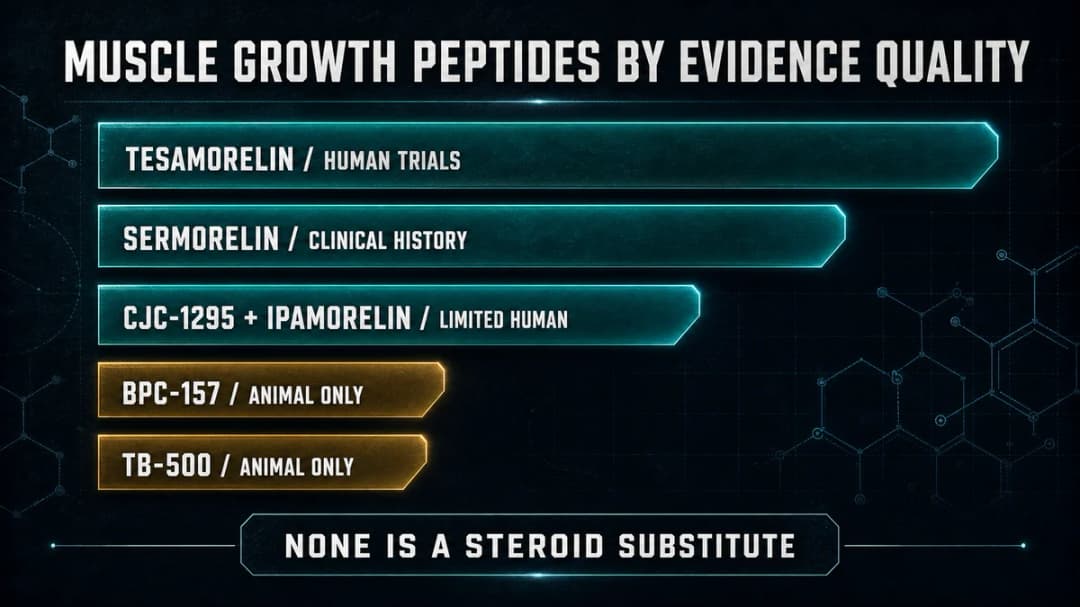
Rank peptides for muscle growth by evidence quality rather than popularity and the usual list turns upside down. Tesamorelin lands on top because it is the only compound in the category with FDA approval and published phase 3 data, and none of that data used muscle growth as an endpoint. Everything below it is thinner still.
- Not one peptide in this category has a controlled human trial with muscle hypertrophy as the primary endpoint. That covers CJC-1295, ipamorelin, sermorelin, tesamorelin, BPC-157 and TB-500 without exception.
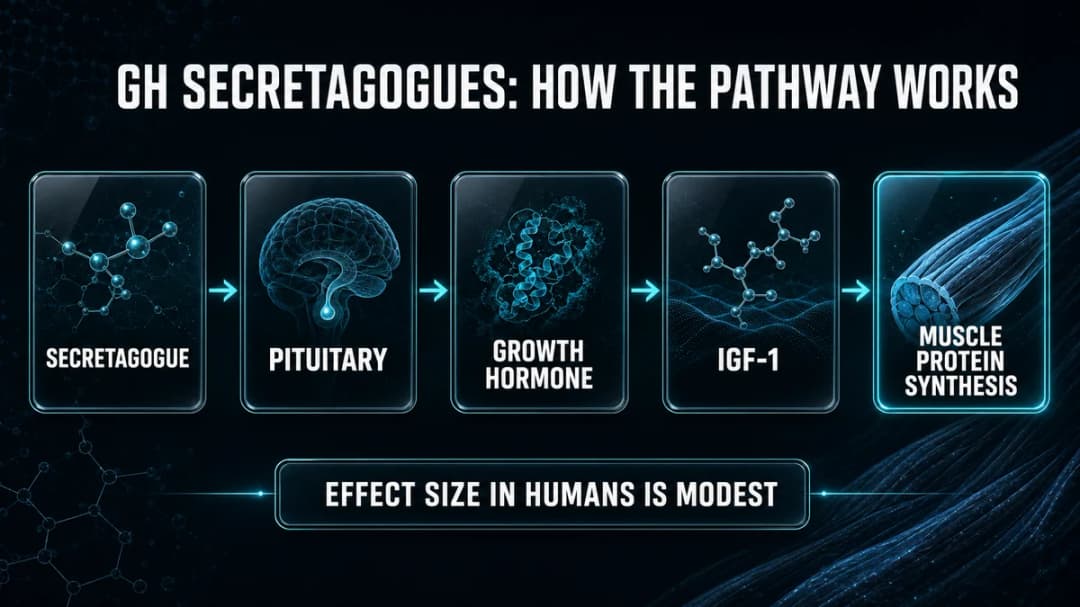
- Growth hormone secretagogues raise GH and IGF-1, but reviews of growth hormone itself in healthy adults keep finding that the lean mass it adds is largely fluid, with no reliable strength gain.
- Tesamorelin is the only approved drug here, and its approved use is visceral fat reduction in HIV-associated lipodystrophy, not muscle building.
- BPC-157 and TB-500 are repair compounds, not anabolics. Any effect on muscle size is indirect and only matters if an injury is genuinely limiting your training.
- None of these replaces anabolic steroids, because none acts on the androgen receptor pathway that drives contractile protein synthesis.
Why None of These Is a Steroid Substitute
This is the part vendor pages leave out, and it is mechanistic rather than moral.
Anabolic androgens work by binding the androgen receptor inside muscle fibers, which directly upregulates myofibrillar protein synthesis and satellite cell activity. The effect is large enough that controlled work has shown fat-free mass increases in humans even without training. That is a direct anabolic signal aimed at contractile tissue.
Growth hormone secretagogues do something else entirely. They prompt the pituitary to release its own GH in pulses, which raises circulating IGF-1. GH's dominant confirmed actions in adults are lipolytic, plus effects on fluid balance, collagen turnover and glucose handling. It moves connective tissue and water more convincingly than it moves myofibrils.
That distinction shows up in the human record. Systematic reviews of recombinant growth hormone in healthy adults, including athletic populations, have repeatedly landed on the same conclusion. Lean body mass measurements go up, the increase is dominated by extracellular water rather than contractile protein, and measured strength or performance does not reliably follow. If injecting GH directly does not produce a dependable strength benefit in healthy people, a peptide whose entire job is to nudge your own GH release into a slightly higher pulse is not going to outperform it.
Read the rest of this article with that ceiling in mind.
Ranking the Best Peptides for Muscle Growth by Evidence Quality
The ranking below is deliberately not a popularity list. It sorts by how much human data exists and how close that data sits to the outcome you actually care about.
| Compound | Class | Human evidence that exists | Evidence it grows muscle | Status |
|---|---|---|---|---|
| Tesamorelin | GHRH analogue | Phase 3 trials, visceral fat endpoint in HIV lipodystrophy | None with hypertrophy as an endpoint | FDA approved, one narrow indication |
| Sermorelin | GHRH analogue (GRF 1-29) | Older approved use in pediatric GH deficiency | None in healthy trained adults | Brand withdrawn commercially, now compounded |
| CJC-1295 with DAC | Long-acting GHRH analogue | Published pharmacology showing sustained GH and IGF-1 rise | None | Never approved, development discontinued |
| Ipamorelin | Selective ghrelin receptor agonist | Early-phase human work on gut motility | None | Never approved |
| CJC-1295 plus ipamorelin | Combination | No controlled trial of the pairing | None | Research use only |
| TB-500 | Thymosin beta-4 fragment | Full-length TB4 studied in humans for other endpoints | None, animal repair data only | Not approved |
| BPC-157 | Gastric pentadecapeptide | Early clinical work in gut disease, no published randomized results in healthy adults | None, animal repair data only | Not approved, restricted for compounding |
| IGF-1 LR3 | IGF-1 analogue | IGF-1 biology studied in deficiency states, not this analogue for hypertrophy | None | Not approved, banned in sport |
Tier 1: tesamorelin, best evidence, wrong endpoint
Tesamorelin is the only compound on this page that cleared full regulatory review. It is a stabilized GHRH analogue approved to reduce excess visceral abdominal fat in people with HIV-associated lipodystrophy, and the trial program behind it was real, large and placebo-controlled. It reliably raises IGF-1.
What it does not have is a muscle-growth trial. Body composition shifts in those studies were driven by visceral fat reduction. If you want the compound with the most trustworthy human safety and pharmacology record, this is it. If you want proof that it adds muscle to a healthy lifter, that proof does not exist.
Tier 2: the GHRH analogues, sermorelin and CJC-1295
Sermorelin is the 29-amino-acid active fragment of natural GHRH. It carried an approval decades ago in pediatric growth hormone deficiency and was pulled from the market for commercial rather than safety reasons, which is why it still shows up in compounding pharmacies today. Its human record is about correcting deficiency, not enhancing a normal system.
CJC-1295 is a modified GRF 1-29 built for a longer life in circulation. Two versions circulate and they are not the same thing. The version with DAC binds albumin and produces multi-day elevation of GH and IGF-1, which is what published pharmacology in healthy adults actually demonstrated. The version without DAC, often labeled mod GRF 1-29, is short-acting and produces a pulse rather than a plateau.
That distinction matters more than most sources admit. The DAC version raises baseline IGF-1 in a way that looks less like a natural pulsatile pattern, and continuous elevation is not obviously better for muscle. Development of the DAC version was discontinued, so there is no late-stage safety dataset.
Tier 3: ipamorelin and the CJC-1295 stack
Ipamorelin is a ghrelin receptor agonist, a different receptor from the GHRH analogues. Its selling point is selectivity. Compared with older GHRPs it triggers relatively little cortisol or prolactin release, which is a genuine pharmacological advantage. Its human trial history is in gastrointestinal motility, not body composition.
The pairing of a GHRH analogue with a ghrelin agonist, sold widely as a FIT stack, rests on a defensible idea. Two separate receptors, two separate arms of GH control, a larger combined pulse than either alone. The pharmacology is sound. What is missing is any controlled human study of the combination measured against a hypertrophy or strength endpoint. Our broader comparison of growth hormone secretagogues walks through how the options differ.
Tier 4: the repair peptides
BPC-157 and TB-500 are frequently sold under a muscle-growth banner, and that framing is simply wrong. Neither is anabolic. BPC-157 is a synthetic fragment derived from a protein in gastric juice, studied almost entirely in rodents for tendon, ligament, gut and nerve repair. TB-500 is a construct based on thymosin beta-4, an actin-binding repair protein, and its mechanism is cell migration and new blood vessel formation rather than protein accretion.
The honest case for either is indirect. If a tendon problem is keeping you out of the gym, anything that shortens that layoff means more accumulated training stimulus over a year. That is a hypothesis about training availability, not evidence of hypertrophy, and it only applies if you are actually injured. The combination of the two, often called the Wolverine stack, inherits the same limitation.
The One Pathway With Real Human Muscle Data
There is a class of drugs that unambiguously increases lean mass in humans, and it is not on the peptide vendor list.
Myostatin restrains muscle growth. Blocking it, or blocking the activin receptors it signals through, increases muscle mass across species. ACE-031, a soluble activin receptor decoy, reached human trials and did increase lean mass before development was halted following bleeding-related adverse events. Bimagrumab, an antibody rather than a peptide, has produced meaningful lean mass increases alongside fat loss in human studies.
This is the useful comparison. When something in this general space genuinely builds muscle in people, it shows up clearly in trials, it gets studied by pharmaceutical companies, and it runs into safety questions serious enough to stop or slow development. The GH secretagogues have been available to researchers for decades and have never produced that signal.
Follistatin-344 and similar products sold to consumers are marketed off this pathway without any of the supporting human work.
Reported Dosing, and Why It Is Not Instruction
Protocol numbers circulate widely for all of these. They come from research literature, early-phase pharmacology and community reporting rather than from any dosing guideline for muscle growth, because no such guideline exists.
Tesamorelin has an actual approved label dose for its actual approved indication, which is the only figure on this page with regulatory standing. For the rest, reported ranges cluster in the low hundreds of micrograms per administration for sermorelin, CJC-1295 without DAC and ipamorelin, with weekly rather than daily schedules cited for CJC-1295 with DAC and for TB-500, and daily microgram ranges for BPC-157. Treat every one of those numbers as approximate. Peptide products vary in purity, in actual peptide content per labeled milligram, and in the case of TB-500, in which molecule is even in the vial.
The individual guides linked above carry the specifics. This page is about whether any of it earns a place in a muscle-building plan, and the answer is that the evidence does not currently support it.
Legal Status, Purity and Sport Testing
Three practical points that decide the question for many people before the science does.
Most of these compounds are not approved drugs and are sold for laboratory research use only. In 2023 the FDA placed several, including BPC-157, ipamorelin and CJC-1295, in the compounding category reserved for substances with significant safety concerns, which effectively closed the legitimate compounding route. Tesamorelin, as an approved drug, sits outside that problem. Sermorelin, on the strength of its earlier approval, has generally remained available through compounding pharmacies. Our tesamorelin for sale page covers where it is sold and what documentation to ask for.
Every compound discussed here is prohibited by the World Anti-Doping Agency, either as a growth factor or under the catch-all category for non-approved substances. For any tested athlete this is disqualifying, and no exception exists for the repair peptides.
Purity is the third issue. Research-use vials come with no requirement for sterility, identity or content verification, and third-party testing on this market has repeatedly found underdosed and misidentified product. You cannot evaluate a compound honestly if you cannot confirm what you injected.
What Actually Moves Muscle Mass
Nothing on this page competes with the boring inputs. Progressive resistance training with adequate weekly volume, protein intake in the range that supports muscle protein synthesis across the day, an energy intake that is not chronically low, and sleep that allows your own GH pulses to happen normally.
That last point deserves emphasis. The largest natural GH release of the day happens during slow-wave sleep. Chasing an extra pulse with an injectable while sleeping five hours is a strange allocation of effort and money.
If you are in a calorie deficit, especially on a GLP-1 medication, lean mass protection is a real and separate concern with much better-supported answers, and we cover that in the guide to protecting lean mass during rapid weight loss and in our walkthrough of building muscle on a GLP-1.
FAQ
Which peptide is best for muscle growth?
By evidence quality, tesamorelin, because it is the only one with completed phase 3 human trials and regulatory approval. By evidence that it grows muscle specifically, none of them, because no compound in this category has been tested against a hypertrophy endpoint in a controlled human study.
Do CJC-1295 and ipamorelin actually build muscle?
The combination reliably raises GH and IGF-1, which is a pharmacological effect, not a body composition outcome. No controlled human trial has measured whether that translates into muscle gain in healthy trained adults. Given what reviews of growth hormone itself show in healthy people, expecting substantial hypertrophy is not supported.
Does BPC-157 help you build muscle?
Not directly. BPC-157 is a repair compound with animal data on tendon, ligament and gut healing, and no published randomized human results in healthy adults. If an injury is preventing you from training, faster recovery could indirectly allow more training, but that is a plausible mechanism rather than a demonstrated result.
Are peptides for muscle growth legal?
Mostly no, in the sense that matters. Tesamorelin is an approved prescription drug for a specific condition. Sermorelin can be compounded. The rest are sold for research use only, several were flagged by the FDA in 2023 as unsuitable for compounding, and all of them are banned in tested sport.
Can peptides replace steroids?
No. Androgens act directly on the androgen receptor in muscle tissue and produce large, well-documented increases in fat-free mass. GH secretagogues work through a pathway whose confirmed effects in adults are mainly on fat, fluid and connective tissue. The two are not comparable in mechanism or in effect size.