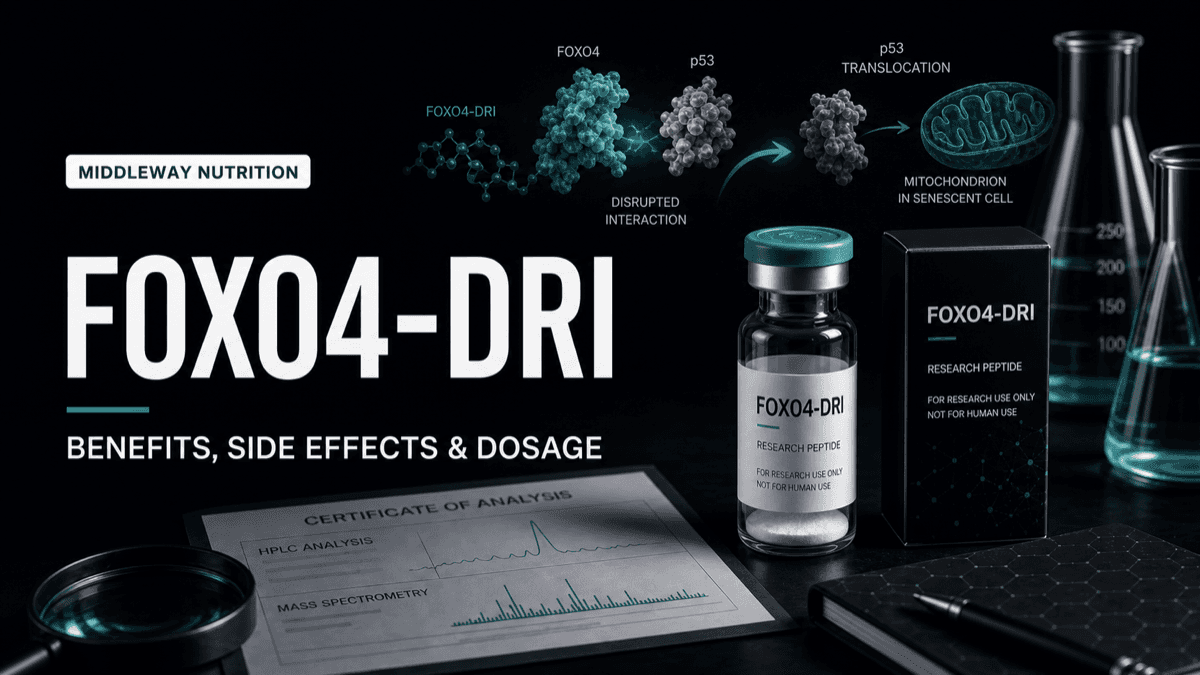

FOXO4-DRI is a senolytic peptide designed to kill senescent cells selectively by breaking the interaction between the FOXO4 protein and p53, and its entire evidence base consists of animal work. Any honest FOXO4-DRI review has to hold two things together: the mechanism is one of the most elegant in longevity biology, and there is no human clinical trial data at all.
Those are not contradictory. They describe a compound that is scientifically interesting and, as a purchase, speculative.
The Mechanism
Senescent cells are cells that have permanently stopped dividing but have not died. They accumulate with age across tissues, and the problem is not their presence but their behaviour: they secrete a mix of inflammatory signals, collectively called the senescence-associated secretory phenotype, which damages surrounding tissue and appears to push neighbouring cells toward senescence as well.
They make up a small fraction of cells in aged tissue but exert influence well out of proportion to their number, which is why clearing them has become a serious research strategy.
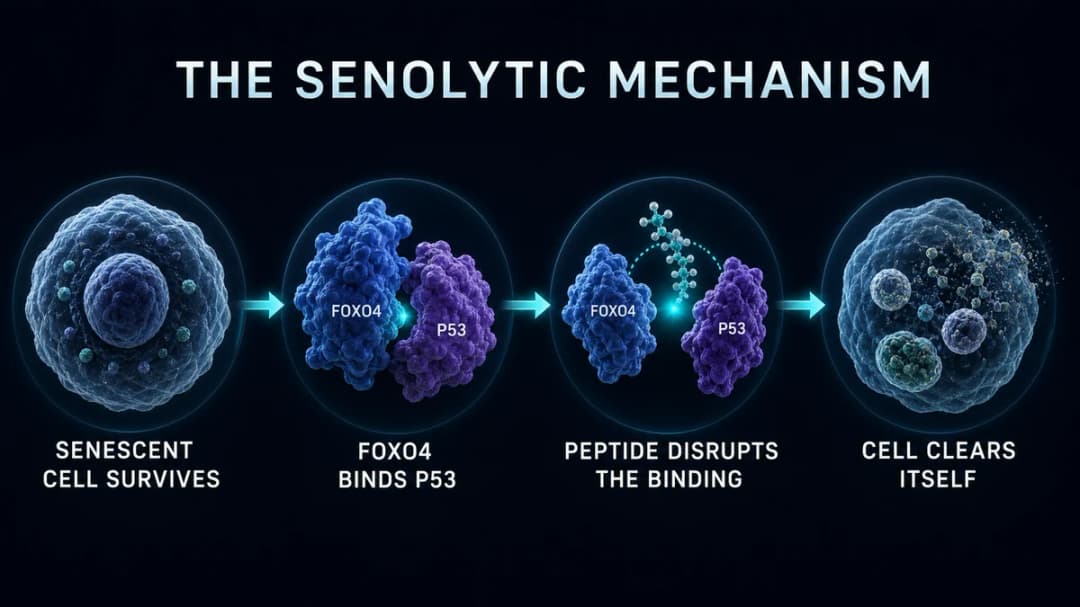
FOXO4-DRI exploits how these cells survive. A damaged cell would normally activate p53, which triggers programmed cell death. Senescent cells escape that by having FOXO4 bind p53 in the nucleus and block it from doing its job.
FOXO4-DRI competes with that interaction. It interferes with FOXO4 binding p53, which frees p53 to trigger apoptosis in the cell. Healthy cells are largely unaffected because they do not overexpress FOXO4.
The DRI part is D-retro-inverso, a modification reversing both the amino acid chirality and the sequence direction. It makes the peptide far more resistant to enzymatic breakdown, and a conventional L-peptide version would be degraded too quickly to reach its target.
What the Research Actually Showed
The foundational work is a 2017 paper in the journal Cell reporting that FOXO4-DRI selectively killed senescent cells and, in aged mice, produced restored fitness, hair regrowth and improved kidney function.
Those are striking findings and the paper is legitimate, well-known research. Three things need to be said about them.
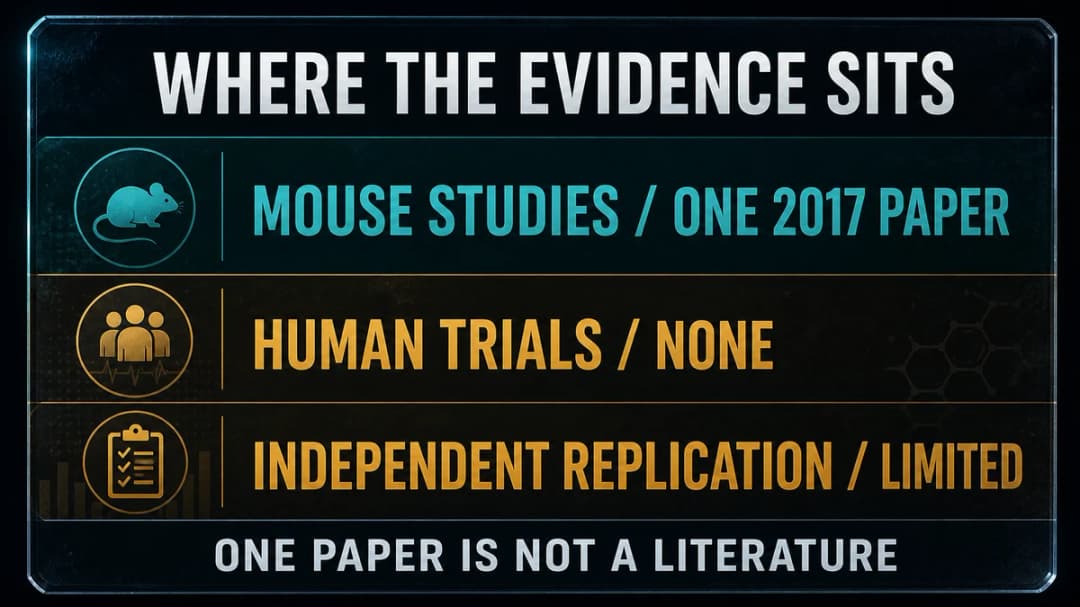
They are mouse results. The gap between mouse longevity results and human outcomes is the widest in biology. Many interventions that extended healthy life in mice have produced nothing comparable in people.
There has been no human trial. Not a completed one, not a failed one, not an in-progress one that has published results. The human evidence file for FOXO4-DRI is empty.
Senolytics as a field has not delivered yet. Other senolytic approaches have entered human trials, and results so far have been mixed and considerably more modest than the animal work implied. That is relevant context for a compound that has not been tested at all.
Where the Evidence Actually Sits
| Question | Status |
|---|---|
| Does it clear senescent cells in cell culture? | Demonstrated in published work |
| Does it clear them selectively, sparing healthy cells? | Demonstrated in animal models |
| Does it improve function in aged animals? | Reported in the 2017 mouse work |
| Is there a published human trial? | No |
| Is there a human safety dataset? | No |
| Is there an established human dose? | No |
| Is there an approved product anywhere? | No |
Reading that table row by row is the fastest way to understand the compound. The top half is genuine science. The bottom half is the part a buyer is actually exposed to.
What Is Sold and How
FOXO4-DRI is sold as a research compound. Protocols in circulation use short intermittent courses, commonly one to two weeks, repeated a few times a year rather than continuous dosing.
The intermittent pattern has a genuine rationale, which is worth understanding because it distinguishes senolytics from most compounds. If the goal is to clear a population of cells that accumulates slowly, you do not need continuous exposure. You need periodic clearance. This is sometimes described as a hit and run approach, and it is one of the more coherent ideas in the space.
The doses in circulation are conventions from the research chemical market, scaled loosely from animal work. Interspecies scaling for a compound like this is not a simple weight conversion, and nobody has established a human dose.
The Risks Worth Naming
The mechanism is apoptosis. This compound is designed to trigger cell death. Selectivity is the entire safety argument, and it rests on animal data. If selectivity is less clean in humans than in mice, the consequence is not a mild side effect.
No safety monitoring exists. No approved product, no adverse event reporting, no long-term follow-up in humans.
Product identity is unverifiable without documentation. A D-retro-inverso peptide is more complex to synthesise correctly than a standard peptide, which raises the stakes on third-party analytical verification. A batch-specific certificate of analysis is the only available check.
Interaction with cancer treatment is unknown. p53 signalling and apoptosis sit at the centre of oncology, and anyone with an active or recent malignancy should not be experimenting here without an oncologist involved.
FOXO4-DRI Review: An Honest Verdict
As science, this is among the most interesting things in aging research. The mechanism is specific, the logic is clean, and the animal results were genuinely notable.
As a purchase, it is a bet on mouse data with no human safety information, no established dose and a mechanism that deliberately triggers cell death. Anyone treating it as an established anti-aging intervention has skipped the most important sentence in every paper written about it.
For related reading, see our FOXO4-DRI guide and our overview of bioregulator peptides for aging, which covers another longevity category with a similar evidence problem. If you have already decided to buy, our guide to FOXO4-DRI for sale shows how to check a vial before you pay.
Frequently Asked Questions
Does FOXO4-DRI work in humans?
Nobody knows. There is no human clinical trial data for it, and its evidence base consists of animal studies. The mouse results published in 2017 were striking, but the record of mouse longevity findings translating to humans is poor, which is exactly why human trials exist.
What are senescent cells and why clear them?
They are cells that have stopped dividing but not died, accumulating with age. They secrete inflammatory signals that damage surrounding tissue and appear to spread senescence to neighbouring cells. Removing them is a leading strategy in aging research, though human results from senolytic approaches have been more modest than animal work suggested.
How is FOXO4-DRI dosed?
Circulating protocols use short intermittent courses of one to two weeks, repeated a few times a year, following the logic that a slowly accumulating cell population needs periodic clearance rather than continuous exposure. The specific doses are conventions scaled from animal work rather than established human doses.
Is FOXO4-DRI safe?
That is unknown. Its mechanism deliberately triggers cell death, and its safety argument rests entirely on selectivity demonstrated in animals. There is no human safety data, no monitoring system and no approved product. Anyone with a cancer history should not use it without oncology input.
What does DRI mean in FOXO4-DRI?
D-retro-inverso, a modification that reverses both the chirality of the amino acids and the direction of the sequence. It makes the peptide much more resistant to enzyme degradation. A standard L-peptide version would be broken down too fast to do anything.