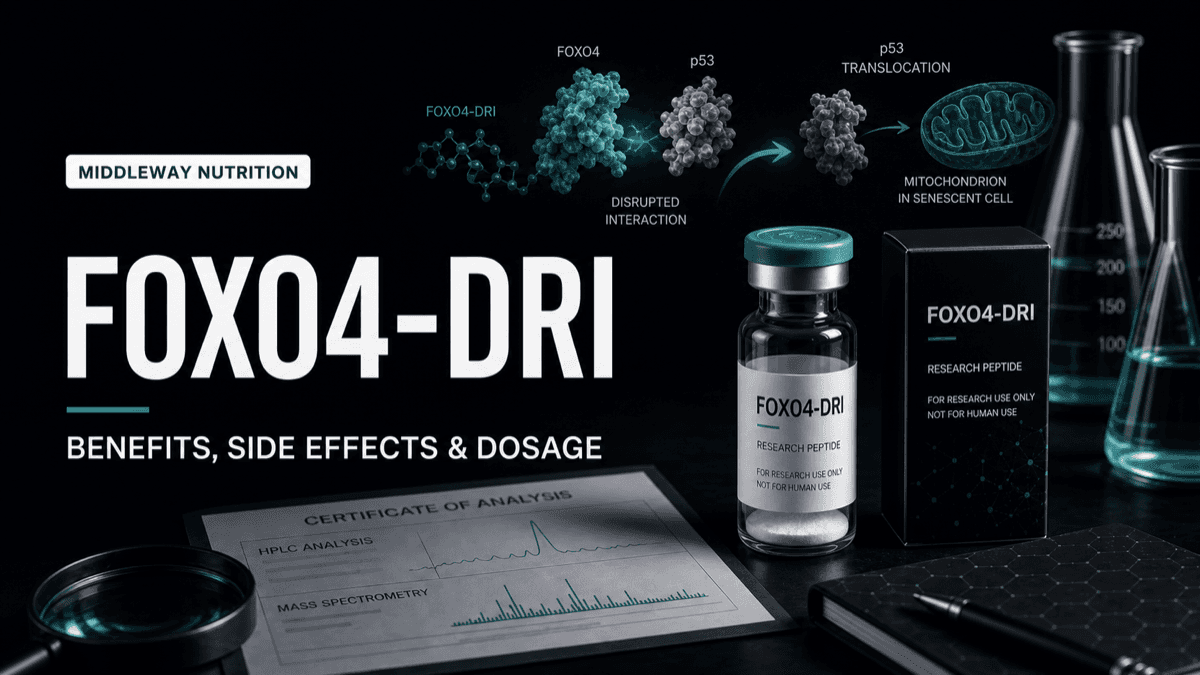
FOXO4-DRI peptide benefits rest on a single idea, clearing senescent cells, the side effects most often reported are a short flu-like reaction, and dosage sits somewhere between a mouse study and guesswork. That last part is the honest heart of this compound. Its evidence problem has an unusual shape: the preclinical work is genuinely good, widely cited, and published in a top-tier journal, while the human dosing everyone quotes online has no published basis at all. Those two facts sit side by side and get blurred together constantly in marketing copy. Our FOXO4-DRI review works through that evidence gap in more detail.
- FOXO4-DRI is a senolytic research peptide, meaning it is designed to kill off aged cells rather than improve the function of healthy ones.
- It is built as a D-retro-inverso construct, using mirror-image D-amino acids in reversed order, which makes it resistant to the enzymes that would otherwise destroy it quickly.
- Its target is the FOXO4-p53 interaction that senescent cells depend on to avoid self-destructing.
- The core evidence is a 2017 paper in Cell from Baar and colleagues, using mice at 5 mg/kg intraperitoneally every other day. No published human trial exists.
- Reported human use runs roughly 1 mg to 3 mg subcutaneously per dose, in short courses a few times per year, and those figures are community convention rather than validated dosing.
What FOXO4-DRI Actually Is
Start with the biology, because the name only makes sense once you have it.
Cells that suffer enough DNA damage, oxidative stress, or simple division exhaustion can enter a permanent state of growth arrest called senescence. This is not a malfunction. It evolved as a brake on cancer, and short-lived senescence also plays a constructive role in wound healing. The trouble is disposal. Natural killer cells and macrophages are supposed to clear these cells, and in a young body that works reasonably well. As immune surveillance itself ages, removal slows down at exactly the point where production speeds up, and the cells pile up in tissue.
While they sit there, they secrete. The senescence-associated secretory phenotype, or SASP, is a mix of inflammatory cytokines such as IL-6, IL-8 and TNF-alpha along with matrix-degrading enzymes. That secretion degrades surrounding connective tissue, sustains low-grade chronic inflammation, and can push neighboring healthy cells into senescence too. Senescent cells are only a small fraction of total cells in aged tissue, but their inflammatory output is disproportionate to their numbers, which is why their accumulation is treated as one of the recognized hallmarks of aging.
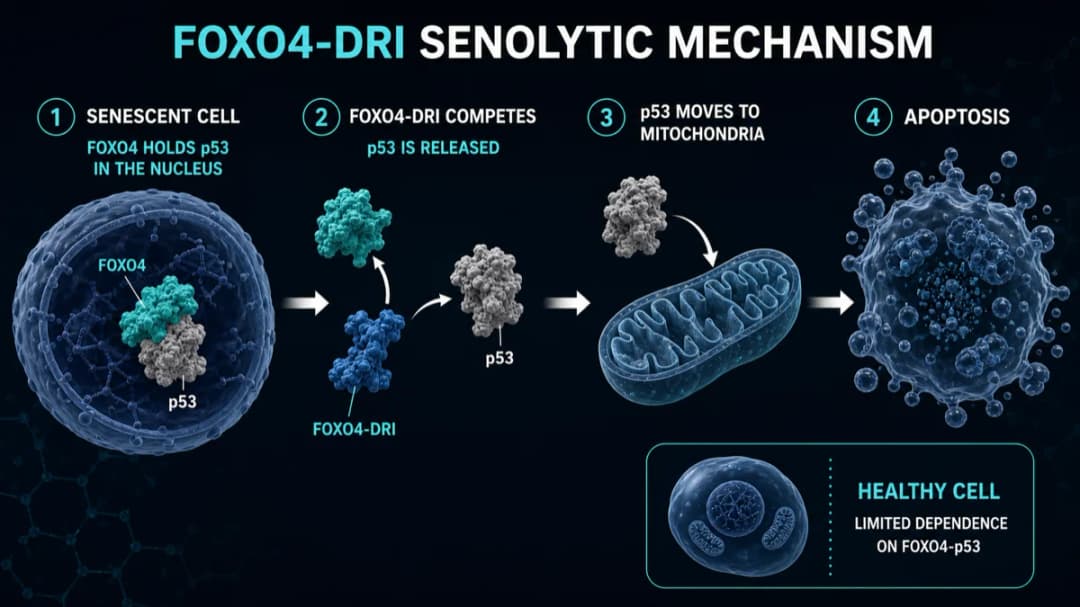
FOXO4-DRI is a molecular tool aimed narrowly at that population. Senescent cells stay alive by keeping p53, the tumor suppressor that would normally order their death, tied up in the nucleus, where the FOXO4 protein binds and holds it. FOXO4-DRI is modeled on the exact stretch of FOXO4 that does the binding, so it competes for the same contact point and displaces p53, which can then move to the mitochondria and start apoptosis. Healthy cells largely ignore the peptide because they do not lean on that interaction for survival, and that is where the selectivity comes from.
One naming note, because it routes people to the wrong listings. FOXO4 is short for forkhead box protein O4, spelled with the letter O, not a zero, and the gene carries the older aliases AFX, AFX1 and MLLT7. Vendor pages and search boxes are full of FOX04-DRI typed with a numeral, which is the same molecule mistyped rather than a second compound.
The DRI suffix describes how it is built. Ordinary peptides made of L-amino acids are chopped apart by proteases within minutes. A D-retro-inverso design reverses both the chirality of every residue and the order of the sequence, and the two reversals cancel out geometrically, leaving a molecule that presents a similar binding surface while being largely invisible to those enzymes. Without that modification the peptide would be degraded long before reaching anything. If a vendor lists plain "FOXO4" with no mention of the DRI form, clarify that before buying, because the standard L-peptide version would be expected to have very little activity.
FOXO4-DRI is not an approved drug in any jurisdiction. It is sold as a research compound, and nothing below should be read as a protocol.
FOXO4-DRI Benefits
The benefits attributed to this peptide come from one very well-executed body of animal work plus a layer of anecdote. Keeping those layers separate is the whole job here.
Selective removal of senescent cells. This is the claim with actual data behind it. In the 2017 Cell paper (Baar et al., Cell 2017;169(1):132-147), FOXO4-DRI triggered apoptosis in senescent cells in culture and reduced senescent cell burden across several tissues in living mice. The mechanism has been characterized in detail rather than inferred. Evidence grade: strong, preclinical only.
Restored physical function in aged animals. Treated mice showed improved running capacity and general fitness, alongside recovery of fur density. The interpretation offered is that clearing SASP-producing cells from muscle and skin lifts an inflammatory drag rather than adding any new capacity. Evidence grade: solid in rodents, unverified in people.
Improved kidney function in aged mice. The kidney is one of the organs where senescent burden climbs steadily over a lifespan, and the published work reported measurable recovery of function after treatment. Evidence grade: reproducible in the original models, no human confirmation.
Hair regrowth after chemotherapy-induced senescence. Chemotherapy drives a large, acute wave of senescence, and clearing it allowed regrowth in treated animals. This finding attracted the most press, though the context differs sharply from ordinary aging, where senescent burden builds slowly over decades. Evidence grade: real finding, narrow applicability.
Reduced systemic inflammation. Follows logically from clearing SASP-producing cells rather than being measured as an endpoint. Evidence grade: mechanistically reasonable, indirectly supported.
Subjective improvements in energy, skin and recovery. Reported by users. No controls, no blinding, and a strong expectation effect around a compound with this much narrative attached. Evidence grade: anecdote.
Laid out against what was actually measured, the benefit list separates cleanly into three tiers.
| Claimed benefit | What was actually demonstrated | Where | Evidence grade |
|---|---|---|---|
| Senescent cell clearance | p53 excluded from the nucleus of senescent cells, triggering apoptosis in those cells while sparing healthy ones | Cell culture and mice | Strong, preclinical |
| Restored physical fitness | Fitness recovered in fast-aging XpdTTD/TTD mice and in naturally aged mice | Mice | Solid in rodents |
| Hair and fur density | Fur density restored in those same two mouse models | Mice | Solid in rodents |
| Kidney function | Renal function restored in those same two mouse models | Mice | Solid in rodents |
| Protection from chemotherapy damage | The peptide neutralized doxorubicin-induced chemotoxicity | Mice | Real finding, narrow context |
| Lower systemic inflammation | Not measured as an endpoint; inferred from removing the cells that produce SASP | Inference | Mechanistically reasonable |
| Energy, skin, recovery | Nothing published; uncontrolled self-report | Humans, unblinded | Anecdote |
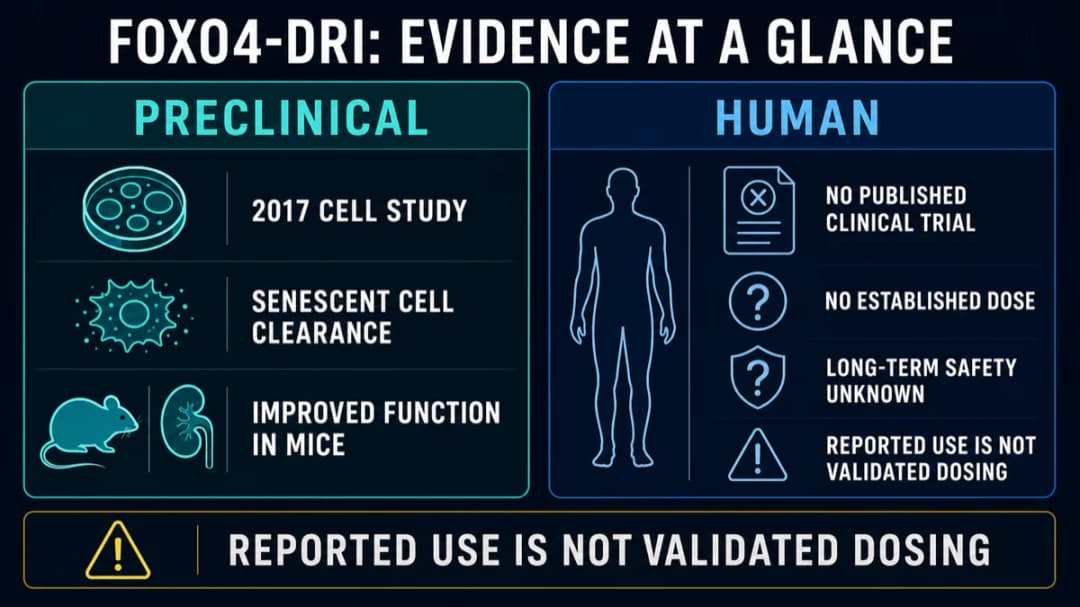
Every row that names a species names a mouse. A search of ClinicalTrials.gov in August 2026 returns no registered human trial of FOXO4-DRI, so there is no human row to put underneath.
What is genuinely absent: any completed human trial, any established biomarker showing clearance in a person, and any long-term follow-up. Small molecule senolytics such as dasatinib with quercetin and fisetin have progressed further into human testing. FOXO4-DRI has the cleaner mechanism on paper and the thinner human record in practice, and both statements are true at once.
Worth saying what it is not, too. FOXO4-DRI does not build tissue, raise growth hormone, or improve mitochondrial output. Those are different jobs handled by different compounds. Subtraction and support are separate categories.
FOXO4-DRI Side Effects
The side effect profile here has an unusual feature: the most common reaction is a direct consequence of the mechanism working, not a sign of toxicity. Clearing a batch of senescent cells produces apoptotic debris and a burst of released inflammatory signaling, and the body responds to that the way it responds to any clean-up job.
Commonly reported
- Flu-like symptoms in the one to three days following a dose: fatigue, mild body aches, sometimes a low-grade fever
- Injection site redness or swelling, typically settling within a day
- General tiredness for 24 to 48 hours after each injection
- A temporary rise in inflammatory markers
Reported less often
- Nausea, usually described as mild and dose-related
- Headache
- Muscle soreness
Intensity appears to scale with dose, which is the main reason cautious users start at the low end of the reported range. The published mouse work is frequently cited as showing no measurable damage to healthy tissue, normal blood panels, and none of the weight loss typical of a broadly toxic compound. That is a genuine finding, and it is also a finding in mice.
Where the data is thin, and it is thin in several places worth naming plainly:
- No human safety dataset of any size exists. Everything about tolerability in people is aggregated self-report.
- Long-term effects are unknown. Nobody has followed repeated annual courses over years.
- The interaction with active or recent malignancy is unresolved. The FOXO4-p53 axis matters in cancer biology, and the direction of effect is not something you can reason out from first principles.
- The consequence of clearing too many cells at once in a person has been extrapolated, never characterized.
- How the compound interacts with the immune system's own senescent cell surveillance is unstudied.
Caution is repeatedly flagged for anyone with an active cancer diagnosis, anyone taking immunosuppressants, anyone whose immune function is compromised enough that processing apoptotic debris is a concern, and anyone pregnant or breastfeeding. That is not advice, it is a description of where the unknowns concentrate.
FOXO4-DRI Dosage Chart
There is no established human dose for FOXO4-DRI. The chart below collects ranges from the published animal literature and from commonly repeated community protocols, labeled so you can see where each number came from. Allometric conversion from rodents to humans is unreliable for peptides, and the gap between the first row and every row under it is an extrapolation nobody has validated.
| Context | Reported range | Frequency | Typical cycle |
|---|---|---|---|
| Published mouse studies | 5 mg/kg, intraperitoneal | Every other day | Varies by study (about three doses in one aged-mouse study, one month in another) |
| Conservative reported use | 1 mg, subcutaneous | Once daily | 3 consecutive days, 1 to 2 courses per year |
| Most commonly cited | 2 mg, subcutaneous | Once daily | 3 consecutive days, 2 to 3 courses per year |
| Extended course | 2 mg, subcutaneous | Once daily | 5 consecutive days, roughly once per year |
| Upper end reported | 3 mg, subcutaneous | Once daily | 3 consecutive days, roughly once per year |
| Alternating schedule | 1 to 2 mg, subcutaneous | Every other day | 7 to 14 days, 2 to 4 courses per year |
Two structural points sit behind every row. First, this is not a daily peptide, and treating it like one is the most common misunderstanding people bring to it. Senescent cells accumulate slowly over months and years, so pulsed clearance matches the rate of accumulation while continuous exposure would add inflammatory load for nothing. Second, courses cluster at two to four per year rather than monthly because of concern about clearing too much at once.
A 10 mg vial, the size most commonly sold, covers roughly one course at 2 mg per day for five days, or two shorter courses at 1 mg per day. That is arithmetic about vial size, not a recommendation.
Reconstitution and Storage
FOXO4-DRI ships as a lyophilized powder and needs bacteriostatic water before use. Adding 2 mL to a 10 mg vial gives 5 mg/mL, which puts a 1 mg dose at 20 units on a U-100 insulin syringe and a 2 mg dose at 40 units. Direct the water down the inside wall of the vial rather than onto the powder, and swirl gently instead of shaking.
Unreconstituted powder keeps best around -20 C. Once mixed, refrigerate at 2 to 8 C and use within roughly 28 to 30 days. Avoid repeated freeze-thaw cycles, and discard anything cloudy, discolored, or showing particulates.
Stacking
Genuine documentation for FOXO4-DRI combinations does not exist. No study has tested it alongside another peptide, so what follows is reasoning about mechanism, which is a weaker thing than evidence.
The one point with something close to consensus behind it is negative: running FOXO4-DRI at the same time as another senolytic, whether dasatinib with quercetin or fisetin, is generally avoided because the clearance effects stack and so does the inflammatory response to them. Sequencing across a year is the more common approach.
Beyond that, senescent cell accumulation is one hallmark of aging among several, and the peptides people pair it with tend to address different hallmarks entirely. Epithalon is studied around telomere biology, SS-31 around mitochondrial membrane integrity, and NAD+ around cellular energy metabolism. A frequently described sequence is to run the FOXO4-DRI course first, allow a couple of weeks, then begin something regenerative, on the reasoning that you clear before you rebuild. The logic is tidy. It has not been tested.
How to Verify What You Buy
FOXO4-DRI is a synthesis-heavy peptide, and a D-retro-inverso construct is harder to make correctly than a short standard sequence, which makes independent testing more important here than for most compounds. Ask for a batch-specific third-party certificate of analysis with mass spectrometry confirming the correct molecular weight for the DRI form specifically, plus HPLC purity, and confirm the vendor is selling the D-retro-inverso version rather than a plain L-peptide. Our guide to where to buy FOXO4-DRI walks through which suppliers publish usable documentation and what a weak COA looks like. If you have already decided to buy, our guide to FOXO4-DRI for sale shows how to check a vial before you pay.
Looking for the numbers behind this guide? Our FOXO4-DRI dosage chart sets label and trial doses beside what Reddit users report taking.
Frequently Asked Questions
What are the benefits of FOXO4-DRI peptide?
Every documented benefit belongs to mice. In the 2017 Cell work the peptide cleared senescent cells and restored fitness, fur density and kidney function in fast-aging and naturally aged animals, and it blunted doxorubicin toxicity. In people there is no completed trial, no published dose-finding, and no test that confirms clearance actually happened; the reports of better energy, skin and recovery are uncontrolled self-report from users who knew what they were taking. The mouse column and the human column are separate things, and vendor copy usually blurs them.
What is the point of taking FOXO4-DRI?
It is designed to kill senescent cells selectively. It does this by binding the site where the FOXO4 protein normally holds p53 captive in the nucleus of a senescent cell. Displacing p53 lets it reach the mitochondria and initiate apoptosis. Healthy cells are largely unaffected because they do not depend on that interaction to stay alive.
How risky is FOXO4-DRI?
Nobody can answer that with confidence, because no human safety study has been published. The animal work reported good tolerability and no visible damage to healthy tissue, and the flu-like reaction people describe is consistent with cellular clearance rather than toxicity. But absence of reported harm in a small self-selected group is not the same as demonstrated safety, and the unknowns around cancer interaction and long-term repeated use are real.
How much FOXO4-DRI do people use?
Reported use clusters around 1 mg to 3 mg subcutaneously per dose, in short courses of three to five days, repeated one to four times a year. The published mouse protocol used 5 mg/kg intraperitoneally every other day; course length varied by study and a ten day course could not be confirmed. No human dose-finding study underlies any of it.
Is FOXO4-DRI legal?
In the United States it is not an approved drug and is not scheduled, so it is sold legally as a research chemical for laboratory use. It is not legal to market it for human consumption, and vendors that do are operating outside the rules regardless of how the product is labeled. Import rules and enforcement vary by country, so check your own jurisdiction rather than assuming.
Can you tell if it is working?
Not reliably. There is no routine clinical test for senescent cell burden. Some researchers track hs-CRP, IL-6, or p16INK4a expression in T cells as indirect proxies, and functional measures like grip strength or walking speed move slowly over months if at all. The flu-like response after dosing is often read as a sign of activity, but it is a subjective signal and not a measurement.