In the FOXO4-DRI vs fisetin comparison, fisetin has the stronger case today, but only by a little. FOXO4-DRI rests on one 2017 mouse paper and has never been tested in a registered human trial. Fisetin has a mouse lifespan study, a null result from a larger follow-up test, and several placebo-controlled human trials that have not yet reported. If you widen the question to "which senolytic has any human data at all", the answer is neither of them: it is dasatinib plus quercetin (D+Q), which has small human pilots and one randomised trial.
All three are sold or discussed as ways to clear senescent cells, the damaged cells that stop dividing but refuse to die and keep releasing inflammatory signals. They get there by different routes, cost wildly different amounts, and sit at different rungs of the evidence ladder. This page lays them side by side. For the full profile of the peptide on its own, see our FOXO4-DRI peptide guide.
This is an evidence summary for research purposes, not medical advice. None of these compounds is approved to treat ageing.
FOXO4-DRI vs Fisetin vs D+Q at a Glance
| FOXO4-DRI | Fisetin | Dasatinib + quercetin | |
|---|---|---|---|
| What it is | Synthetic 46-amino-acid D-retro-inverso peptide | Plant flavonoid (strawberries, apples) | Leukaemia drug plus a plant flavonoid |
| How it kills senescent cells | Breaks the FOXO4-p53 hold, freeing p53 to trigger apoptosis | Not fully mapped; broad pro-survival pathway effects | Blocks several senescent-cell survival networks at once |
| Key animal paper | Baar et al., Cell, 2017 | Yousefzadeh et al., EBioMedicine, 2018 | Zhu et al., Aging Cell, 2015 |
| Independent replication | None of the lifespan-style findings | NIA testing programme found no lifespan effect (2024) | Multiple groups, many models |
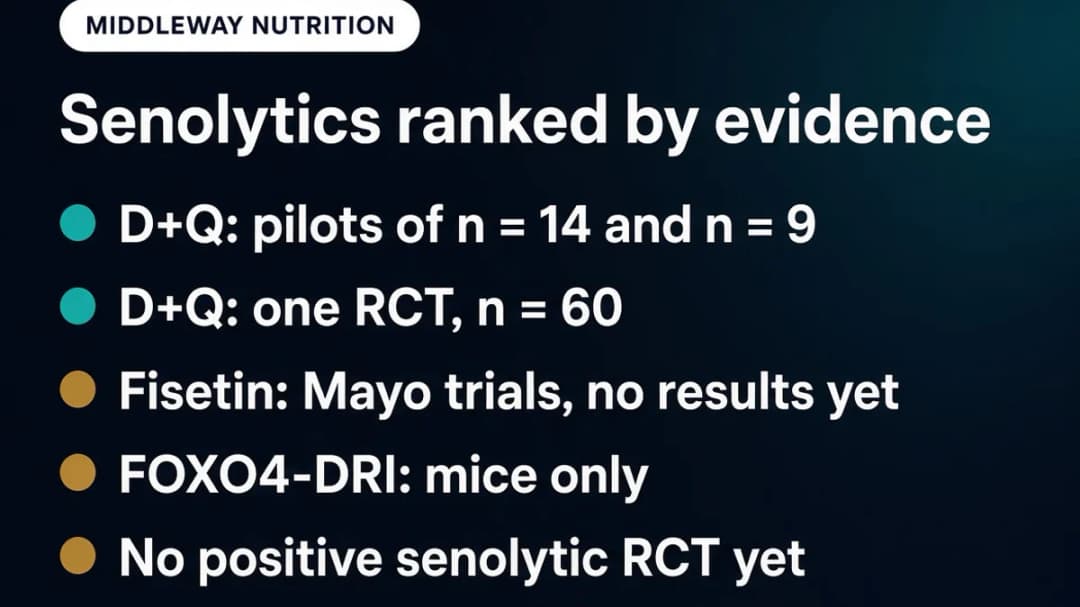
| Human data | None; no registered trials | Placebo-controlled Mayo trials running, no results posted | Two open-label pilots (n = 14, n = 9) and one RCT (n = 60) |
| Route | Injection | Oral capsule | Oral |
| Legal access | Research chemical only | Over-the-counter supplement | Dasatinib is prescription-only |
| Rough cost of one course | $195 to $270 per 10 mg vial, several vials at mouse-derived doses | About one $22.99 bottle at the trial dose for a 70 kg adult | Dasatinib is a prescription cancer drug |
| Biggest unknown | Whether it does anything in humans at all | Whether mouse potency survives oral dosing in people | Long-term safety of repeated courses |
How Each Senolytic Works
Senescent cells survive by switching on internal anti-death programmes. Every senolytic tries to switch one off in the senescent cell while sparing healthy cells; the three differ in which switch and how precisely.
FOXO4-DRI: breaking a single protein interaction
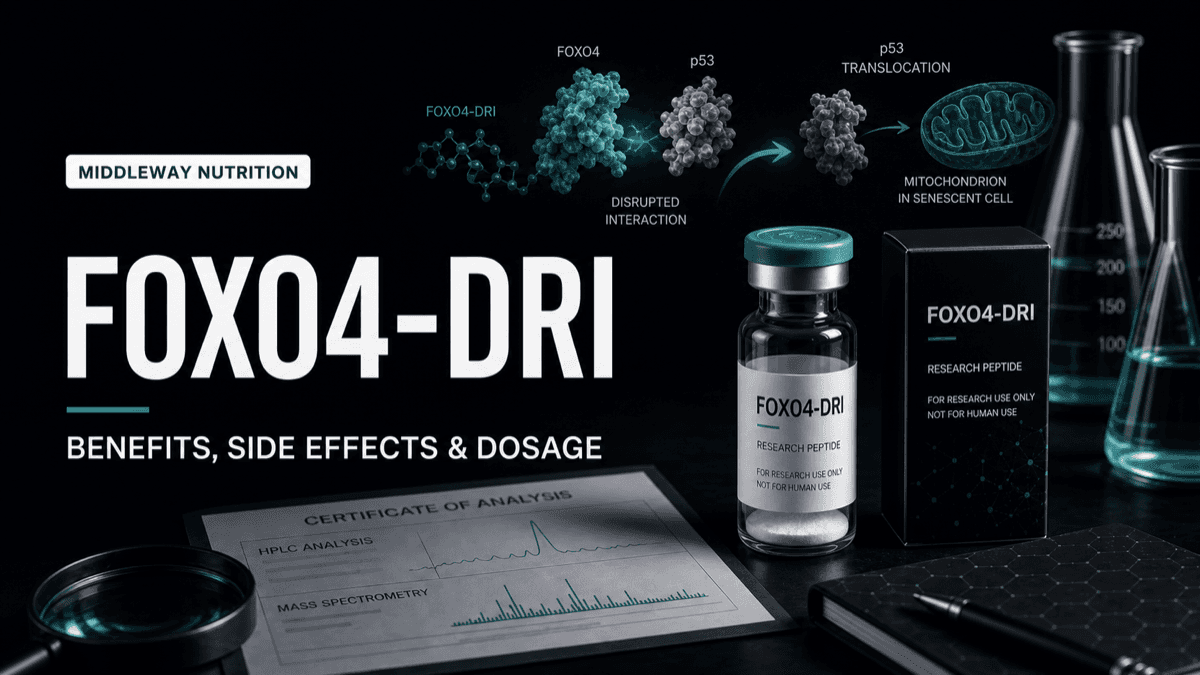
In senescent cells, the transcription factor FOXO4 binds p53 and keeps it in the nucleus, where p53 holds the cell in arrest rather than pushing it into apoptosis. Baar and colleagues at Erasmus MC designed a peptide that mimics the part of FOXO4 that grabs p53. It competes for that binding site, and in senescent cells the result is p53 moving out of the nucleus and the cell dying by its own apoptosis machinery (Baar et al., Cell, 2017, PMID 28340339).
The "DRI" stands for D-retro-inverso: the peptide is built from mirror-image D-amino acids in reversed order, which keeps its shape but makes it hard for proteases to chew up. That is why it lasts long enough to work in an animal, and also why it is expensive to make.
The appeal is precision. The FOXO4-p53 interaction is particularly important in senescent cells, so in principle healthy cells are spared. In the 2017 paper the peptide did not noticeably affect platelet levels, which matters because platelet loss is the dose-limiting problem with the older senolytic navitoclax. Our FOXO4-DRI review goes deeper on the mechanism and on the gap between it and human use.
Fisetin: a flavonoid screened for senolytic activity
Fisetin was not designed for anything. It is a flavonoid found at low levels in strawberries, apples and persimmons. Yousefzadeh and colleagues screened a panel of 10 flavonoids against senescent mouse and human cells and found fisetin was the most potent senolytic of the group (Yousefzadeh et al., EBioMedicine, 2018, PMID 30279143).
Its exact target is not pinned down. Like other flavonoids it touches several signalling pathways at once, including the survival networks senescent cells lean on. The same paper reported that it cleared senescence in only a subset of cell types in adipose tissue, so it is not a universal senolytic even in the lab.
Dasatinib plus quercetin: two partial senolytics combined
D+Q came first. Zhu and colleagues at the Mayo Clinic mapped the pro-survival networks senescent cells rely on and found that dasatinib, a tyrosine kinase inhibitor used for leukaemia, cleared senescent human fat-cell progenitors, while quercetin was more effective against senescent endothelial cells. The combination covered more cell types than either alone (Zhu et al., Aging Cell, 2015, PMID 25754370).
That broad approach cuts both ways: it reaches more tissues, but dasatinib acts on kinases healthy cells also use, so selectivity is lower than the FOXO4-DRI design aims for. Quercetin on its own is a weak senolytic; if you have seen it marketed for metabolic effects, our look at whether quercetin boosts GLP-1 covers that separate claim.
What the Evidence Actually Shows for Each
FOXO4-DRI: one lab, mice only
The 2017 Cell paper tested the peptide in three settings: mice given doxorubicin chemotherapy, fast-ageing XpdTTD/TTD mice, and naturally aged mice. Dosing was 5 mg/kg given three times, every other day. The peptide neutralised doxorubicin-induced liver damage and restored fitness, fur density and kidney function in both the fast-ageing and the naturally aged animals.
Those are striking results, and they have not been independently reproduced in the same form. Later papers from other groups used FOXO4-DRI on narrower targets in mice, such as testosterone-producing Leydig cells, and on human cartilage cells in a dish. None is a human study. A search of ClinicalTrials.gov on 26 September 2026 returned zero registered trials for FOXO4-DRI. There is no published human pharmacokinetic data, no human dose-finding and no human safety data of any kind.
Fisetin: a promising mouse study, then a null result
The Yousefzadeh paper did two things. In old wild-type mice aged 22 to 24 months, 100 mg/kg of fisetin by mouth for 5 consecutive days reduced senescent cells in fat tissue. And in a lifespan arm, mice fed a diet containing 500 ppm fisetin from 85 weeks of age lived longer, with both median and maximum lifespan extended.
The lifespan arm was small: 8 to 9 mice per group. In 2024 the National Institute on Aging's Interventions Testing Program, which tests compounds in large genetically diverse mouse cohorts across three sites, reported that fisetin did not significantly affect lifespan in either sex at the doses and schedules it used (Harrison et al., GeroScience, 2024, PMID 38041783). That does not prove fisetin is useless as a senolytic, since lifespan is a blunt endpoint and dosing differed, but it removes the strongest headline claim made for it.
In humans, fisetin has no published efficacy results yet. The trials are covered in the next section.
Dasatinib plus quercetin: the only one with human results
D+Q is the only one of the three with human results, and they are modest.
- Idiopathic pulmonary fibrosis pilot. Fourteen patients with stable IPF took dasatinib 100 mg/day with quercetin 1,250 mg/day, three days a week for three weeks. Six-minute walk distance, gait speed and chair-stand time improved significantly. Lung function, frailty index and reported health did not change, and effects on circulating inflammatory markers were inconclusive. It was open-label, with no placebo group, and one serious adverse event was recorded (Justice et al., EBioMedicine, 2019, PMID 30616998).
- Diabetic kidney disease pilot. Nine patients, mean age 68.7, took dasatinib 100 mg and quercetin 1,000 mg for three days. Biopsies 11 days later showed fewer p16- and p21-positive cells and fewer SA-β-gal-positive cells in fat tissue, fewer senescent cells in skin, and lower circulating IL-1α, IL-6, MMP-9 and MMP-12. This was the first direct evidence that a senolytic reduces senescent-cell burden in people. It was also open-label, and a corrigendum was published in 2020 (Hickson et al., EBioMedicine, 2019, PMID 31542391).
- Randomised trial in postmenopausal women. Sixty women were randomised to intermittent D+Q or control. The primary endpoint, change in the bone-resorption marker CTx at 20 weeks, did not differ between groups (P = 0.611). The bone-formation marker P1NP rose 16% at 2 and 4 weeks but was back to no difference by 20 weeks. There were no serious adverse events (Farr et al., Nature Medicine, 2024, PMID 38956196).
So the best-tested senolytic combination has shown that it can reduce senescent-cell markers in people and may help physical function in one disease, and it missed its primary endpoint in its first proper randomised trial. That is the ceiling of the field right now. No senolytic has yet produced a positive primary result in a randomised trial of an ageing-related outcome.
Where the Human Trials Stand in 2026
The fisetin trials people cite most are the Mayo Clinic AFFIRM studies. We checked their registry entries on 26 September 2026.
| Trial | Population | Fisetin dose | Status | Results posted |
|---|---|---|---|---|
| AFFIRM (NCT03430037) | Older women, est. 40 | 20 mg/kg/day for 2 consecutive days, for 2 consecutive months | Enrolling by invitation, primary completion listed as November 2026 | No |
| AFFIRM-LITE (NCT03675724) | Older adults, est. 40 | 20 mg/kg/day for 2 consecutive days | Enrolling by invitation, primary completion listed as November 2026 | No |
| PAD mobility trial (NCT06399809) | Peripheral artery disease, est. 34 | 20 mg/kg/day for 2 days, every 14 days | Recruiting | No |
| Healthy ageing trial (NCT07195318) | est. 120 | 100 mg daily | Recruiting | No |
Both AFFIRM trials started in 2018. Eight years on, neither has posted results. That says nothing about whether fisetin works, only that the evidence people expected years ago still does not exist. Anyone calling fisetin "clinically proven" as a senolytic is ahead of the data.
FOXO4-DRI has no equivalent table because it has no registered trials.
Hit-and-Run Dosing: Why Senolytics Are Taken in Short Bursts
Senolytics are not meant to be taken every day. The logic, which the Mayo group calls "hit and run", is that a senescent cell killed stays dead. Senescent cells build up slowly over months and years, so there is no need to keep a drug in the bloodstream continuously. A brief pulse clears the existing load, and the drug can then wash out long before the next pulse.
The Hickson paper made the point directly: dasatinib and quercetin both have elimination half-lives under 11 hours, yet senescent-cell markers were still lower 11 days after a three-day course. The effect outlasted the drug.
Two consequences follow.
- Short exposure may help safety. A drug taken for two or three days a month has fewer chances to cause cumulative harm than one taken daily. That is an argument, not a demonstration: long-term data on repeated courses do not exist for any of the three.
- Daily low-dose fisetin is a different thing. A 100 mg capsule every day is closer to a general flavonoid supplement than a senolytic protocol. The Mayo trials use a large dose for two days. One newer registered trial is testing 100 mg daily, which may eventually show whether that approach does anything.
The open question is how often a pulse needs repeating. Nobody knows how fast senescent cells come back in a human after clearance, so every interval you see quoted, whether monthly, quarterly or twice a year, is a guess.
Reported Protocols (Not Evidence-Based)
The table below collects what is used in trials and what circulates in longevity forums and vendor pages. The trial doses are the only rows with any formal basis, and even those have no published efficacy result yet for fisetin. Every community row is anecdote.
| Compound | Source | Reported dose | Schedule |
|---|---|---|---|
| Fisetin | Mayo AFFIRM trials | 20 mg/kg/day orally | 2 consecutive days (AFFIRM repeats this the following month) |
| Fisetin | Community | 1,000 to 2,000 mg/day | 2 to 4 days, once a month |
| Fisetin | Community | 100 mg | Daily |
| FOXO4-DRI | Mouse study (Baar 2017) | 5 mg/kg by injection | 3 doses, every other day |
| FOXO4-DRI | Community | 1 to 3 mg subcutaneous | 3 doses over about a week, 2 to 4 courses a year |
| D+Q | IPF pilot | D 100 mg + Q 1,250 mg per day | 3 days a week for 3 weeks |
| D+Q | Kidney disease pilot | D 100 mg + Q 1,000 mg | 3 consecutive days |
The FOXO4-DRI dose problem
The community FOXO4-DRI doses deserve a closer look. Converting the mouse dose of 5 mg/kg to a human equivalent using the standard body-surface-area method gives roughly 0.4 mg/kg, which is about 28 mg for a 70 kg adult per injection. The 1 to 3 mg doses that circulate online are about a tenth of that.
Allometric conversion is unreliable for peptides, so 28 mg is not a target. But either people are injecting a fraction of any dose grounded in the animal data, or the effective human dose is unknown in both directions. Neither supports the confidence of forum protocols.
The fisetin weight problem
The AFFIRM dose of 20 mg/kg is large. For a 70 kg adult it works out at 1,400 mg a day, or 2,800 mg across a two-day course. Plain fisetin is also poorly absorbed by mouth, which is why some supplement brands sell formulated versions with enhanced-absorption claims. Those claims come from manufacturers, and nobody has shown which formulation, if any, reaches senolytic concentrations in human tissue.
Cost and Access
Fisetin: cheap and over the counter
Fisetin is sold as a dietary supplement in most countries. One widely stocked 100 mg capsule product listed at $22.99 for 30 capsules in September 2026. At the AFFIRM dose, a 70 kg adult would need about 28 capsules for one two-day course, so roughly one bottle per course. Supplement quality varies, and fisetin content is not independently verified for most brands.
FOXO4-DRI: expensive and research-only
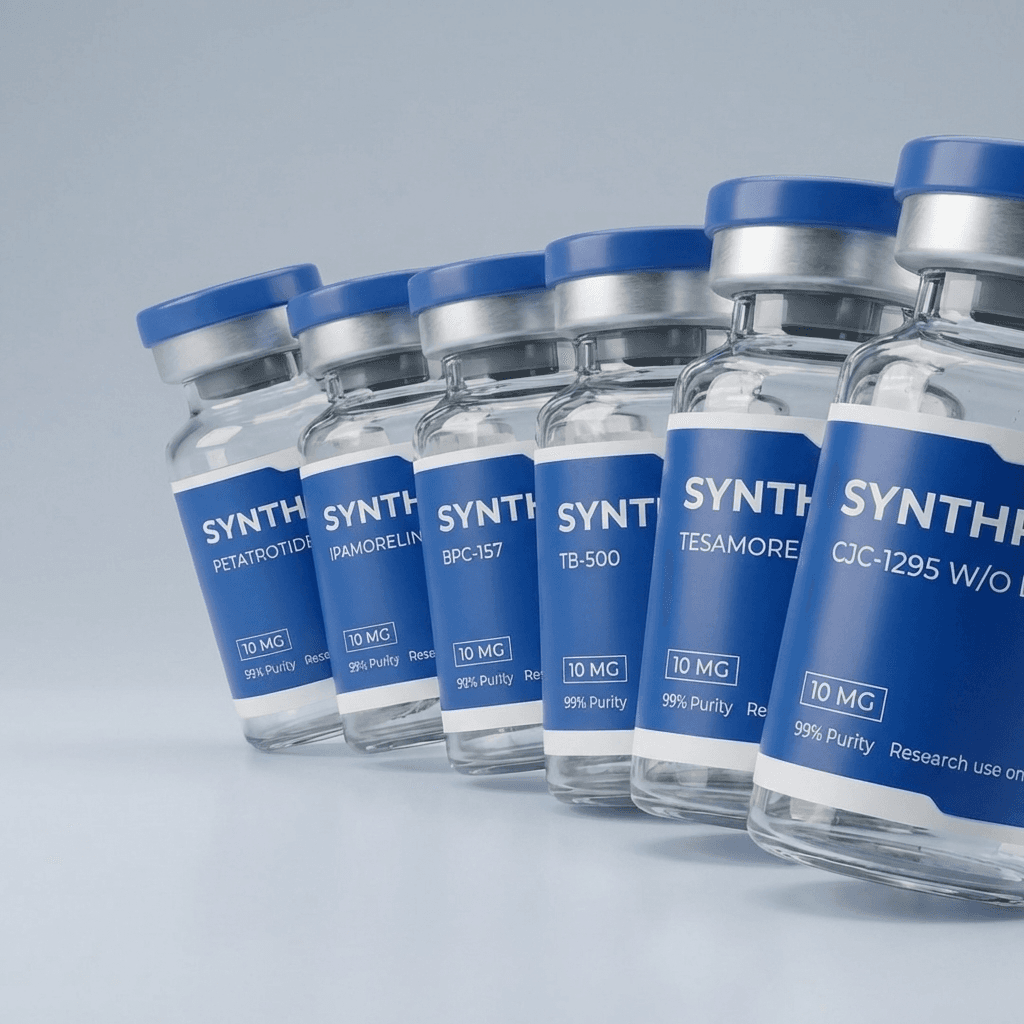
FOXO4-DRI is sold only as a research chemical, labelled not for human use. Three 10 mg vial listings we checked in September 2026 were priced at $195, $235 and $270. None of the vendors we recommend stocks it, so we do not name a supplier.
The cost gap is bigger than the vial price suggests. A community course of 2 mg for three doses uses 6 mg, so one vial covers it. But at the roughly 28 mg per injection implied by the mouse data, a three-dose course would need 84 mg, or nine 10 mg vials: roughly $1,755 to $2,430 at the prices above. D-retro-inverso synthesis is also harder than standard peptide synthesis, so fake or wrong-form product is a real concern, and a certificate of analysis with mass spectrometry matters more here than for most peptides.
Dasatinib plus quercetin: needs a prescriber
Quercetin is an inexpensive supplement. Dasatinib is a prescription drug licensed for certain leukaemias, so using it as a senolytic means finding a doctor willing to prescribe off-label or buying outside normal channels, with the usual counterfeit risks.
Safety Unknowns
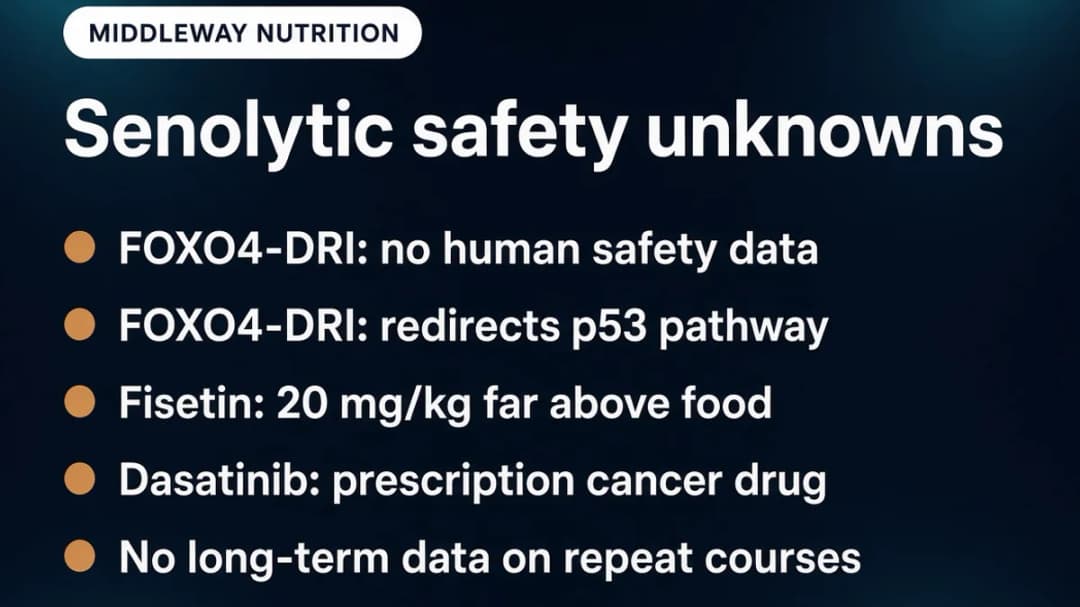
None of these compounds has long-term human safety data for repeated senolytic courses. Beyond that shared gap, each carries its own risks.
FOXO4-DRI
- No human safety data of any kind. The mouse study reported it was well tolerated under the conditions tested and did not noticeably affect platelets, but mouse tolerability does not predict human tolerability for a new peptide.
- p53 is a tumour-suppressor pathway. FOXO4-DRI works by redirecting p53. Deliberately interfering with that system in a human has not been studied, and the long-term consequences are unknown.
- A signal of harm in lung vessels. A 2023 study of pulmonary hypertension found that clearing senescent cells, whether by a suicide gene, navitoclax or FOXO4-DRI, caused loss of lung endothelial cells and worsened pulmonary haemodynamics in several mouse and rat models (Born et al., Circulation, 2023, PMID 36515093).
- Product identity. A plain L-amino-acid version of the sequence would be degraded quickly and may not work at all. Without mass spectrometry you cannot tell which you have.
Fisetin
- Generally recognised as a food constituent, but the 20 mg/kg dose is far above anything eaten in food.
- Drug interactions are poorly characterised. Flavonoids can affect drug-metabolising enzymes, which matters for anyone on anticoagulants or other medicines with narrow safety margins.
- Supplement quality is not verified for most products.
Dasatinib plus quercetin
- Dasatinib is a serious drug. Its prescribing label lists myelosuppression, fluid retention including pleural effusion, bleeding and QT prolongation among its risks when used for cancer.
- Pilot side effects. In the IPF pilot, the most frequent non-serious events were respiratory symptoms (16 events), skin irritation or bruising (14) and gastrointestinal discomfort (12).
- Short courses reduce, but do not remove, that risk.
Risks shared by all senolytics
Senescence is not purely harmful. It is a defence against cancer and part of normal wound healing. Clearing senescent cells at the wrong time or in the wrong tissue is not guaranteed to help, and the pulmonary hypertension study above shows it can make disease worse in some animal models. Combining senolytics, for example running FOXO4-DRI alongside fisetin, adds unknowns on top of unknowns and has never been studied.
Which Senolytic Makes Sense, If Any?
Rank them by evidence and the order is D+Q, then fisetin, then FOXO4-DRI. Rank them by accessibility and fisetin moves to the top: cheap, oral and legal to buy. That is why it is the senolytic most people actually try, though its human benefit remains untested until the AFFIRM results post.
FOXO4-DRI has the most elegant mechanism and the thinnest evidence. It is the most expensive of the three, has no human data, and the doses in circulation are not grounded in the one study that exists. For longevity compounds with some human record, look elsewhere, such as the comparison of NAD+ and NMN, where at least some human trials have reported.
Senolytics also address only one of the proposed hallmarks of ageing. Telomere biology and cellular signalling peptides are a separate conversation, covered in our Epithalon peptide guide and the overview of bioregulator peptides for aging.
FAQ
Is FOXO4-DRI better than fisetin?
In theory FOXO4-DRI is more selective, because it targets one protein interaction that matters especially in senescent cells. In practice there is no human evidence that it works, while fisetin at least has placebo-controlled trials under way. On evidence, fisetin is ahead; on mechanism, FOXO4-DRI looks cleaner on paper.
Has FOXO4-DRI been tested in humans?
No. As of 26 September 2026 there are no registered human trials on ClinicalTrials.gov and no published human data. Everything known comes from mice and from human cells grown in a dish.
Did the Mayo fisetin trial show results?
Not yet. The two AFFIRM trials started in 2018, are listed as enrolling by invitation, and give a primary completion date of November 2026. No results have been posted to the registry.
What dose of fisetin is used as a senolytic?
The Mayo trials use 20 mg/kg per day by mouth for two consecutive days, which is about 1,400 mg a day for a 70 kg adult. Community protocols vary from 100 mg daily to 1,000 to 2,000 mg for a few days a month, none of which has published efficacy data.
Can you take FOXO4-DRI and fisetin together?
No study has tested it. Combining senolytics stacks the unknowns, including the inflammatory response to clearing cells, and there is no evidence that the combination does more than either alone. Where both are used, the usual community approach is to space them months apart, which is a convention rather than an evidence-based rule.
Is dasatinib plus quercetin better than fisetin?
It has more human evidence, including two pilots and a 60-person randomised trial, although that trial missed its primary endpoint. It also carries more risk, because dasatinib is a prescription cancer drug with significant side effects. Fisetin is safer to obtain and less proven.