The HCG diet combines small daily doses of human chorionic gonadotropin, the hormone made in pregnancy, with an eating plan of roughly 500 calories a day. People do lose weight quickly on it, but every well-run placebo-controlled trial has found that the weight loss comes from the 500 calories, not the hormone. Take the hCG away, keep the diet, and the result is the same.
The protocol dates from 1954 and still sells through weight loss clinics and online shops. Below: what the original protocol involved, what the trials showed, why regulators went after the over-the-counter versions, what 500 calories a day does to the body, and why GLP-1 medication has largely replaced it.
This is an informational page, not medical advice. Anyone considering a very low calorie diet should do it under medical supervision.
What Is the HCG Diet?
The HCG diet traces back to Albert T. W. Simeons, a British physician, who published a short paper in The Lancet in 1954 titled "The action of chorionic gonadotrophin in the obese" (PMID 13213083). He later set the method out at length in a manuscript called Pounds and Inches: A New Approach to Obesity, which is still circulated by clinics today. In the German medical literature the regimen became known as the "cura romana", the Roman cure.
Simeons' idea was not that hCG itself burned fat. His claim was subtler: that daily low-dose hCG would make a near-starvation diet tolerable by blunting hunger, and would steer the weight loss towards "abnormal" fat stores on the hips, belly and thighs rather than muscle or structural fat. A 1987 German review summarised his position this way: patients were not expected to lose more weight than they would without hCG, but the injections were supposed to make the diet easier and reshape where the loss came from (Rabe et al., 1987, PMID 3609673).
That is exactly what the controlled trials went on to test: hunger and body shape, not weight alone.
The Original Simeons Protocol: Loading Days and the 500-Calorie Phase
Loading days
The course opens with two days of eating as much as possible, particularly fatty food, while the hCG injections begin. Simeons believed it made the first week less punishing. There is no trial evidence that loading changes anything except the scale reading.
The 500-calorie phase
After loading comes the restriction proper: about 500 kcal a day, with a daily hCG injection. Simeons' dose was 125 IU by intramuscular injection each day (Rabe et al., 1987).
The menu is rigid. As it is usually reproduced:
- Breakfast: tea or coffee without sugar, with a single tablespoon of milk allowed across the whole day.
- Lunch and dinner: 100 g (raw weight) of lean protein such as beef, chicken breast, veal, white fish or shellfish; one vegetable from a short list (spinach, tomatoes, celery, cabbage, asparagus, cucumber, green salad and a few others); one breadstick or one Melba toast; one piece of fruit (an apple, an orange, half a grapefruit or a handful of strawberries).
- Seasoning: salt, pepper, vinegar, garlic, herbs, and a lemon a day at most. No oil or butter.
Two 100 g portions of lean meat or fish supply somewhere around 35 to 45 g of protein a day, depending on the cut. That is well below what most adults need, which becomes relevant in the risks section.
Course length
The restricted phase is commonly described in two lengths: a 23-day course for smaller targets and a 40-day course for larger ones. Many versions continue the diet for about three days after the last injection, while the hormone clears.
Stabilisation
For three weeks afterwards, the rule is to eat normally but avoid starch and sugar, then reintroduce them gradually.
Does the HCG Diet Work? What the Controlled Trials Found
People on the diet lose weight, but hCG adds nothing to that loss. The claim was tested repeatedly from the 1970s to the 1990s, and the better the trial, the more clearly it came out negative.
The 1995 meta-analysis
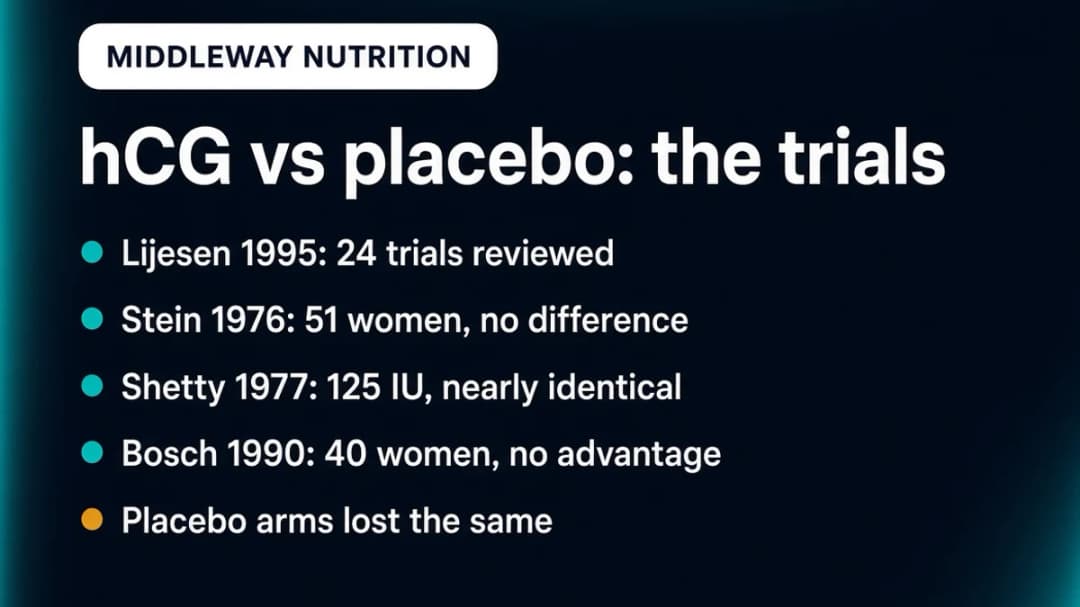
The most cited summary is a criteria-based meta-analysis by Lijesen and colleagues in the British Journal of Clinical Pharmacology (Lijesen et al., 1995, PMID 8527285). They traced 24 trials of hCG for obesity: 8 controlled and 16 uncontrolled. Each was scored for methodological quality on a 100-point scale, and scores ranged from 16 to 73, meaning most of the literature was weak.
The key finding came from the better studies. Of the 12 trials that scored 50 or more, all were controlled, and only one concluded that hCG was a useful adjunct. The authors' conclusion was blunt: there is no scientific evidence that hCG is effective in treating obesity. It did not produce weight loss or fat redistribution, did not reduce hunger, and did not improve wellbeing.
The individual trials
| Trial | Design | Participants | What was compared | Result |
|---|---|---|---|---|
| Stein et al., 1976 (PMID 786001) | Randomised, double-blind, 32 days | 51 women aged 18 to 60 | hCG vs placebo, same 500-calorie diet | No significant difference in weight loss, hip or waist measurements, or hunger |
| Shetty & Kalkhoff, 1977 (PMID 836112) | Controlled, in hospital, 30 days | 11 obese women (6 hCG, 5 placebo) | 125 IU hCG daily vs diluent, identical 500-calorie diets | Mean weight loss nearly identical; skinfolds and body measurements not different |
| Greenway & Bray, 1977 (PMID 595585) | Randomised, double-blind | Obese adults | hCG vs placebo injections | Weight loss identical; no difference in hunger, mood or localised measurements |
| Bosch et al., 1990 (PMID 2405506) | Double-blind, placebo-controlled, 6 weeks | 40 obese women, BMI over 30 | hCG vs saline, 6 days a week, same 5,000 kJ diet | No advantage for hCG on any variable measured |
The Stein trial was designed specifically to replicate an earlier 1973 study by Asher and Harper, one of the few positive reports, using the same diet. It did not reproduce the benefit. Twenty of 25 women on hCG and 21 of 26 on placebo completed all 28 injections, so dropout does not explain the null result.
Shetty and Kalkhoff used Simeons' own dose and calorie level in hospitalised patients whose intake was controlled. It was small, but it is about as clean a test of the original protocol as exists.
The Bosch diet supplied 5,000 kJ a day, roughly 1,200 kcal, far more than 500. Weight loss was similar to that reported on severely restricted intake, and hCG made no difference to hunger, measurements or blood results.
The German review by Rabe and colleagues counted 10 positive and 10 negative studies in the literature up to 1987, but noted that most of the positive ones were uncontrolled case reports, while the negative ones were mostly controlled or double-blind. It also described a German trial in which 82 randomised premenopausal women dieted with or without hCG, again with no difference (Rabe et al., 1987).
What about the fat redistribution claim?
It was measured directly: hip and waist circumference in Stein, skinfolds and chest, waist, hip and thigh circumference in Shetty and Kalkhoff, localised measurements in Greenway and Bray. None found a difference. The prescription product's own US label now states that hCG "has no known effect on fat mobilization, appetite or sense of hunger, or body fat distribution."
Evidence grade
The trials are old and mostly small, a fair criticism, but they point the same way, and the positive studies were the poorly controlled ones. No modern trial has overturned them. hCG works as an expensive placebo alongside a starvation diet.
Why People Lose Weight on the HCG Diet Anyway
The answer is the deficit: 500 kcal a day is a very large one, and the early weeks of any severe diet produce dramatic scale readings.
The arithmetic of 500 calories
A typical adult who needs 2,000 to 2,500 kcal a day to maintain their weight runs a deficit of 1,500 to 2,000 kcal on the diet. A kilogram of body fat stores roughly 7,700 kcal, so that deficit corresponds to about 0.2 to 0.26 kg of fat per day, or roughly half a pound. Over a 40-day course, that adds up to a substantial amount of real fat loss, with or without an injection.
Water and glycogen
The first days of severe restriction strip out stored glycogen, and each gram of glycogen is held with several grams of water. Cutting starch almost entirely, as the menu does, accelerates that. The fast early drop is mostly fluid, and some of it returns when carbohydrates come back.
Why it feels easier than expected
Ketosis blunts appetite in some people after a few days, a rigid menu removes decisions, daily injections and weigh-ins add accountability, and believing the hormone works is motivating. None of that is specific to hCG, as the placebo arms showed.
HCG Drops and the 2011 FDA and FTC Crackdown
From the late 2000s the diet was revived online through over-the-counter "homeopathic" hCG drops, pellets and sprays sold without a prescription.
The warning letters
On 6 December 2011 the US Food and Drug Administration and the Federal Trade Commission jointly issued seven warning letters to companies marketing OTC hCG products labelled as homeopathic for weight loss (FDA press release, 6 December 2011). The letters said the companies were selling unapproved drugs and making unsupported claims, and gave them 15 days to set out how they would correct the violations or face possible seizure, injunction or criminal prosecution.
The release stated that there are no FDA-approved hCG products for weight loss, and that there is no substantial evidence hCG increases weight loss beyond the very low calorie diet the products' own labels told buyers to follow. It also flagged the increased risk of gallstones, electrolyte imbalance and heart arrhythmias on such diets.
The FDA's consumer guidance, updated in 2020, states plainly that hCG "is not approved for use without a prescription for any purpose" and "is not approved for weight loss."
What the drops actually contain
A homeopathic product is, by design, diluted to the point where little or none of the original substance remains. So OTC "hCG drops" are, at best, a 500-calorie diet sold with a bottle of flavoured water. A 2016 review by Butler and Cole examined what some hCG diet preparations actually contained and concluded that, on current data, they may do more harm than good (Butler & Cole, 2016, PMID 27010890).
What the prescription label says
Genuine hCG is a prescription injectable. Its US label carries a capitalised statement under Indications and Usage: "HCG has not been demonstrated to be effective adjunctive therapy in the treatment of obesity." Clinics that prescribe it for weight loss are using it off-label against the label's own warning.
Risks of a 500-Calorie Diet
Most of the harm on the HCG diet comes from the diet, not the hormone. A very low calorie diet (usually defined as under 800 kcal a day) can be used safely under medical supervision with a nutritionally complete formula. The HCG menu is neither supervised in most cases nor nutritionally complete.
Gallstones
Rapid weight loss is one of the best-established causes of gallstones, because the gallbladder empties less often and bile becomes more concentrated. A Swedish matched cohort of 6,640 adults in a commercial weight loss programme compared a 500 kcal/day diet with a 1,200 to 1,500 kcal/day diet (Johansson et al., 2014, PMID 23736359). Gallstones requiring hospital care were about three times as common in the 500 kcal group (hazard ratio 3.4), and most of those events ended in gallbladder removal. The absolute risk was low, but real.
Muscle loss
With protein at somewhere around 35 to 45 g a day and almost no energy coming in, the body breaks down lean tissue alongside fat. Simeons claimed hCG protected muscle; the controlled trials found it changed nothing about body composition. Lost muscle lowers resting energy expenditure, one reason weight returns after aggressive diets.
Electrolytes and heart rhythm
Severe restriction with high fluid losses shifts sodium, potassium and magnesium, causing cramps, dizziness, fatigue and, in susceptible people, abnormal heart rhythms.
Other effects of the diet
Headaches, fatigue, irritability, constipation, feeling cold, temporary hair shedding and menstrual changes are common on any diet this restrictive.
Effects of hCG itself
The prescription label lists headache, irritability, restlessness, depression, fatigue, oedema, gynaecomastia and injection site pain among reported adverse reactions. hCG is unsafe in pregnancy and should not be used by people with hormone-sensitive cancers such as prostate cancer.
Who should not attempt it
Anyone who is pregnant or breastfeeding, has a history of gallstones, an eating disorder, heart rhythm problems, kidney disease, type 1 diabetes or diabetes on insulin or sulfonylureas, or is under 18, should not follow a 500-calorie diet without direct medical oversight.
What an HCG Diet Plan Looks Like, Phase by Phase
Clinics and followers today mostly describe a four-phase version of Simeons' protocol. The table shows how it is typically presented, not a recommendation.
| Phase | Typical length | Calories | hCG | What it involves |
|---|---|---|---|---|
| 1. Loading | 2 days | Unrestricted, high fat | Injections start | Eating heavily before restriction |
| 2. Restriction | 23 or 40 days | About 500 kcal | Daily, 125 IU in the original | Two small meals of lean protein, vegetable, breadstick and fruit |
| Taper | About 3 days | About 500 kcal | Stopped | Diet continues while hCG clears |
| 3. Stabilisation | 3 weeks | Normal intake | None | No starch or sugar |
| 4. Maintenance | Open-ended | Normal intake | None | Starch and sugar reintroduced gradually |
How modern versions differ
Many clinics now run looser variants: 800 to 1,200 kcal, broader food lists, oral products instead of injections. Higher calories make the diet safer, and the Bosch trial suggests the hormone is irrelevant at that level too.
What happens after the course
There is little good long-term follow-up data on HCG dieters specifically, so claims about how many keep the weight off, favourable or not, deserve caution. Rapid loss followed by an abrupt return to old habits tends to reverse.
HCG Diet vs GLP-1 Medication: Why the Protocol Has Been Displaced
For most people who would once have tried the HCG diet, the conversation with a doctor now starts with GLP-1 medicines such as semaglutide and tirzepatide. They do what Simeons claimed hCG did, reducing hunger so eating less is sustainable, and large trials show it.
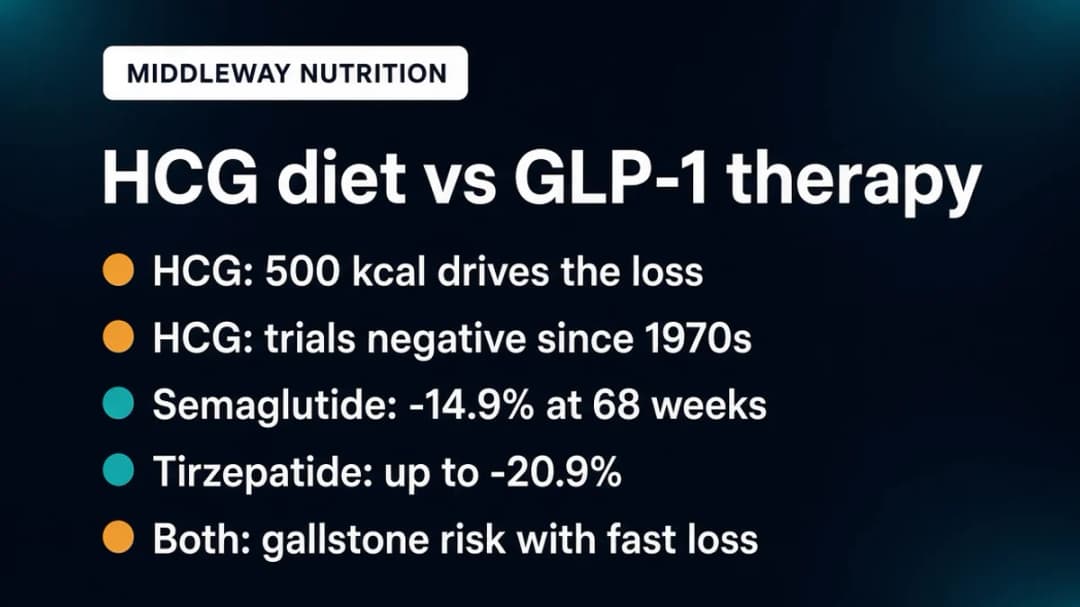
In the STEP 1 trial, 1,961 adults with obesity took once-weekly semaglutide 2.4 mg or placebo alongside lifestyle intervention for 68 weeks. Mean weight change was -14.9% with semaglutide versus -2.4% with placebo (Wilding et al., 2021, PMID 33567185). In SURMOUNT-1, 2,539 adults took tirzepatide or placebo for 72 weeks; mean weight change was -15.0% at 5 mg, -19.5% at 10 mg and -20.9% at 15 mg, against -3.1% on placebo (Jastreboff et al., 2022, PMID 35658024). Our semaglutide guide and tirzepatide guide cover dosing and side effects in detail.
| HCG diet | GLP-1 therapy | |
|---|---|---|
| What drives weight loss | A 500 kcal/day diet; hCG adds nothing over placebo | Reduced appetite and slower gastric emptying from the drug, plus a moderate deficit |
| Evidence | Controlled trials negative since the 1970s | Large placebo-controlled trials, e.g. STEP 1 (-14.9% at 68 weeks) and SURMOUNT-1 (up to -20.9% at 72 weeks) |
| Approved for weight loss | No; label warns against it for obesity | Yes, for specific formulations (e.g. Wegovy, Zepbound) |
| Hunger | Controlled trials found no reduction versus placebo | Appetite reduction is the main mechanism |
| Typical duration | 3 to 6 weeks plus stabilisation | Long-term, ongoing |
| Main risks | Gallstones, muscle loss, electrolyte problems from the diet | Nausea and other GI effects, gallbladder events, lean mass loss |
| After stopping | Little good follow-up data | STEP 1 extension: two-thirds of lost weight regained within a year |
GLP-1 drugs are not risk-free, and some risks overlap with the HCG diet. Rapid weight loss on any route raises gallstone risk, and lean mass is lost alongside fat unless protein intake and resistance training are deliberate; see building muscle on a GLP-1. The broader picture is in our GLP-1 side effects hub.
Weight also returns after stopping. In the STEP 1 off-treatment extension, participants had lost 17.3% by week 68 and had regained two-thirds of that loss one year after stopping semaglutide and the lifestyle programme (Wilding et al., 2022, PMID 35441470). That is a real limitation, but it is at least measured, which the HCG diet never was.
The practical barrier is price, not evidence. Brand GLP-1s are expensive without insurance, and our GLP-1 cost hub compares the current routes. Food still matters on these drugs too, and eating well on a GLP-1 looks very different from a 500-calorie menu: the emphasis is on protein and nutrient density at a moderate deficit, not starvation.
What hCG Is Actually Used For
hCG is a genuine and useful medicine, just not for weight loss. It is a glycoprotein hormone that acts on the same receptor as luteinising hormone (LH), which is why it can stimulate the ovaries and testes.
Its approved US indications are prepubertal cryptorchidism (undescended testes) not caused by an anatomical obstruction, hypogonadotropic hypogonadism in men, and induction of ovulation in certain infertile women. In fertility medicine it is best known as the "trigger shot" that prompts final egg maturation in IVF and IUI cycles.
Off-label, it is widely used in men on testosterone replacement therapy (TRT) to keep the testes producing their own testosterone and sperm while exogenous testosterone suppresses natural LH. Some clinics now use gonadorelin for the same job; our page on gonadorelin and how it compares with hCG covers that switch. For dosing ranges, side effects and how hCG is handled in those settings, see the hCG peptide guide.
Those uses typically involve hundreds to thousands of IU per injection. Simeons' 125 IU a day is small by comparison, and the trials show it does nothing measurable to appetite or fat.
FAQ
Does the HCG diet actually work?
People lose weight on it, often quickly, but the hormone is not the reason. Placebo-controlled trials that gave both groups the same diet found no difference in weight loss, hunger or body shape.
How much weight can you lose on the HCG diet?
The loss comes from the calorie deficit, so it depends on body size and starting intake. At 500 kcal a day, most adults run a deficit of 1,500 to 2,000 kcal, roughly half a pound of fat a day, plus extra early water loss from depleted glycogen.
What can you eat on the HCG diet?
The original menu allows unsweetened tea or coffee in the morning, then two meals each made of 100 g of lean protein, one vegetable from a short list, one breadstick or Melba toast and one piece of fruit. It adds up to about 500 kcal a day.
Are HCG drops legal?
Over-the-counter hCG drops, pellets and sprays marketed for weight loss are illegal in the US. In December 2011 the FDA and FTC issued seven warning letters to companies selling "homeopathic" hCG for weight loss, and the FDA says hCG is not approved without a prescription for any purpose.
Is the HCG diet safe?
Unsupervised, it carries real risks, mostly from the 500-calorie diet: gallstones, muscle loss, electrolyte disturbances and irregular heart rhythm. hCG itself can cause headaches, fatigue, mood changes, fluid retention and breast enlargement in men, and it is unsafe in pregnancy.
Is the HCG diet better than Ozempic or other GLP-1 drugs?
No. GLP-1 drugs have large placebo-controlled trials showing meaningful weight loss, such as -14.9% at 68 weeks with semaglutide 2.4 mg in STEP 1, and they reduce appetite, which hCG was never shown to do. Weight tends to return after stopping, but the evidence base is not comparable.
Why do clinics still offer the HCG diet?
It produces visible results fast, costs far less than GLP-1 drugs, and daily injections and weigh-ins keep people engaged. None of that changes what the trials found.