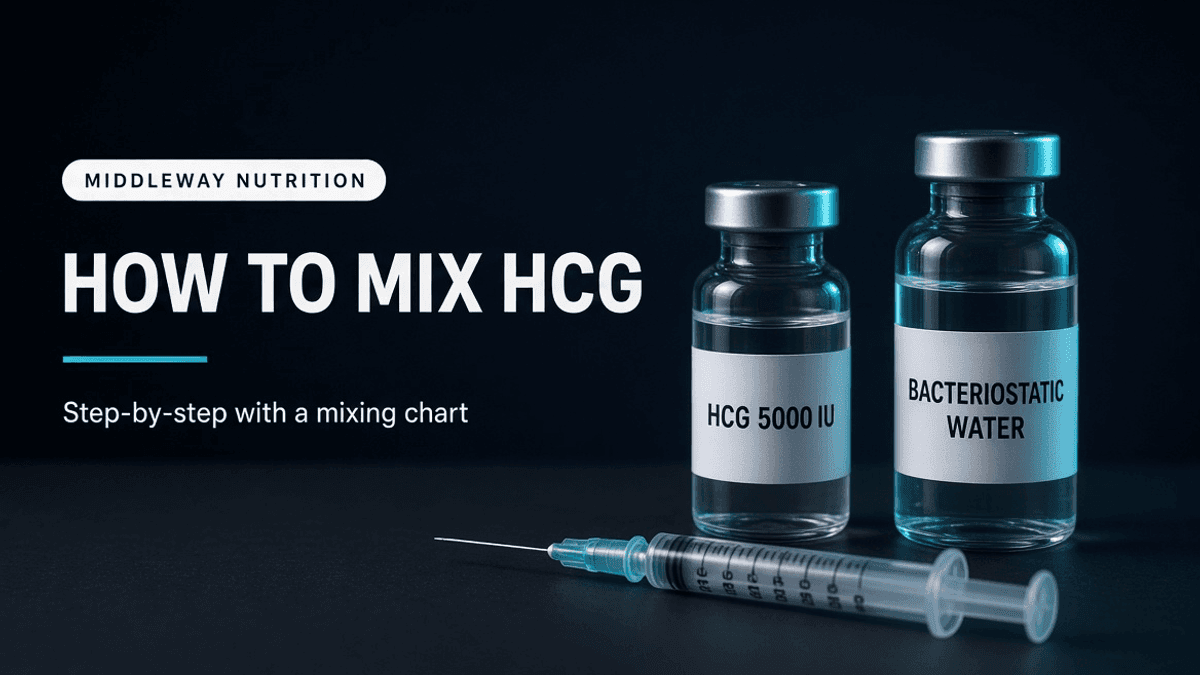
To reconstitute HCG, you wipe both stoppers, draw your chosen volume of bacteriostatic water, run it slowly down the inside wall of the powder vial, and swirl (never shake) until the solution is clear. Then you label the vial and refrigerate it at 2 to 8°C. How much water you add does not change how much HCG is in the vial. It only changes the concentration, and so how many units you draw on the syringe. With a 5,000 IU vial and 2 mL of water, every unit on a U-100 insulin syringe holds 25 IU.
Everything else follows from that one division. What catches people out is the detail around it: the diluent in the box differs between countries, the official labels disagree on how long a mixed vial lasts, and some water volumes leave you reading half-unit marks. For why HCG is used and what dose ranges have been reported, see the HCG dosage and side-effects guide.
This is educational information, not medical advice. HCG is a prescription medicine, and your prescriber's or pharmacy's instructions take precedence over anything here.
What You Need to Reconstitute HCG
Lay everything out on a clean, dry surface first:
- The HCG vial. A freeze-dried white powder or cake, usually 5,000 IU or 10,000 IU. Check the size on the vial label, because every number in the chart depends on it.
- The diluent. Bacteriostatic water, or the solvent supplied in a pharmacy kit (see the next section).
- A mixing syringe. A 3 mL or larger syringe moves a few millilitres at once. The University Hospitals fertility instructions for a 10,000 IU vial use a 10 mL syringe with a 22 gauge, 1½ inch needle.
- Insulin syringes for dosing. These are U-100 syringes, where 100 units equals 1 mL. The same University Hospitals sheet uses a 0.5 mL, 28 gauge, ½ inch insulin syringe for the injection itself.
- Alcohol swabs, a pen for labelling, and a sharps container.
Use one needle to mix and a fresh one for every injection. Each pass through a rubber stopper dulls the tip.
Bacteriostatic Water vs the Diluent in the Box
Most mixing guides get this part wrong, because "the diluent that comes with it" means different things in different markets.
Bacteriostatic water is sterile water with 0.9% benzyl alcohol added as a preservative. The preservative suppresses bacterial growth, so a vial can be punctured again and again over several weeks. That is exactly what an HCG vial goes through: a 5,000 IU vial used at 250 IU per dose gives 20 draws. Our bacteriostatic water guide covers the specification and the in-use window for the water on its own.
Sterile water or plain sodium chloride contains no preservative. Once it is mixed into a vial, nothing stops bacteria brought in on a needle from growing. Preservative-free solutions are meant to be used in a single session.
Here is what the actual pharmacy kits contain:
| Product (market) | Diluent supplied | Route on label | After mixing |
|---|---|---|---|
| Novarel 5,000 or 10,000 IU (US) | 10 mL Bacteriostatic Water for Injection, 0.9% benzyl alcohol | Intramuscular only | Refrigerate at 2 to 8°C, use within 30 days |
| Pregnyl 10,000 IU (US) | 10 mL water for injection with 0.56% sodium chloride and 0.9% benzyl alcohol | Intramuscular only | Refrigerate at 2 to 8°C, discard after 60 days |
| Chorionic Gonadotropin 10,000 USP units, Fresenius Kabi (US) | Accompanying bacteriostatic water, 10 mL | Intramuscular only | Refrigerate at 2 to 8°C, discard after 60 days |
| Pregnyl 5,000 IU (UK) | 1 mL ampoule of sodium chloride 9 mg/mL | Intramuscular or subcutaneous | Use immediately, discard any remainder |
The US multi-dose kits already ship with a preserved diluent. The "saline" in the US Pregnyl box contains benzyl alcohol, so it suits a vial used over weeks. The UK Pregnyl ampoule is plain 0.9% sodium chloride, sized for a single dose, and its product information says to use the solution straight away.
In practice:
- Single dose, such as an IVF trigger: the supplied solvent is what the product was designed for.
- Several doses over weeks from one vial: use a preserved diluent, either the kit's bacteriostatic solvent or bacteriostatic water. If your kit came with plain sodium chloride ampoules and you have been prescribed repeated small doses, ask the pharmacy which diluent to use rather than improvising.
- Benzyl alcohol: the labels warn it is not for newborns. Sensitivity in adults is uncommon but real.
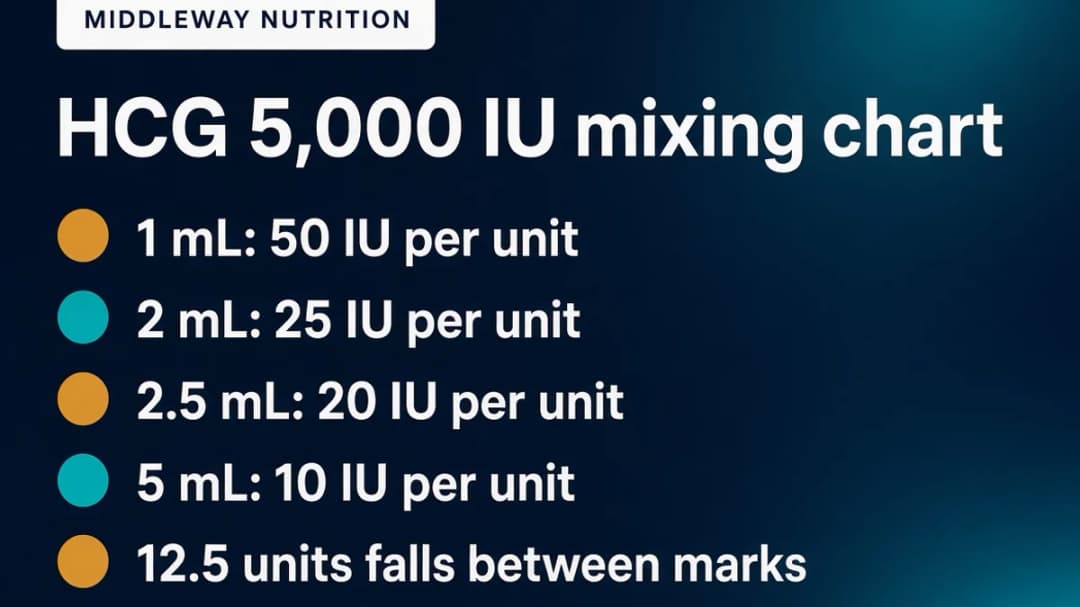
HCG Mixing Chart: How Much Water to Add
There is no correct volume. There are only volumes that make your particular dose easy or awkward to measure. Three relationships do all the work:
- Concentration (IU per mL) = IU in the vial ÷ mL of water added.
- On a U-100 insulin syringe, 1 unit = 0.01 mL. So IU per unit = concentration ÷ 100.
- Units to draw = dose in IU ÷ IU per unit.
5,000 IU vial
| Water added | IU per mL | IU per unit | 250 IU | 500 IU | 1,000 IU |
|---|---|---|---|---|---|
| 1 mL | 5,000 | 50 | 5 units | 10 units | 20 units |
| 2 mL | 2,500 | 25 | 10 units | 20 units | 40 units |
| 2.5 mL | 2,000 | 20 | 12.5 units | 25 units | 50 units |
| 5 mL | 1,000 | 10 | 25 units | 50 units | 100 units |
10,000 IU vial
| Water added | IU per mL | IU per unit | 250 IU | 500 IU | 1,000 IU |
|---|---|---|---|---|---|
| 1 mL | 10,000 | 100 | 2.5 units | 5 units | 10 units |
| 2 mL | 5,000 | 50 | 5 units | 10 units | 20 units |
| 2.5 mL | 4,000 | 40 | 6.25 units | 12.5 units | 25 units |
| 5 mL | 2,000 | 20 | 12.5 units | 25 units | 50 units |
| 10 mL | 1,000 | 10 | 25 units | 50 units | 100 units |
Checking the arithmetic
Run every row backwards before you trust it. Take the 5,000 IU vial with 2.5 mL: 5,000 ÷ 2.5 = 2,000 IU per mL, and 2,000 ÷ 100 = 20 IU per unit. A 500 IU dose is 500 ÷ 20 = 25 units. Check it the other way: 25 units is 0.25 mL, and 0.25 × 2,000 = 500 IU. It matches.
For the 10,000 IU vial with 5 mL: 10,000 ÷ 5 = 2,000 IU per mL, the same concentration as 5,000 IU in 2.5 mL, so the units are identical (12.5 / 25 / 50). The 10 mL row matches the Novarel label's multi-dose figure of 1,000 IU/mL for the 10,000 IU vial, and the label's 500 IU/mL for a 5,000 IU vial in 10 mL is what 5,000 ÷ 10 predicts.
The mistake worth guarding against: a 10,000 IU vial read off the 5,000 IU table gives double the intended dose. Write the vial size and the IU per unit on the vial label so no one has to redo the sum later.
Which volume to choose
Two things pull in opposite directions.
More water makes measuring more accurate. At 1 mL in a 5,000 IU vial, each unit is 50 IU, so misreading the syringe by one unit changes a 250 IU dose by 20%. At 5 mL, each unit is 10 IU, and the same one-unit misreading is a 4% error.
More water also means more volume per injection. At 5 mL, a 1,000 IU dose fills a whole 100-unit syringe, against 20 units at 1 mL.
For 250 to 500 IU doses, 2 mL or 5 mL in a 5,000 IU vial gives whole-number marks. The 2.5 mL option common in online guides puts 250 IU at 12.5 units, between the markings on most syringes. Also check that your vial will actually hold the volume: pharmacy vials are 10 mL multi-dose vials, but a small research vial may not take 5 mL plus the air you displace. A reconstitution calculator does the same division for any other vial size.
How to Reconstitute HCG, Step by Step
- Wash your hands and clean the surface. Let refrigerated vials reach room temperature.
- Flip off both caps and swab both stoppers with alcohol. Let them air-dry, and do not touch them after wiping. The Novarel label asks for exactly this.
- Equalise the pressure. The US labels for both Pregnyl and the Fresenius Kabi generic say to withdraw sterile air from the powder vial and inject it into the diluent vial. This stops the powder vial pressurising and spitting solution back around the needle.
- Draw the diluent. With the diluent vial upside down, pull back to your chosen volume and push out any large bubbles.
- Add it slowly, down the wall. Angle the needle so the stream runs down the inside of the glass, not straight onto the powder cake. A hard jet onto the powder makes it foam. If you feel resistance, pause and let the plunger ease back rather than forcing it.
- Swirl, do not shake. Roll the vial gently between your palms or swirl it until the powder has dissolved completely. The Pregnyl label puts it as "agitate gently until powder is completely dissolved in solution. Do not shake." HCG is a large glycoprotein, and rough agitation at the air-liquid surface is the standard way proteins lose structure.
- Inspect it. The solution should be clear and colourless. If you see particles or discolouration, the labels say not to use it.
- Label and refrigerate. Write the date, the diluent, the volume added and the IU per unit (for example "25 IU/unit") on the vial. Then put it in the fridge.
The same procedure for other compounds is covered in how to use peptides.
How to Draw 250, 500 and 1,000 IU Doses
Once the vial is mixed, every dose is one lookup, but syringe markings matter. Most 1 mL (100-unit) syringes are marked in 2-unit steps, while 0.5 mL (50-unit) and 0.3 mL (30-unit) syringes are marked in single units, and some 0.3 mL syringes add half-unit marks.
At the most common mix, 5,000 IU with 2 mL of water (25 IU per unit):
| Dose | Units to draw | mL | Syringe that reads it cleanly |
|---|---|---|---|
| 250 IU | 10 units | 0.10 mL | 0.3 mL or 0.5 mL |
| 500 IU | 20 units | 0.20 mL | 0.3 mL or 0.5 mL |
| 1,000 IU | 40 units | 0.40 mL | 0.5 mL or 1 mL |
At 5,000 IU with 5 mL (10 IU per unit), the same doses are 25, 50 and 100 units, which suits a 0.5 mL or 1 mL syringe.
Drawing technique:
- Swab the stopper.
- Draw air equal to your dose into the syringe, and inject it into the vial so you are not pulling against a vacuum.
- Invert the vial and draw slightly past your mark.
- Tap out bubbles, then push the plunger back to the exact line. Read it at eye level, from the top edge of the plunger's rubber seal.
A bubble is volume that is not HCG. At 1 mL in a 5,000 IU vial, a 2-unit bubble is 100 IU missing from the dose.
Will you finish the vial in time?
Almost nobody asks this before mixing. A 5,000 IU vial lasts:
| Dose and frequency | IU per week | 5,000 IU vial lasts |
|---|---|---|
| 250 IU twice weekly | 500 | 10 weeks (70 days) |
| 250 IU three times weekly | 750 | about 6.7 weeks (about 47 days) |
| 500 IU twice weekly | 1,000 | 5 weeks (35 days) |
| 500 IU three times weekly | 1,500 | about 3.3 weeks (about 23 days) |
| 1,000 IU three times weekly | 3,000 | about 1.7 weeks (about 12 days) |
At low maintenance doses, a single vial outlasts the 30-day window on the Novarel label, and at 250 IU twice weekly it outlasts even the 60-day Pregnyl window. The honest options are to discard what is left when the window closes, or use a smaller vial if one is available. Mixing a 10,000 IU vial for 250 IU twice weekly means throwing most of it away.
How Long Does Reconstituted HCG Last?
Mixed HCG goes in the fridge at 2 to 8°C, upright, capped and away from light. It should not be frozen: the Pregnyl and Fresenius Kabi labels both say "do not freeze". The stability window depends on the product, and the labels really do differ:
- Novarel (US): "Refrigerate reconstituted product at 2° to 8°C (36° to 46°F) and use within 30 days." This is with its supplied bacteriostatic water.
- Pregnyl (US): "The reconstituted solution is stable for 60 days when refrigerated," then discard. This is with its preserved sodium chloride solvent.
- Chorionic Gonadotropin, Fresenius Kabi (US): refrigerate and "discard after 60 days."
- Pregnyl 5,000 IU (UK): use immediately after reconstitution, because the solvent is unpreserved and the ampoule cannot be resealed.
So "30 or 60 days?" has two correct answers, each for the product that states it, and neither transfers to anything else. A research-labelled vial has no approved label, no checkable stability data and no guarantee its formulation matches Novarel or Pregnyl, so the shorter 30-day window is the defensible default. The clock starts when you mix.
Unmixed powder storage varies too. The US labels say room temperature (20 to 25°C for Novarel, 15 to 30°C for Pregnyl); the UK Pregnyl product information says fridge, in the outer carton to protect from light. For unlabelled powder, the fridge is the cautious choice.
None of the labels give an out-of-fridge allowance for the mixed solution, so how much potency survives a warm night is unknown.
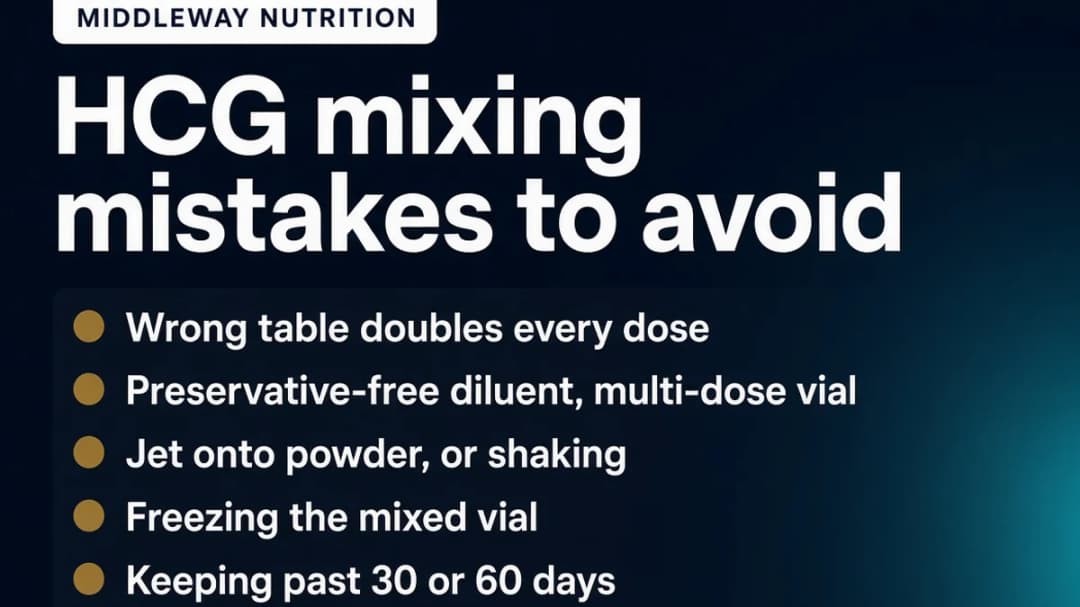
HCG Mixing Mistakes to Avoid
Using the wrong table for the vial. The most consequential error, and purely arithmetical: a 10,000 IU vial read as 5,000 IU doubles every dose. Check the vial label, not the box.
Mixing a multi-dose vial with preservative-free diluent. Plain sterile water or a single-use sodium chloride ampoule suits an immediate dose, not a vial punctured 20 times over weeks.
Squirting the diluent onto the powder, or shaking the vial. Both create foam and air-liquid turbulence. Run the liquid down the glass and swirl.
Choosing a volume that lands on half units. At 2.5 mL in a 5,000 IU vial, 250 IU is 12.5 units. Unless you have a syringe with half-unit marks, pick 2 mL or 5 mL instead.
Freezing the mixed vial. The labels rule it out explicitly. The fridge door, where temperature swings, is a poor spot too.
Keeping a vial past its window "because it still looks clear". Clarity says nothing about potency or contamination. A clear solution on day 75 is still past every label's limit.
Converting IU to milligrams. HCG is standardised by biological activity, not weight. Keep everything in IU.
Drawing HCG into a syringe that already holds testosterone. HCG is aqueous and testosterone is in oil, and an oily needle contaminates the HCG vial. Our guide to mixing peptides in one syringe sets out the general rules.
Subcutaneous or Intramuscular HCG?
The US labels for Novarel, Pregnyl and the Fresenius Kabi generic all say intramuscular use only. The UK Pregnyl product information allows intramuscular or subcutaneous injection. In practice, many clinics, including the University Hospitals low-dose programme cited above, use subcutaneous abdominal injection with a fine insulin needle. The comparative data support that, within the limits of small studies:
- Saal and colleagues (1991) gave 5,000 IU either intramuscularly or subcutaneously to 24 healthy men. Subcutaneous dosing delayed the peak and lengthened the serum half-life, but the testosterone, LH and FSH responses were identical. (Fertil Steril; PMID 1712735.)
- Sills and colleagues (2001) randomised 28 women undergoing ovulation induction to 5,000 IU urinary HCG, reconstituted in 0.5 mL, by either route. Serum HCG 24 hours later was similar, and the authors suggested subcutaneous use was suitable for women with a BMI under 30. (Fertil Steril; PMID 11476796.)
- Stelling and colleagues (2003) compared a 10,000 IU dose in 40 women having IVF. At egg retrieval 36 hours later, serum HCG was higher after subcutaneous injection (348.6 IU/L) than intramuscular (259.0 IU/L). (Fertil Steril; PMID 12749424.)
None were large, and none studied repeated low doses in men on testosterone. The small-dose male data come from studies like Coviello and colleagues (2005), where 29 men received 200 mg testosterone enanthate weekly plus placebo or 125, 250 or 500 IU HCG every other day for three weeks. Intratesticular testosterone ended 7% below baseline in the 250 IU group (J Clin Endocrinol Metab; PMID 15713727). If you inject subcutaneously, rotate sites; our injection site guide covers the abdomen, thigh and arm. For how HCG compares with the upstream alternative, see the gonadorelin guide.
FAQ
How much bacteriostatic water do I add to 5,000 IU of HCG?
There is no single right amount. The common choices are 2 mL (2,500 IU per mL, 25 IU per unit) and 5 mL (1,000 IU per mL, 10 IU per unit). Both give whole-number marks for 250 to 500 IU doses, and more water makes small doses easier to measure accurately.
How many units is 250 IU of HCG on an insulin syringe?
It depends on how the vial was mixed. For a 5,000 IU vial, 250 IU is 5 units at 1 mL, 10 units at 2 mL, 12.5 units at 2.5 mL, and 25 units at 5 mL. Divide the dose by the IU per unit, which is the vial's IU divided by the mL added, divided by 100.
Can I reconstitute HCG with sterile water instead of bacteriostatic water?
Yes, for a dose you inject straight away. Sterile water has no preservative, so it does not suit a vial drawn from repeatedly over weeks. For multi-dose use, the pharmacy kits supply a benzyl-alcohol-preserved diluent.
How long does HCG last after mixing?
It depends on the product. The Novarel label says refrigerate at 2 to 8°C and use within 30 days. The US Pregnyl label and the Fresenius Kabi generic say 60 days refrigerated. For research-labelled vials with no approved label, 30 days is the cautious limit, counted from the day you mix.
Does HCG need to be refrigerated before it is mixed?
Not always. The US Novarel and Pregnyl labels store unopened powder at room temperature, while UK Pregnyl says fridge at 2 to 8°C. After mixing, every label says refrigerate.
What should I do if mixed HCG looks cloudy?
Discard it. The labels say not to use the solution if you see discolouration or particles, and at home there is no way to tell aggregation from contamination.
Can I mix HCG and testosterone in the same syringe?
No. HCG is water-based and testosterone is dissolved in oil, so they do not combine, and a needle that has been through an oil vial can contaminate the HCG. Draw and inject them separately.