The hexarelin peptide produces the largest growth hormone pulse of the GHRP family, and it also desensitises faster than any of them, which is the central problem with using it. Reported hexarelin peptide dosage sits around 100 micrograms per injection, one to three times daily, but the more important number is how many weeks it keeps working before the response fades.
Hexarelin is a synthetic hexapeptide that binds the growth hormone secretagogue receptor GHSR-1a, the same receptor ghrelin acts on. It is not approved as a medicine in any market and is sold as a research compound.
What Makes It Different From the Other GHRPs
Two things.
Potency. Dose for dose, the growth hormone spike it triggers is steeper and higher than the other members of its family manage. That is the reason people are interested in it.
CD36 binding. Hexarelin also binds CD36, a scavenger receptor found on cardiac tissue and macrophages, which no other GHRP does to the same degree. Research from the 1990s onward examined cardioprotective effects in animal models and some small human studies, independent of growth hormone release. This is a genuinely distinctive property and it is the strand of hexarelin research with the most academic interest behind it.
The GH pulse gets the attention. The CD36 activity is arguably the more interesting finding and has nothing to do with why most people buy it.
Hexarelin Peptide Dosage as Reported
These ranges come from user reports and older research protocols rather than any approved dosing schedule.
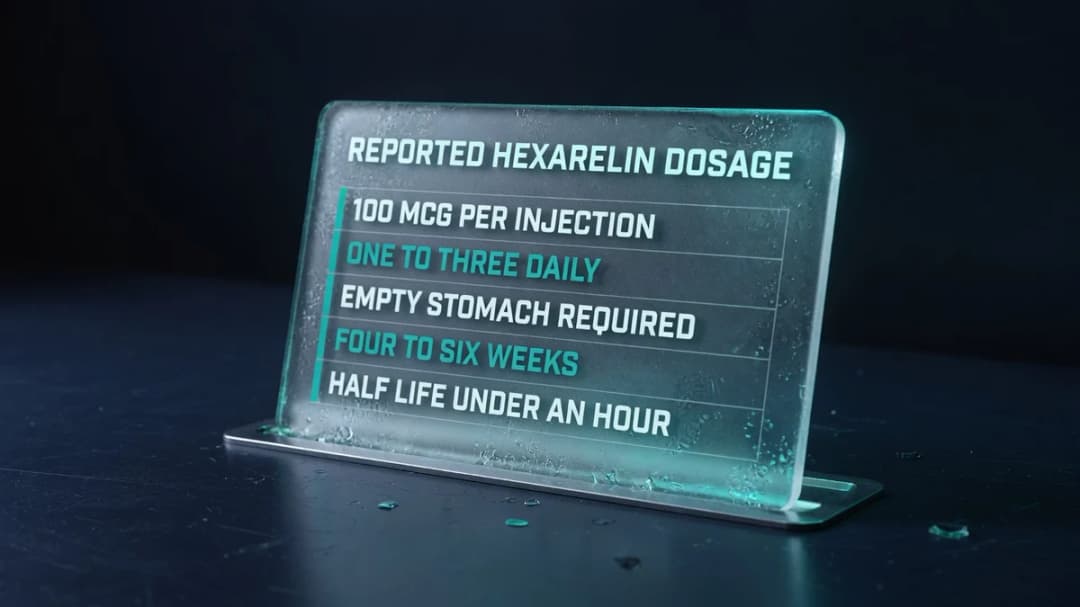
| Parameter | Reported practice | Note |
|---|---|---|
| Per injection | Around 100 mcg | Some report up to 200 mcg with diminishing return |
| Frequency | One to three times daily | Typically morning, post training, before bed |
| Timing relative to food | On an empty stomach | Carbohydrate and fat blunt the GH response |
| Cycle length | Four to six weeks | Shorter than other GHRPs specifically because of desensitisation |
| Break | Similar length to the cycle | Convention rather than evidence |
| Half life | Under an hour | Which is why multiple daily injections are used |
The dose ceiling is real. Increasing beyond around 100 micrograms per injection does not produce a proportionally larger GH pulse, because the receptor response saturates. What increasing the dose does reliably produce is more of the cortisol and prolactin effects discussed below.
Desensitisation Is the Defining Limitation
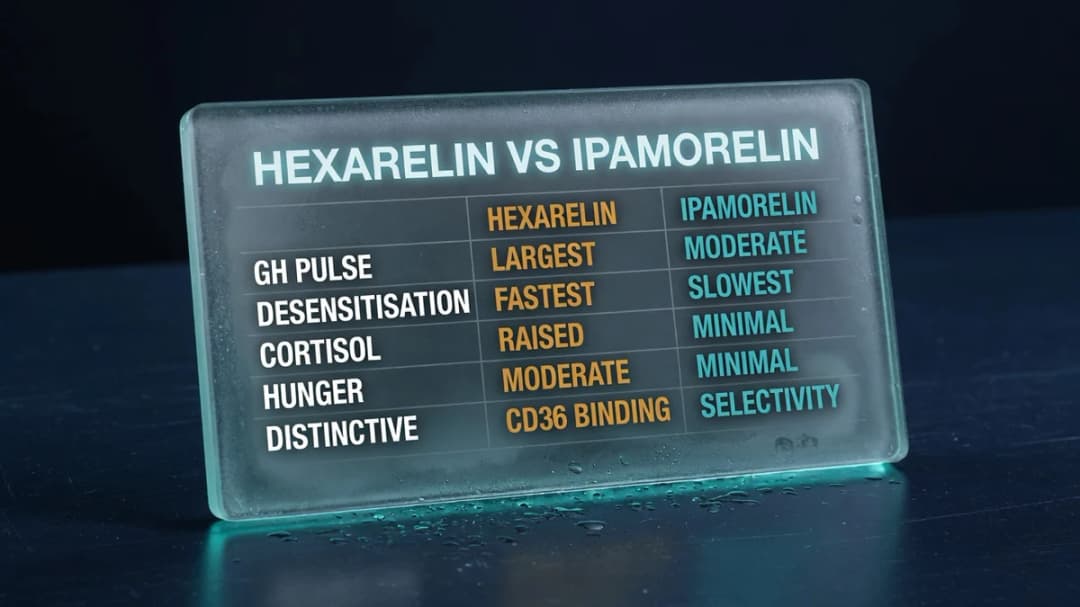
Continuous GHSR-1a stimulation downregulates the receptor. With hexarelin this happens faster and more completely than with ipamorelin, with a noticeable fall in GH response over a matter of weeks.
Practically, that means hexarelin is a short cycle compound by nature. Running it continuously produces a fading response with the side effects continuing unchanged, which is the worst of both positions.
If you are looking for something that can be run continuously, ipamorelin is the more suitable compound in this family, at the cost of a smaller pulse. Our growth hormone secretagogue comparison sets them out side by side.
The Cortisol and Prolactin Problem
This is the effect most hexarelin content skips.
GHRPs vary in how selectively they stimulate GH release. Ipamorelin is notable for being relatively clean, with little effect on cortisol or prolactin. Hexarelin and GHRP-6 are not.
Hexarelin raises cortisol and prolactin at higher doses, and both matter. Elevated cortisol works against the muscle and recovery outcomes people are pursuing. Elevated prolactin can cause a range of effects including reduced libido and, at sustained high levels, gynaecomastia risk.
Keeping to lower doses limits both. That is the main practical argument for staying at 100 micrograms rather than pushing higher.
Other Reported Effects
- Water retention and a puffy appearance, particularly in the first weeks
- Hunger, sometimes intense, since GHSR-1a is the ghrelin receptor
- Tingling or numbness in the hands, consistent with the carpal tunnel effects seen with growth hormone
- Reduced insulin sensitivity with prolonged use, an effect shared across GH raising interventions
- Injection site reactions
- Lethargy for some
The insulin sensitivity point deserves attention from anyone with prediabetes or a family history of type 2 diabetes. Growth hormone is counter regulatory to insulin, and raising it chronically is not a neutral act metabolically.
There is also a question that applies to this entire compound class and rarely gets asked. Raising growth hormone raises IGF-1, and IGF-1 is a growth signal that acts on tissue generally rather than muscle specifically. That is the mechanistic reason anyone with active or previous cancer should not be using a growth hormone secretagogue, and the reason indefinite use in a healthy adult is a different proposition from a defined block.
The Combination Question
Hexarelin is frequently paired with a growth hormone releasing hormone analogue on the reasoning that the two act on separate receptors and produce a larger combined pulse than either alone. The pharmacology behind that reasoning is sound, and it is the standard rationale for pairing a GHRP with a GHRH analogue.
What has not been established is that a larger pulse produces a better outcome in body composition, recovery or anything else that people are actually pursuing. Growth hormone release is a surrogate marker. Nobody has run the trial that connects it to the endpoints, and stacking on the assumption that more of a surrogate is better is exactly the sort of reasoning that looks obvious and turns out wrong.
Where It Sits in Practice
| Hexarelin | Ipamorelin | GHRP-6 | |
|---|---|---|---|
| GH pulse size | Largest | Moderate | Large |
| Cortisol and prolactin | Raised at higher doses | Minimal | Raised |
| Hunger stimulation | Moderate | Minimal | Pronounced |
| Desensitisation speed | Fastest | Slowest | Intermediate |
| Distinctive property | CD36 and cardiac effects | Selectivity | Appetite stimulation |
None of these is an approved medicine, all are prohibited in competitive sport under anti-doping rules, and none has human trial evidence supporting the body composition outcomes they are sold for. Our HGH peptides overview covers the class, and ipamorelin covers the more commonly used alternative.
FAQ
How much hexarelin should be used per injection?
Reported practice is around 100 micrograms, one to three times daily. The receptor response saturates near that level, so higher doses mainly add cortisol and prolactin effects rather than more growth hormone.
Why does hexarelin stop working?
The growth hormone secretagogue receptor downregulates with continuous stimulation, and hexarelin causes this faster than other compounds in its family. Response typically fades over several weeks, which is why cycles with it are kept short.
Is hexarelin better than ipamorelin?
It produces a larger growth hormone pulse and a worse hormonal side effect profile, and it desensitises faster. Which is better depends entirely on whether a bigger pulse over a short window or a cleaner profile over a longer one is more useful, and neither has human outcome evidence behind it.
Does hexarelin have cardiac effects?
It binds CD36, a receptor present on cardiac tissue, and research in animal models and some small human studies has examined protective effects independent of growth hormone. This is a research finding rather than a therapeutic application, and hexarelin is not a cardiac medicine.
When should hexarelin be injected?
Reported practice is on an empty stomach, since food, particularly fat and carbohydrate, blunts the growth hormone response. Common timings are on waking, after training, and before sleep.