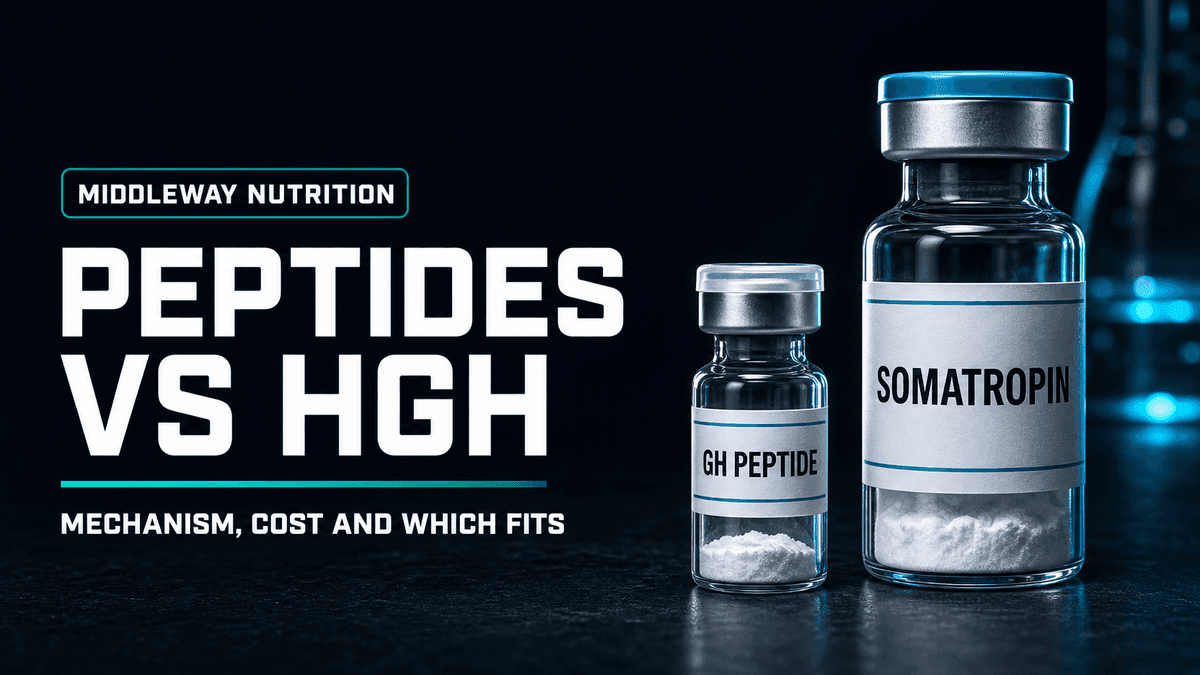
HGH peptides do not contain HGH. Every compound sold under that label is a signaling molecule that asks your own pituitary to release more growth hormone, and only one has ever held an FDA approval. That fact explains most of the confusion in this category, and it is the right place to start when deciding which of these deserve to be taken seriously.
- These are secretagogues, not hormone replacement. They raise the growth hormone your pituitary already makes rather than supplying growth hormone from outside the body.
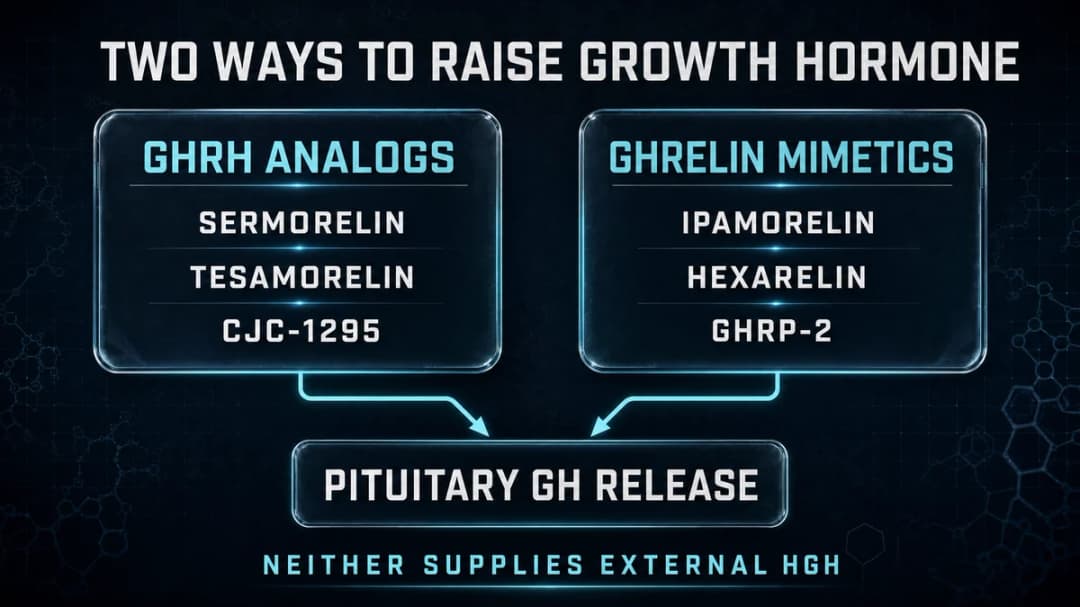
- The class splits in two. GHRH analogs (sermorelin, tesamorelin, CJC-1295) act on the GHRH receptor. Ghrelin mimetics (ipamorelin, hexarelin, GHRP-2, GHRP-6) act on GHS-R1a, the receptor ghrelin uses.
- Evidence quality is wildly uneven. Tesamorelin has randomized controlled trials and an approved label; several others have never been tested for any outcome buyers care about.
- A measurable GH pulse is not an outcome. Nearly all human data here stops at hormone levels and never reaches body composition, recovery, or aging endpoints in healthy adults.
- Actual HGH, meaning recombinant somatropin, is a prescription drug on a separate legal footing. Distributing it in the US for anti-aging or athletic use is a federal offense.
What HGH Peptides Actually Do
Growth hormone release runs on a small circuit. The hypothalamus sends growth hormone-releasing hormone (GHRH) into the anterior pituitary, where somatotroph cells answer with a pulse of growth hormone. Somatostatin applies the brake. Ghrelin, arriving mostly from the stomach, amplifies the pulse through its own receptor.
Every peptide here pushes on one of those two accelerator inputs. None adds growth hormone to your blood directly, which matters in three practical ways.
The response depends on a working pituitary. If somatotroph function has been lost to surgery, radiation, or a structural problem, a secretagogue has nothing to act on. Recombinant growth hormone works in that setting; these peptides do not.
Output stays pulsatile and inside the body's feedback loop, because rising growth hormone and IGF-1 both increase somatostatin tone. That is usually framed as a safety advantage, and mechanistically it is reasonable, but long-term comparative data has never shown it.
And the effect is smaller and far less predictable than injecting the hormone. This is the part marketing tends to skip.
GHRH Analogs vs Ghrelin Mimetics
The two families are not interchangeable. The difference shows up in half-life, side effect profile, and how much evidence exists.
GHRH analogs are modified fragments or variants of the natural 44-amino-acid GHRH molecule. Sermorelin is GHRH(1-29), the shortened active portion. Tesamorelin is a full-length analog stabilized against enzymatic breakdown. CJC-1295 is a modified GHRH(1-29) that, in its DAC form, binds albumin and circulates for days instead of minutes. All three amplify a pulse the hypothalamus was already going to produce, so release stays roughly physiological.
Ghrelin mimetics, historically called growth hormone-releasing peptides or GHRPs, bind GHS-R1a. Ipamorelin, hexarelin, GHRP-2, and GHRP-6 belong here. This route produces a larger single pulse than a GHRH analog alone, but the receptor is not exclusive to growth hormone signaling: GHS-R1a activation also touches appetite, cortisol, prolactin, and cardiovascular tissue, and the older members of the family are far less selective than the newer ones.
Because the two families act through separate receptors on the same cell, combining one from each column produces a bigger pulse than either alone. That synergy is reproducible in pharmacology work, and it is why stacked protocols dominate the informal market.
HGH Peptides Ranked by Evidence Quality
Ranking by popularity would put CJC-1295 and ipamorelin on top. Ranking by evidence puts them mid-table. Here is the honest order.
Tier 1: Controlled human trials with a hard endpoint
Tesamorelin stands alone. The FDA approved it in 2010 as Egrifta for reducing excess visceral abdominal fat in adults with HIV-associated lipodystrophy, and a more concentrated formulation has since been approved for the same indication. The approval rested on placebo-controlled trials measuring visceral fat by CT imaging over roughly six months, an anatomical endpoint rather than a hormone reading. Its side effects are documented on a label rather than inferred. The catch is that this evidence applies to a narrow population, and use outside that indication is not supported by the labeling.
Tier 2: Human pharmacology data, no outcome trials in healthy adults
Sermorelin has the longest regulatory history of any peptide here. It was approved as Geref for pituitary function testing and later for idiopathic growth hormone deficiency in children, then discontinued by the manufacturer and the approvals subsequently withdrawn. That withdrawal was commercial rather than a safety or efficacy finding, which is the legal basis on which compounding pharmacies still prepare it. Its half-life is very short, roughly 10 to 20 minutes, so it produces a brief pulse rather than sustained elevation. Human data on the growth hormone response is solid; human data on body composition in healthy adults is essentially absent. Our sermorelin guide covers the mechanism in depth.
CJC-1295 has early-phase human work in healthy volunteers showing dose-dependent increases in growth hormone and IGF-1, with the DAC version keeping IGF-1 elevated for well over a week after a single injection. That is genuine human evidence, more than most compounds here can claim. What does not exist is any late-phase trial, approved indication, or long-term safety dataset. Sustained IGF-1 elevation from a long-acting analog is also the most plausible risk in this category, and it has never been characterized over meaningful timeframes.
GHRP-2, also called pralmorelin, is the one ghrelin mimetic with a formal medical use anywhere: it has served as a diagnostic agent for growth hormone deficiency in Japan. That is a narrow but real credential, covering single-dose administration. Repeated dosing in healthy adults is not what it was reviewed for.
Tier 3: Pharmacology characterized, human outcome data absent
Ipamorelin is a synthetic pentapeptide designed for selectivity. At typical research doses it releases growth hormone with little effect on cortisol or prolactin, a genuine improvement over the older GHRPs and the main reason it displaced them. It was investigated clinically and never reached approval. Its reputation rests on a clean receptor profile, not on demonstrated outcomes.
GHRP-6 reliably provokes strong hunger, unsurprising for a ghrelin receptor agonist. For anyone using it for body composition, that is a defect rather than a feature. Its growth hormone effect is well documented; its clinical utility was never established.
Hexarelin produces a potent initial growth hormone response and has drawn separate research interest for cardiac effects that appear independent of growth hormone. Two things are consistently reported: it raises cortisol and prolactin more than the selective agents, and its growth hormone effect fades with continued dosing as receptors desensitize. That tachyphylaxis makes it a poor fit for the continuous-use protocols people apply to it.
| Compound | Family | Strongest human evidence | Regulatory status (US) | Confidence in stated benefits |
|---|---|---|---|---|
| Tesamorelin | GHRH analog | Placebo-controlled trials, imaging endpoint | Approved, HIV lipodystrophy only | High, within that population |
| Sermorelin | GHRH analog | Prior approval, pituitary testing and pediatric GHD | Approval withdrawn, compounded only | Moderate for GH release, low for outcomes |
| CJC-1295 (DAC) | GHRH analog | Early-phase GH and IGF-1 pharmacology | Not approved, research use | Low to moderate |
| CJC-1295 (no DAC) | GHRH analog | Inferred from GHRH(1-29) pharmacology | Not approved, research use | Low |
| GHRP-2 (pralmorelin) | Ghrelin mimetic | Diagnostic use approved in Japan | Not approved, research use | Low, single-dose context only |
| Ipamorelin | Ghrelin mimetic | Receptor selectivity and GH release studies | Not approved, research use | Low |
| GHRP-6 | Ghrelin mimetic | GH release and appetite pharmacology | Not approved, research use | Low |
| Hexarelin | Ghrelin mimetic | GH release, desensitization documented | Not approved, research use | Low |
For a side-by-side view that also covers the oral non-peptide MK-677, see our comparison of the best growth hormone secretagogues.
HGH Peptides vs Real HGH (Somatropin)
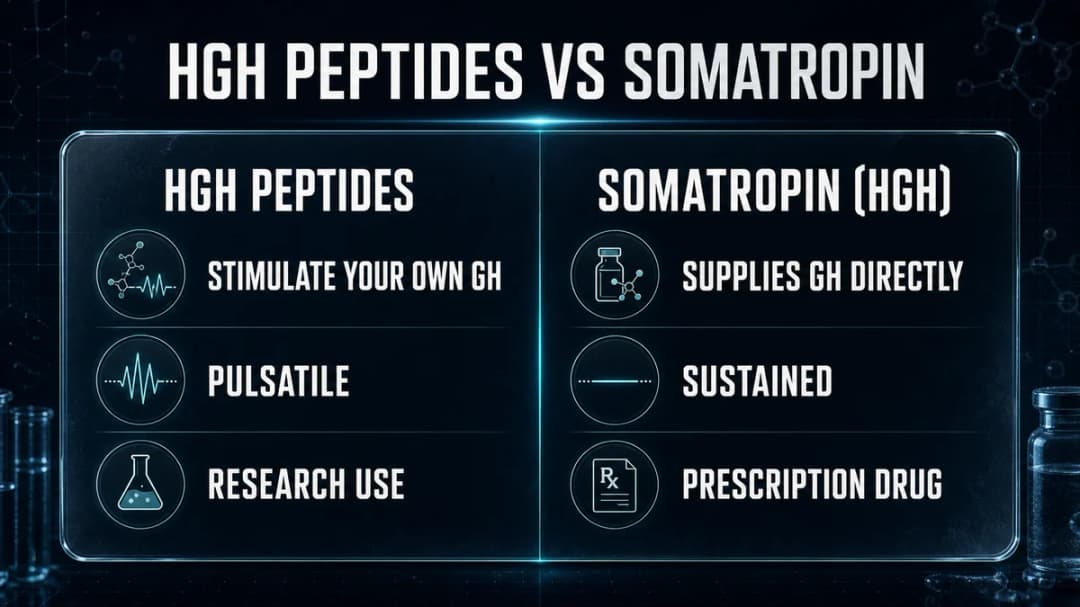
Somatropin is recombinant human growth hormone: the actual 191-amino-acid hormone, manufactured and injected. It is a US prescription drug with approved uses including pediatric and adult growth hormone deficiency, Turner syndrome, Prader-Willi syndrome, and HIV-associated wasting. The differences that matter:
- What is delivered. Somatropin supplies the hormone. HGH peptides supply a signal and depend on your pituitary to answer it.
- Predictability. Somatropin produces a dose-proportional rise in serum growth hormone. Secretagogue response varies with age, sleep, adiposity, somatostatin tone, and baseline pituitary function.
- Feedback. Somatropin bypasses the body's regulatory loop. Secretagogues stay inside it, which limits how high they can drive levels.
- Legal status. The sharpest divide. Under US federal law, distributing human growth hormone for any use other than an approved indication is a criminal offense, not merely an off-label prescribing question. The peptides here sit in a less defined space: mostly unapproved, mostly labeled for research use only, and not lawfully marketed as human therapeutics.
The shorthand that calls these compounds HGH peptides is therefore misleading in both directions. It implies a legal equivalence that does not exist and an effect size that has not been demonstrated.
Where the Human Data Is Missing
The gaps are larger than the evidence, so they deserve stating plainly.
There are no long-term controlled trials of any of these compounds in healthy adults for body composition, recovery, sleep quality, or aging. The endpoint measured repeatedly is serum growth hormone and, less often, IGF-1. Those are intermediate markers, and a compound can raise them reliably while producing no measurable change in the thing a person actually wants.
There is also no comparative safety data, so claims that one secretagogue is safer than another are inferences from receptor selectivity, not head-to-head results. Stacked protocols have never been studied as products. And chronic IGF-1 elevation from these agents, the concern most relevant to long-acting analogs, remains uncharacterized.
Safety Signals Reported Across the Class
Reported effects cluster predictably, because they trace back to growth hormone itself: fluid retention, joint aching or carpal tunnel-type symptoms, transient flushing after injection, tingling in the hands, and injection site irritation. Increases in fasting glucose or reduced insulin sensitivity are documented with growth hormone elevation generally and appear in tesamorelin's labeling.
Ghrelin mimetics add their own: appetite increase, most pronounced with GHRP-6, plus cortisol or prolactin elevation with the less selective agents, notably hexarelin.
Where dosing figures circulate, they are reported ranges from research literature and informal protocols, not validated regimens. For the unapproved compounds there is no established dose, because establishing one requires trials that were never run.
Quality is its own variable. Outside tesamorelin and compounded sermorelin, identity and purity depend entirely on the seller, since research-use-only material carries no enforced pharmaceutical standard. Batch-specific third-party analysis is the only meaningful check, and in a category where the expected effect is modest, an underdosed vial is nearly impossible to detect from experience alone.
FAQ
Are HGH peptides the same as HGH?
No. HGH is the hormone itself, sold as recombinant somatropin and available only by prescription. HGH peptides are separate molecules that signal the pituitary to release more of your own. They contain no growth hormone, cannot work if the pituitary cannot respond, and sit in a different legal category.
Which HGH peptide has the most evidence?
Tesamorelin, without close competition. It is the only one with placebo-controlled trial data measuring an anatomical outcome and the only one holding a current FDA approval, granted for excess visceral fat in HIV-associated lipodystrophy. Sermorelin and CJC-1295 have real human pharmacology data but no outcome trials.
Do HGH peptides build muscle?
That has not been demonstrated in controlled trials of healthy adults for any compound in this class. Growth hormone influences body composition and these peptides raise growth hormone, but the step from a hormone increase to measurable lean mass has not been tested in that population. Claims about muscle gain are extrapolation, not findings.
Why combine a GHRH analog with a ghrelin mimetic?
They act on different receptors on the same pituitary cell, so together they generate a larger pulse than either alone. The synergy is well established in pharmacology work. What has not been studied is whether the combinations sold as stacks are safe or effective over time in humans.
Are HGH peptides legal?
Tesamorelin is an approved prescription drug, and sermorelin can be compounded because its withdrawal was commercial rather than safety-driven. The rest are unapproved and generally sold labeled for research use only, meaning they are not lawfully marketed for human use. That is separate from recombinant HGH, where distribution for unapproved purposes carries federal criminal penalties.
This article is informational and describes research findings and reported protocols. It is not medical advice or a treatment plan. Most compounds discussed here are unapproved and sold for research use only. Growth hormone secretagogues can affect glucose metabolism, fluid balance, and endocrine function. Speak with a qualified clinician before any decision about them, particularly if you have diabetes, a history of cancer, or a pituitary condition.