How to use peptides comes down to four numbers and one formula. You need the milligrams in the vial, the millilitres of bacteriostatic water you add, the dose you want in micrograms, and the fact that a U-100 insulin syringe treats 1 mL as 100 units. Everything else is technique.
Most people who search how to use peptides get stuck at the same point. A vial is printed in milligrams. A protocol is quoted in micrograms. A syringe barrel counts in units. Nobody finds three measurement systems intuitive on a first attempt, and the problem is arithmetic rather than anything clinical. What follows is the whole sequence, sealed vial to finished injection, with the numbers shown rather than assumed.
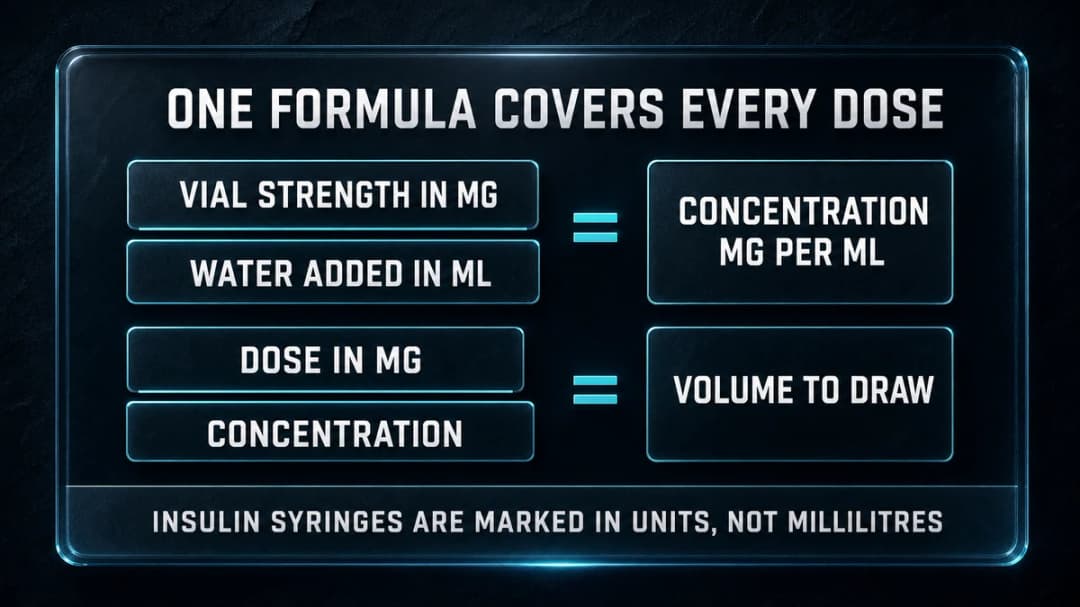
One Formula Covers Every Dose
Units to draw = (dose in mcg ÷ total mcg in the vial) × mL of water added × 100
Run it once with real figures. Say the vial contains 5 mg, which is 5,000 mcg. Say you reconstitute with 2 mL of bacteriostatic water, and the dose you are after is 250 mcg.
(250 ÷ 5,000) × 2 × 100 = 10 units.
Ten is where the plunger stops. Nothing else is involved, and the same three inputs work for every compound, vial size and reconstitution volume you will meet. Our peptide reconstitution calculator does the same sum if you would rather not hold it in your head.
The one conversion to burn into memory: 1 mg = 1,000 mcg. Confusing those two is the single most dangerous mistake in this whole process, and it is off by a factor of a thousand in either direction.
How to Use Peptides Step by Step
Step 1: Reconstitute the vial.
Freeze dried peptide sits in the bottom of the vial as a thin disc or a dusty film, sometimes so faint you have to tilt the glass to see it. Putting it back into solution is what reconstitution means.
- Take both vials off the cold shelf and leave them out for twenty minutes or so. Chilled water hitting chilled powder throws up more foam than either does at room temperature.
- Run an alcohol wipe over both rubber tops and give the alcohol ten seconds to evaporate before anything touches them.
- Measure out whatever water volume you settled on. A 3 mL syringe handles a 2 mL transfer in one pull, which beats stitching two draws together.
- Tilt the needle so the water tracks down the inside of the glass. Firing it straight into the powder is the version of this step to avoid.
- Expect suction. Sealed vials sit under vacuum, and a thumb held against the plunger keeps the water entering at a pace you set instead of a pace the vial sets.
- Mix it by rotating the vial slowly in one hand until the liquid runs clear. Shaking is the thing not to do, since mechanical agitation can pull the peptide apart.
- Write on the label what is in there, the milligram content, the water volume you used and the date, then put it in the fridge.
Step 2: Pick the water volume before you mix.
Once the water is in there is no undoing it, so decide on purpose rather than by habit. A larger volume dilutes the solution and pushes each dose further up the barrel, where it is easier to read. A smaller volume compresses everything into a few marks near the tip, where small misreads cost more.
| Vial | Water added | Concentration | One unit delivers |
|---|---|---|---|
| 2 mg | 1 mL | 2,000 mcg/mL | 20 mcg |
| 5 mg | 1 mL | 5,000 mcg/mL | 50 mcg |
| 5 mg | 2 mL | 2,500 mcg/mL | 25 mcg |
| 10 mg | 1 mL | 10,000 mcg/mL | 100 mcg |
| 10 mg | 2 mL | 5,000 mcg/mL | 50 mcg |
| 15 mg | 1.5 mL | 10,000 mcg/mL | 100 mcg |
| 30 mg | 1.5 mL | 20,000 mcg/mL | 200 mcg |
For anything dosed in the hundreds of micrograms, 2 mL into a 5 mg vial is the default most people land on, since it drops the usual doses somewhere between the 8 and 30 marks where the scale is legible. Compounds dosed in whole milligrams go the other way and are mixed tighter, otherwise a single dose swallows most of the barrel.
The useful trick is to memorise what a single unit is worth on whatever you are running. At 25 mcg a unit, a 500 mcg dose is 20 on the barrel, and you never open the formula again.
Step 3: Draw the dose.
U-100 insulin syringes are what almost everyone uses, and the scale on them is fixed: 1 mL spans 100 units, so half a millilitre is 50 and a tenth is 10.
Read the barrel before the first draw of a new box. There are also U-40 syringes, made for certain veterinary insulins, on which 1 mL spans only 40 units. Take the same numbered mark on one of those and you have given yourself 2.5 times what you intended.
Fractions are worth designing out rather than eyeballing. A result of 7.3 units is not something to guess at halfway between two lines. Adjust the water volume next time so the numbers land whole, or move to a 0.3 mL barrel where the half units are actually printed.
Step 4: Inject subcutaneously.
Almost all research peptides are given subcutaneously, into the fat layer just under the skin rather than into muscle.
Common sites are the abdomen at least two inches from the navel, the outer thigh, and the back of the upper arm. Rotate sites so the same spot is not used repeatedly.
Swab the skin, pinch a fold of fat, insert at 45 to 90 degrees depending on how much tissue you have, depress the plunger steadily, then withdraw and apply light pressure. There is no need to aspirate for subcutaneous injections with an insulin needle.
Worked Examples
| Compound and setup | Dose | Volume | Units |
|---|---|---|---|
| 5 mg vial, 2 mL water | 250 mcg | 0.10 mL | 10 |
| 5 mg vial, 2 mL water | 500 mcg | 0.20 mL | 20 |
| 5 mg vial, 2 mL water | 100 mcg | 0.04 mL | 4 |
| 10 mg vial, 1 mL water | 2 mg | 0.20 mL | 20 |
| 10 mg vial, 1 mL water | 4 mg | 0.40 mL | 40 |
| 30 mg vial, 1.5 mL water | 5 mg | 0.25 mL | 25 |
| 30 mg vial, 1.5 mL water | 10 mg | 0.50 mL | 50 |
Read the first three rows as a set. One 5 mg vial mixed into 2 mL yields twenty separate 250 mcg doses. Counting how many doses a vial holds before you commit to a water volume answers a practical question, which is whether you can realistically finish it inside the two to four week refrigerated window.
Doses Written per Kilogram
A minority of research protocols scale the dose to body weight rather than quoting a flat figure. Weight only decides the starting number: multiply the per kilogram value by what you weigh, and the answer in micrograms goes into the same equation as everything else on this page.
Someone at 80 kg following a 2.5 mcg/kg protocol needs 200 mcg. On the 5 mg in 2 mL setup, where a unit carries 25 mcg, that comes out at 8 units.
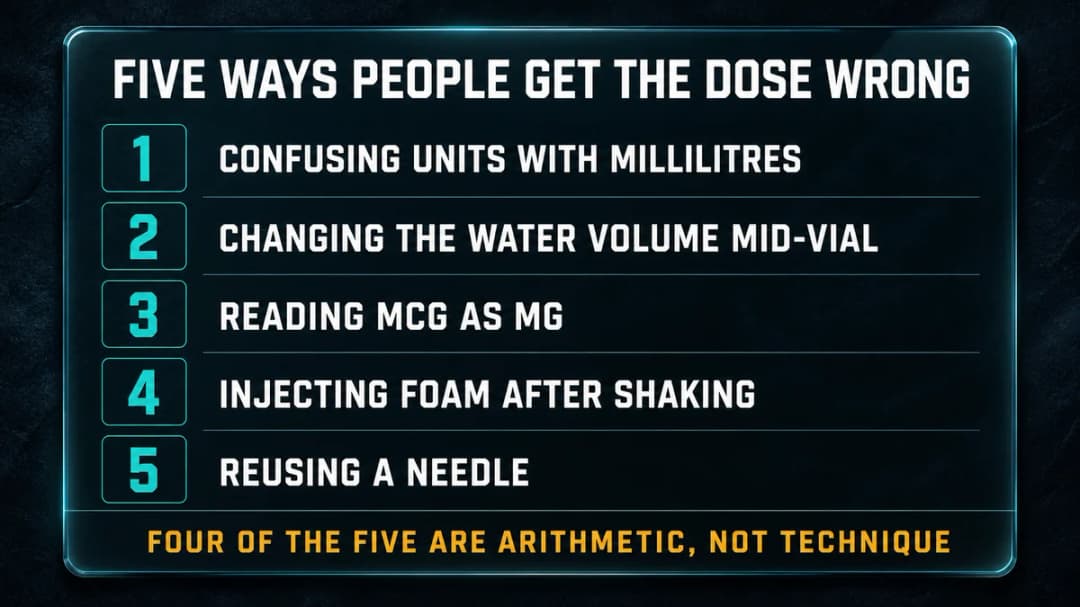
Five Ways People Get the Dose Wrong
Treating milligrams and micrograms as interchangeable. This is the one with real consequences, and it happens most often late at night. Put both numbers into micrograms before dividing anything.
Not checking which scale is on the barrel. Every new box deserves a two second look for the U-100 marking.
Watering it down too far. A 5 mg vial in 5 mL leaves a solution weak enough that being one line out on the plunger moves the dose by a noticeable margin. On small vials, 1 mL or 2 mL is the sensible bracket.
Forgetting that glass and rubber keep some of it. Peptide adsorbs to the vial wall and the stopper. Usually that is a few percent, more with the sticky compounds and more again on the last draws. Budget on finishing a vial rather than squeezing extra doses out of the bottom.
Eyeballing part units. Fix the problem at the dilution stage so doses land on printed lines, instead of squinting at the gap between two of them.
Storage While You Are Using the Vial
Dry powder in a sealed vial is remarkably durable: years in a freezer, six to twelve months on a fridge shelf, and a few weeks at ordinary room temperature, which is why a package arriving without cold packs is not the disaster people assume. Adding water resets that clock to something much shorter. The benzyl alcohol in bacteriostatic water acts as a preservative and buys most compounds a two to four week window under refrigeration. Plain sterile water carries no preservative at all, and a vial mixed that way is realistically good for a day or two.
Do not freeze a reconstituted vial. Ice crystals disrupt peptide structure, and what thaws out is not reliably what you froze. Our how to store peptides so they actually last guide covers handling in detail, and peptide side effects covers what to watch for once you start.
FAQ
What is the right amount of bacteriostatic water for a peptide vial?
There is no single right answer, because the water changes only the concentration and never the amount of peptide sitting in the vial. On a 5 mg vial most people settle on 2 mL, which places a 250 mcg dose at the 10 mark. Halving that to 1 mL gives a stronger solution and shorter draws.
What is the conversion from millilitres to units on an insulin syringe?
The number of units is the millilitres times 100, because a U-100 barrel spreads 1 mL across 100 marks. So 0.25 mL stops at 25, and 0.05 mL stops at 5. Barrel size makes no difference to this as long as the syringe is U-100.
Where should peptides be injected?
Subcutaneously, into the fat layer under the skin. The abdomen away from the navel, the outer thigh and the back of the upper arm are the usual sites. Rotate between them rather than using one spot repeatedly.
Can peptides be taken orally instead of injected?
For most, no. Digestive enzymes break peptide bonds before absorption, which is why the injectable route dominates. A few compounds have oral or intranasal formulations designed around that problem, but an oral version of a peptide normally given by injection is usually marketing rather than pharmacology.
How long is a mixed vial good for?
Two to four weeks in the fridge is the usual figure once bacteriostatic water is in, though it moves around by compound. Appearance overrides the calendar: anything that has turned cloudy, thrown particles or shifted colour goes in the bin no matter how recently it was mixed.
What size needle should I use?
A 29G to 31G insulin syringe with a half inch or shorter needle is standard for subcutaneous injection. Higher gauge numbers mean thinner needles, which are more comfortable but slower to draw viscous solutions.