This KPV dosage chart keeps the three routes apart, because the numbers people quote for a capsule, an injection and a cream are not interchangeable. It also separates published and regulatory evidence from what Reddit users say they use. There is no approved KPV dose for any route, so everything below is a published or reported range, not a recommendation.
Key Takeaways
- No human dosing study for KPV exists. FDA's July 2026 advisory briefing says it found no studies of KPV in humans by any route
- The only published dosing logic is animal or lab work: mice given KPV in drinking water, oral nanoparticle formulations, and a skin study showing plain KPV barely crosses human skin
- In the Reddit data I read, 13 comments named a dose for themselves. Nine sat at 250 to 500 mcg a day and three at 2 mg a day, which is an outlier, not a safety signal
- The units math is easy to botch: with a 10 mg vial and 2 mL of water, 500 mcg is 10 units on a U-100 syringe. One commenter in a blend thread was caught off by a factor of ten
- KPV is sold as a research chemical and is not an approved drug. This page is information, not medical advice
For what KPV is and how the evidence stacks up overall, see our KPV peptide guide. This page is the dose-focused companion, and a side-by-side with its better-known stack partner is in KPV vs BPC-157.
KPV dosage chart: what each route actually rests on
Start with the table, because it shows the real structure of the evidence. Every column has the same empty row at the top: no human trial, no label dose. What differs is what sits underneath.
KPV dosage chart by route: what each number rests on
| Oral capsules | Subcutaneous injection | Topical cream or gel | |
|---|---|---|---|
| Human dosing study | None found | None found | None found (FDA: none by any route) |
| Published lab or animal basis | Mice, KPV in drinking water, DSS and TNBS colitis; oral nanoparticle carriers | Mice, systemic KPV in peritonitis; abstract gives no dose | Human skin test: plain KPV below detection limit without microneedles or iontophoresis |
| Label or approved dose | None | None | None (a 0.1% cream or gel was nominated, then withdrawn) |
| Community guide ranges | 200 to 500 mcg a day, up to 1 mg | 100 to 500 mcg a day; vendor post up to 2 to 5 mg | 0.01 to 0.1% (unsourced guide post) |
| Reddit first-hand dose | 1 comment: 500 mcg a day, just starting | 12 comments: 250 mcg to 2 mg a day (injection or unstated) | 0 comments |
The oral column leans on a real mouse mechanism but no dose, the injection column on community habit, and the topical column on a withdrawn pharmacy nomination and a permeation study that argues against the idea.
Oral KPV capsules: the route with a mechanism and no dose
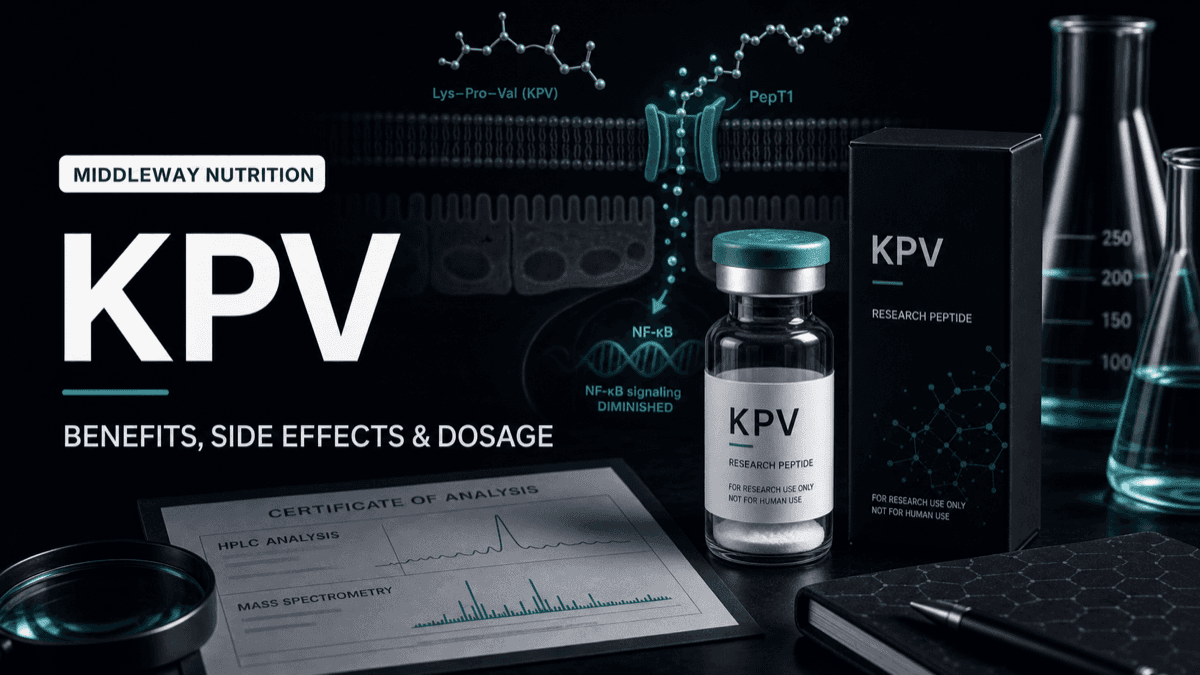
The case for oral KPV is a good one on paper. A 2008 study in Gastroenterology found that KPV is carried into intestinal and immune cells by PepT1, a peptide transporter that is switched on in inflamed colon, and that KPV added to the drinking water of mice reduced DSS and TNBS colitis (PMID 18061177). The abstract does not give a concentration, so it cannot be turned into a human number. A second 2008 colitis study (PMID 18092346) also reported earlier recovery in mice, with no dose in its abstract.
The complication is delivery. A 2017 study packed KPV into hyaluronic acid nanoparticles inside a chitosan and alginate hydrogel to get it to the colon after oral dosing (PMID 28143741), and a 2026 paper reported that an engineered conjugate reached the colon 3.8 times better than free KPV and worked at a 20-fold lower dose in colitis mice (PMID 41533788). Researchers building protective carriers for oral KPV is a hint that a plain capsule may not deliver what the mouse drinking-water result implies. I cannot say how much of a given retail capsule survives the stomach, because I found no human data on it.
What the community uses is lower than the injection numbers. A popular r/NTNPerformance guide post (May 2026, 52 upvotes) lists 200 to 500 mcg a day on an empty stomach, up to 1 mg for active gut flares, with 4 to 8 weeks on and 2 to 4 off. It cites no source for the figures, and the author says plainly that no human dose-finding trial exists. Only one first-hand oral dose turned up in the data: a commenter in that thread who was about to start 500 mcg a day of oral KPV with oral BPC-157 for Crohn's disease. No outcome yet. Several others asked where to find capsules, and two repeated hearsay about squirting a reconstituted vial into the mouth.
Subcutaneous injection: community numbers, no published human dose
Injection is the route most Reddit users describe, and it is also the one with the thinnest paper trail. A 2003 mouse study gave KPV systemically and saw fewer white cells entering an inflamed abdominal cavity (PMID 12750433), but the abstract gives no dose, and I found no study of subcutaneous KPV in people. Every "standard" figure you see on a vendor chart is therefore convention.
The conventions cluster tightly. The community guides I read give 100 to 500 mcg a day, a vendor-written post on r/NovaPeptides adds a 500 mcg to 2 mg systemic row and a 2 to 5 mg "acute" row for 4 to 8 weeks, and one commenter in a dosing thread said 200 to 400 mcg a day is the most common. The upper rows are unsourced marketing, not evidence that more is better or tolerated. One competing calculator page I fetched prints its oral dose as 250 mcg in the chart and 250 mg in the text, a thousand-fold slip that shows how loosely these charts are checked.
Topical KPV: a 0.1% nomination and a skin barrier problem
For skin, two documents carry real weight. FDA's briefing for its July 23 and 24, 2026 compounding advisory meeting says the KPV drug products proposed in a pharmacy nomination were a cream and a gel at 0.1%. The nomination was withdrawn, FDA evaluated KPV on its own initiative, and its conclusion was that the criteria weigh against putting KPV on the 503A bulks list. 0.1% means 1 mg per gram, so a 2 g application would carry about 2 mg; that is my arithmetic, not a labelled dose.
The second document undercuts the idea. A 2017 study on dermatomed human skin found that KPV applied by simple diffusion was below detectable levels, and only microneedle treatment or iontophoresis pushed it through (PMID 28343991). FDA's briefing cites the same work and notes that poor penetration could limit both systemic absorption and usefulness. A guide post in the data also lists 0.01 to 0.1% creams, again without a source. No Reddit commenter described a first-hand topical dose, so there is nothing to chart there.
What Reddit users report
I read all 251 posts and comments in the data set. They came from 25 threads across 10 subreddits, and most of it was noise: moderator bots, vendor review posts, a 31,000-character cheat sheet, and long threads about thymosin alpha-1 and mast cell disease that mention KPV in passing. After discarding that, 25 comments from 8 threads and 6 subreddits (r/BodyHackGuide 7, r/Peptidesource 5, r/Biohacking 4, r/MCAS 6, r/NTNPerformance 2, r/postvasectomypain 1) were first-hand accounts of using KPV, alone or in a blend. Of those, 13 named a dose. That is a small, self-selected sample from people who chose to post, and none of it is verified.
What 13 Reddit comments said they use, by KPV amount per day
Most people sit at 250 to 500 mcg a day, usually once daily. Three of them dose five days a week and skip weekends, in one case as an 8-week run. Cycle lengths people mentioned were about 30 days, one month then a two-week break, and roughly 50 days then three weeks off on a blend. Three comments said 2 mg a day; two came from the same thread and may be one person, and the third came from a different thread. One of them said it worked better for them than a different peptide blend, which is a preference, not a safety result.
Blend users add a wrinkle. Two commenters on a four-peptide blend thread worked out their KPV share at roughly 400 to 500 mcg a day (12 to 15 units from a 3 mL reconstitution of an 80 mg vial). In that same thread a user wrote 1.5 units, another commenter pointed out that this would stretch the vial to 200 doses rather than 20, and the first user confirmed they meant 15. That is a ten-fold slip, and it is easy to make.
How did it go? Of the 25 first-hand comments, 9 described an improvement (gut, skin or inflammation), 5 were too early or unclear, and 11 gave no outcome. Nobody described a harm. Many also ran other things at the same time (GHK-Cu, BPC-157, TB-500, antihistamines, a GLP-1 drug), so none of these can be pinned on KPV. One commenter on r/BodyHackGuide (Mar 2026) wrote "KPV was effective for me within about 2 weeks. Gut feeling better, less gi issues, skin on my arms cleared up." (link). A r/MCAS commenter (Sep 2026) offered the opposite framing: "KPV provides some anti-inflammatory benefits while taking it. Once you stop, the benefits stop." (link). That is an unsourced assertion.
The practical complaints were small. A r/Biohacking commenter (Oct 2026) noticed "when I draw the kpv it trickles out slower than something like my ghk which comes out very easily" (link). Another thread, with over a dozen replies, pointed out that you cannot judge how much peptide is in a vial by how full it looks, because most of the cake is filler, and that a third-party certificate of analysis is the only check.
Reconstitution math: mg, mL and syringe units
Most "dose" confusion is really arithmetic. A vial holds a fixed mass of freeze-dried powder, and the water you add only sets the concentration, which sets the volume you draw.
The formula: units on a U-100 syringe = dose in mcg ÷ concentration in mcg per mL × 100. A worked example: a 10 mg vial with 2 mL of bacteriostatic water is 10,000 mcg in 2 mL, or 5,000 mcg/mL. A 500 mcg dose is 500 ÷ 5,000 = 0.1 mL, which is 10 units. A 250 mcg dose is 5 units, and the r/BodyHackGuide thread that asked about starting at 50 mcg got the correct reply that 5 mg/mL makes that 1 unit.
KPV units on a U-100 syringe for a 10 mg vial
| Concentration | 250 mcg | 500 mcg | 1 mg | 2 mg | |
|---|---|---|---|---|---|
| 10 mg + 1 mL | 10,000 mcg/mL | 2.5 units | 5 units | 10 units | 20 units |
| 10 mg + 2 mL | 5,000 mcg/mL | 5 units | 10 units | 20 units | 40 units |
| 10 mg + 4 mL | 2,500 mcg/mL | 10 units | 20 units | 40 units | 80 units |
| 10 mg + 5 mL | 2,000 mcg/mL | 12.5 units | 25 units | 50 units | 100 units |
| Doses per vial | 40 | 20 | 10 | 5 |
Scaling by vial follows from the same line. A 10 mg vial holds 40 doses of 250 mcg, 20 of 500 mcg, 10 of 1 mg or 5 of 2 mg. A 5 mg vial holds half of each. At 500 mcg five days a week, a 10 mg vial lasts four weeks; at 500 mcg daily it lasts 20 days. Extra water does not change the number of doses, only how many units you draw.
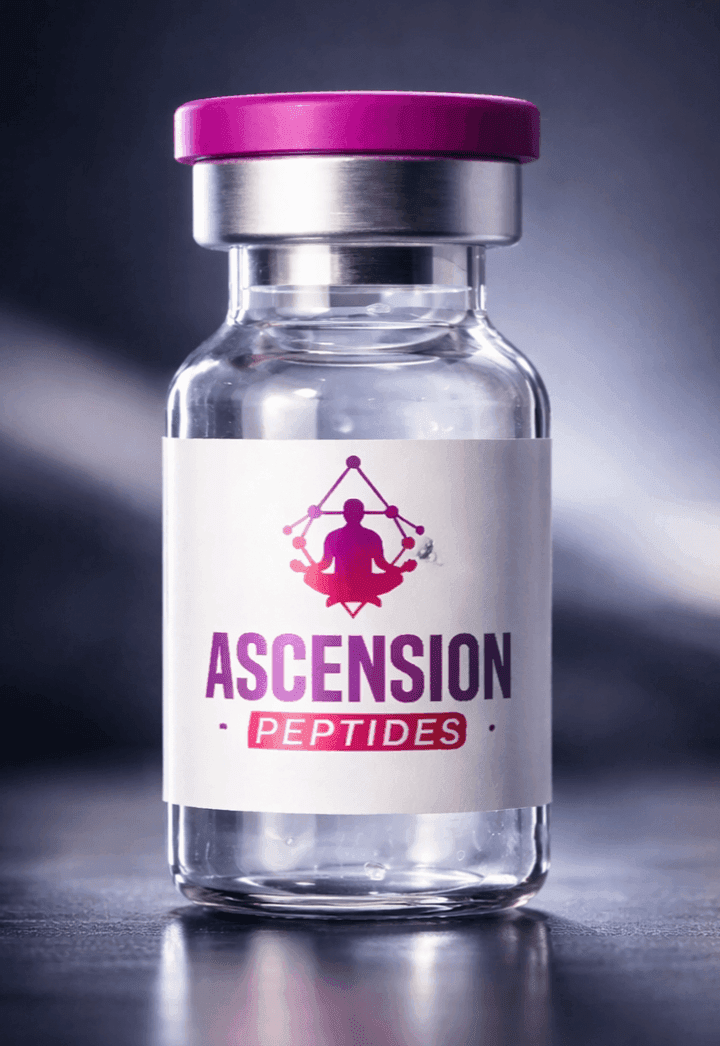
If you buy KPV for research use, a priced reference point helps. Ascension Peptides lists KPV 10 mg at $50.00 (checked 2026-10-11, USD, US shipping only, all sales final). Their listing shows batch results from Kovera Labs, which tests every batch for HPLC purity, LC-MS identity, net content, endotoxin, sterility and heavy metals, with more than 98 percent of batches passing and public batch COAs. KPV 10 mg at Ascension. New customers can use code PEPTIDEDECK for 50 percent off the first order. It is sold for research use, not as a drug.
What changes the number
Several things move a dose range, and few of them are about body weight.
- Route. Oral, injected and topical amounts are not comparable. The oral number is meant to act on the gut lining; the injected number is meant to be systemic; and topical KPV may not get below the skin surface without a delivery aid.
- Target. Gut-focused users cluster at 200 to 500 mcg; the 2 mg comments mention inflammation, gut and face, and none of them said a clinician set the amount.
- Purity and mass. Without a batch certificate you do not know how many micrograms are in the vial. A label of 10 mg is a claim, not a measurement.
- Stacking. Blends fix the ratio for you. In a four-peptide blend, KPV was dosed at the same level as BPC-157 and TB-500 according to the protocol author in the thread (about 400 mcg each against 2 mg of GHK-Cu), so changing the blend dose changes all four at once.
- Timing. Opinions split: one r/Biohacking commenter said timing is irrelevant and titration is not needed, others started at 250 mcg and stepped up. None of this is tested.
- Cycle length. The "4 to 8 weeks on, 2 to 4 off" pattern comes from guides and a commenter's doctor who said peptides cannot be used continuously. I found no data on tolerance to KPV either way.
The card below puts the page's main numbers in one place.

Safety, legal status and when to stop
KPV is not an FDA-approved drug. FDA's compounding safety page places it among bulk substances for which the agency has identified no human exposure data on any KPV-containing drug product and says it lacks information on whether it would cause harm in people. The agency's briefing also found no human pharmacokinetic data and no adverse-event case reports, which means a clean-looking Reddit thread is the absence of data, not the presence of safety.
Anyone who is pregnant or breastfeeding, has inflammatory bowel disease or an autoimmune condition, or takes immune-modulating drugs should talk to a clinician before using any research peptide. Stop and seek care for spreading redness, fever, swelling or pus at an injection site, hives, throat tightness or trouble breathing. Do not replace a prescribed therapy with KPV.
If you are comparing sources, our guide on where to buy KPV covers what to check. See also LL-37 and KPV.
Frequently asked questions
What is the standard KPV dosage?
There is no standard. No label or human trial sets one. Community guides give 200 to 500 mcg a day, and the most common first-hand number among the 13 Reddit comments that named a dose was 250 to 500 mcg a day. That is a pattern among self-selected posters, not a recommendation.
How many mcg of KPV per day do people use?
Of 13 comments, 2 said 250 mcg a day, 5 said 500 mcg (one orally), 2 gave a blend-derived 400 to 500 mcg, 1 used 1 mg twice daily then 500 mcg twice daily, and 3 said 2 mg a day. The 2 mg figures are outliers, not proof of safety.
What is the oral KPV dosage?
No human oral dose has been tested. Mouse work gave KPV in drinking water, and guides quote 200 to 500 mcg a day for capsules. In the Reddit data only one commenter described an oral dose, 500 mcg a day, with no outcome yet.
How many units is 500 mcg of KPV?
With a 10 mg vial and 2 mL of water, 500 mcg is 10 units on a U-100 syringe. With 1 mL it is 5 units, and with 4 mL it is 20 units. Always recompute for your own vial and syringe.
How long do people run KPV?
Commenters mentioned about 30 days, 8 weeks and roughly 50 days on a blend, often with 2 to 3 weeks off. Guides say 4 to 8 weeks on and 2 to 4 off. Nothing here is based on a trial.
Is KPV legal?
It is not an approved drug. It is sold as a research chemical, and FDA's staff evaluation for its July 2026 advisory meeting weighed against adding it to the compounding bulks list. Check current FDA pages before relying on any status.
For research use only, Ascension lists KPV 10 mg at $50.00 (2026-10-11) with public batch COAs: KPV 10 mg listing. Use code PEPTIDEDECK for the optional new-customer 50 percent off.
Medical disclaimer: This page is for information only and is not medical advice. KPV is a research compound that is not approved by the FDA. Dose figures shown are published or self-reported ranges, not recommendations. Talk to a qualified clinician before using any peptide.