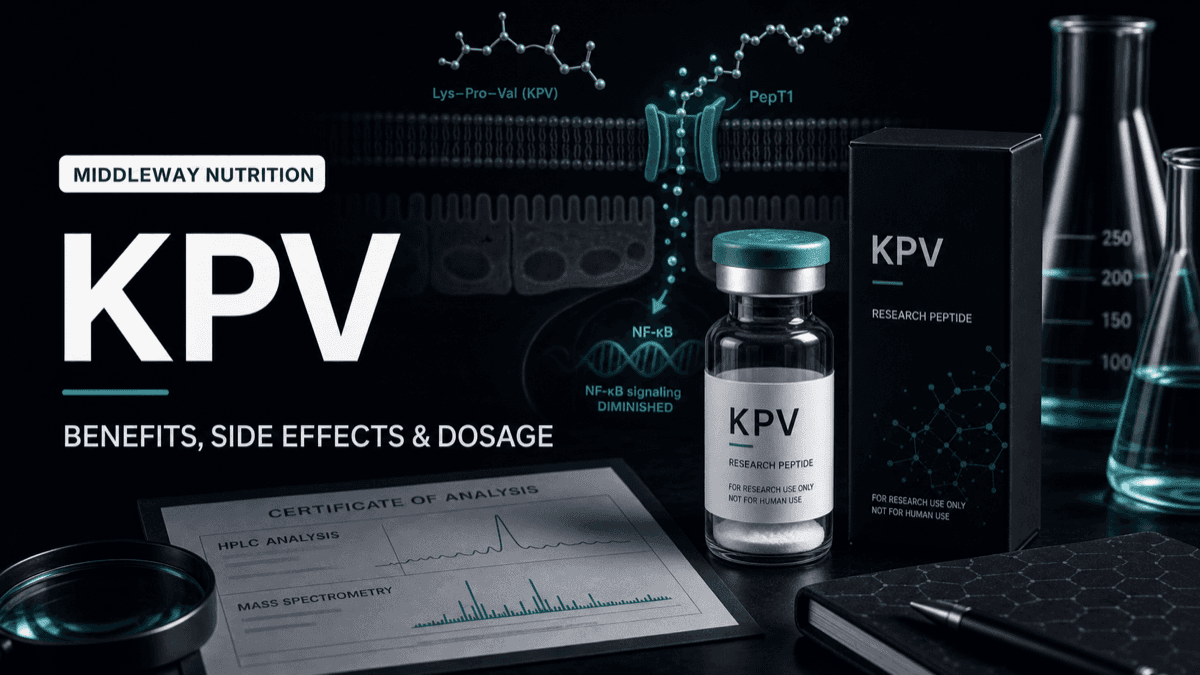
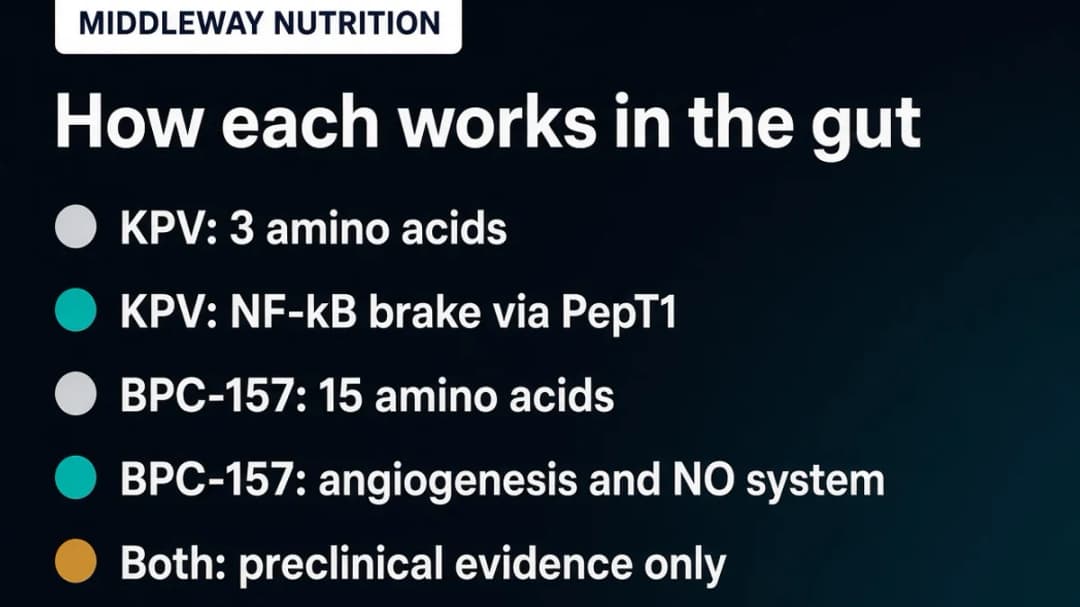
KPV vs BPC-157 comes down to what is going wrong in the gut. KPV is a three-amino-acid fragment of alpha-MSH that switches down inflammatory signalling inside intestinal cells, so it is the one discussed for active colitis-type inflammation. BPC-157 is a 15-amino-acid gastric peptide linked to blood-vessel growth and mucosal repair, so it is the one discussed for damaged lining. Neither has a completed controlled trial in human IBD, and both should be read as preclinical compounds.
That last point matters more than the mechanism comparison. Nearly everything written about KPV vs BPC-157 for the gut, including the confident "use KPV for colitis, BPC-157 for leaky gut" splits you will find in clinic blogs, is an extrapolation from mouse and rat models. The extrapolation is reasonable in places and shaky in others, and this article tries to show which is which.
KPV vs BPC-157 at a Glance
| KPV | BPC-157 | |
|---|---|---|
| What it is | Tripeptide Lys-Pro-Val, alpha-MSH(11-13) | Pentadecapeptide GEPPPGKPADDAGLV, from a gastric juice protein |
| Size | 3 amino acids | 15 amino acids (MW 1419) |
| Main proposed action | NF-kB and MAP kinase inhibition, lower cytokine output | Angiogenesis, NO-system interaction, mucosal and anastomosis healing |
| How it enters gut cells | Carried in by the PepT1 transporter, which is induced in inflamed colon | No specific transporter established |
| Best animal gut data | DSS, TNBS and transfer colitis in mice | Cysteamine colitis, anastomosis, fistula and ulcer models in rats |
| Human gut trials | None completed | Phase II ulcerative colitis trial referenced by developers, results never fully published |
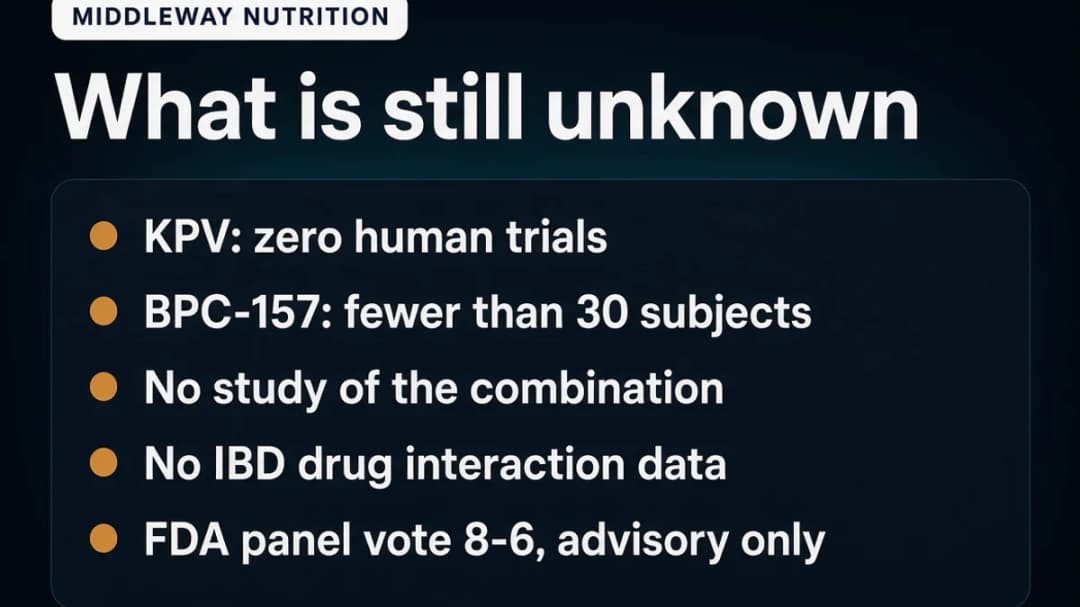
| Human data of any kind | None | Fewer than 30 subjects across three uncontrolled pilot studies |
| Oral route for gut use | Used orally in every mouse colitis study | Described as stable in human gastric juice; oral dosing works in rats |
| Tanning effect | No | No |
| Evidence tier | Preclinical | Preclinical |
The table flatters BPC-157 slightly. It has far more published papers, but most come from one research group in Zagreb, and "more rat studies" is not the same as "closer to proven in people". The sections below go through each row.
What KPV Is and How It Works in the Gut
A fragment of alpha-MSH without the tanning
KPV is the last three amino acids (positions 11 to 13) of alpha-melanocyte-stimulating hormone, the hormone behind skin pigmentation that also has a long-studied anti-inflammatory side. Cutting it down to Lys-Pro-Val keeps much of the anti-inflammatory activity and drops the pigment signalling. A German group showed in 2008 that KPV still protected mice with a non-functional melanocortin-1 receptor, which suggests its gut effect runs at least partly outside the classic melanocortin pathway (Kannengiesser et al., Inflamm Bowel Dis 2008).
For the broader profile, including skin and wound work, see our complete KPV peptide guide.
NF-kB inhibition and PepT1 uptake
The mechanism that makes KPV interesting for IBD specifically was set out by Didier Merlin's laboratory in Dalmasso et al., Gastroenterology 2008. Two findings carry the argument:
- It works inside the cell. At nanomolar concentrations, KPV inhibited activation of NF-kB and MAP kinase inflammatory signalling in human intestinal epithelial cells and T cells, and reduced pro-inflammatory cytokine secretion.
- It gets in through PepT1. PepT1 is a di- and tripeptide transporter normally found in the small intestine. In inflammatory bowel disease it is switched on in the colon, where it is usually absent or barely expressed. KPV is a PepT1 substrate, so the inflamed colon is, in principle, the tissue best equipped to take it up.
A drug preferentially absorbed by inflamed cells is exactly what IBD researchers want. It is also still a mouse-and-cell-line finding.
The colitis studies
Four papers do most of the work, and they are worth separating because they are often blurred together.
- Dalmasso 2008. KPV added to drinking water reduced the severity of both DSS- and TNBS-induced colitis in mice, measured by histology and pro-inflammatory cytokine expression.
- Kannengiesser 2008. In DSS colitis, KPV-treated mice recovered earlier and regained more weight, with fewer inflammatory infiltrates and lower myeloperoxidase activity. It also worked in CD45RB(hi) transfer colitis, a T-cell-driven model. In the receptor-deficient mice, KPV treatment rescued every animal in the treatment group from death during DSS colitis.
- Laroui 2010 (the nanoparticle study). This is the one often misattributed to Dalmasso 2008. The same lab loaded KPV into 400 nm nanoparticles inside an alginate-chitosan gel designed to break down in the colon. Mice given DSS then the KPV nanoparticles were protected, and the authors estimated the nanoparticles delivered a similar effect at a concentration 12,000-fold lower than free KPV in solution (Laroui et al., Gastroenterology 2010).
- Xiao 2017. Hyaluronic acid-coated KPV nanoparticles, again in a colon-releasing hydrogel, reduced mucosal damage and TNF-alpha in a mouse ulcerative colitis model and outperformed uncoated KPV nanoparticles (Xiao et al., Mol Ther 2017).
The nanoparticle papers carry a quiet warning. The lab that found KPV's PepT1 route spent years building colon-targeted carriers for it, which suggests plain oral KPV is not an efficient way to reach inflamed colon. Nobody sells those carriers; what people buy is free KPV.
What BPC-157 Is and How It Works in the Gut
A gastric pentadecapeptide
BPC-157 is a synthetic 15-amino-acid sequence (GEPPPGKPADDAGLV) taken from a protein found in human gastric juice. Almost all of its literature comes from Predrag Sikiric's group at the University of Zagreb, which describes it as "stable gastric pentadecapeptide BPC 157" and has published on it since the early 1990s. Our BPC-157 peptide guide covers its non-gut uses, including the tendon and ligament work that drives most of its popularity.
Angiogenesis and the NO system
Where KPV is framed as an anti-inflammatory, BPC-157 is framed as a repair signal. The proposed mechanisms are:
- promoting new blood-vessel growth into damaged tissue, reported through VEGFR2 and the Akt-eNOS axis (McGuire et al., Curr Rev Musculoskelet Med 2025)
- interacting with the nitric oxide system to protect the endothelium
- stimulating early growth response genes tied to collagen and matrix formation
In gut terms, a better-perfused mucosa should heal ulcers, fistulas and surgical joins faster. KPV aims at the inflammatory switch; BPC-157 aims at the tissue that inflammation has already damaged.
The rodent gut and colitis data
The GI work is broad. Rats have been given BPC-157 after cysteamine-induced colitis, colon-to-colon anastomosis, short bowel resection, fistulas and a long list of ulcer models. A representative study is Klicek et al., J Physiol Pharmacol 2013, in which untreated rats could not heal cysteamine colitis or a colon anastomosis over 14 days, while rats given BPC-157 at 10 μg/kg or 10 ng/kg by injection, or orally in drinking water, healed both.
Two caveats apply to that whole body of work. Cysteamine colitis and surgical anastomosis are injury models, not models of the chronic immune dysregulation that defines Crohn's disease and ulcerative colitis. And the near-absence of independent replication outside one group is a real weakness, not a technicality. The deeper look at the rat GI data lives in our piece on BPC-157 for gut healing.
The near-total absence of human trials
Sikiric's group wrote in 2012 that a formulation of BPC-157 coded PL 14736 had been "so far only tested in clinical phase II" for ulcerative colitis (Sikiric et al., Curr Med Chem 2012). Those trial results were never published as a full peer-reviewed paper. A 2026 pharmaceutics review that searched the literature to April 2026 found no completed phase II trial, no validated dosing regimen and no approved formulation, and counted the entire clinical dataset at fewer than 30 subjects across three uncontrolled pilot studies (Mateescu et al., Pharmaceutics 2026). None of those pilots was in IBD.
How Strong Is the Evidence for Each?
Both compounds sit in the same tier: plausible mechanism, consistent animal results, no controlled human efficacy data for any gut condition.
KPV: zero human trials
There is no completed human trial of KPV for ulcerative colitis, Crohn's disease, IBS or intestinal permeability. There is also no published human pharmacokinetic study, so nobody knows how much oral KPV reaches the colon in a person, how long it lasts, or whether the PepT1 route works in human IBD tissue the way it does in cell lines.
BPC-157: many rat papers, a handful of people
BPC-157 has a far larger animal literature, but volume is not the same as tier. A 2025 systematic review of its musculoskeletal literature found 36 eligible studies, of which 35 were preclinical and 1 was clinical (Vasireddi et al., HSS J 2025). For the gut specifically, the human evidence is the unpublished PL 14736 trial and nothing else of trial quality.
Why the mouse models can mislead
DSS, TNBS and cysteamine colitis are acute chemical or immune injuries. They are useful screening tools, and many compounds that worked in them failed in human IBD trials. Speeding recovery from a two-week injury in a rodent is not the same as holding a relapsing autoimmune disease in remission for years.
Oral vs Injected: Which Route Makes Sense for Gut Use?
Route is the one area where the two compounds genuinely differ in a way that matters for gut use.
KPV by mouth
Every mouse colitis study above gave KPV orally, either in drinking water or as a nanoparticle gel. As a tripeptide, KPV is small enough to be a transporter substrate rather than something that has to survive digestion as a large chain. That supports oral use in principle.
The practical problem is location. PepT1 is abundant in the healthy small intestine, so free oral KPV may be taken up well before it reaches the colon. For small-bowel Crohn's disease this matters less; for distal ulcerative colitis, nobody has shown that a plain KPV capsule gets enough peptide to the right place.
BPC-157 by mouth
BPC-157's oral case rests on its reported stability in human gastric juice, a claim that comes from the developer group and has been repeated in independent reviews, including the 2026 pharmaceutics review, which describes "unusual stability in gastric juice". The rat studies support it functionally: drinking-water dosing healed colitis and anastomoses in the same experiments as injected dosing.
What is not established is human oral bioavailability, and plasma half-life after injection is short, under 30 minutes in both animal data and a two-person human pilot, according to the same review.
The acetate vs arginate claim
A number of retailers argue that "arginate" BPC-157 survives stomach acid while the standard acetate salt does not. We looked for the peer-reviewed comparison behind that claim and could not find one; a PubMed ID cited for it on one leading page turned out to be a paper about thyroid tumours. Treat it as marketing until a published stability study appears. Our comparison of oral BPC-157 vs capsules covers the formulation question in more detail.
Injection for gut problems
Subcutaneous injection puts either peptide into the bloodstream rather than onto the gut lining. For BPC-157, systemic dosing did work in the rat gut models. For KPV, there are no published gut studies using injection at all, so injected KPV for colitis is a guess on top of a guess.
Which One for Which Gut Problem?
This is how the rationale lines up. None of it is a treatment recommendation.
Active ulcerative colitis or Crohn's inflammation
KPV has the better-fitting mechanism: an NF-kB brake delivered through a transporter that inflamed colon switches on. BPC-157 has the only human IBD trial, though its results are unpublished. Anyone with diagnosed IBD should not swap either peptide for established therapy, and flares need medical assessment, not a stack.
"Leaky gut" and permeability
Increased intestinal permeability is real and measurable, but "leaky gut syndrome" as a stand-alone diagnosis is not accepted in mainstream gastroenterology. In one mouse study, KPV nanoparticles accelerated mucosal healing as well as reducing inflammation (Xiao 2017); BPC-157 is argued to support mucosal repair more generally. Neither has been tested against a permeability measure in humans.
Ulcers, NSAID damage and surgical healing
This is BPC-157's home ground in the animal literature, which includes a long run of ulcer, NSAID-lesion, fistula and anastomosis models. KPV has no comparable data here.
IBS
IBS is a disorder of gut-brain signalling and motility, usually without visible inflammation. Neither compound has an IBS-specific evidence base, and the anti-inflammatory rationale for KPV fits it poorly.
Using KPV and BPC-157 Together
The rationale
The case for combining them is that they appear to act on different parts of the same problem: KPV on the inflammatory signalling, BPC-157 on the damaged tissue. Different mechanisms and no known pharmacological conflict make the pairing intuitive, and it is why KPV and BPC-157 appear together in the four-peptide KLOW blend alongside TB-500 and GHK-Cu.
What is unknown
No study has given KPV and BPC-157 together, in animals or people. There is no data on whether the effects add up, whether one changes the other's absorption, or what ratio makes sense. Blends also fix the ratio, so one component cannot be stopped alone if a problem appears.
Side Effects and Unknowns
KPV
With no human trials, there is no measured side-effect profile. Mouse and cell studies reported no toxicity at the doses used, and the nanoparticles in Laroui 2010 did not affect cell viability or barrier function. An open theoretical question is whether long-term NF-kB suppression in the gut affects defence against infection.
BPC-157
The developer group describes BPC-157 as free of side effects, with no toxic effect and a lethal dose never reached in animals. That claim comes largely from one source. The main theoretical concern is the one built into the mechanism: a compound that promotes new blood vessels could, in principle, feed existing tumours, and nobody has tested this in people. Our dedicated page on BPC-157 side effects and what is still unknown covers the reported effects in more depth.
Shared unknowns
- Product identity. At the July 2026 FDA advisory meeting, agency scientists said there is no universally accepted chemical specification for these peptides, which makes quality comparisons hard. Grey-market vials vary.
- Interaction with IBD drugs. Nothing is known about either peptide alongside biologics, JAK inhibitors, thiopurines or steroids.
- Pregnancy, children and long-term use. No data at all.
- Doping. BPC-157 is on the World Anti-Doping Agency prohibited list; tested athletes should avoid it.
This is research-use information, not medical advice.
Legal Status and Sourcing in 2026
On 23 July 2026, the FDA's Pharmacy Compounding Advisory Committee voted 8-6, with one abstention, to recommend adding BPC-157 to the 503A bulks list, which governs what compounding pharmacies can make. The nomination under review was BPC-157 for ulcerative colitis. KPV received the same 8-6 recommendation. FDA staff had recommended against both. The vote is advisory; as of late September 2026 there has been no final FDA decision, and formal rulemaking still has to happen. Neither compound is an approved medicine in the US, UK or EU.
For research sourcing, Synthro Lab lists BPC-157 at A$53.88 (about US$38) for a 10 mg vial (price checked 26 September 2026). It does not sell KPV, and we do not point to a KPV vendor. Anyone researching KPV's antimicrobial side, often grouped with LL-37, will find that covered in our article on antimicrobial peptides LL-37 and KPV.
FAQ
Is KPV or BPC-157 better for gut inflammation?
For inflammation as such, KPV has the more targeted mechanism, because it blocks NF-kB inside intestinal cells and is taken up through PepT1, which inflamed colon switches on. BPC-157 is aimed more at repairing damaged tissue. Neither has been shown to work in people, so "better" here means a better-fitting theory, not a proven result.
Can you take KPV and BPC-157 together?
People do, and the pairing appears in the KLOW blend. The logic is complementary mechanisms, but no study has ever tested the two together, so any added benefit or interaction is unknown.
Does KPV work orally?
In mice, yes: every colitis study gave it orally, in drinking water or colon-targeted nanoparticles. There is no human data on how much oral KPV reaches the colon.
Is BPC-157 stable in stomach acid?
Its developers describe it as stable in human gastric juice, independent reviews repeat that, and rat studies show oral dosing works in gut models. Human oral absorption has never been measured, and claims that an "arginate" salt is far more stable than acetate have no published comparative study behind them that we could find.
Is there human evidence for KPV or BPC-157 in IBD?
For KPV, none. For BPC-157, a formulation coded PL 14736 reportedly reached phase II testing in ulcerative colitis, but the results were never fully published, and the total human dataset across all uses is fewer than 30 subjects in uncontrolled pilots.
Does KPV cause tanning like Melanotan?
No. KPV is only the last three amino acids of alpha-MSH and does not carry the pigment-stimulating part of the hormone. Its gut effects in mice persisted even without a working melanocortin-1 receptor.
Are KPV and BPC-157 legal?
Neither is an approved medicine. In July 2026 an FDA advisory committee voted 8-6 to recommend both for the compounding bulks list, but the recommendation is not binding and no final decision has followed.