KPV peptide benefits center on inflammation control, the side effects reported so far are mild and mostly local, and dosage discussion sits in the microgram range rather than the milligram range. That combination makes it one of the more approachable research peptides on paper, and also one of the easiest to sell badly, because a three amino acid molecule is cheap to make and simple to mislabel.
- KPV is a tripeptide, Lysine-Proline-Valine, taken from the tail end of alpha-MSH. It keeps the anti-inflammatory half of that hormone and drops the pigmentation and appetite signaling.
- The mechanism is better characterized than most research peptides: uptake through the PepT1 transporter, then interference with NF-kB activation inside the cell.
- Nearly all efficacy data is preclinical. Colitis and dermatitis models in rodents are consistent and repeated across labs, but no completed human dose-finding trial exists.
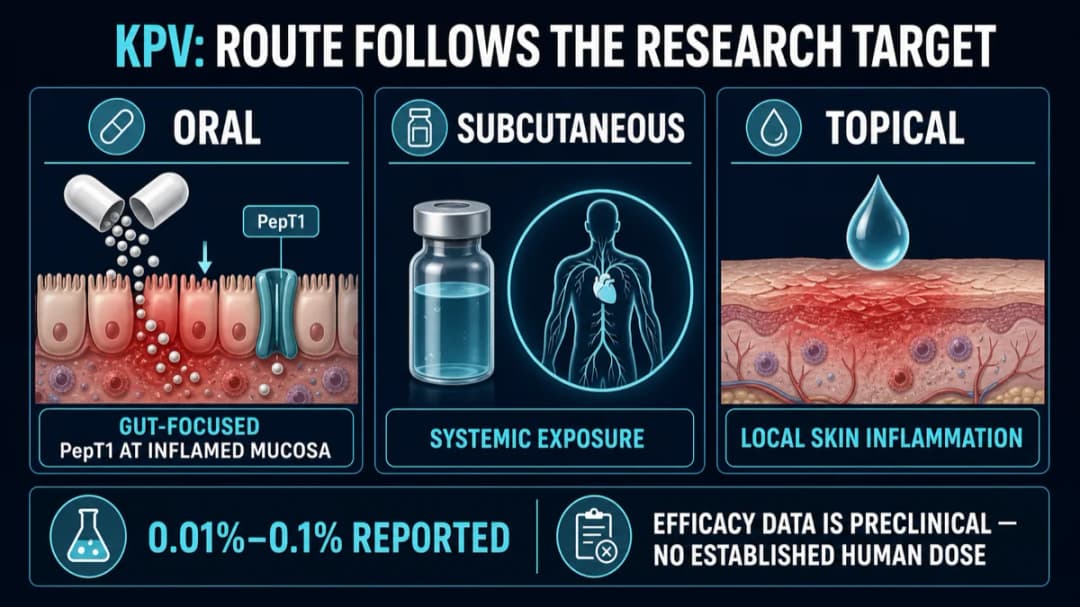
- Reported use clusters around 200 to 500 mcg per day orally or subcutaneously, or a 0.01 to 0.1 percent topical preparation, run for roughly four to eight weeks before reassessing.
- Because the peptide itself is short and inexpensive to synthesize, the real quality risk is identity and endotoxin control, not the usual purity percentage argument.
What KPV Actually Is
KPV is about as small as a bioactive peptide gets. Three residues: lysine, proline, valine. Written out as Lys-Pro-Val, abbreviated to the single-letter code that gives it its name.
It is not a designed molecule in the way that many research peptides are. It is a fragment. Alpha-melanocyte-stimulating hormone (alpha-MSH) is a 13 amino acid pituitary hormone with an unusually broad job list: skin pigmentation, appetite signaling, sexual function, and immune modulation. Most of that breadth runs through melanocortin receptors. The anti-inflammatory portion sits largely in the last three residues at the C-terminus, and those residues do not need the receptors to work.
That is the entire reason KPV exists as a separate compound. Researchers isolated the useful fragment and left the hormonal machinery behind. Pigmentation, hunger signaling, and the sexual-function effects associated with melanocortin activation all sit outside what this fragment can do, even though it shares a parent hormone with compounds that produce them.
The sequence itself creates two practical consequences:
Proline and valine resist digestive proteases. Most peptides taken by mouth are shredded before they reach anywhere useful. KPV holds up better than its size would suggest, which is why oral administration is discussed at all.
Its size lets it hitch a ride on active transport. Carriers that shuttle di- and tripeptides across intestinal cell membranes will accept KPV, which means it can be drawn into cells at low concentrations instead of relying on passive diffusion.
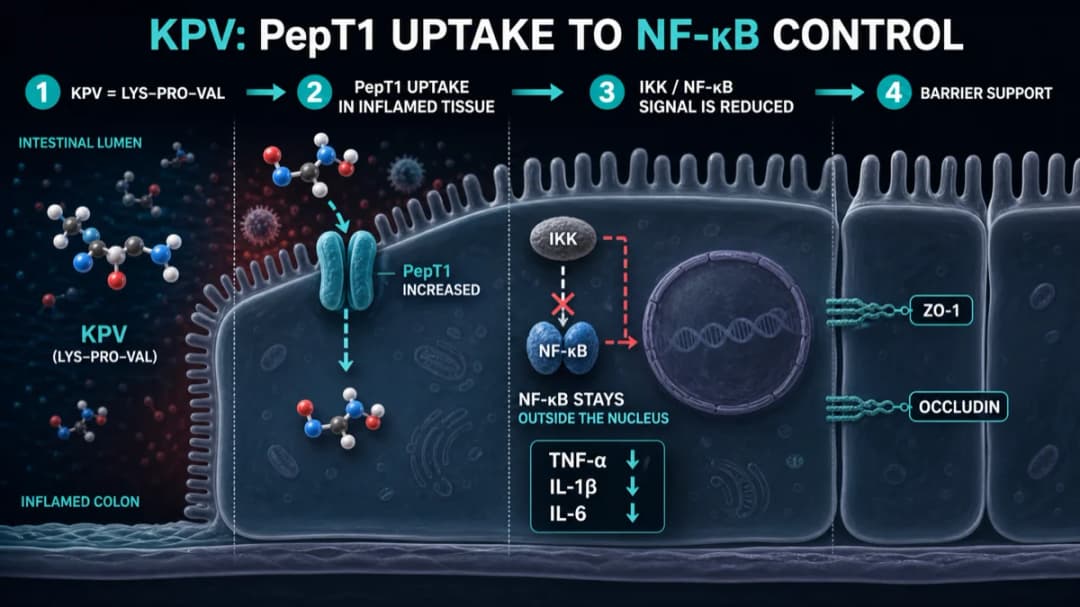
The second point matters for gut work specifically. PepT1 expression in the colon is normally low but rises substantially in inflamed intestinal tissue, so inflamed tissue takes up more KPV than healthy tissue does. That produces a rough self-targeting effect without any delivery engineering.
Once inside a cell, the primary described action is on NF-kB, the transcription factor that switches on most inflammatory gene programs. KPV appears to keep NF-kB sequestered in the cytoplasm rather than letting it translocate to the nucleus, with reported inhibition of the upstream IKK enzyme as part of the picture. Downstream that shows up as lower TNF-alpha, IL-1beta, and IL-6 output. A parallel dampening of MAP kinase signaling has also been described.
None of this makes KPV an approved drug anywhere. It is sold and studied as a research compound, and everything below should be read in that frame.
KPV Benefits
The honest version of this section separates what has been repeated in animal models from what is genuinely speculative. Very little of it involves humans.
None of it involves a completed human trial. A ClinicalTrials.gov search in August 2026 returns no registered KPV study in any indication, which means there is no human dose-finding, no human efficacy endpoint, and no human safety follow-up anywhere to point at. The table maps each claim to the evidence that actually sits behind it.
| Reported benefit | What the evidence actually is | Human evidence |
|---|---|---|
| Intestinal inflammation | DSS and TNBS colitis in mice, plus immune-driven transfer colitis; human intestinal epithelial and T cell lines in vitro; repeated by more than one group | None |
| Inflammatory skin conditions | Psoriasis-like and contact dermatitis models in rodents, keratinocyte-derived mediators measured in culture | None |
| Wound repair | Animal wound models including corneal epithelial work, measuring closure rate and collagen organization | None |
| Direct antimicrobial action | In vitro only, and contested: some reports describe activity against S. aureus and C. albicans, others find no direct killing | None |
| Systemic and neuroinflammation | Animal models of brain injury, arthritis-like synovial inflammation, systemic inflammatory states | None |
Read the middle column as the ceiling on each claim rather than a preview of a human result. A repeated rodent finding earns a compound a human trial. It does not stand in for one.
Intestinal inflammation (strongest preclinical case)
This is where the data is densest. In chemically induced colitis models (PMID 18061177, PMID 18092346), oral KPV administration has been reported to reduce colonic inflammatory cytokine expression, cut immune cell infiltration into the mucosal lining, and improve histological tissue scores. The mechanistic account behind that work is transporter-mediated uptake into inflamed mucosa, and the general effect has been described by more than one group across more than one colitis model.
Two model types carry most of the weight, and they fail for different reasons, which is why benefit in both counts for more than benefit in either. Chemically induced colitis, DSS or TNBS, tests whether KPV blunts an acute chemical insult to the mucosa. Transfer colitis, where naive T cells are moved into a host that cannot regulate them, tests it against immune-driven inflammation that builds over weeks. Reported outcomes in the transfer model include weight regain and reduced inflammatory change on histology.
One detail from that work is worth carrying into any read of the dosing conventions further down: in the transporter study, KPV was added to the animals' drinking water rather than given as a discrete daily dose. The animals were exposed more or less continuously across the day. That is not the same exposure pattern as one capsule or one injection every 24 hours, and nothing in the literature establishes which pattern the reported effects depend on.
The finding worth flagging is tight junction preservation. Proteins like ZO-1 and occludin hold the intestinal barrier closed, and colitis models show them degrading. KPV-treated animals retained more of that structure. That points at a structural driver of intestinal permeability rather than a symptom of it, which is a more interesting claim than simple cytokine suppression.
What does not exist: any completed human trial in ulcerative colitis, Crohn's disease, or IBS. The mechanism is coherent and the animal work is consistent, but the translation step has not been made.
Inflammatory skin conditions
Topical and systemic KPV has been studied in psoriasis-like and contact dermatitis models, with reduced keratinocyte-derived inflammatory mediators and less immune cell infiltration reported. This is mechanistically the same story as the gut work, applied to a different tissue where NF-kB is also the driver.
One point that gets repeated and is worth noting carefully: unlike topical corticosteroids, KPV has not been associated with skin thinning in the available reports. That is an absence of a documented harm over relatively short study windows, not a demonstrated long-term safety advantage. Treat it as an open question.
Wound repair
Improved closure rates and better organized collagen deposition have been described across several wound models, including corneal epithelial work. The plausible reading is indirect: lowering local inflammation removes an obstacle to repair rather than actively driving it. That distinction matters for stacking, and it is why KPV and BPC-157 tend to be discussed as complements rather than substitutes.
Antimicrobial activity (contested)
Some in vitro reports describe direct activity against Staphylococcus aureus, including methicillin-resistant strains, and against Candida albicans, at concentrations comparable to those producing anti-inflammatory effects. Other reviews characterize KPV as having no meaningful direct killing activity and attribute any apparent antimicrobial benefit to inflammation control instead. Our comparison of antimicrobial peptides LL-37 and KPV takes that disagreement further.
Both framings appear in the literature and we are not going to pretend the question is settled. If direct antimicrobial action is the goal, the peptide with the clearer case is LL-37, which works by physically disrupting microbial membranes. KPV's documented strength is on the inflammatory side.
Systemic and neuroinflammatory contexts
Anti-inflammatory effects have been reported in models of brain injury, arthritis-like synovial inflammation, and systemic inflammatory states. Consistent NF-kB suppression across tissue types makes these plausible directions. They are directions, not findings.
KPV Side Effects
The side effects of KPV peptide reported so far are mild, and the reason for that is at least partly structural: KPV does not touch melanocortin receptors, so it skips the class of effects that make other alpha-MSH derivatives noticeable.
What gets reported:
- Local injection site reactions. Redness, a small welt, or transient stinging with subcutaneous use. Typically resolves within hours.
- Mild gastrointestinal upset with oral dosing, more often at the top of the discussed range. Nausea or looser stools, generally reported to settle at lower amounts.
- Headache in the first week, mostly noted when starting at the higher end rather than titrating up.
- Short-lived fatigue in a minority of reports, usually within the first few days.
What has consistently not been reported: pigmentation change, appetite shift, libido effects, or broad immune suppression. The described action is narrow, hitting particular inflammatory signaling steps instead of suppressing immune function wholesale, and animals in the available work were not reported to become more vulnerable to infection.
Now the part that most pages skip. The FDA has stated plainly that human exposure data is lacking for KPV-containing drug products by any route. That is the operative safety fact. A clean profile drawn from rodent studies, in vitro work, and self-reported user experience is not the same thing as a characterized safety profile. Nobody has run the multi-year human follow-up that would produce one, and low reported harm from a small, self-selected group of users tells you very little about rare events.
There is also no channel collecting the reports. Adverse event surveillance attaches to approved products and to the pharmacies and manufacturers that supply them. A research chemical sold with a not-for-human-use label has nothing pointed at it, so a quiet side effect profile partly reflects the fact that nobody is counting.
Circumstances where the sensible answer is either avoidance or clinician oversight: pregnancy or breastfeeding, active malignancy or a melanoma history given the alpha-MSH lineage, concurrent immunosuppressive therapy, active acute infection, and anyone under 18.
Side effects by route
The three routes do not carry the same risks, and the reports do not cover them evenly.
Oral. This is where gastrointestinal complaints cluster, which is unsurprising for a compound whose stated target is the gut wall. Worth noting that the animal work behind the oral route delivered KPV continuously in drinking water, not as a single daily dose, so the tolerability seen there was produced by a different exposure pattern than the one people actually use.
Subcutaneous. Reported effects are local and short-lived. The larger risk on this route is not the peptide at all but what surrounds it: a self-reconstituted vial introduces sterility and endotoxin exposure that oral and topical use avoid entirely. That is a handling and sourcing problem, and it is the reason the verification section below spends its time on endotoxin and sterility documentation rather than purity percentages.
Topical. The least documented of the three by a wide margin. The available reports do not characterize a distinct side effect profile for topical KPV, so anyone quoting one is filling a gap rather than citing something. A compounded topical also carries the vehicle it is suspended in as a separate variable, and irritation from a base is easy to mistake for a reaction to the active.
KPV Dosage Chart
There is no established dose. No completed human dose-finding study defines one, so every figure below reflects what has been reported in clinic protocols and user communities rather than anything validated. Published ranges are wildly inconsistent, largely because some write-ups convert laboratory animal exposures directly into human figures, which produces numbers nobody in practice is anywhere near.
The table describes reported practice. It is not a protocol and not a recommendation.
| Goal / context | Reported range | Frequency | Typical cycle |
|---|---|---|---|
| Gut inflammation, oral route | 200 to 500 mcg | Once daily, often before food | 4 to 8 weeks, then reassess |
| Systemic inflammation, subcutaneous | 200 to 500 mcg | Once daily, rotating sites | 4 to 8 weeks |
| Localized skin inflammation, topical | 0.01 to 0.1 percent preparation | Once or twice daily | 4 to 8 weeks |
| Repair-focused stack alongside BPC-157 | 200 to 500 mcg | Once daily | 4 to 8 weeks, some protocols insert a 2 to 4 week break |
Route selection tracks the target. When the goal is intestinal, swallowing the peptide puts it where the relevant transporter and the inflamed tissue both live, so the point of absorption and the point of action collapse into one. When the goal is systemic or part of a stack, injection is preferred simply because exposure is easier to predict.
Timelines split by target too. Skin irritation is where people describe an early signal soonest, roughly one to three weeks. Intestinal goals get judged over four to eight weeks, mainly because the symptoms people track there swing around on their own from week to week, which makes any shorter window nearly impossible to read. No human clinical timeline exists for either.
KPV for Women
There is no sex-specific data on KPV, for the same reason there is no sex-specific data on most questions about it: there is no human data at all. No completed trial, and a ClinicalTrials.gov search in August 2026 returns no registered KPV study in any indication. Nothing in this section is a female-specific benefit claim, because none can be supported.
Three things can be said honestly.
The most-cited animal result came from female animals. The Gastroenterology paper that established PepT1-mediated uptake (PMID 18061177) ran its DSS and TNBS colitis models in female C57BL mice, with KPV delivered in the drinking water. That is a fact about study design, not evidence that KPV works better in women. A mouse result does not become a human result by matching sex.
The conditions driving the search skew female. The NIDDK puts IBS at up to twice as common in women as in men. The NIAMS lists rosacea as more common in women, with more severe disease in the men who do get it. Demand for a low-side-effect anti-inflammatory in those two categories is therefore female-weighted, which explains the search better than any female-specific mechanism does.
The hormonal objection does not apply here. KPV comes off the opposite end of alpha-MSH from the melanocortin-binding region, so the pigmentation, appetite and sexual-function effects that follow melanocortin activation sit outside what the fragment can do. What that does not mean is that interaction with hormonal contraception, cycle timing, or fertility has been ruled out. Nobody has looked. No mechanism to worry about is a weaker statement than no effect.
Two practical points follow. Reported dosing is neither sex-adjusted nor weight-adjusted: the 200 to 500 mcg range in the table above gets quoted identically for a 55 kg person and a 100 kg one, which says more about how loose the convention is than about how forgiving the compound is. And pregnancy, breastfeeding and a melanoma history stay on the avoid list for the reasons in the side effect section, which is that no exposure data exists in either direction and the parent hormone's connection to melanocyte biology is a reason for caution rather than a demonstrated risk.
Reconstitution and Storage
KPV is usually supplied as a lyophilized powder in a small vial, so the concentration is whatever you create when you add bacteriostatic water. The arithmetic trips people up more often than the technique does.
| Vial and diluent | Resulting concentration | 200 mcg | 500 mcg |
|---|---|---|---|
| 5 mg + 2 mL BAC water | 2,500 mcg/mL | 8 units | 20 units |
| 10 mg + 2 mL BAC water | 5,000 mcg/mL | 4 units | 10 units |
| 10 mg + 3 mL BAC water | 3,333 mcg/mL | 6 units | 15 units |
Every unit figure above is read off a U-100 insulin syringe, on which the 100 mark corresponds to a full milliliter of fluid. Swap in a syringe graduated differently and none of those marks mean the same thing, so the only safe habit is running the arithmetic against the vial actually in front of you.
Handling is unremarkable for a small peptide, which is to say the failure modes are all human. Alcohol on the stopper before every entry. Diluent aimed at the glass wall so it runs down rather than jetting into the powder. Gentle rolling instead of agitation. A date and a concentration written on the label while you still remember them. Cold storage once it is in solution, and no cycling in and out of the freezer. Undissolved powder outlasts reconstituted solution by a wide margin.
Stacking
KPV is rarely used alone, and the pairings that have any real rationale behind them share a division of labor: KPV lowers the inflammatory signaling, the partner peptide does something structural.
With BPC-157, for gut work. This is the most commonly described pairing. BPC-157 is associated with tissue rebuilding and angiogenesis, KPV with calming the inflammation that damaged the tissue. Different mechanisms, overlapping territory.
With GHK-Cu, for skin. Anti-inflammatory action paired with a peptide associated with remodeling and collagen support.
With TB-500, for broader tissue repair in stubborn injuries.
All three partners appear together with KPV in the KLOW blend, which is the most common way people encounter KPV at all. Worth knowing that a blend fixes the ratios for you, which is convenient and also removes your ability to adjust one component independently.
How to Verify What You Buy
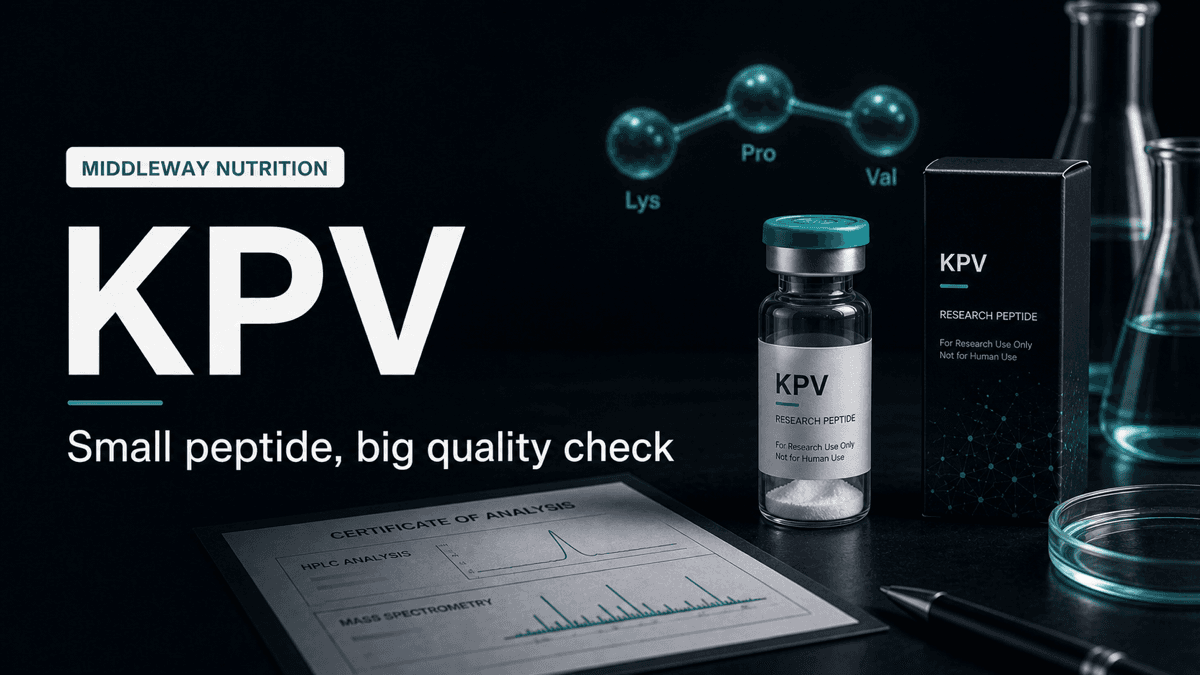
A tripeptide is trivial to synthesize, which means purity percentages are not where the risk lives. Identity is. Ask for a batch-specific certificate of analysis with mass spectrometry confirming the molecule is actually Lys-Pro-Val, check that the batch number on that document matches the vial in your hand rather than a generic file, and look for endotoxin and sterility data if you intend to inject it. Salt form matters too, since acetate and TFA content affect how much actual peptide is in a labeled milligram. Our KPV buying guide walks through which suppliers publish that documentation and which only publish a number.
Looking for the numbers behind this guide? Our KPV dosage chart sets label and trial doses beside what Reddit users report taking.
Frequently Asked Questions
What does KPV peptide do?
It suppresses inflammatory signaling. KPV enters cells through the PepT1 transporter and interferes with NF-kB activation, which reduces output of inflammatory cytokines including TNF-alpha, IL-1beta, and IL-6. The best supported application in the research is intestinal inflammation, followed by inflammatory skin conditions and wound repair. All of that is preclinical.
What are the benefits and side effects of KPV peptide?
The reported benefits are all anti-inflammatory and all preclinical: reduced colonic inflammation and better preserved tight junctions in mouse colitis models, fewer keratinocyte-derived inflammatory mediators in skin models, faster closure in animal wound models, and a contested in vitro antimicrobial effect. The reported side effects are local injection site reactions, mild nausea or looser stools on the oral route at the top of the range, a first-week headache in people who start high instead of titrating up, and short-lived fatigue. Pigmentation, appetite and libido effects are not part of the picture, because KPV does not bind melanocortin receptors. The summary is a narrow mechanism with a mild reported profile and no human trial on either side of the ledger.
Is KPV peptide safe?
Reported adverse effects are mild and uncommon, and KPV avoids the hormonal effects associated with its parent molecule because it does not bind melanocortin receptors. But the FDA has specifically noted the absence of human exposure data, and no long-term human safety study exists. Mild reported side effects from a small user population is a weaker statement than it sounds. Anyone pregnant, immunosuppressed, or with a cancer history should not be self-directing here.
How much KPV peptide do people use?
Reported use clusters around 200 to 500 mcg daily, oral for gut-focused goals and subcutaneous for systemic ones, typically over a four to eight week window. Topical preparations are described at 0.01 to 0.1 percent. These are observed ranges, not established doses, and there is no validated dosing standard to point to.
Are there KPV peptide benefits specific to women?
None that the evidence supports, because no human study of KPV exists in which sexes could be compared. The question comes up because the conditions people reach for KPV over lean female, not because a female-specific effect has been described: the NIDDK puts IBS at up to twice as common in women, and the NIAMS lists rosacea as more common in women. Worth knowing that the mouse colitis work most often cited for KPV used female animals, that reported dosing is not sex-adjusted, and that pregnancy and breastfeeding stay on the avoid list because no exposure data exists either way.
Is KPV peptide legal?
There is no licensed KPV drug product on the US market. It is sold as a research chemical, which is legal to buy and possess for laboratory use but not approved for human administration. FDA's July 2026 briefing document for its Pharmacy Compounding Advisory Committee (fda.gov/media/193346) evaluated KPV (free base and acetate) for the 503A bulk drug substances list and concluded that the evaluation criteria weigh against placing it there, citing a lack of any human data on KPV drug products by any route. That is a staff evaluation ahead of the committee's own recommendation, and as of 2026-10-11 we have not verified a final FDA decision, so check the current status. That process governs whether a compounding pharmacy may use the substance at all, which is a separate question from drug approval, and the position can change again.
Does KPV cause tanning like Melanotan 2?
No. Both derive from alpha-MSH, but KPV comes from the opposite end of the molecule and does not activate melanocortin receptors. Anti-inflammatory activity has been reported to persist in animals whose melanocortin signaling is non-functional, which is the strongest available indication that the pigmentation pathway plays no part in how KPV works.
This article is for informational purposes only and describes compounds sold for research use. KPV is not an approved drug and is not intended to diagnose, treat, cure, or prevent any disease. Nothing here is medical advice or a dosing instruction. Reported ranges reflect what appears in published literature and user discussion, not validated clinical guidance. Speak with a qualified healthcare professional before making any decision about your health, particularly if you have an existing condition or take prescription medication.