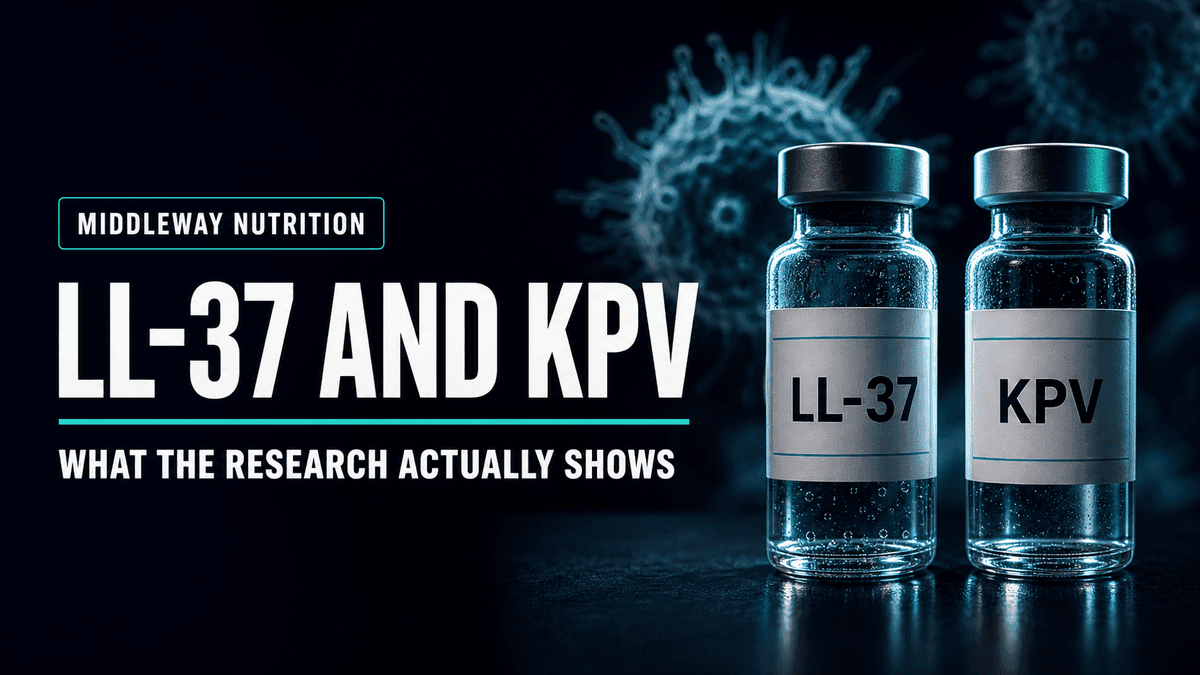
Antimicrobial peptides LL-37 & KPV are frequently sold and discussed together, and they do close to opposite things. LL-37 is a broad-spectrum antimicrobial that also amplifies immune signalling. KPV is an anti-inflammatory fragment that suppresses it. Understanding that difference is the whole point of the comparison.
The category label groups them because both are short peptides with roles in host defence, but treating antimicrobial peptides LL-37 & KPV as interchangeable tools for the same job produces exactly the wrong choice. One turns the immune response up, the other turns it down.
LL-37: The Human Cathelicidin
LL-37 is the only cathelicidin found in humans, a 37 amino acid peptide named for the two leucines at its start. It is produced by neutrophils, epithelial cells and skin keratinocytes, and its expression depends on vitamin D, which is one of the more concrete mechanisms linking vitamin D status to immune function.
Its antimicrobial action is physical rather than metabolic. The peptide is cationic and amphipathic, meaning one face carries positive charge and the other is hydrophobic. Bacterial membranes carry more negative surface charge than human cell membranes, so LL-37 associates with them preferentially and disrupts them. Because the mechanism is structural rather than targeting a specific enzyme, resistance develops less readily than it does with conventional antibiotics, which is a large part of the scientific interest in this class.
It also has a second job. LL-37 acts as a signalling molecule, recruiting immune cells, influencing wound healing and modulating inflammatory responses. That dual role is what makes it interesting and what makes it a poor candidate for casual use.
The Caution With LL-37
The immune amplification cuts both ways. Elevated LL-37 has been implicated in the pathology of several inflammatory skin conditions, rosacea and psoriasis among them, where excess cathelicidin activity contributes to the disease rather than resolving it.
This is not a hypothetical concern. It means someone with an inflammatory skin condition using LL-37 for its antimicrobial reputation may be adding to the mechanism driving their condition. Anyone in that position should treat it as a reason not to, rather than as a footnote.
There is no controlled human trial establishing that supplemental LL-37 treats any infection. Our LL-37 guide covers the compound in more detail.
KPV: The Anti-Inflammatory Tripeptide
KPV is three amino acids, lysine, proline and valine, corresponding to the C-terminal end of alpha-melanocyte stimulating hormone. Alpha-MSH has anti-inflammatory activity, and KPV retains much of it without the pigmentation effects the full hormone carries.
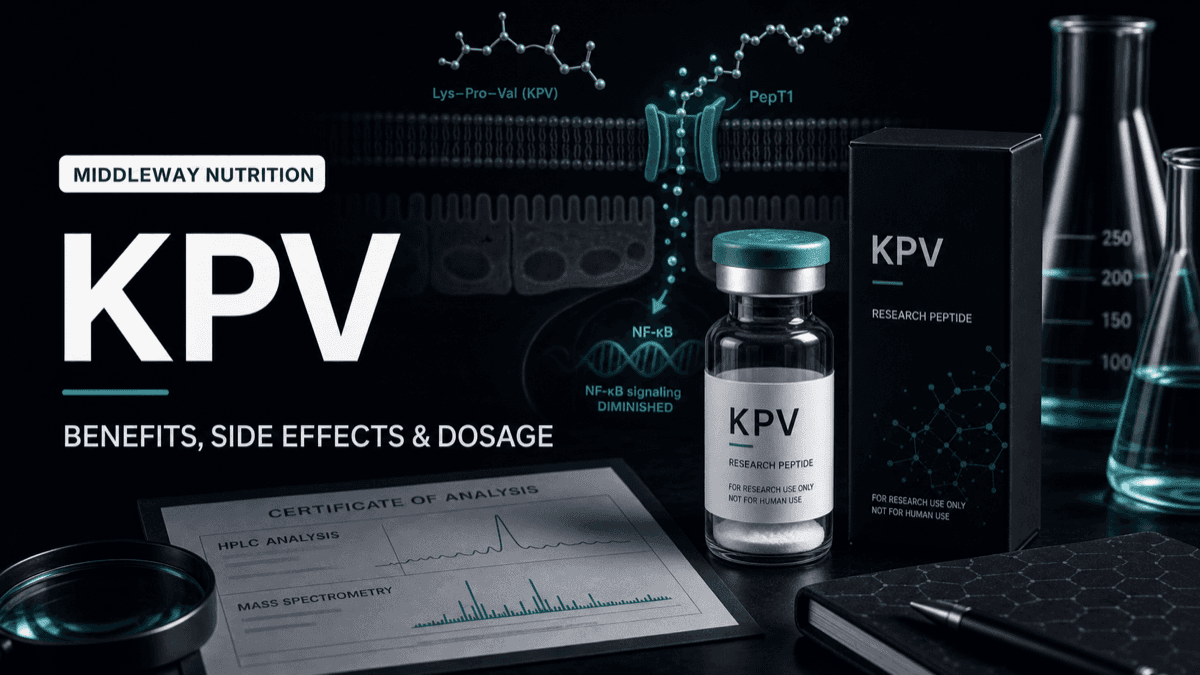
Its mechanism is intracellular. KPV appears to enter cells and interfere with NF-kB signalling, one of the central pathways driving inflammatory gene expression. That is a different kind of action from LL-37 entirely: no membrane disruption, no microbial killing, just suppression of an inflammatory cascade.
The practical detail that makes KPV unusual is absorption. It is taken up through intestinal peptide transporters, and expression of those transporters increases in inflamed gut tissue. Inflammation therefore increases the peptide's own uptake at the site where it is wanted, which is an elegant piece of biology and the basis for oral dosing in gut conditions.
Research interest has centred on colitis and inflammatory bowel disease, with supporting work in animal models, and on inflammatory skin conditions topically. Human trial evidence is limited. Our KPV guide covers it further.
Antimicrobial Peptides LL-37 & KPV Side by Side
| LL-37 | KPV | |
|---|---|---|
| Size | 37 amino acids | 3 amino acids |
| Origin | Human cathelicidin, vitamin D dependent | C-terminal fragment of alpha-MSH |
| Primary action | Disrupts microbial membranes | Suppresses NF-kB inflammatory signalling |
| Effect on immunity | Amplifies | Dampens |
| Oral viability | Poor, injected | Reasonable, absorbed via PepT1 |
| Main research area | Antimicrobial and wound healing | Colitis, IBD, inflammatory skin |
| Key caution | Can worsen inflammatory skin conditions | Little acute risk reported, thin data |
| Reported dose | Around 100 to 500 mcg daily, short courses | 250 to 500 mcg daily, oral or injected |
Doses shown are figures reported in practice, not established protocols. Neither compound is approved for human use.
When Each One Makes Sense
If the problem is inflammatory, and there is no infection component, KPV is the compound with the matching mechanism. Gut inflammation is the use case with the most supporting research behind it, and the oral route works, which is rare.
If the interest is antimicrobial, the honest answer is that LL-37 is not a treatment for infection. It has no trial evidence supporting that use, and a real infection needs a diagnosis and, usually, an actual antibiotic. Delaying proper treatment for an infection while trying a research peptide is one of the genuinely dangerous decisions in this field.
If you have an inflammatory skin condition, LL-37 is the compound to avoid and KPV is the one with a rationale pointing in the right direction.
Using them together is common in blends and is mechanistically odd, since one amplifies and one suppresses immune signalling. The argument made for it is that they act in different compartments and on different timescales. There is no data supporting the combination.
Where the Evidence Actually Is
For LL-37: substantial basic science on structure and mechanism, real interest as a template for future antibiotics, and no controlled human trials of supplemental use.
For KPV: animal models in colitis, mechanistic work on NF-kB and on transporter-mediated uptake, and limited human data.
For both: no long-term safety data, no interaction studies, and no approved indication anywhere.
That places them alongside most of the research peptide category. The specific reason to be careful here is that both compounds act on immune function, and immune modulation has consequences that are less obvious than a sore injection site. Our peptide side effects page covers the wider picture. If you are weighing up sources, our guide on where to buy LL-37 covers vendor checks, certificate red flags and what to expect from a legitimate seller.
FAQ
What is the difference between LL-37 and KPV?
LL-37 is a 37 amino acid antimicrobial peptide that disrupts bacterial membranes and amplifies immune signalling. KPV is a three amino acid fragment of alpha-MSH that suppresses inflammatory signalling. They act in opposite directions on the immune system despite being sold in the same category.
Can LL-37 replace antibiotics?
No. There is no controlled human trial showing that supplemental LL-37 treats any infection, and an untreated bacterial infection can become serious quickly. Its scientific value is as a model for developing future antimicrobials, not as a substitute for one.
Is KPV safe to take orally?
Oral dosing is the route most used for gut conditions, because KPV is absorbed through intestinal peptide transporters whose expression rises in inflamed tissue. Reported side effects are minimal, though there is no controlled safety study, so "safe" here means no observed signal rather than demonstrated safety.
Why can LL-37 make skin conditions worse?
Elevated cathelicidin activity has been implicated in the pathology of rosacea and psoriasis, where excess LL-37 contributes to inflammation rather than resolving it. Adding more to a condition already driven by that mechanism is the wrong direction.
Should LL-37 and KPV be used together?
They are combined in some blends, and the combination has never been studied. Since one amplifies immune signalling and the other suppresses it, the rationale for pairing them is weaker than for most stacks, and starting both at once makes any effect unattributable.