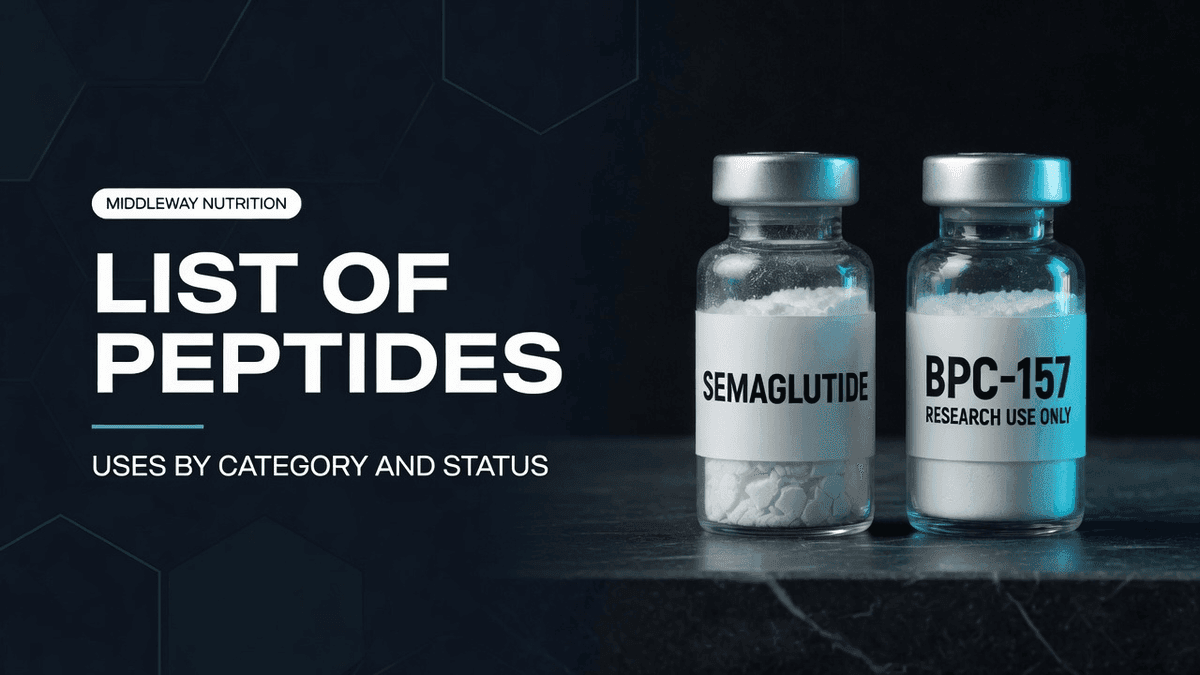
This list of peptides and their uses is organised by what each compound is for, not alphabetically, because the category tells you more than the name does. The single most useful column is the last one: whether a compound is an approved medicine or a research chemical, since that determines everything about how it can be obtained and how much is actually known about it.
Anyone compiling a list of peptides and their uses runs into the same problem, which is that the field mixes drugs with decades of trial data and compounds whose entire human evidence base is forum posts. The tables below keep those apart rather than presenting everything at the same level of confidence.
Doses shown are figures reported in research settings or common practice. They are not recommendations, and for unapproved compounds no authority has established a correct dose.
Metabolic and Weight Loss Peptides
The category with genuine clinical evidence, because these are approved drugs.
| Peptide | What it does | Route | Status |
|---|---|---|---|
| Semaglutide | GLP-1 receptor agonist, reduces appetite and slows gastric emptying | Weekly injection or daily tablet | Approved |
| Tirzepatide | Dual GIP and GLP-1 agonist | Weekly injection | Approved |
| Liraglutide | GLP-1 agonist, shorter acting | Daily injection | Approved |
| Dulaglutide | GLP-1 agonist | Weekly injection | Approved |
| Exenatide | GLP-1 agonist, the original of the class | Twice daily or weekly | Approved |
| Retatrutide | Triple agonist at GLP-1, GIP and glucagon receptors | Weekly injection | Investigational |
| Survodutide | GLP-1 and glucagon dual agonist | Weekly injection | Investigational |
| Cagrilintide | Amylin analogue, often paired with semaglutide | Weekly injection | Investigational |
| Mazdutide | GLP-1 and glucagon dual agonist | Weekly injection | Approved in China, investigational elsewhere |
| AOD-9604 | Fragment of growth hormone studied for fat loss | Injection | Research compound, not approved |
| Adipotide | Targets blood supply to fat tissue | Injection | Preclinical, safety concerns |
Our GLP-1 medications overview covers the approved end of this table properly.
Growth Hormone Support
These do not supply growth hormone. They prompt the pituitary to release more of its own, which is why their side effect profile differs from synthetic HGH.
| Peptide | Mechanism | Reported dose | Status |
|---|---|---|---|
| Sermorelin | GHRH analogue | 200 to 500 mcg before bed | Was approved, brand discontinued |
| Tesamorelin | GHRH analogue with visceral fat data | 2 mg daily | Approved for HIV lipodystrophy |
| CJC-1295 without DAC | Short acting GHRH analogue | 100 to 200 mcg | Research compound |
| CJC-1295 with DAC | Long acting version | 1 to 2 mg weekly | Research compound |
| Ipamorelin | Selective ghrelin receptor agonist | 100 to 300 mcg | Research compound |
| GHRP-2 | Ghrelin receptor agonist, stronger release | 100 to 300 mcg | Research compound |
| GHRP-6 | Ghrelin receptor agonist, marked hunger effect | 100 to 300 mcg | Research compound |
| Hexarelin | Potent secretagogue, desensitises quickly | 100 mcg | Research compound |
| MK-677 | Oral secretagogue, long duration | 10 to 25 mg orally | Research compound |
Repair and Recovery
| Peptide | Main reported use | Route | Status |
|---|---|---|---|
| BPC-157 | Tendon, ligament, gut and soft tissue repair | Injection or oral for gut | Research compound |
| TB-500 | Tendon and ligament injury, systemic distribution | Injection | Research compound |
| KPV | Anti-inflammatory, gut and skin | Injection or oral | Research compound |
| GHK-Cu | Collagen synthesis, skin and wound repair | Topical or injection | Cosmetic ingredient, research compound injected |
| ARA-290 | Studied for neuropathic pain and small fibre neuropathy | Injection | Investigational |
| Cartalax | Bioregulator directed at cartilage tissue | Injection | Research compound |
Longevity and Cellular
The category where the gap between claim and evidence is widest.
| Peptide | Proposed action | Evidence |
|---|---|---|
| Epithalon | Pineal tetrapeptide, telomerase activity claimed | Largely Russian observational work |
| MOTS-c | Mitochondria-derived, metabolic signalling | Animal data, early human work |
| Humanin | Mitochondria-derived, cytoprotective | Preclinical |
| SS-31 (elamipretide) | Stabilises cardiolipin in mitochondria | The strongest here, real clinical trials |
| FOXO4-DRI | Senolytic, targets senescent cells | Preclinical only |
| Bioregulators (Pinealon, Vesugen, Cardiogen, Bronchogen) | Organ-specific peptide signalling | Russian clinical literature, little Western validation |
Cognitive and Mood
| Peptide | Reported use | Route | Status |
|---|---|---|---|
| Semax | Focus, cognitive support | Intranasal or injection | Approved in Russia, research compound elsewhere |
| Selank | Anxiolytic without sedation | Intranasal or injection | Approved in Russia, research compound elsewhere |
| Dihexa | Synaptogenesis, studied preclinically | Oral or injection | Preclinical |
| Cerebrolysin | Mixed neuropeptide preparation | Injection | Approved in several countries |
| P21 | Neurogenesis, preclinical | Injection | Preclinical |
Sexual Health
| Peptide | Mechanism | Route | Status |
|---|---|---|---|
| PT-141 (bremelanotide) | Melanocortin agonist, central arousal pathway | Injection | Approved for HSDD in women |
| Kisspeptin | Upstream of the reproductive hormone axis | Injection | Research compound |
| Gonadorelin | GnRH analogue, fertility and hormone axis | Injection | Approved in some formulations |
| Melanotan-2 | Melanocortin agonist, pigmentation and libido | Injection | Research compound, notable safety concerns |
| Oxytocin | Bonding, social and sexual behaviour | Nasal or injection | Approved for obstetric use |
Melanotan-2 is worth flagging separately in any list of peptides and their uses. It darkens existing moles and can prompt new pigmented lesions, which complicates skin cancer surveillance for years. It is the compound in this table most often used casually and least suited to it.

Immune and Antimicrobial
| Peptide | Reported use | Status |
|---|---|---|
| Thymosin alpha-1 | Immune modulation, used clinically in several countries | Approved outside the US in some indications |
| LL-37 | Cathelicidin, broad antimicrobial activity | Research compound |
| KPV | Anti-inflammatory, alpha-MSH fragment | Research compound |
| Thymulin | Thymic peptide, immune regulation | Research compound |
Sleep
| Peptide | Reported use | Status |
|---|---|---|
| DSIP | Sleep architecture, stress regulation | Research compound |
| Epithalon | Melatonin pathway effects claimed | Research compound |
How to Read This List of Peptides and Their Uses
Three things are worth taking from it.
Approval status is the strongest signal. An approved drug has been through trials that found its side effects and quantified its benefit. A research compound has not. That does not make research compounds useless, but it does mean any confident claim about one is running ahead of the evidence.
Category predicts side effects better than individual compound. Everything in the growth hormone section shares a profile of fluid retention, tingling and glucose effects. Everything in the melanocortin group shares flushing and nausea. Our peptide side effects breakdown works through this.
The longevity section is where scepticism pays. Mechanistic plausibility is cheap. Several of those compounds have been promoted for a decade without a single controlled human trial appearing.
FAQ
How many peptides are there?
Hundreds of therapeutic peptides exist and roughly a hundred have been approved as drugs worldwide, insulin and oxytocin among the oldest. The list of compounds in active non-prescription use is much shorter, perhaps thirty to forty that account for almost all discussion.
Which peptides are FDA approved?
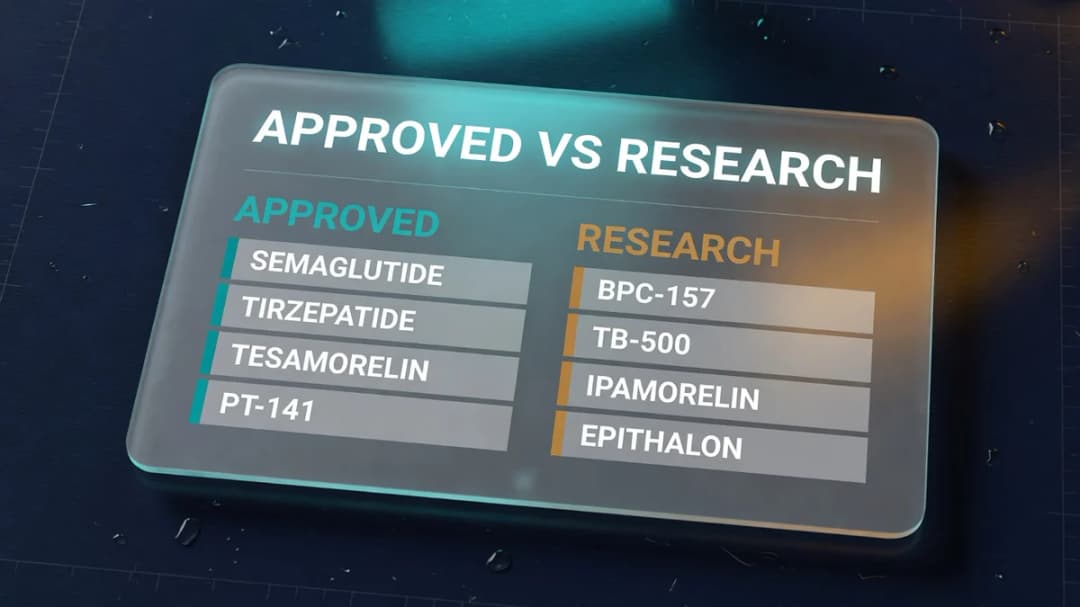
The approved list includes insulin analogues, semaglutide, tirzepatide, liraglutide, dulaglutide, exenatide, tesamorelin, bremelanotide, oxytocin and others. Compounds such as BPC-157, TB-500, ipamorelin and epithalon are not approved and are sold for research use only.
What is the most researched peptide?
Insulin, by a very large margin, with a century of clinical use behind it. Among the compounds people usually mean by "peptides", semaglutide has the largest modern trial base, and among unapproved research compounds BPC-157 has the most preclinical literature.
Are peptides drugs or supplements?
Neither category fits cleanly, which is the source of most confusion. Approved peptides are drugs. Unapproved peptides are not supplements either, since they are not sold under dietary supplement rules; they are sold as research chemicals, which is a third category with different obligations.
Which peptides can be taken orally?
Very few, because digestive enzymes cleave peptide bonds. Oral semaglutide works using an absorption enhancer and still delivers around one percent of the dose. MK-677 is orally active because it is not a peptide. BPC-157 and KPV are the research compounds most often taken orally, and in both cases the target is the gut itself.