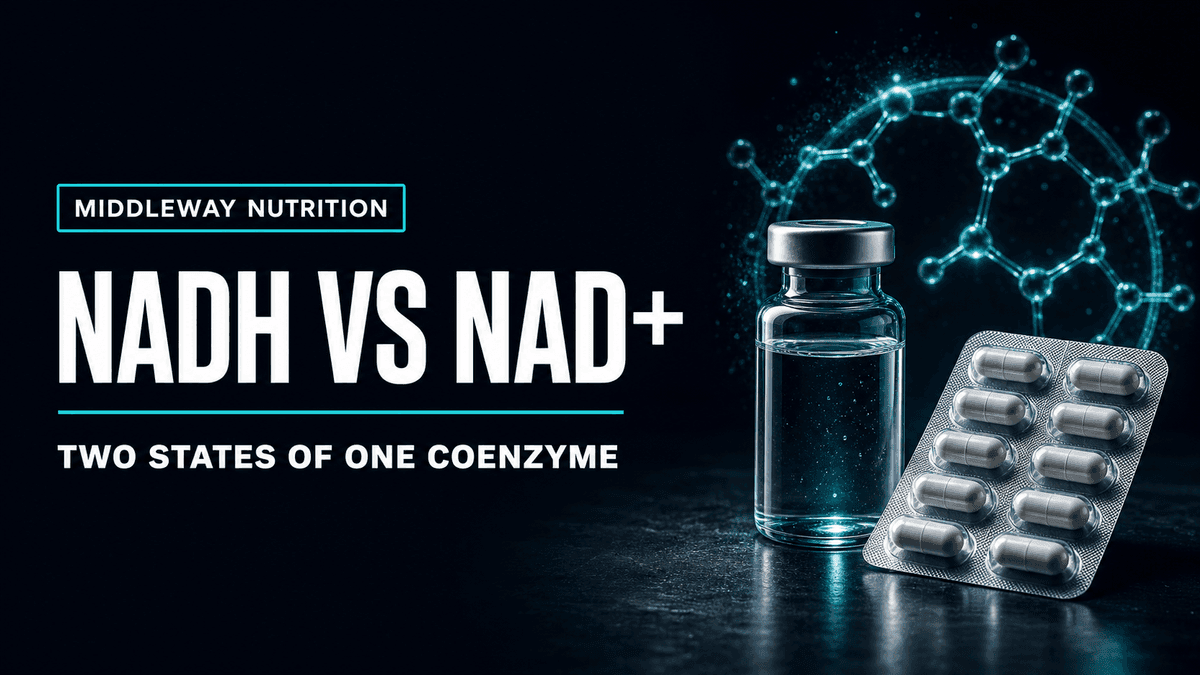
NADH vs NAD+ is not a contest between two supplements. They are the reduced and oxidised forms of a single coenzyme, nicotinamide adenine dinucleotide, cycling between states thousands of times a second inside every cell. Framing NADH vs NAD+ as rivals is the root of most of the confusion in this category, and it leads people to buy the form their cells are least short of.
The practical consequence is straightforward. A shortage of the reduced form is not what ageing produces. What shrinks is the size of the pool itself, the total quantity of the coenzyme available in either state. That is why longevity research targets precursors that expand the pool rather than either individual form.
NADH vs NAD+: What Separates Them
NAD+ is the oxidised form. It has no cargo and is available to accept electrons from fuel molecules.
NADH is the reduced form. It has picked up two electrons and a proton and is carrying them to the mitochondrial electron transport chain, where it hands them over and reverts to NAD+.
| NAD+ | NADH | |
|---|---|---|
| Redox state | Oxidised | Reduced |
| Role | Electron acceptor, oxidising agent | Electron donor, reducing agent |
| Where it is consumed | Glycolysis, citric acid cycle, sirtuin and PARP reactions | Complex I of the electron transport chain |
| Relative abundance in cytosol | Dominant | Small fraction of the free pool |
| Regenerated by | Handing electrons off at the mitochondria, or by fermentation | Accepting electrons during fuel breakdown |
In healthy cytoplasm the free NAD+ to NADH ratio is heavily skewed toward the oxidised form, on the order of several hundred to one. That skew is not a deficiency. It is the working state the cell maintains deliberately, because having empty carriers available is what allows metabolism to keep moving.
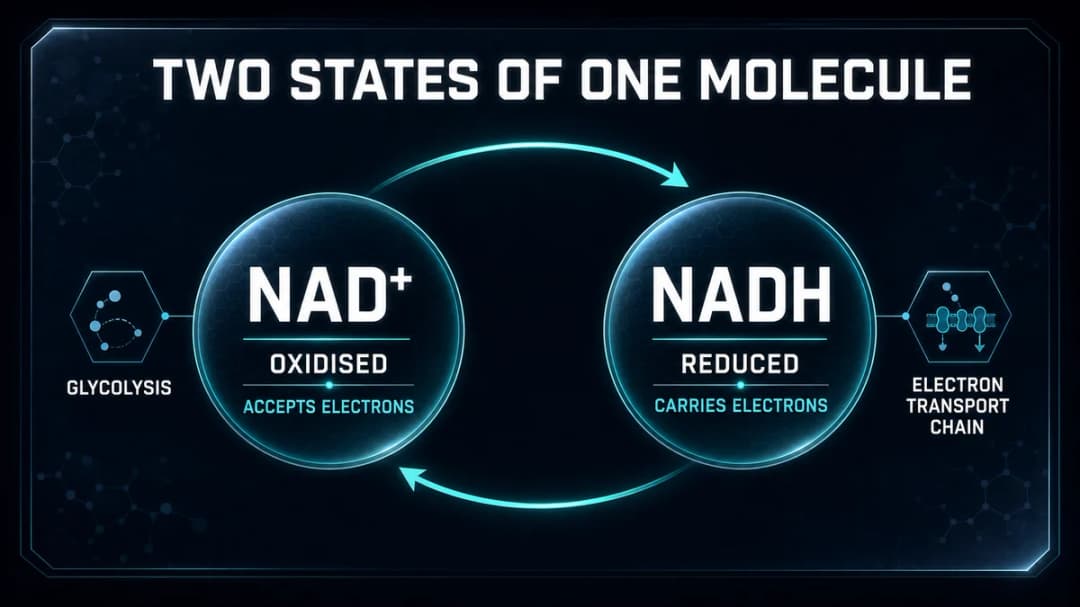
Where NAD Sits in Glycolysis
This is the question most often asked in a biochemistry exam context, and it has a clean answer.
Glycolysis breaks one glucose molecule into two pyruvate molecules, yielding a net two ATP and two NADH. NAD+ is a participant that gets consumed at the step catalysed by glyceraldehyde 3 phosphate dehydrogenase, where it is reduced to NADH. So NADH is a product of glycolysis and NAD+ is a substrate for it.
The regeneration step is the one worth remembering. Glycolysis cannot continue unless NAD+ is restored. Under aerobic conditions the mitochondria do this by accepting NADH's electrons. Under anaerobic conditions, such as a sprinting muscle, pyruvate is converted to lactate specifically to regenerate NAD+. Lactate production is not a waste process; it exists to keep the NAD+ supply running.
So Should You Take NADH?
Stabilised oral NADH is sold as a supplement, and there is a small trial literature behind it. Randomised work in chronic fatigue syndrome used doses around 10 mg daily and reported modest symptom improvement. Older work in Parkinson's disease was largely uncontrolled and has not been convincingly replicated. Some studies have combined NADH with coenzyme Q10, which makes the contribution of NADH alone harder to isolate.
Taken together, the case for oral NADH is weak but not empty. It is a small evidence base, mostly decades old, in specific clinical populations, with little bearing on healthy adults taking it for energy or longevity.
The mechanistic argument against it is more persuasive than the trial data either way. If the limiting factor is the total size of the NAD pool rather than the proportion sitting in the reduced state, then adding NADH addresses the wrong variable. Precursors such as nicotinamide riboside and NMN expand the pool, and they are what the modern trials use.
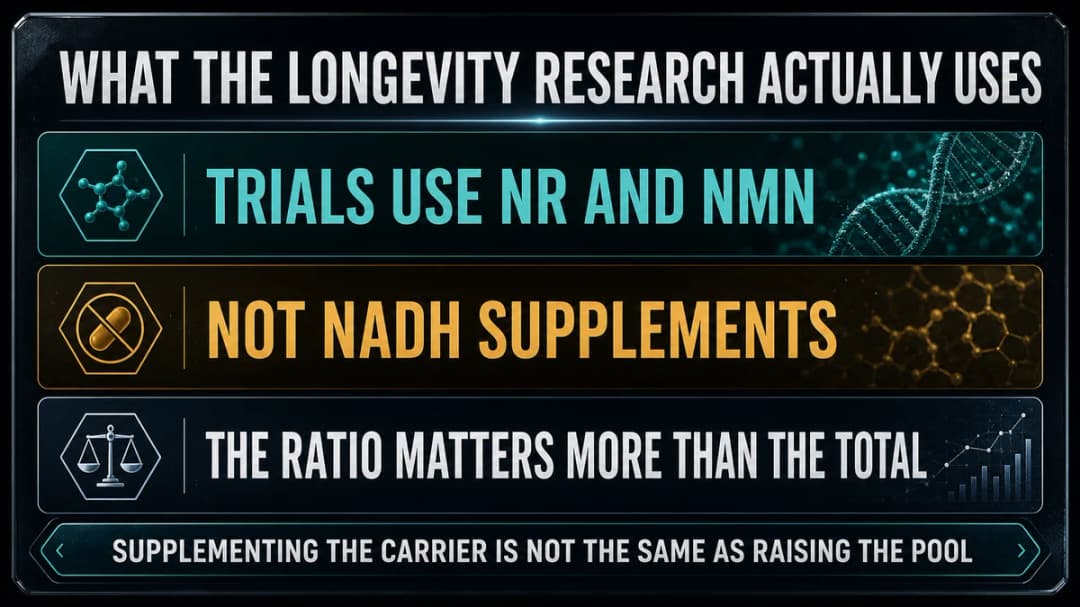
What the Longevity Research Actually Uses
Almost all recent human work on NAD targets the salvage pathway with a precursor rather than supplying either redox form directly.
| Approach | What it does | Human evidence |
|---|---|---|
| Nicotinamide riboside | Precursor, enters the salvage pathway | Several small randomised trials, reliably raises blood NAD+ |
| NMN | Precursor, one step from NAD+ | Small randomised trials, raises NAD+, mixed functional results |
| Oral NADH | Supplies the reduced form directly | Limited old trials in specific conditions |
| Oral NAD+ | Supplies the coenzyme directly | Largely degraded before absorption |
| Injected NAD+ | Bypasses the gut | Little controlled evidence |
The honest summary of the entire category is that raising blood NAD+ in humans is now well demonstrated, and demonstrating that it changes anything a person would notice is still work in progress. Our NAD+ guide goes further into what the trials have and have not shown, and the NAD+ vs NMN comparison covers the precursor question specifically.
Practical Notes
- Niacin, nicotinamide, nicotinamide riboside and NMN all feed the same pool by different entry points. They are not interchangeable in cost or side effect profile, but they share a destination
- High dose nicotinamide can cause flushing at some forms and doses, and very high intakes have been associated with liver enzyme changes
- NADH is unstable and requires stabilised formulations, which is part of why it is expensive relative to its evidence
- None of these compounds is an approved treatment for fatigue, cognitive decline or ageing
- Exercise raises NAD related signalling reliably and costs nothing, which is a genuinely awkward comparison for the supplement case
That last point deserves more attention than it gets. Physical activity influences the same metabolic machinery these products target, with decades of outcome evidence behind it rather than weeks of surrogate marker data. Anyone considering a precursor who is not already training regularly is optimising the wrong variable first.
FAQ
Is NAD oxidised or reduced?
Both, depending on the step. NAD+ is the oxidised form and NADH is the reduced form. NAD is reduced to NADH during glycolysis and the citric acid cycle, and NADH is oxidised back to NAD+ at the electron transport chain.
Is NADH better than NAD+ for energy?
There is no good evidence that it is. Cells are not short of the reduced form; they are short of total NAD as the pool shrinks with age and metabolic stress. Supplements that expand the pool are the more logical target, though their functional benefits in humans remain unproven.
How many NADH molecules does glycolysis produce?
Two per glucose molecule, along with a net two ATP and two pyruvate. Those NADH molecules must be reoxidised for glycolysis to continue, which happens either at the mitochondria or through lactate formation.
Can you take NADH and an NAD+ precursor together?
Nothing suggests a harmful interaction, but there is no evidence the combination outperforms a precursor alone. Given the cost of stabilised NADH, the combination is difficult to justify on current data.
Does a low NAD+ to NADH ratio mean something is wrong?
A shifted ratio is seen in some metabolic and mitochondrial disease states and is a research marker rather than something measurable in routine practice. Commercial tests claiming to report your NAD status should be treated cautiously, since sampling and stability issues make the measurement difficult.