In the NAD+ vs NMN comparison, NMN is the more sensible oral choice and NAD+ only makes sense if it is being delivered by injection or infusion. The reason NAD+ vs NMN generates so much argument online is that most comparisons ignore the route of administration, which is the variable that actually decides the answer.
NAD+ is nicotinamide adenine dinucleotide, a coenzyme every cell uses in hundreds of reactions. NMN, nicotinamide mononucleotide, sits one enzymatic step upstream of it. Neither is a peptide, and neither is an approved medicine for any longevity indication.
NAD+ vs NMN: Which Should You Actually Take?
| Oral NAD+ | Oral NMN | Injected or infused NAD+ | |
|---|---|---|---|
| Reaches cells intact | Poorly. Largely broken down before absorption | Better, though still degraded in part | Yes, directly into circulation |
| Human trial evidence | Very limited | Several small randomised trials | Mostly uncontrolled clinic reports |
| Practical cost | Poor value for the delivered dose | Moderate | High, particularly for IV |
| Regulatory position | Sold as a supplement in many markets | Contested in the United States | Compounded or research use, not an approved therapy |
| Sensible use case | Rarely the best option | Daily maintenance | Not established by controlled evidence |
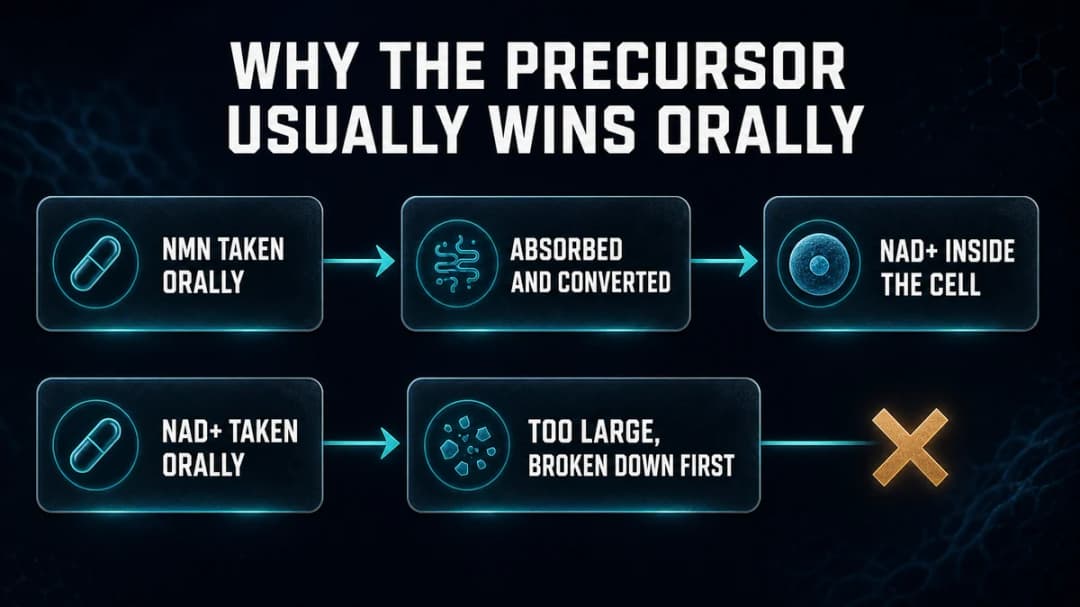
The short version: swallowing NAD+ is an inefficient way to raise NAD+, because the molecule is large, charged, and is broken down in the gut into smaller precursors before anything is absorbed. What ends up in your bloodstream after an oral NAD+ capsule is largely nicotinamide and related fragments, which is roughly what you would get from a cheaper precursor.
Why the Precursor Usually Wins Orally
NAD+ is not transported across the intestinal wall intact in any meaningful quantity. It is dephosphorylated and cleaved, then reassembled inside cells through the salvage pathway. That reassembly is the same route a precursor takes, so paying a premium for the finished coenzyme in oral form buys very little.
NMN is smaller and closer to the finished product, requiring a single enzymatic conversion once inside the cell. Whether NMN is absorbed intact or first converted to nicotinamide riboside in the gut is still argued about. A dedicated NMN transporter was described in mice and remains contested for humans. From a practical standpoint the distinction matters less than it sounds, because both routes end at the same salvage pathway.
What the Human Trials Show
This is where the marketing and the evidence separate.
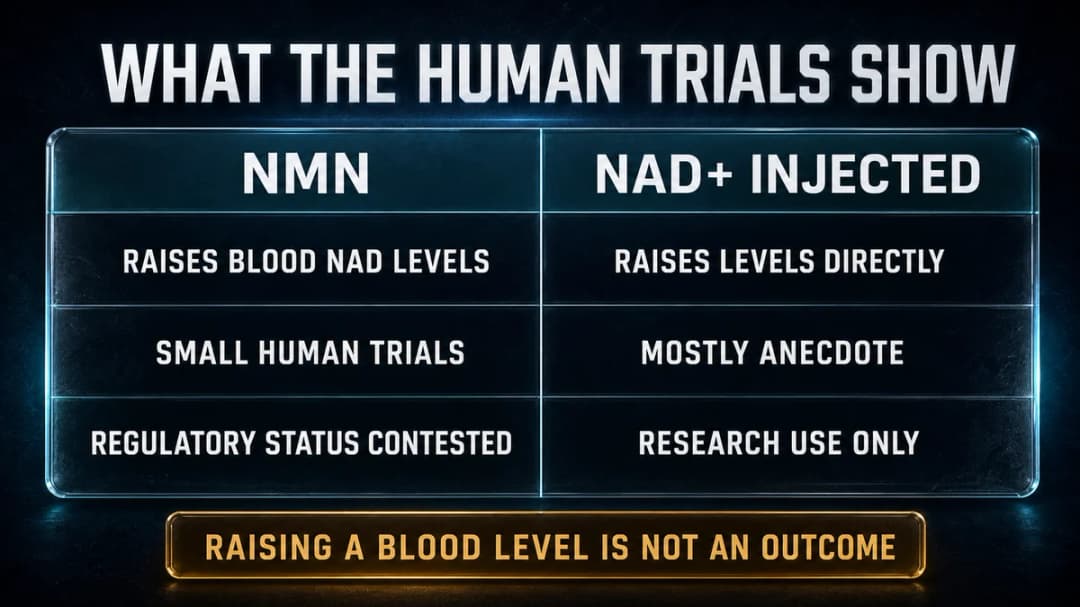
Small randomised trials of oral NMN have shown that it raises blood NAD+ concentrations reliably. Beyond that, findings are modest and inconsistent. Improvements have been reported in aerobic capacity in older amateur runners, and in skeletal muscle insulin sensitivity in a small trial of prediabetic postmenopausal women. Nicotinamide riboside, the other well studied precursor, similarly raises NAD+ in blood and has shown effects on measures of arterial stiffness and blood pressure in small studies of older adults.
What has not been shown in humans is the headline claim. No trial has demonstrated that raising NAD+ with any precursor extends human lifespan, reverses biological ageing, or produces the effects seen in aged mice. Trials to date have been short, small, and focused on surrogate markers.
That does not make the compounds useless. It makes them promising early stage interventions with a good safety record and unproven long term benefit, which is a different thing from what the category is usually sold as.
Regulatory Status Is Part of the Comparison
NMN's position in the United States has been unstable since the FDA took the view that it is excluded from the dietary supplement definition, on the grounds that it had been investigated as a drug. Availability has fluctuated as a result, and some retailers have shifted to nicotinamide riboside or plain nicotinamide instead.
NAD+ sold for injection is not an approved medicine either. Products marketed for research use are not manufactured under the standards applied to injectable drugs, and sterility, endotoxin content and purity vary between suppliers. Anyone considering that route should read our NAD+ injections guide and treat vendor claims with the same scepticism as any other unapproved injectable.
Dosing Ranges Reported in the Literature
These are ranges used in published human studies, not recommendations. Nothing here constitutes a dosing protocol.
| Compound | Range used in human studies | Notes |
|---|---|---|
| NMN, oral | Commonly 250 to 1,000 mg daily | Higher doses studied without notable safety signals over short trials |
| Nicotinamide riboside, oral | Commonly 250 to 1,000 mg daily | The most studied precursor by trial count |
| NAD+, oral | No meaningful trial base | Absorption makes the dose largely academic |
| NAD+, injected | No controlled dose finding data | Infusion protocols vary widely between clinics |
Methyl donors such as trimethylglycine are frequently recommended alongside NAD+ precursors on the theory that clearing excess nicotinamide consumes methyl groups. The reasoning is plausible. Controlled evidence that supplementing methyl donors alongside a precursor changes any outcome in humans is not there.
How to Decide
- If the goal is daily maintenance at reasonable cost, an oral precursor is the only sensible option, and nicotinamide riboside has the deepest trial base
- If the appeal of injectable NAD+ is speed of effect, be clear that the evidence for what that speed achieves is anecdotal
- If you are comparing prices, compare cost per gram of the actual active compound, not per capsule
- If a product claims to reverse ageing, that claim is ahead of the data regardless of which molecule is in the bottle
For the broader picture, see our NAD+ guide and, if you are evaluating suppliers, where to buy NAD+.
FAQ
Is NMN better than NAD+?
For oral use, yes, in the practical sense that more of it survives to raise NAD+ levels. As molecules they are not competitors, since NMN exists to become NAD+. If NAD+ is being delivered by injection the comparison changes, but that route has far weaker evidence behind it.
Does oral NAD+ work at all?
It raises NAD+ indirectly, because it is broken down into precursors that are then absorbed and reassembled. That makes it an expensive way to deliver something a cheaper precursor delivers directly. There is no good trial evidence supporting oral NAD+ specifically.
Can you take NMN and NAD+ together?
You can, and no interaction problem is known. Whether it achieves anything beyond taking a precursor alone has not been tested. Stacking is a marketing convention in this category rather than an evidence based practice.
How long before NAD+ or NMN has an effect?
Blood NAD+ concentrations rise within days to a couple of weeks of starting an oral precursor. Whether anything you can feel follows is much less certain, and the trials that reported functional improvements ran for six to twelve weeks.
Are there side effects?
Both are generally well tolerated in short trials, with occasional nausea, flushing and headache. The larger unknown is long term use, since no trial has run for years. See our NAD+ side effects guide for detail.