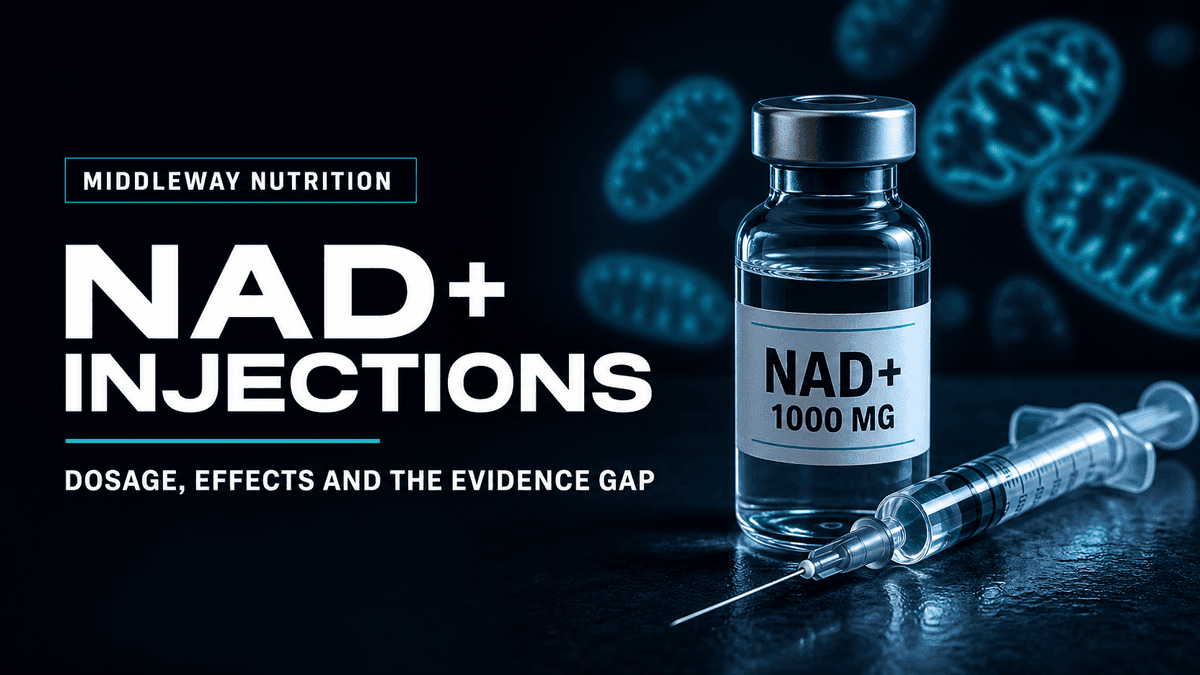
NAD+ injections deliver nicotinamide adenine dinucleotide under the skin or into a vein, which reliably raises circulating NAD+ in a way oral capsules do not, but no controlled trial has established what that rise achieves in a healthy adult. Anyone considering NAD+ injections should hold those two facts together: the delivery problem is genuinely solved, and the benefit question is genuinely open.
NAD+ is a coenzyme involved in energy metabolism, DNA repair and sirtuin signalling. Levels in tissue appear to fall with age, though how much and in which tissues is less settled in humans than the marketing suggests.
Why Injection Rather Than a Capsule
Swallowed NAD+ does not reach cells intact. It is a large, charged molecule that is cleaved in the gut into smaller precursors, which are then absorbed and reassembled into NAD+ inside cells. Paying for the finished coenzyme in oral form is therefore an expensive way to deliver its building blocks.
Subcutaneous and intravenous routes bypass that entirely. Circulating NAD+ rises within a couple of hours of a subcutaneous injection and essentially immediately during an infusion.
What that does not settle is whether the extra circulating NAD+ reaches the tissues that matter, or whether it is simply degraded in plasma to nicotinamide and taken up through the ordinary salvage pathway, arriving at the same place a much cheaper precursor would have reached.
NAD+ Injections: Dosage Ranges People Report
These are ranges described in clinic protocols and user reports, not a recommendation and not a validated dosing schedule. No dose finding trial exists for subcutaneous NAD+ in healthy adults.
| Route | Reported range | Frequency reported | Notes |
|---|---|---|---|
| Subcutaneous | 50 to 100 mg | Starting point | Where most people begin, to assess tolerance |
| Subcutaneous | 100 to 300 mg | Two to five times weekly | The commonly described maintenance band |
| Intramuscular | 50 to 200 mg | Similar to subcutaneous | More discomfort reported at the site |
| Intravenous infusion | 250 to 1,000 mg | Weekly to monthly at clinics | Must be infused slowly. Rapid infusion causes chest tightness and nausea |
Two practical points come up repeatedly. Subcutaneous NAD+ stings, sometimes considerably, and the burn scales with dose and concentration. And infusion rate matters more than infusion dose for tolerability: pushing NAD+ quickly produces flushing, chest pressure and a wave of nausea that resolves when the rate is slowed.
What People Report, and What Has Been Measured
Reported effects cluster around subjective energy, mental clarity and sleep quality. Some clinics also market it for addiction recovery and post viral fatigue.
Measured effects are a much shorter list. Injectable and infused NAD+ raise plasma NAD+ and its metabolites. Beyond that, the published human literature is dominated by uncontrolled case series and clinic observations, with no adequately powered randomised trial of injectable NAD+ for any of the outcomes it is sold for.
That gap matters because the conditions NAD+ infusion is marketed for, fatigue and brain fog in particular, are precisely the conditions with the largest placebo response in controlled trials. Uncontrolled reports cannot distinguish the compound from the setting.
By contrast, oral precursors such as nicotinamide riboside and NMN do have small randomised trials behind them, and those trials show reliable NAD+ elevation with modest and inconsistent functional effects. If the goal is raising NAD+ at low cost with the better evidence base, the precursor route is the more defensible one. See our NAD+ vs NMN comparison for that argument in full.
Product Quality Is a Real Variable
NAD+ sold in vials for research use is not manufactured to the standards applied to injectable medicines. Sterility, endotoxin content and purity are the vendor's claims rather than a regulator's requirement.
If you are evaluating a supplier, the meaningful checks are a batch specific certificate of analysis with HPLC purity, third party rather than in house testing, and lyophilised presentation with clear reconstitution instructions. Our NAD+ buying guide covers what a usable COA looks like.
NAD+ is also unstable in solution. Reconstituted vials degrade faster than many peptides, so refrigeration and a short in use window matter more here than for most compounds. A solution that has yellowed has degraded, and the sensible response is to discard it rather than to use it up.
Sterility deserves particular attention with this compound because the injection volumes are larger than for most peptides and the frequency is higher. More injections into more sites, with a solution that does not keep well, is a combination that punishes casual technique. New needles every time, alcohol swabs, and no reuse of a vial past its window are the basics.
Side Effects Reported with Injection
- Burning or stinging at the injection site, common and dose related
- Flushing, particularly with faster infusion
- Nausea, often the first sign an infusion is running too quickly
- Headache and transient fatigue after dosing
- Chest tightness during rapid IV administration, which should stop the infusion
- Muscle cramps and lightheadedness at higher doses
Anyone with active cancer, anyone pregnant or breastfeeding, and anyone on chemotherapy should not use NAD+ products without oncology or obstetric input. The concern with cancer is theoretical rather than demonstrated: tumour metabolism is often NAD dependent, and supplying more of a substrate a tumour uses is a reasonable thing to be cautious about until there is data.
Full detail is in our NAD+ side effects guide.
FAQ
How long do NAD+ injections take to work?
Plasma NAD+ rises within one to two hours of a subcutaneous injection. Whether anything subjectively changes on that timescale is a different question, and the reports are inconsistent. Nothing in the controlled literature supports a specific onset for a functional effect.
Are NAD+ injections better than IV drips?
They deliver the same molecule at lower cost and without a clinic visit, at the price of a slower rise and a stinging injection. Neither route has controlled evidence establishing benefit, so the comparison is about convenience and cost rather than efficacy.
How often should NAD+ be injected?
Protocols in circulation range from twice weekly to daily, and none is evidence based. Given the absence of dose finding data, less frequent and lower dose is the more conservative starting position, taken up only if tolerated.
Do NAD+ injections help with fatigue?
Many users say so. No adequately controlled trial has tested it, and fatigue is a symptom with a very large placebo response, so the anecdotal reports cannot settle the question. Persistent fatigue deserves a medical workup rather than a supplement.
Is injectable NAD+ legal?
It is sold in most markets as a research chemical rather than an approved medicine, and it is not licensed to treat any condition. Compounded versions are available through some clinics. The regulatory position varies by country and is worth checking locally.