Peptides for beginners 2026 comes down to three decisions: pick one compound with a use case that matches your actual problem, buy it from a supplier that publishes batch-specific third-party testing, and run it long enough on its own to know whether it did anything. Almost every bad first experience with peptides traces back to skipping one of those three.
This guide is written for someone starting from zero. Peptides for beginners is a crowded search term and most of what ranks for it is either a product page in disguise or a wall of mechanism with no practical guidance. What follows is the shape of the category, an honest sort of what has evidence behind it, and the buying checks that matter.
What a Peptide Actually Is
A peptide is a chain of amino acids, conventionally between two and roughly fifty of them. Longer than that and it is called a protein. Insulin sits right at the boundary. Oxytocin is nine amino acids. BPC-157 is fifteen.
The important part is what they do. Peptides are signalling molecules. They bind a receptor and trigger a response inside the cell. They are not extra protein for your body to build with, which is why doses are measured in micrograms and milligrams rather than the grams you eat at dinner. A 250 mcg dose is roughly a hundred thousand times smaller than a day's protein intake, and it works because it is a signal, not a raw material.
That also explains why almost all of them are injected. Digestive enzymes cleave peptide bonds, so most peptides swallowed as tablets never reach circulation intact. Oral semaglutide gets around this with an absorption enhancer and still delivers only around one percent of the dose.
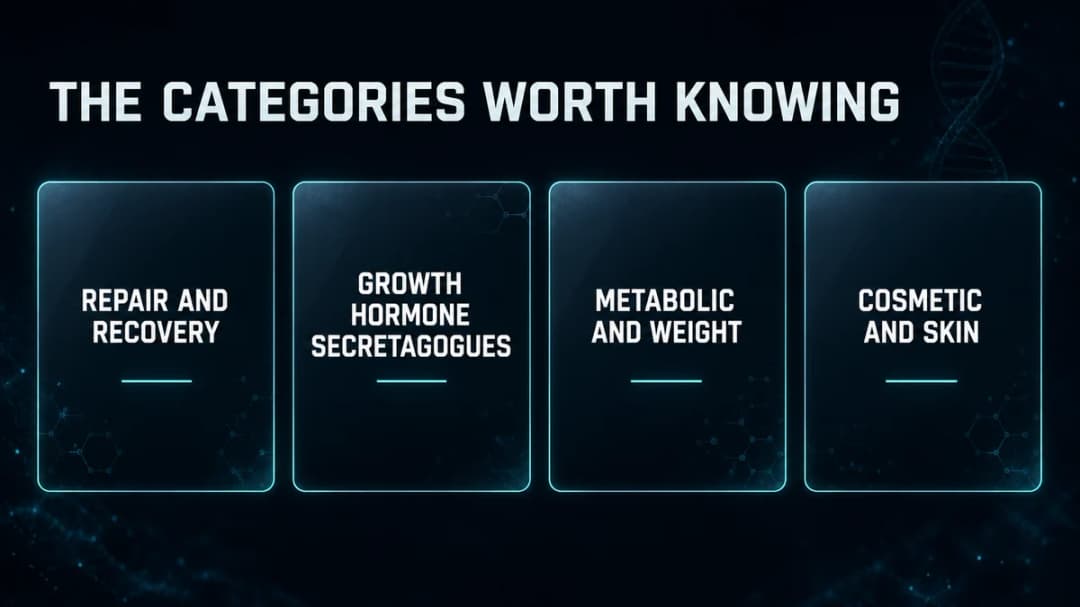
Peptides for Beginners 2026: The Categories Worth Knowing
| Category | Common compounds | How strong is the evidence |
|---|---|---|
| Metabolic and weight loss | Semaglutide, tirzepatide, liraglutide, retatrutide | Strong. Large randomised trials, approved drugs |
| Growth hormone support | Sermorelin, ipamorelin, CJC-1295, tesamorelin | Mixed. Tesamorelin and sermorelin have real clinical data, the others less |
| Repair and recovery | BPC-157, TB-500, KPV | Weak in humans. Mostly animal models and user reports |
| Skin and hair | GHK-Cu | Moderate topically, thin for injection |
| Longevity | Epithalon, MOTS-c, FOXO4-DRI, bioregulators | Thin. Mechanism is plausible, human trials are small or absent |
| Cognitive and mood | Semax, Selank, Dihexa | Thin outside Russia, where several have long clinical use |
| Immune | Thymosin alpha-1, LL-37 | Thymosin alpha-1 has genuine clinical use in several countries |
| Sleep | DSIP | Thin, mostly older observational work |
If you are new to this, notice how much of the table says the evidence is thin. That is not a reason to avoid the category, but it is a reason to be suspicious of any page that describes a research peptide with the confidence normally reserved for approved medicines.
The one category where the evidence is genuinely strong is the metabolic one, and those are prescription drugs. Our overview of peptides for weight loss covers that side; peptides for muscle growth covers the growth hormone family.
A Sensible First Cycle
The single most common beginner mistake is starting three compounds at once. When something changes, good or bad, you have no idea which one did it, and you have spent three times the money to learn nothing.
A workable structure looks like this:
Before you inject anything. Get baseline bloods if you can, at minimum a metabolic panel and lipids. Write down what you are actually trying to change and how you would measure it. "Better recovery" is not measurable. "Shoulder still aches on overhead press after eight weeks" is.
Weeks one and two. One compound, at the low end of the reported range. Track sleep, appetite, injection site response and whatever your target symptom is. Most side effects that are going to appear will appear here.
Weeks three to six. If tolerance is fine, this is where a step up to a standard dose is reasonable. Change one variable at a time. Never change dose and frequency in the same week.
Weeks six to twelve. Evaluate honestly against what you wrote down at the start. If nothing has moved, adding a second peptide to rescue the first one is the wrong move. Stop and reassess.
What Beginners Should Expect to Spend
Prices move, but the ranges below are the realistic 2026 picture for research peptides sold as lyophilised powder.
| Item | Typical range | Note |
|---|---|---|
| Common repair peptide, 5 to 10 mg vial | $35 to $80 | Under roughly $3 per mg deserves scrutiny, not excitement |
| Growth hormone secretagogue, 5 to 10 mg vial | $40 to $90 | Blends are usually priced per stack |
| Bacteriostatic water, 30 mL | $8 to $15 | Buy this at the same time, not after |
| Insulin syringes, 100 count | $15 to $25 | 29G to 31G, half inch, is standard |
| Third-party testing | Included or nothing | If a vendor charges for a COA, walk away |
Budget for the accessories on the first order. A vial with nothing to reconstitute it with is a common and avoidable false start. Our peptide reconstitution calculator handles the dose maths once the vial arrives.
Where to Buy Peptides as a Beginner
This is where beginners lose money, and price is a poor guide. Two vials at the same price can differ enormously in what is actually inside them, because there is no regulator checking. The documentation is the only signal you have. Our BPC-157 vial prices and lot checks page shows what that documentation looks like on one compound.
Require all of the following before you order:
- A batch-specific certificate of analysis. The lot number printed on your vial should appear on the document. A generic product-level PDF that never changes is not a COA in any meaningful sense.
- HPLC purity at or above 98%, with the chromatogram visible rather than just a number typed into a table.
- Mass spectrometry identity confirmation. Purity tells you the sample is clean. Identity tells you it is the right molecule.
- Sterility or endotoxin testing for anything injectable.
- A real business presence. Address, working support channel, published refund policy.
- No therapeutic claims. A vendor promising to heal your injury is telling you they are willing to break the rules they operate under, which is not a good sign about the rest of their operation.
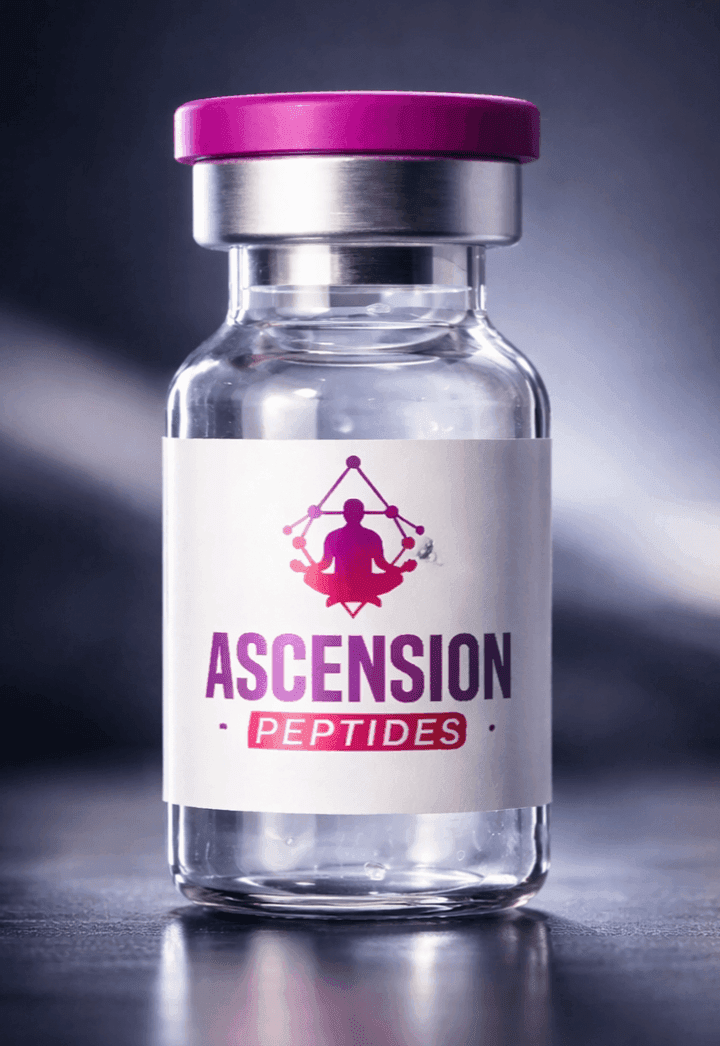
For a vetted starting point, Ascension Peptides is our house recommendation for research peptides. Every batch is independently tested (currently by Kovera Labs), and the certificates cover HPLC purity against a >98% pass mark, LC-MS identity, net content, endotoxin, a rapid sterility screen and heavy metals, with 85 batch-specific certificates in a public library. Their catalogue covers the common beginner compounds, including BPC-157 at $49.00 USD for 10 mg. They do not sell bacteriostatic water, so budget for the diluent from a separate source. Note that they ship within the US only and all sales are final, with damaged or incorrect items replaced if reported quickly. Compare against anyone else you are considering using the same criteria rather than taking our word for it.
What to Avoid in Your First Six Months
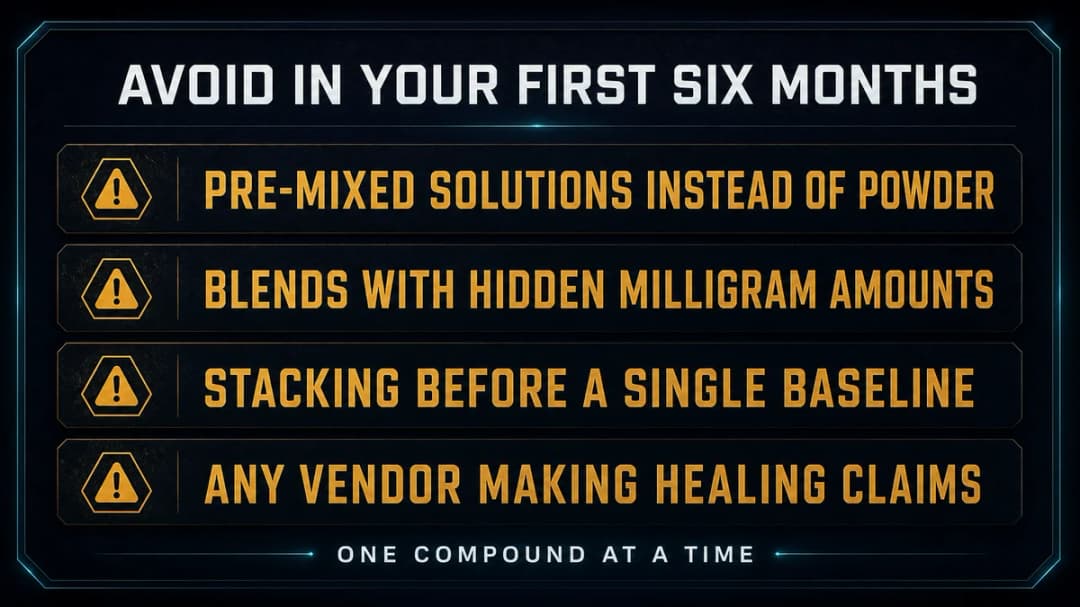
Pre-mixed solutions rather than lyophilised powder. Reconstituted peptide degrades, and a vendor shipping it wet is either not thinking about stability or is hiding something about content.
Blends where you cannot see the individual milligram amounts. Convenient, opaque, and impossible to titrate.
Anything sold with a countdown timer or a claim about curing something. Urgency is a sales technique, not a property of biology.
Melanotan-2 as a starter compound. Mole darkening is a real, documented effect and it complicates skin cancer surveillance for years afterwards. It is a poor first peptide regardless of what it does for tanning.
FAQ
What is the best peptide for a beginner to start with?
There is no universal answer, because the right compound depends on the problem. For weight loss, the evidence-backed route is a prescribed GLP-1 medicine through a clinician rather than anything from a research supplier. For soft tissue recovery, BPC-157 is the most commonly used starting point, with the caveat that its human evidence is limited.
Do peptides need to be injected?
Most do. Digestive enzymes destroy the majority of peptides before absorption, so subcutaneous injection is the reliable route. A handful work orally or intranasally, but oral versions of injectable peptides are usually marketing rather than pharmacology.
How long before peptides do anything?
It depends heavily on the compound. Metabolic effects from GLP-1 medicines show within the first few weeks. Repair and growth hormone peptides are usually assessed over eight to twelve weeks. Anything promising results in days is overselling.
Are peptides safe for beginners?
Safety is a property of the individual compound, not of peptides as a class. Approved peptide medicines have known side effect profiles from large trials. Most research peptides have never been through a controlled human safety study, so the honest position is that long-term risk is unquantified.
Can I stack two peptides on my first cycle?
You can, but you should not. Running one compound at a time is the only way to attribute an effect or a side effect to a cause, and the information you get from a clean first cycle is worth more than the few weeks it costs.