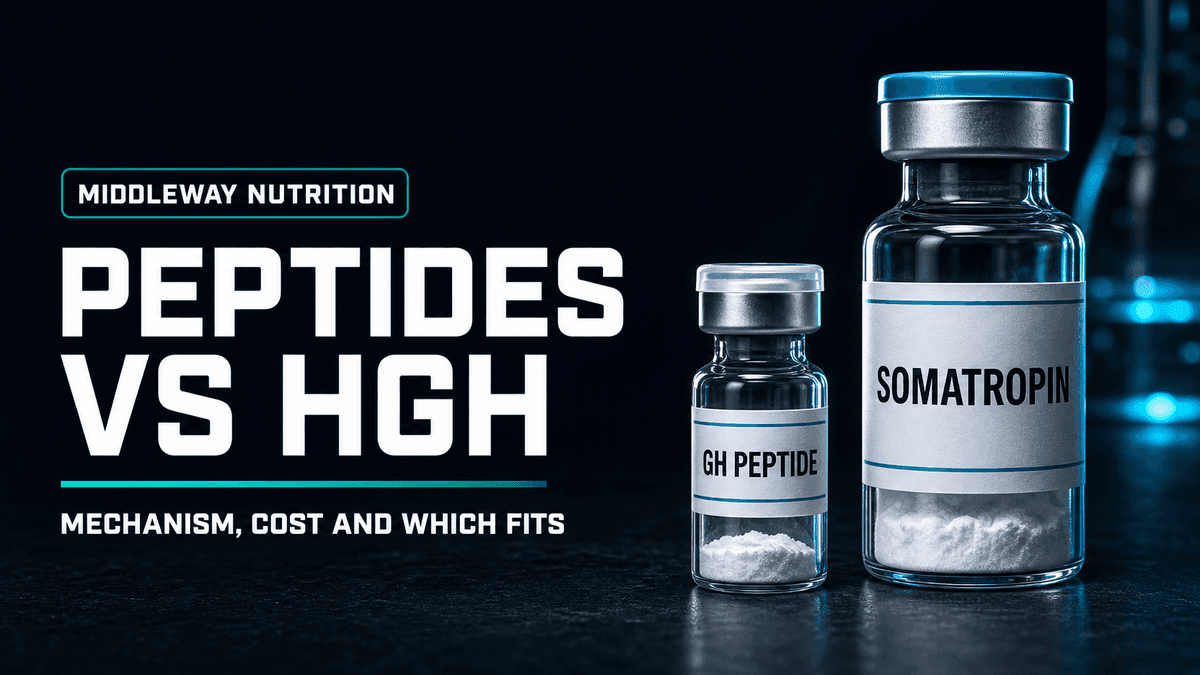
The peptides vs HGH question comes down to one structural difference: growth hormone replaces what your pituitary makes and eventually tells it to stop, while secretagogue peptides ask the pituitary to make more and leave the regulatory system intact. Everything else in the peptides vs HGH comparison, the cost gap, the side effect profiles, the legal position, follows from that.
Neither approach is right in the abstract. Which one fits depends on whether your pituitary works.
The two mechanisms
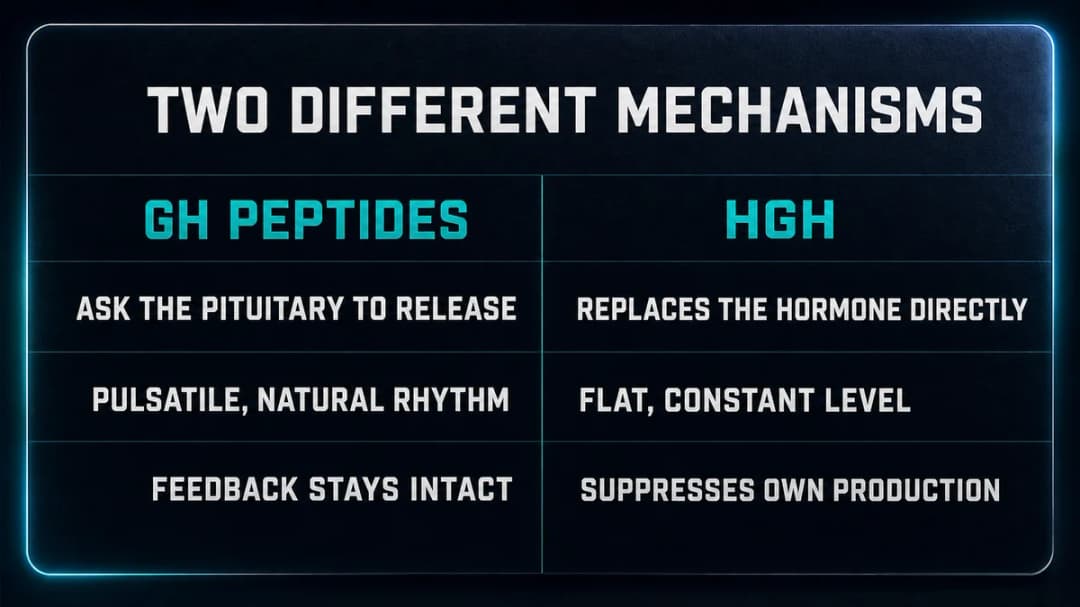
Growth hormone is a 191-amino-acid protein made by the pituitary. Recombinant somatropin is a bioidentical copy, injected directly. It bypasses the pituitary entirely, producing sustained rather than pulsatile elevation, and driving IGF-1 continuously. Because the feedback system reads the high level and reduces its own output, prolonged use suppresses natural production.
Secretagogue peptides work upstream. GHRH analogues such as sermorelin, CJC-1295 and tesamorelin bind GHRH receptors on the pituitary. Growth hormone releasing peptides such as ipamorelin, GHRP-2 and GHRP-6 act on a different receptor to the same end. MK-677 is an orally active non-peptide that does something similar. All of them prompt the gland to release its own hormone in pulses, and somatostatin still rises in response to dampen the output.
The pulsatile pattern is not a technicality. Natural growth hormone secretion is pulsatile, concentrated in early deep sleep, and several of its effects appear to depend on that pattern rather than on average concentration.
Peptides vs HGH: head to head
| HGH (somatropin) | Secretagogue peptides | |
|---|---|---|
| What it does | Replaces the hormone | Stimulates your own release |
| Pattern | Sustained elevation | Pulsatile |
| Effect size | Larger, more controllable | Moderate, capped by pituitary capacity |
| Natural production | Suppressed over time | Preserved |
| Works if the pituitary is damaged | Yes | No |
| Typical cost per month | Several hundred to over a thousand | Tens to low hundreds |
| Legal status | Prescription medicine, tightly restricted | Research chemicals, grey area, except approved ones |
| Injection frequency | Usually once daily | Often one to three times daily |
| Side effects | More pronounced | Generally milder |
Where the effect ceiling sits
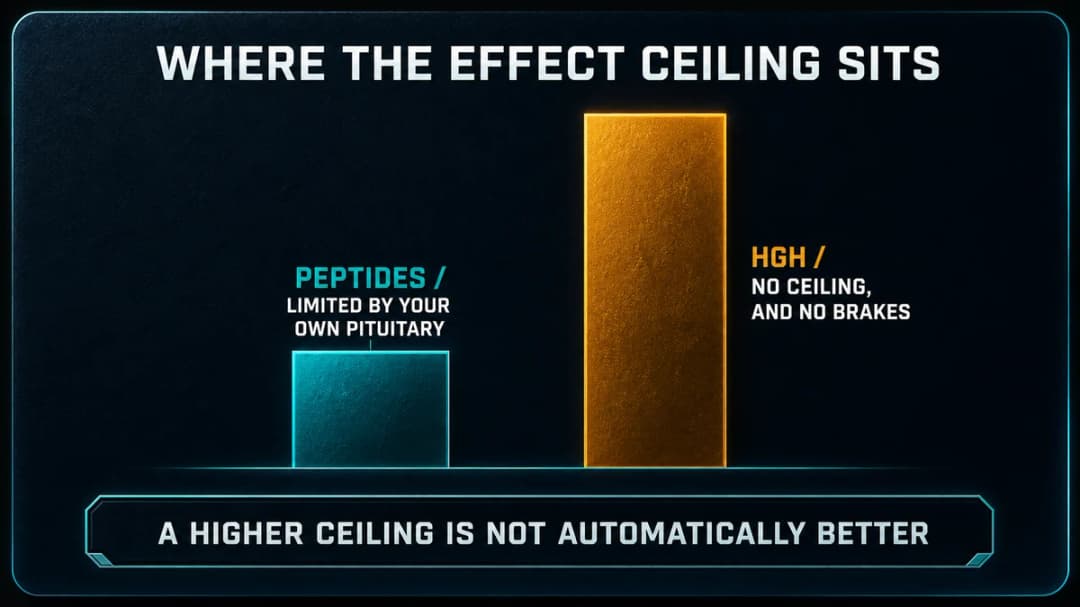
This is the point most comparisons soften. Peptides cannot exceed what your pituitary is capable of producing. If the gland is healthy, that ceiling is reasonably high. If it is damaged, absent, or was removed surgically, the ceiling is zero and no peptide will change that.
Injected growth hormone has no such ceiling, which is both its clinical advantage and the source of its risks. Exceeding physiological levels is trivially easy and produces exactly the problems you would expect.
So the honest version of the comparison is not that one is better. It is that they answer different questions. Replacement therapy for a deficient gland is a medical intervention with a diagnosis behind it. Stimulating a working gland is optimisation, with all the ambiguity that word carries.
Side effects
Growth hormone, particularly above physiological levels: joint pain and swelling, carpal tunnel symptoms from fluid retention, peripheral oedema, worsening insulin resistance and glucose control, and with chronic excess the acromegalic changes of enlarged extremities, jaw and organ growth. Pituitary suppression is not a side effect so much as a consequence, and it is why stopping abruptly after long use is a problem. The theoretical cancer concern that attaches to sustained supraphysiological IGF-1 is real enough to take seriously and unquantified in this population.
Peptides: injection site reactions, mild water retention, flushing shortly after injection, occasional headache, sometimes fatigue early on. GHRP-6 in particular causes marked hunger; ipamorelin is used precisely because it is selective and largely avoids the appetite, cortisol and prolactin effects of the older GHRPs. MK-677 raises appetite substantially and has been reported to worsen insulin sensitivity.
The difference in severity is largely a difference in how far the resulting hormone levels go, not a difference in kind.
Cost and access
The gap is large. Pharmaceutical growth hormone typically runs several hundred to well over a thousand per month depending on dose and country, and it requires a prescription. Peptide protocols commonly land somewhere between fifty and a couple of hundred. For what a single peptide actually costs and how to check a vendor, see our ipamorelin buying guide.
The legal picture differs more than the price. In the US, growth hormone distribution and possession outside FDA-recognised indications under a valid prescription is a federal offence, not a grey area. It is prescription-only across the UK and EU. Research peptides sit in genuine ambiguity, sold for research use, not approved for human use, and subject to rules that have been tightening.
Tesamorelin is the exception worth knowing about: an approved prescription medicine in the secretagogue class, with real phase 3 data behind it. See our tesamorelin review.
Monitoring, either way
Anyone doing either should be measuring rather than guessing:
- IGF-1, the primary marker of growth hormone activity and the number that tells you whether you are in physiological range or above it
- Fasting glucose and HbA1c, because growth hormone opposes insulin and this is the effect most likely to cause quiet harm
- A thyroid panel, since growth hormone influences thyroid hormone conversion
- A lipid panel, for general metabolic context
Running either approach blind is how people discover a problem years later.
How to decide
Get baseline bloodwork first. A single growth hormone measurement is nearly meaningless because of the pulsatile pattern; IGF-1 is the practical marker, and proper deficiency diagnosis requires stimulation testing.
If testing shows genuine deficiency, that is a medical condition with a treatment, and the treatment is prescribed growth hormone under supervision. Peptides are the wrong tool if the gland cannot respond.
If levels are normal but you want more, peptides are the more proportionate option: cheaper, milder, and they leave your own system running. Whether the benefit justifies the effort is a separate and more honest question.
If the goal is body composition or recovery, be clear that both approaches sit far below sleep, training and protein intake in effect size. The growth hormone secretagogues overview covers what these compounds realistically do.
Combining low-dose growth hormone with peptides appears in some advanced protocols. It requires medical supervision, because the point of a peptide, preserving pituitary function, is undermined by the thing suppressing it.
FAQ
Are peptides safer than HGH?
Generally they have a milder side effect profile, because they work through the pituitary's own regulation rather than around it, and the resulting hormone levels stay within physiological range. Pharmaceutical growth hormone is better studied, though, so "safer" depends on whether you mean better characterised or lower risk.
Do peptides work as well as HGH for muscle?
No, and the reason is structural. Peptides are capped by what your pituitary can produce, while injected growth hormone has no such ceiling. For general recovery and body composition the difference is often small; for the extremes people chase, growth hormone does more, at greater risk and cost.
Will peptides suppress natural growth hormone production?
Not in the way growth hormone does. Because they act through the pituitary, the feedback loop keeps operating and the gland continues to regulate output. That is the central argument for the class.
Can peptides help recover natural production after stopping HGH?
Some protocols use them for that, on the reasoning that stimulating a suppressed pituitary may speed its return. It is plausible and unproven, and recovery timelines after prolonged growth hormone use vary a great deal.
Which peptide comes closest to HGH?
A GHRH analogue combined with a GHRP, typically CJC-1295 with ipamorelin, produces the largest growth hormone elevations in the peptide class. MK-677 raises IGF-1 substantially by a different route, at the cost of significant appetite stimulation and possible effects on insulin sensitivity.
How long do results take with each?
Both are usually described as showing initial changes in sleep and recovery within two to four weeks, with body composition changes over eight to twelve. Growth hormone produces visible change faster because the levels achieved are higher.