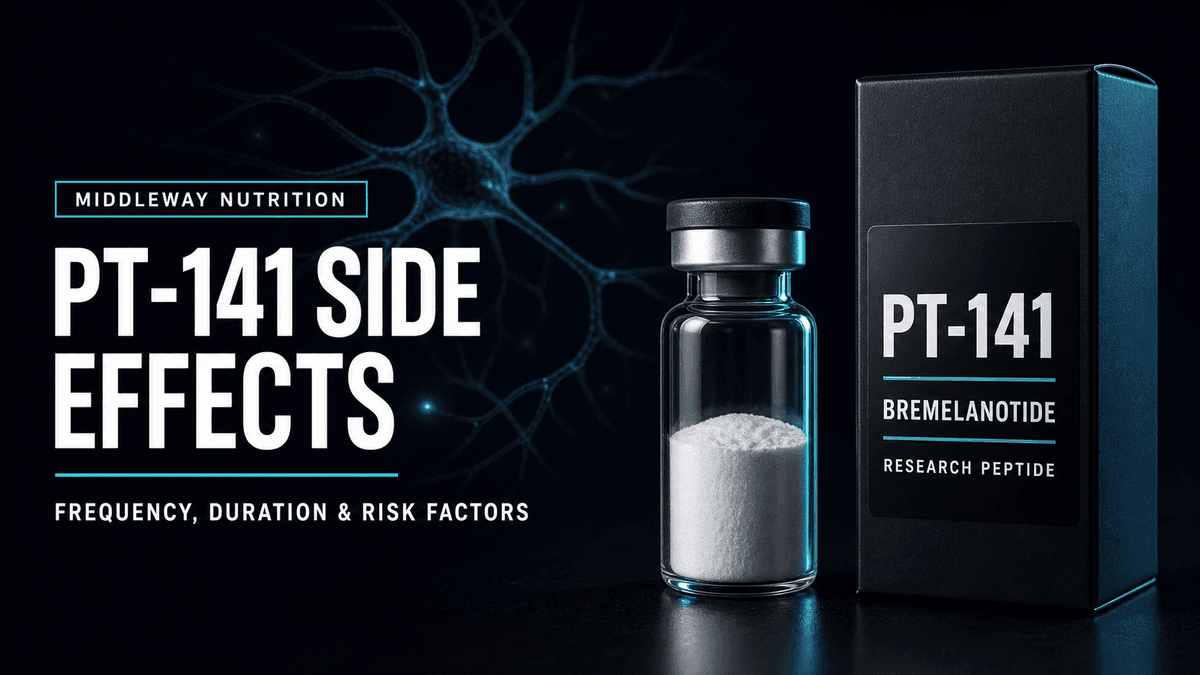
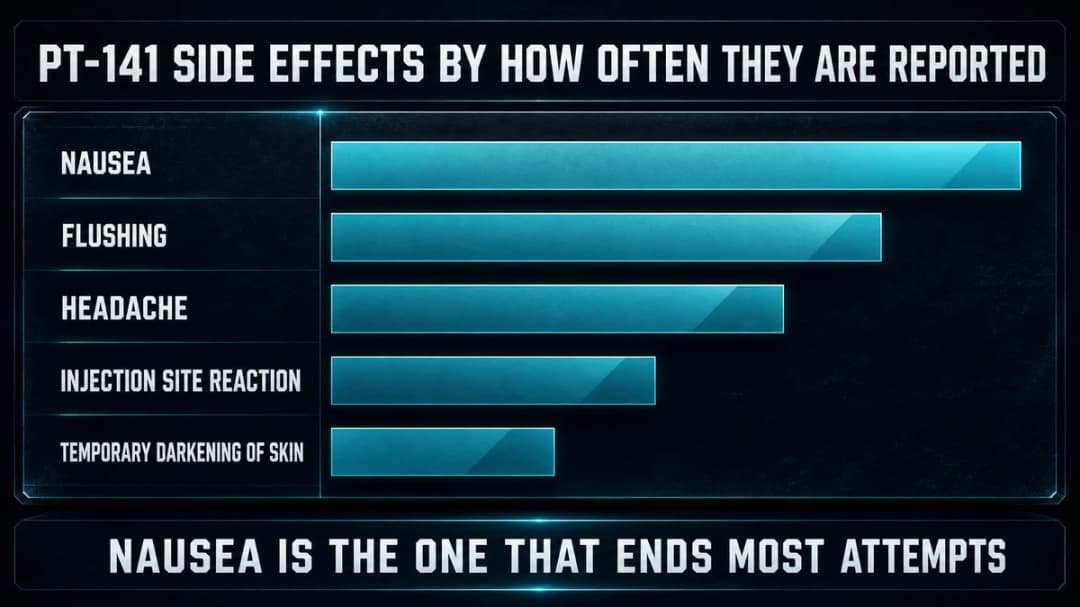
PT-141 side effects follow directly from where the drug acts: it stimulates melanocortin receptors in the brain, and that system also governs nausea signalling, blood vessel tone and skin pigmentation, so it produces all three. The most common of the PT-141 side effects is nausea, reported by roughly 40% of users in the trials that supported approval, and the most consequential is a temporary rise in blood pressure that can persist for hours after everything else has faded.
Bremelanotide is approved as Vyleesi for hypoactive sexual desire disorder in premenopausal women. Research-grade PT-141 is not approved for human use.
Why the profile looks nothing like Viagra
PDE5 inhibitors work peripherally on blood vessels, so their side effects are vascular: headache, flushing, occasionally vision changes, and a dangerous interaction with nitrates because both lower blood pressure.
PT-141 works centrally on melanocortin-3 and melanocortin-4 receptors. That family of receptors also regulates appetite, energy balance, immune signalling and pigmentation, which is why the effects are scattered across systems that have nothing obvious to do with sexual function. Nausea traces to melanocortin receptors in the brain's vomiting centre and in the gut. Flushing traces to melanocortin-driven vasodilation. Mole darkening traces to the pigmentation arm of the same system.
Crucially, PT-141 raises blood pressure rather than lowering it, which is the opposite of the PDE5 problem and creates a different set of people who should stay away.
PT-141 side effects by frequency
| Effect | How common | Character |
|---|---|---|
| Nausea | Around 40% | Usually mild to moderate, dose-dependent |
| Facial flushing | Roughly a fifth to a third | Warmth and redness, benign |
| Headache | Around one in six | Pressure-type, tracks the flushing |
| Injection site reaction | Around one in eight | Local, brief |
| Blood pressure rise | Consistent and measurable | Modest on average, longest-lasting effect |
| Spontaneous erection in men | Common above 1 mg | Expected, not dangerous |
| Fatigue | Variable | More at higher doses |
| Darkening of moles and freckles | With repeated use | Slow, usually reversible |
Nausea, the one that ends most attempts
Nausea typically begins 30 to 60 minutes after injection, peaks between one and two hours, and clears within two to four. It is rarely severe enough to need treatment, and it is the most common reason people abandon the compound after one or two tries.
It is strongly dose-dependent. Reports suggest roughly 10 to 15% at 0.5 mg, 30 to 40% at 1 mg, and 50 to 60% at 2 mg, which is a steep enough curve that dose choice is effectively a choice about nausea.
What reduces it, in rough order of usefulness: using a lower dose; eating something light beforehand rather than dosing on an empty stomach; lying down rather than staying upright; staying hydrated; and ginger, which has reasonable evidence as a general antiemetic. Nausea also tends to ease with repeated exposure.
There is a contradiction in the community advice worth flagging. Some sources claim an empty stomach reduces nausea, others that food reduces it. The approved product's guidance and most user experience favour eating something first. If you are trying to work out what suits you, change one variable at a time.
Blood pressure: the effect that matters most
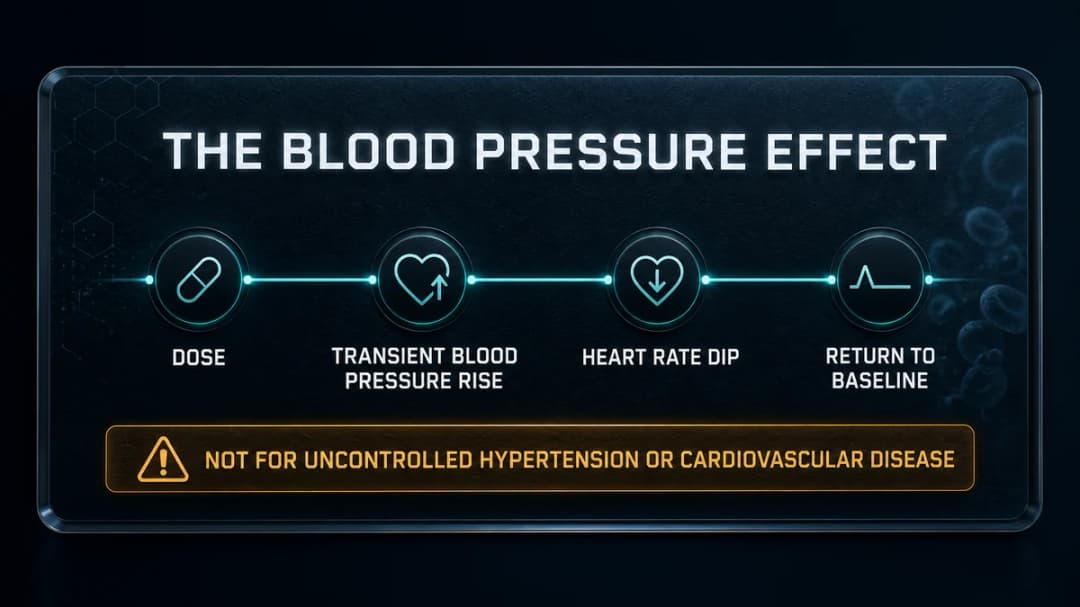
In the trials supporting approval, the 1.75 mg dose raised systolic pressure by an average of around 6 mmHg, and the elevation persisted for up to 12 hours after injection. Community reports describe larger rises at 2 mg.
An average 6 mmHg rise in a healthy adult is unremarkable. The problem is that averages describe populations, and the people most likely to be looking at this drug are not always the ones the average describes. From an already elevated baseline, or on top of antihypertensive medication that PT-141 partially opposes, the same increase carries a different meaning.
This is also the longest-lasting effect. Nausea, flushing and headache have all gone by the six-hour mark for most people, while the blood pressure elevation can still be present at twelve.
Anyone with a borderline baseline should measure blood pressure before dosing and again around two hours after a first dose. Anyone with established cardiovascular disease should not be using this without a clinician involved.
Flushing, headache and fatigue
Flushing appears within the first hour, peaks around an hour in, and passes within one to three hours. It is benign and usually resolves before the intended effects peak.
Headache tends to arrive one to two hours in and lasts two to six hours. It is typically pressure-like rather than migrainous and tracks the flushing and blood pressure changes, which suggests a shared vascular origin. Hydration helps, ordinary painkillers work, and lower doses reduce it substantially. A severe or migraine-level headache is unusual and is a reason to stop rather than to medicate through.
Fatigue or mild sedation in the hours after dosing is reported at higher doses and is one reason evening dosing suits most people.
Spontaneous erections
At doses above about 1 mg, men commonly report erections unconnected to any stimulus. This is a central effect of MC4 receptor activation, not a vascular one, and it carries none of the risk associated with drug-induced priapism. It resolves as plasma levels fall, generally within two to four hours.
It is best treated as a scheduling consideration rather than a side effect.
The pigmentation question
Because bremelanotide acts on the melanocortin system, repeated use can darken existing moles, freckles and other pigmented spots. It does not create new moles, and the change is usually minor and reverses after stopping.
The reason to take it seriously is not cosmetic. Changes in a mole's colour, size or shape are exactly what dermatologists look for when screening for melanoma, and a drug that alters pigmentation adds noise to that signal. Anyone using this regularly should have an annual skin check and a low threshold for getting a changing mole looked at. A history of melanoma or other skin cancer is a reason not to use it at all.
Who should avoid PT-141
- Uncontrolled hypertension, or blood pressure consistently above 140/90
- Any history of cardiovascular disease, heart attack or stroke
- Current nitrate medication such as nitroglycerin or isosorbide
- Pregnancy or trying to conceive, since animal studies showed harm to the fetus
- A history of melanoma or other skin cancer
- Anyone on blood pressure medication who has not cleared it with their prescriber
Factors that make side effects more likely rather than prohibiting use: higher doses, a first exposure, lower body weight, and existing hypertension.
Reducing the odds
Start at the low end, since almost every effect on this page scales with dose. Eat something light beforehand. Dose in the evening, when fatigue and lying down are both convenient. Keep water intake up. Space doses rather than using it frequently, both because tolerance is reported and because pigmentation effects accumulate with exposure. And measure your blood pressure at least once around a first dose if there is any doubt about your baseline.
For the broader picture on what the compound does, see our PT-141 review and results and the PT-141 guide. If you are comparing vials, our PT-141 for sale page covers sizes, pricing and lot verification.
FAQ
How long do PT-141 side effects last?
Nausea usually clears within two to four hours, flushing within one to three, and headache within two to six. The blood pressure elevation has the longest tail and can persist up to twelve hours after injection, which is why it is the effect worth planning around.
How do you stop PT-141 from causing nausea?
Lower the dose, since nausea rises steeply from roughly 10 to 15% at 0.5 mg to 50 to 60% at 2 mg. Eating something light beforehand, lying down after dosing, staying hydrated and using ginger all help. Nausea also tends to lessen with repeated use.
Does PT-141 raise blood pressure?
Yes. Trials at the approved dose recorded an average systolic rise of around 6 mmHg lasting up to twelve hours. That is minor for most healthy adults and significant for anyone with existing hypertension, cardiovascular disease or on antihypertensive medication.
Can PT-141 darken moles?
Repeated use can darken existing moles and freckles, since it acts on the same receptor system that governs pigmentation. It does not create new moles and the change usually reverses. The practical concern is that it makes skin cancer screening harder, so annual dermatology checks are sensible.
Are spontaneous erections from PT-141 dangerous?
No. They are a central nervous system effect rather than a vascular one and resolve on their own within a few hours, unlike priapism from vasodilating drugs, which is a medical emergency. They are common above about 1 mg.
Is PT-141 safe with blood pressure medication?
Not without medical clearance. PT-141 raises blood pressure and can partially oppose antihypertensive treatment, and it should not be combined with nitrates at all. This is a conversation for the prescriber rather than a risk to take on your own.