This PT-141 Review & Results verdict is narrow but genuine: bremelanotide acts on desire in the brain rather than blood flow in the tissue, which makes it the only pharmacological option for a problem that PDE5 inhibitors cannot touch. The results people report from PT-141 are consistent enough to take seriously, and the measured effect in the trials that led to approval was real but modest, which is a combination worth holding in mind before ordering anything.
The approved product, Vyleesi, is licensed for hypoactive sexual desire disorder in premenopausal women. Everything else discussed here is off-label or research use.
What makes it different
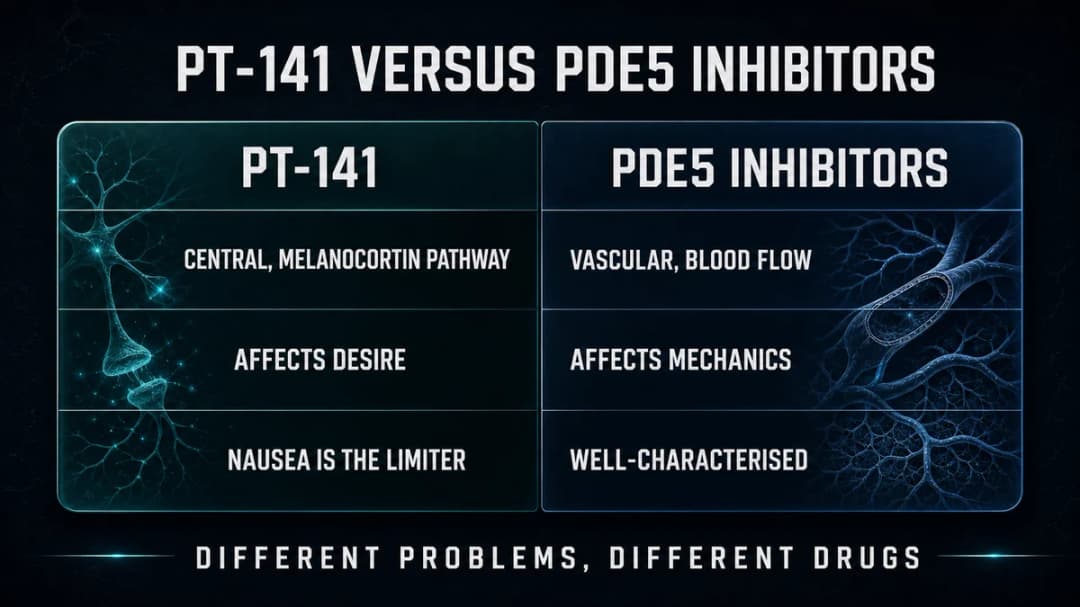
PDE5 inhibitors such as sildenafil and tadalafil block an enzyme that breaks down cGMP, which relaxes smooth muscle and increases blood flow into erectile tissue. The result is mechanical and does not require any particular mental state.
PT-141 activates melanocortin-4 receptors, and to a lesser extent MC3 receptors, in the hypothalamus and limbic system. Those regions handle motivation and reward, and activating them appears to raise sexual interest itself. The physical response, where it happens, follows from the arousal rather than substituting for it.
This is why it works for some people whose problem is not vascular. If desire is the missing component, no amount of improved blood flow addresses it. It is also why PT-141 does nothing for someone whose desire is intact and whose vessels are not cooperating.
It was derived from melanotan II with modifications that reduce MC1 receptor activity, the receptor responsible for tanning, while keeping the arousal effects.
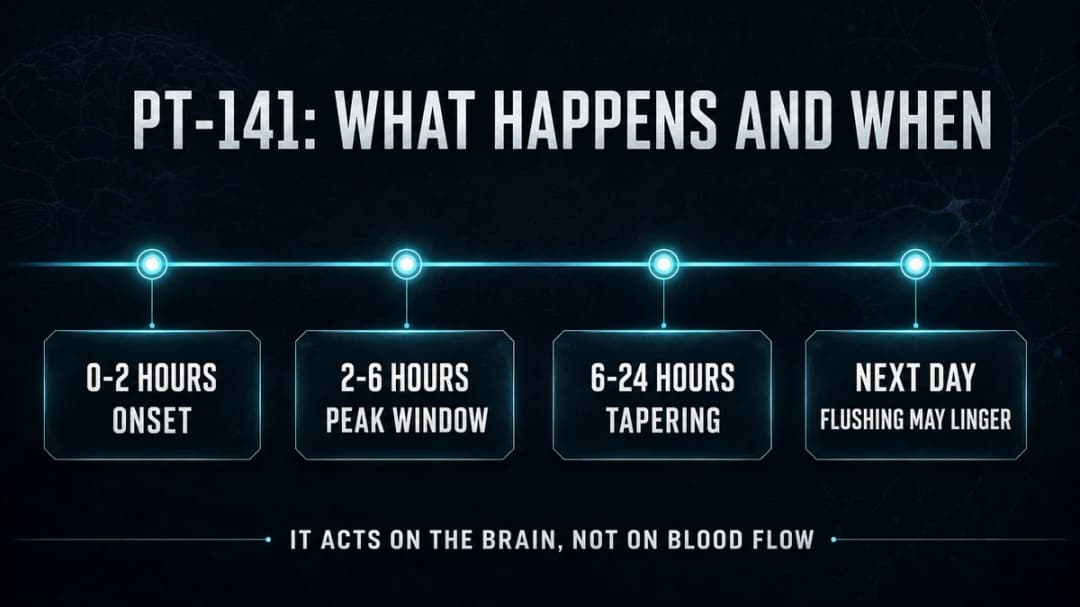
Timeline: what happens and when
| Time after injection | What is typically described |
|---|---|
| 0 to 60 minutes | Little or nothing. Some warmth or mild flushing may start |
| 60 to 90 minutes | Interest starts building |
| 90 minutes to 3 hours | Peak effects |
| 3 to 6 hours | Sustained but declining |
| 6 to 12 hours | Gradual return to baseline, with some reporting effects at the far end |
The single most common first-time mistake is treating this like sildenafil and dosing 30 minutes ahead. The approved label specifies at least 45 minutes, and community reports consistently describe 90 to 120 minutes as the realistic planning window. Rushing it produces a disappointing evening and an incorrect conclusion that the compound does not work.
Onset varies with dose, injection site, body weight and stomach contents. Abdominal injection is generally described as absorbing faster than the thigh.
PT-141 Review & Results: trial data versus user reports
These are two different bodies of evidence and they should not be blurred together.
The trials. Approval rested on a phase 3 programme in over 1,200 premenopausal women with HSDD. Desire scores improved more than placebo, distress scores fell more than placebo, and satisfying sexual events increased by roughly one per month against about half on placebo. Statistically solid, clinically modest.
User reports. Consistently more enthusiastic than the trial data, from both men and women, describing desire that feels intrinsic rather than pharmacological. That consistency is interesting, because the effect is subjective and obvious rather than something people need a lab test to notice.
Where scepticism belongs: sexual function responds strongly to expectation, context and attention, and the placebo arm in the trials also improved. Anyone who has spent money, injected something and cleared their evening has stacked several powerful non-pharmacological variables in the same direction. That does not mean the compound does nothing. It means individual reports overstate what the drug alone contributes.
Dosing
The approved dose is 1.75 mg subcutaneously by autoinjector, no more than once in 24 hours and no more than eight times a month.
Reported research-context ranges are lower, and this is one of the few areas where community practice looks better reasoned than the label. Men commonly describe starting at 0.5 to 1 mg with an effective range of 1 to 2 mg. Women commonly describe starting at 0.5 to 0.75 mg with an effective range of roughly 0.75 to 1.25 mg, on the basis that the approved 1.75 mg produces more nausea than benefit for many people.
Nausea and effect both scale with dose, which is why starting low and adjusting upward is the sensible approach rather than beginning at the maximum. Tolerance is reported with frequent use, and spacing doses to once or twice a week is the usual response.
These are reported ranges rather than recommendations, and self-administering an unapproved product carries risks that a prescription route does not.
Side effects
Nausea is the dominant one, affecting roughly 40% of users in trials. It is dose-dependent, tends to peak in the first few hours, and is the most common reason people stop.
Flushing in the face and chest is very common and benign, usually passing within a couple of hours.
Headache is frequent and generally mild.
Transient blood pressure elevation is documented and is the reason the drug is contraindicated in uncontrolled hypertension and in established cardiovascular disease. This is the one that deserves respect rather than a shrug.
Skin darkening can develop with repeated use, since this is a melanocortin agonist even at reduced MC1 activity.
Yawning turns up often enough in reports to be worth mentioning, and appears to be a melanocortin effect rather than a problem.
What does not happen: no priapism risk, no vision changes, and no dangerous interaction with nitrates of the kind that makes PDE5 inhibitors hazardous for people on cardiac medication. Our PT-141 side effects page goes through these in detail.
PT-141 compared with PDE5 inhibitors
| PT-141 | Sildenafil or tadalafil | |
|---|---|---|
| Mechanism | Central, melanocortin receptors | Peripheral, PDE5 inhibition |
| What it produces | Desire and arousal | Improved erectile blood flow |
| Works without mental engagement | No | Yes |
| Approved for women | Yes, for HSDD | No |
| Onset | 45 minutes minimum, often 90 to 120 | 30 to 60 minutes for sildenafil |
| Duration | 6 to 12 hours | 4 to 6 hours for sildenafil, far longer for tadalafil |
| Route | Subcutaneous injection | Oral |
| Nitrate interaction | No | Yes, dangerous |
The comparison only matters if you know which problem you have. Some people use both, addressing desire and mechanics separately, which is a reasonable idea and one that warrants a clinician's involvement given the blood pressure effects on both sides. For the injectable alternative aimed at mechanics, see alprostadil vs PT-141.
Who it does not suit
Anyone with uncontrolled hypertension or significant cardiovascular disease. Anyone whose problem is clearly mechanical, where a PDE5 inhibitor is simpler, oral and better evidenced. Anyone who has not looked for a cause, since low desire is commonly downstream of depression, medication, alcohol, thyroid or testosterone problems, poor sleep, or a relationship issue that no injection resolves. And anyone expecting on-demand reliability, which this compound does not provide.
For background on the peptide itself, see our PT-141 guide.
FAQ
How long does PT-141 take to work?
Effects typically begin 60 to 90 minutes after injection and peak somewhere between 90 minutes and three hours. Planning for a two-hour lead time is the reliable approach. Dosing 30 minutes ahead, as people do with sildenafil, is the most common reason a first attempt appears to fail.
How long do the effects last?
Most reports describe 6 to 12 hours from injection to return to baseline, with the strongest window in the first few hours. Duration varies with dose and individual response.
Does PT-141 work for women?
Yes, and that is the population where the evidence is strongest, since the approval covers premenopausal women with hypoactive sexual desire disorder. Many women report good results below the approved 1.75 mg dose with less nausea.
What is the most common side effect?
Nausea, reported by roughly 40% of users in trials. It is dose-dependent, so starting low reduces it considerably. Flushing and headache are also common and generally mild.
Can PT-141 be combined with sildenafil?
Some people do, addressing desire and mechanics separately. The combination has not been studied, and both compounds affect blood pressure, so it warrants medical input rather than experimentation.
Does PT-141 cause tanning?
Much less than melanotan II, which is the point of the modification. Some skin darkening can still occur with repeated use, since it remains a melanocortin agonist, but tanning is not a prominent effect at typical doses.