Reported TB-500 side effects are mild and mostly local: injection site redness, brief fatigue after the first doses, and occasional headache account for nearly all of what users describe. The important caveat about TB-500 side effects is that this apparently clean profile rests on self-reported experience rather than trial safety data, because no controlled human study has ever been completed.
That distinction matters. An absence of reported harm from an unmonitored population is not the same as a demonstrated safety record.
TB-500 Side Effects That Get Reported
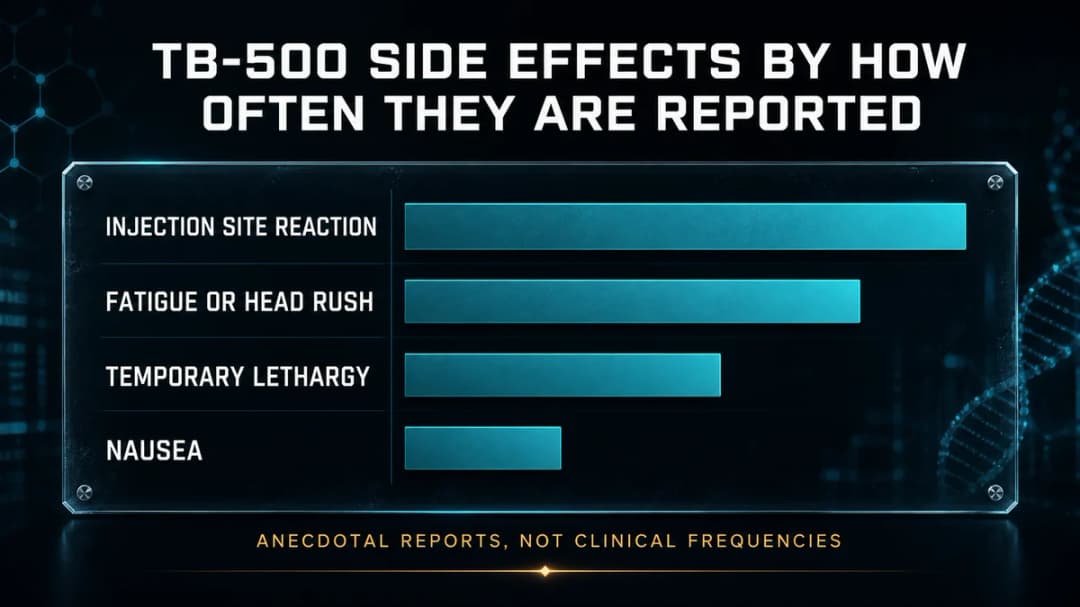
| Effect | How often | Timing | What usually helps |
|---|---|---|---|
| Injection site redness or a small welt | Common | Immediately, fades within hours | Rotate sites, inject slowly, use a fine needle |
| Mild aching at the site | Common | Immediately | Let the vial reach room temperature first |
| Brief fatigue | Occasional | First one or two injections | Usually settles within a week |
| Headache | Occasional | First week | Hydration, and lower the dose if it persists |
| Flu-like feeling after the first dose | Uncommon | First 24 to 48 hours | Self-limiting |
| Nausea | Uncommon, dose-related | Around injection | Reduce dose |
| Increased awareness of an existing injury | Occasional | First two weeks | Usually settles, but do not train through pain |
| Allergic reaction | Rare | Any time | Stop and seek medical care |
Notably absent from the reports, and consistent with the mechanism: hormonal changes, appetite or weight effects, mood changes, and cardiovascular effects. TB-500 has no androgenic, oestrogenic or growth hormone activity. If any of those appear, something else in the protocol is the more likely explanation.
The Angiogenesis Question
This is the concern worth taking seriously, and it is worth being precise about it rather than either dismissing it or overstating it.
Thymosin beta-4 promotes angiogenesis, the formation of new blood vessels, as part of tissue repair. Solid tumours also depend on angiogenesis to grow beyond a very small size. The theoretical concern is therefore whether a compound that promotes new vessel formation could support the growth of a tumour that already exists.
What is established: the mechanism is real, and TB-500 does promote angiogenesis.
What is not established: whether that translates into any clinically meaningful effect on tumour growth in a person. There is no evidence that TB-500 causes cancer, and no documented case of it accelerating one.
What follows practically: anyone with an active malignancy, or a recent cancer history, should not use it. This is the standard, cautious position, and it is the right one when the mechanism is plausible and the data to rule it out does not exist. Anyone in that situation should raise it with their oncologist rather than resolving it from forum posts.
Injection Site Problems Worth Distinguishing
The most common issue is also the most commonly misread. A normal reaction is a small red, slightly raised area appearing straight after injection and fading within a few hours.
What is not normal, and needs medical attention: pain that worsens rather than improves after 24 to 48 hours, spreading redness, warmth, hardness under the skin, or any discharge. Those are signs of infection, not of the peptide, and they come from technique and sterility rather than the compound.
Reducing the Risk
Rotate sites every injection. Repeated injection into the same spot is the main cause of persistent site reactions.
Start at the lower end. Nausea and fatigue are reported more at higher doses, so 2 mg is a more sensible starting point than 5 mg.
Let the vial warm up. Injecting cold solution straight from the fridge stings more and produces more local reaction.
Inject slowly with a fine needle. A 29 to 31 gauge insulin syringe over several seconds is considerably more comfortable than a fast injection.
Keep everything clean. Alcohol swab the vial stopper and the skin, use a new needle every time, and never share a vial. Most avoidable harm from research peptides comes from contamination rather than pharmacology.
Check the product. A batch-specific third-party certificate of analysis tells you what is in the vial. Without one, any side effect could be from the peptide, a contaminant or a completely different compound.

The Effect That Is Easy to Misread
One reported experience deserves separating from the side effect list, because people interpret it in both directions.
Some users describe becoming more aware of an existing injury during the first weeks: a dull ache or a sense that the area is more active. It is commonly presented as evidence that the compound is working on damaged tissue.
That interpretation is not established, and it has an obvious failure mode. Increased awareness of an injury is also what it feels like when an injury is getting worse, and someone who has decided the sensation means healing will keep loading a tissue that is telling them to stop.
The safe reading: treat pain as pain. If discomfort increases while training or persists at rest, that warrants assessment rather than reassurance from a forum.
When to Stop
- Injection site pain that increases after a day or two, or any sign of infection
- Any systemic reaction suggesting allergy, meaning hives, swelling or breathing difficulty, which warrants immediate medical care
- A new cancer diagnosis, in which case stop and speak to the treating clinician
- Any symptom that concerns you, since pausing costs nothing
For related reading, see the TB-500 guide, the dosage guide, and our article on peptides for recovery and where the evidence gets thin.
Frequently Asked Questions
Is TB-500 safe?
Reported side effects are mild and mostly confined to the injection site, but the safety picture rests entirely on user reports rather than trial data, since no controlled human study has been completed. There is no long-term human safety information for it in any indication, and that gap should factor into the decision.
Does TB-500 cause cancer?
There is no evidence that it does. The concern is different: TB-500 promotes angiogenesis, and existing tumours depend on new blood vessels to grow, so there is a theoretical question about whether it could support growth of a cancer that is already present. That is why it is contraindicated in anyone with an active or recent malignancy.
Does TB-500 cause water retention?
It is not a typical report, and there is no clear mechanism for it. Unlike growth hormone secretagogues, TB-500 has no known effect on sodium and fluid balance. If puffiness appears, another compound in the protocol is the more likely cause.
Why do I feel tired after injecting TB-500?
Brief fatigue in the first week is an occasional report and usually resolves on its own. The cause is not established, and one suggested explanation is a mild immune response to a novel peptide. If it persists beyond the first week or two, reducing the dose is the reasonable next step.
Can TB-500 be stacked with BPC-157?
It is the most common pairing, and the side effect profiles are similar and mostly local. There is no human data on the combination, so stacking two unapproved compounds means accepting two sets of unknowns at once rather than one.