TB-500 peptide benefits are strongest in animal tissue repair data, the reported side effects are mostly mild and local, and dosage in research protocols clusters around 2 to 5 mg per week. All of that deserves more caution than most vendor pages give it, starting with a problem almost nobody mentions: two vials labeled TB-500 are not guaranteed to hold the same molecule.
- TB-500 is a synthetic construct based on thymosin beta-4, a 43-amino-acid repair protein present in nearly every nucleated cell and concentrated in platelets and wound fluid.
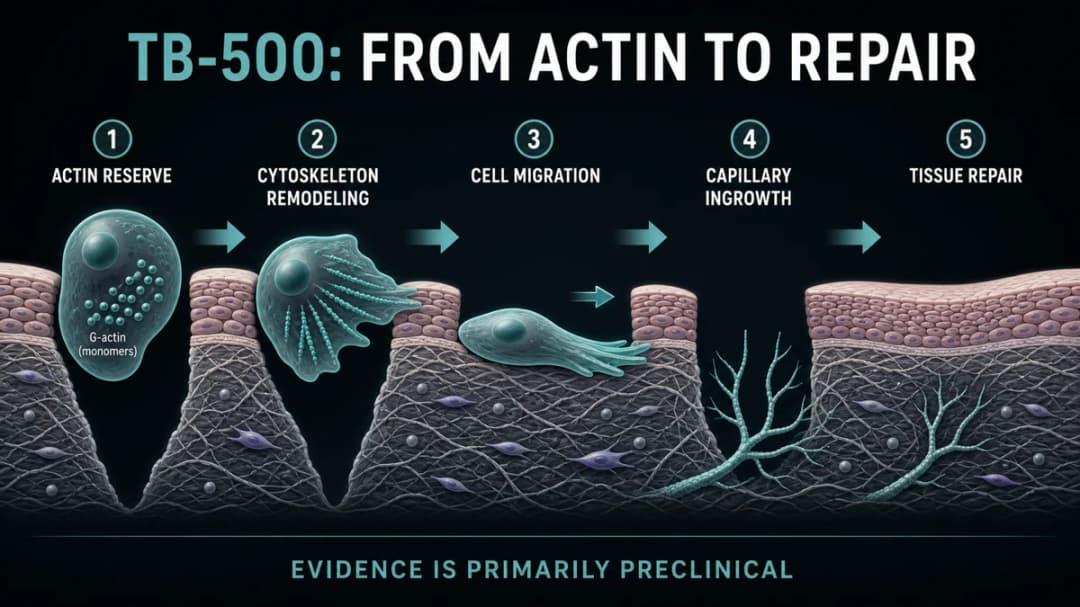
- Its core mechanism is actin binding, which speeds the migration of repair cells toward damaged tissue, with secondary effects on new blood vessel formation and inflammatory signaling.
- The supporting evidence is overwhelmingly preclinical. Full-length thymosin beta-4 has reached human trials; the fragment sold to researchers has not been studied the same way.
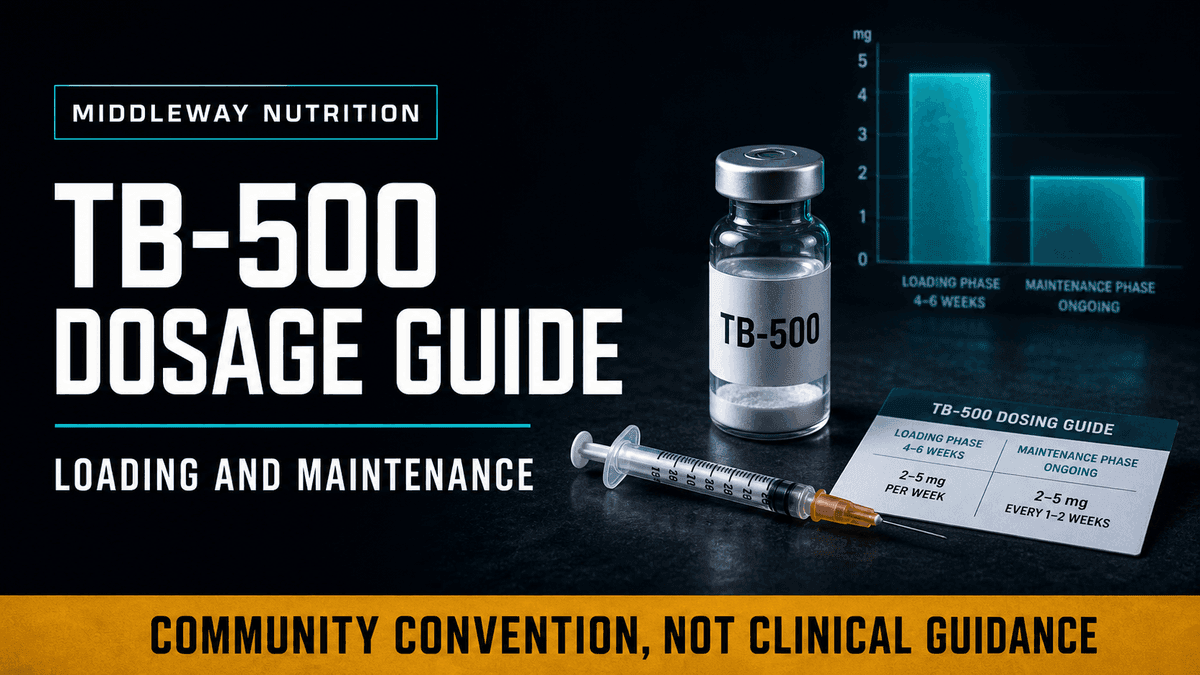
- Reported dosing is weekly rather than daily, typically 2 to 3 mg twice weekly during a loading period, then tapered.
- Documented adverse effects are minor, but the angiogenic mechanism makes any cancer history a genuine reason to stay away, and long-term human safety data does not exist.
What TB-500 Actually Is (And Why Labeling Varies)
Thymosin beta-4 is not an exotic compound. Your body makes it constantly. It is a 43-amino-acid protein found across nearly all nucleated cells, concentrated in blood platelets and in the fluid that collects at a wound. When tissue is damaged, local levels rise sharply and it joins the cascade that pulls repair cells into the injured area.
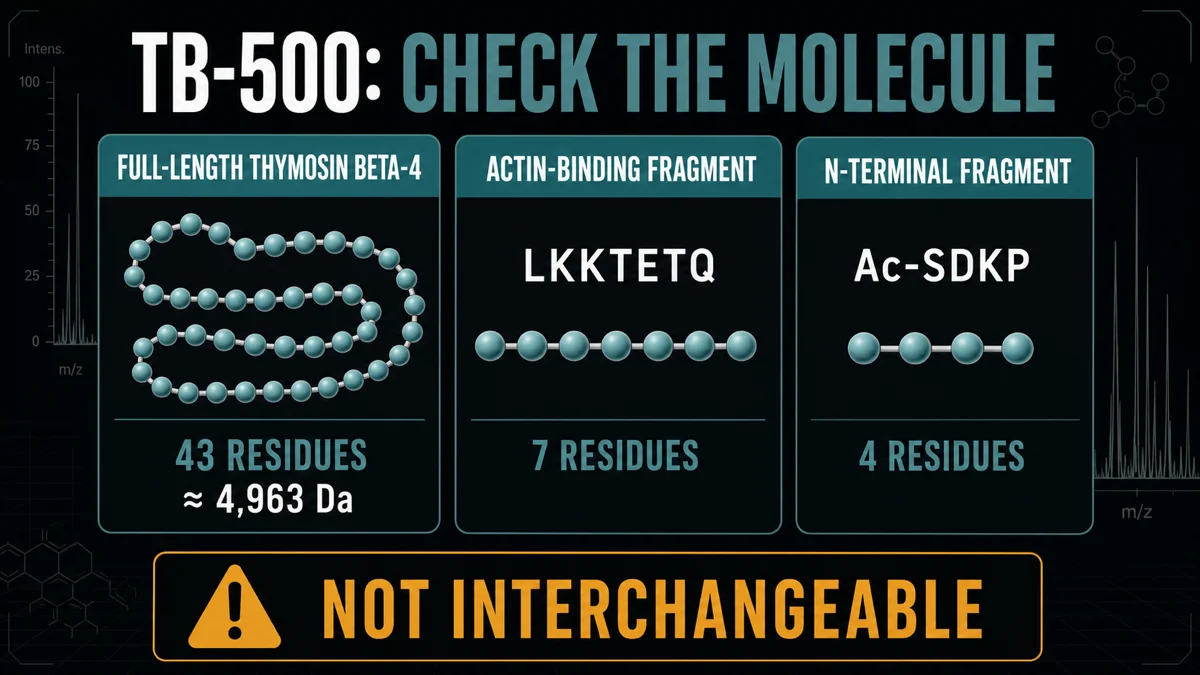
TB-500 entered circulation as a research designation for a synthetic peptide meant to reproduce that activity in an injectable, systemically distributed form. Here is where sourcing matters. Different suppliers and reference sources describe TB-500 in incompatible ways:
- Some describe it as the short actin-binding domain around amino acids 17 to 23, the LKKTETQ region, in acetylated form.
- Others supply what is functionally full-length or near full-length thymosin beta-4, sequence Ac-SDKPDMAEIEKFDKSKLKKTETQEKNPLPSKETIEQEKQAGES, with a molecular weight near 4,963 Da.
- A third framing points to Ac-SDKP, the short N-terminal tetrapeptide with its own documented anti-fibrotic and cell-migration activity.
These are not interchangeable. A four-residue fragment, a seven-residue fragment and a 43-residue protein differ in molecular weight, diffusion behavior and potency per milligram. Read dosing figures from one source, buy a product built to a different specification, and the numbers do not transfer cleanly. Treat any specific dose figure as approximate.
Everything that follows describes research-context findings. TB-500 is not an approved drug anywhere, it is sold for laboratory use only, and it is explicitly prohibited in competition by the World Anti-Doping Agency.
Mechanism in plain terms
Actin is the structural protein that lets a cell change shape and crawl. Cells cannot migrate without continuously assembling and disassembling their actin skeleton. Thymosin beta-4 binds free actin monomers and holds a reserve pool available for rapid reorganization. The practical consequence is faster cell motility across the cell types that rebuild tissue, endothelial cells lining new vessels, keratinocytes closing a skin defect, and the fibroblasts that lay down replacement matrix.
Preclinical work attaches three further effects to the same pathway. Capillary ingrowth increases, apparently through vascular endothelial growth factor signaling. Cells at the margin of an injury survive longer instead of dying off. And the inflammatory phase runs cooler, shortened rather than switched off.
One property genuinely distinguishes TB-500 from a peptide like BPC-157. Distribution is systemic. That decouples the injection site from the target, which is why protocols aimed at shoulders, hips and other awkward locations still describe a routine abdominal shot.
TB-500 Benefits
Grading matters more here than enthusiasm. Below, the benefits are separated by what kind of data actually stands behind them.
| Reported benefit | What the evidence actually is | Detail |
|---|---|---|
| Muscle, tendon and ligament repair | Animal models | Faster closure and less scar tissue than untreated controls across rodent injury studies |
| Skin wound and corneal healing | Animal models | Same pattern in dermal defect and corneal repair models |
| Reduced fibrosis after injury | Animal models plus mechanism | Consistent with the anti-fibrotic activity documented for Ac-SDKP |
| Cardiac tissue repair | Parent protein only | Full-length thymosin beta-4 after induced ischemic injury, not the fragment sold as TB-500 |
| Tendinopathy relief, faster return to training | Anecdotal | User reports, with no controlled human research behind them |
| Joint range of motion | Anecdotal | More plausibly the surrounding synovial and capsular tissue than the joint surface |
| Hair regrowth | Mechanism only | Follicle stem cell activation and scalp perfusion, with no outcome data |
| Bone healing | Weak | Thin preclinical data, no consistent signal |
| Cartilage regeneration | Not supported | Cartilage is avascular, so the migrating cells this pathway mobilizes never arrive |
Not one row in that table rests on a controlled human trial of TB-500, because none has been run. Animal healing data and human benefit are different claims, and every vendor page that blurs them is selling the inference rather than the result.
Reasonably supported in animal models. Soft tissue repair is where the preclinical literature is deepest. Animal work has examined muscle injury, tendon and ligament healing, dermal wound closure and corneal repair, generally reporting faster closure and less scar tissue than untreated controls. Reduced fibrosis is a recurring theme, consistent with Ac-SDKP's known anti-fibrotic behavior.
Supported for the parent protein, not the fragment. Cardiac repair is the most scientifically serious claim attached to thymosin beta-4. Animal work following induced ischemic injury has reported improved cardiac tissue outcomes, and full-length thymosin beta-4 has been investigated clinically in cardiac and wound-healing settings. That research belongs to the parent protein. Extending it to a fragment sold as a research chemical is an inference, not a result.
Anecdotal only. Tendinopathy relief, faster return to training after muscle strains, improved joint range of motion and hair regrowth appear consistently in user reports and almost nowhere in controlled human research. The hair claim rests on follicle stem cell activation and scalp perfusion, a plausible mechanism but not evidence of an outcome, and TB-500 is no substitute for established treatments in androgenic hair loss.
Not supported. Cartilage regeneration is off the table. Without a blood supply, cartilage never receives the migrating cells this pathway mobilizes, so the mechanism has nothing to act on. Reports of joint improvement more plausibly reflect surrounding synovial and capsular tissue. Bone healing data is likewise weak.
Comparing within the healing category, KPV targets inflammatory signaling rather than cell migration, and blended formulations such as KLOW combine several mechanisms in one vial, which makes attributing any single effect harder.
TB-500 Side Effects
The adverse effect profile reported in research settings is mild, with one caveat: it reflects short observation windows in animals plus unsystematic self-reports, not controlled human safety monitoring.
Commonly reported and minor: local injection site reactions (redness, mild swelling, brief aching, occasional bruising), more frequent with larger volumes and repeated use of the same site; transient fatigue in the first week or two; mild headache during the early phase.
Less frequent: nausea, reported more often at the upper end of loading doses; a brief flu-like feeling in the 24 to 48 hours after a first injection; flushing or a spreading warmth, which fits the vascular side of the mechanism but has never been formally attributed.
The angiogenesis question, stated directly. TB-500 promotes new blood vessel growth. That is how it helps poorly vascularized tissue heal, and it is also the process solid tumors depend on to grow beyond a very small size. No demonstration exists that exogenous TB-500 causes cancer, and no tumor-promoting effect has been documented in healthy animal models. But the mechanism is real, thymosin beta-4 is upregulated in some tumor microenvironments, and anyone with an active malignancy, a cancer history, or an undiagnosed suspicious finding should not be near this compound.
Where the data is genuinely thin. Thymosin beta-4 participates in immune regulation, and the long-term immunological consequences of repeated exogenous administration have not been characterized beyond the short observation windows used in animal work. Pregnancy and breastfeeding are unstudied, interaction with autoimmune disease is unknown, and there is no meaningful pediatric data. Absence of reported harm here reflects absence of investigation, not established safety.
TB-500 does not act on the endocrine system. It has no androgenic, estrogenic or growth-hormone activity and no documented appetite or metabolic effect, so hormonal or mood changes during a multi-compound stack likely originate elsewhere.
TB-500 Dosage Chart
The figures below are reported research ranges compiled from preclinical protocols and published research frameworks. They are a description of what appears in the literature and in protocol documentation, not guidance for personal use, and there is no established human dosing standard for this compound.
| Context | Reported range | Frequency | Typical cycle |
|---|---|---|---|
| Conservative loading | 2 mg per injection (4 mg/week) | 2x weekly, non-consecutive days | 4 weeks |
| Standard loading | 2 to 2.5 mg per injection (4 to 5 mg/week) | 2x weekly, non-consecutive days | 4 to 6 weeks |
| High-load research models | 3 mg per injection (6 mg/week) | 2x weekly | 6 weeks |
| Maintenance | 2 to 2.5 mg per week | 1x weekly | 4 to 6 weeks after loading |
| Extended low-dose models | 2 mg | Every 2 weeks | Ongoing, with scheduled breaks |
| Acute soft tissue protocols | 2 mg | Every 3 to 4 days | ~3 weeks, then maintenance |
The two-phase structure is not arbitrary. Because the mechanism depends on tissue-wide saturation rather than a receptor hit at one site, protocols front-load to establish levels and then hold them with less frequent administration. Full cycles run 10 to 12 weeks, loading plus maintenance, with a four-week washout before repeating.
Dosing frequency is unusually low for a peptide, reflecting TB-500's binding behavior and long effective duration. Reported half-life figures are inconsistent and worth treating skeptically, ranging from 24 to 48 hours of circulating activity up to around two weeks of functional persistence attributed to tissue binding. No reliable human pharmacokinetic data is published, and the twice-weekly schedule is inferred from effect duration rather than measured clearance.
Animal studies work in dose-per-kilogram terms, and converting those figures to a human-equivalent dose for a peptide of this size is not a straightforward calculation. Do not read the table as a translation of the animal data.
Reconstitution and Storage
TB-500 arrives as a lyophilized white powder, most often in 5 mg vials. Bacteriostatic water is the standard solvent because the preservative allows repeated vial access.
Standard handling: bring the vial to room temperature, swab the stopper with 70% isopropyl alcohol, then inject the water slowly down the inside glass wall rather than onto the powder. Rotate gently between the palms until dissolved, never shaking. The finished solution should be clear and colorless; cloudiness or particulate indicates a problem.
Concentrations from a 5 mg vial:
- 1 mL diluent gives 5,000 mcg/mL, so a 2 mg dose is 0.4 mL
- 2 mL diluent gives 2,500 mcg/mL, so a 2 mg dose is 0.8 mL
- 2.5 mL diluent gives 2,000 mcg/mL, so a 2 mg dose is 1.0 mL
Because TB-500 doses are large relative to most peptides, dilution is a practical tradeoff. A 1 mL reconstitution keeps injection volume small, which matters more here than with a microgram-dosed compound.
Storage guidance is not consistent across sources. Lyophilized powder should be kept cold and dark, with minus 20 degrees Celsius cited for long-term storage. Reconstituted solution is refrigerated at 2 to 8 degrees Celsius, and stability estimates range from a conservative 8 to 10 days up to 28 to 30 days. When sources disagree, the shorter figure is the safer assumption. Never freeze reconstituted solution.
Stacking
Only one combination has real documentation behind it, and even that is mechanistic reasoning plus user reports.
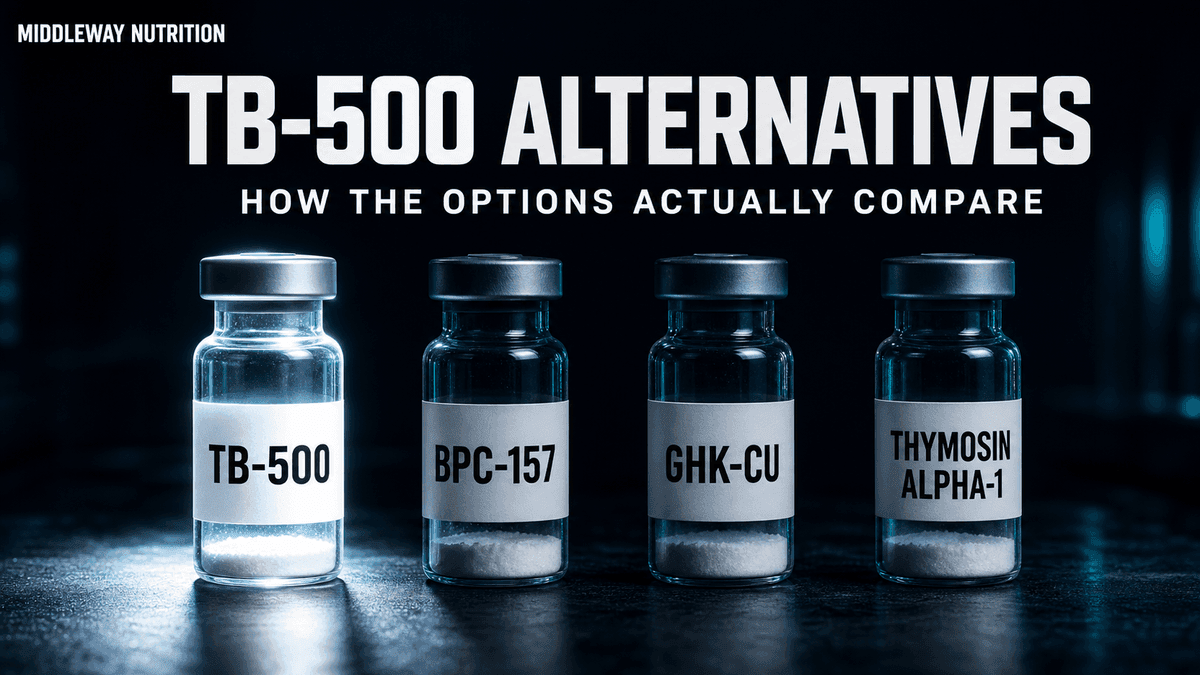
With BPC-157. The pairing that appears constantly in recovery protocols, informally called the Wolverine stack. The rationale holds up: BPC-157 acts through the FAK-paxillin pathway and nitric oxide signaling with strong local effects and unique gastrointestinal activity, while TB-500 handles systemic distribution and cell migration. Reported protocols pair BPC-157 at 250 to 500 mcg daily subcutaneously with TB-500 on its twice-weekly loading schedule. No adverse interaction is documented. No stability data exists for combining them in one syringe either, so separate syringes are the defensible choice.
With GHK-Cu. Reasonable overlap where skin and dermal repair are the focus, since GHK-Cu works at the collagen synthesis level rather than through actin dynamics, though documentation is thinner. Combinations with growth hormone secretagogues appear in recovery protocols, but the rationale is general anabolic support rather than studied synergy.
How to Verify What You Buy
Given how inconsistently TB-500 is defined across suppliers, verification matters more here than for most compounds. Ask for a batch-matched third-party certificate of analysis reporting both identity and purity, and confirm the mass spectrometry result matches the molecule you think you are buying rather than a different fragment sold under the same name. Our guide to where to buy TB-500 covers which vendors publish batch-linked testing. If you have already decided to buy, our guide to TB-500 for sale shows how to check a vial before you pay.
Frequently Asked Questions
What does TB-500 do?
It reproduces the activity of thymosin beta-4, a repair protein your body already produces. The core action is binding free actin monomers, which lets repair cells reorganize and move toward damage faster. Downstream, capillaries grow into the area, cells at the injury margin survive longer, and the inflammatory phase is shorter. Preclinical work describes this as quicker soft tissue healing with less scarring. Since it travels through the circulation, the shot does not have to land anywhere near the problem.
What are TB-500's benefits and side effects?
The benefits reported in animal work are faster soft tissue repair with less scarring, covering muscle, tendon, ligament, skin and cornea, driven by actin binding that speeds repair cells toward damage. None of it has been confirmed in a controlled human trial, and the cardiac results people cite belong to full-length thymosin beta-4 rather than to the fragment.
The side effects reported are mild and mostly local: injection site redness, swelling, aching or bruising; transient fatigue in the first week or two; mild headache early on; occasional nausea at the top of a loading dose; and a brief flu-like feeling in the 24 to 48 hours after a first injection. The one that matters more than its frequency suggests is not on that list at all. TB-500 promotes new blood vessel growth, which is the same process a solid tumor depends on, so a cancer history is a reason to avoid it entirely rather than a reason to dose carefully.
Is TB-500 safe?
Nobody can answer that with confidence, and any source that does is overstating what is known. Short-term reported effects are mild, mostly injection site reactions and transient fatigue, with no significant systemic toxicity at commonly cited research doses. But there are no long-term human safety studies, immunological effects beyond short observation windows are uncharacterized, and the angiogenic mechanism is a legitimate reason for anyone with a cancer history to avoid it entirely.
How much TB-500 is typically used?
Reported research protocols cluster around 4 to 6 mg per week split into two injections during a four to six week loading phase, then 2 to 2.5 mg weekly for maintenance, with full cycles of 10 to 12 weeks and a four-week washout. These describe published protocols, not recommendations, and no human dosing standard exists. The labeling inconsistency discussed earlier means the same milligram figure may not represent the same amount of active molecule across suppliers.
Is TB-500 legal?
In the United States, TB-500 is not FDA approved for human use and cannot legally be sold as a supplement. It is not a scheduled controlled substance and is sold as a research chemical for laboratory purposes, which leaves personal purchase in an unresolved grey area rather than a clearly permitted one. It sits on the World Anti-Doping Agency prohibited list, so any tested athlete should treat it as disqualifying. Rules vary by country, and verifying your own jurisdiction is your responsibility.
Is TB-500 or BPC-157 better for healing?
Neither wins outright. BPC-157 has the stronger case for gut, nerve and localized connective tissue work. TB-500 has the advantage where the injury is distant from a practical injection site, spread across locations, or muscle-dominant. They are frequently combined because the mechanisms overlap so little.