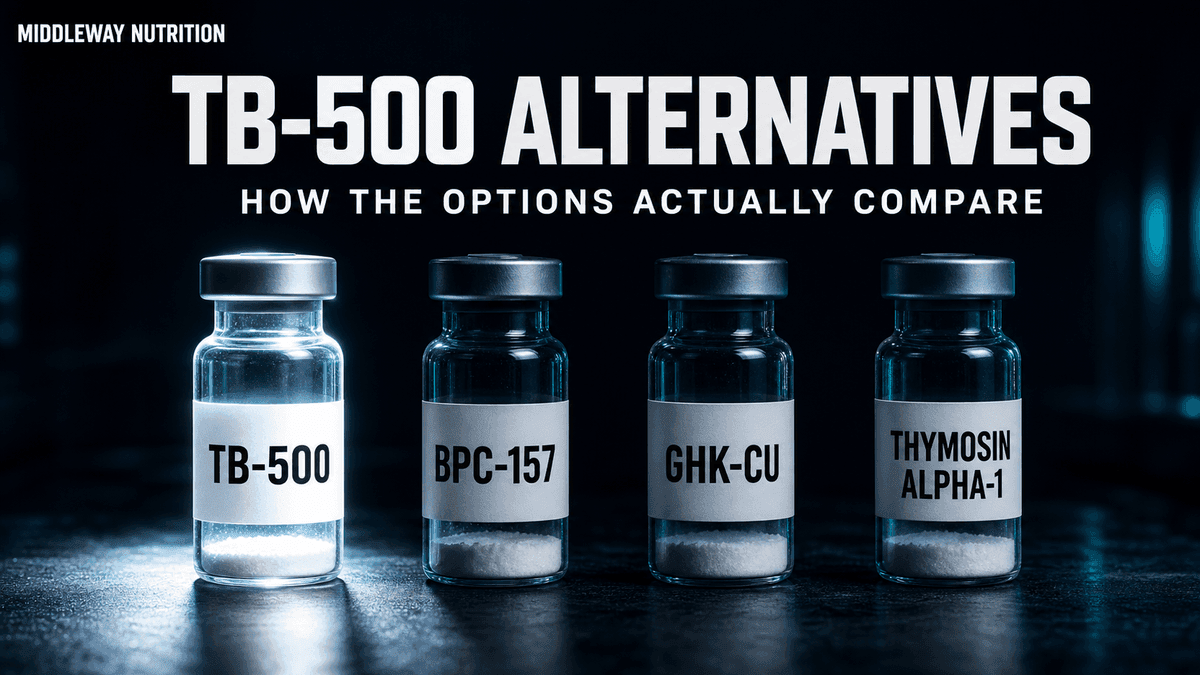
The most commonly used TB-500 alternatives are BPC-157 for localised soft tissue and gut work, GHK-Cu for skin and connective tissue, KPV for inflammatory conditions, and thymosin alpha-1 for immune modulation, and none of them does the same job. Anyone comparing TB-500 alternatives should start with an uncomfortable fact: human clinical evidence is thin to absent across this entire category, so choosing between them is mostly a question of mechanism and plausibility rather than proven outcomes.
That is not a reason to dismiss them. It is a reason to be honest about what you are buying.
What TB-500 Is Supposed to Do
TB-500 is a synthetic peptide corresponding to the active actin-binding region of thymosin beta-4, a protein involved in cell migration, blood vessel formation and tissue remodelling. Its distinguishing feature in this category is systemic action: it is described as circulating and reaching tissue throughout the body rather than acting only where it is injected.
Preclinical work on thymosin beta-4 covers tendon, muscle, cardiac and neural tissue, and the full-length protein has been taken into clinical development for surface wound and ocular indications. What does not exist is a controlled human trial showing that TB-500 heals a torn tendon or a strained muscle faster. That gap applies to every compound on the list below.
One further practical issue: products sold as TB-500 are not consistent. Some vendors supply a short fragment, some supply full-length thymosin beta-4, and the label rarely makes it clear. This is a real reason people look elsewhere.
TB-500 Alternatives at a Glance
| Compound | Main mechanism | Best suited to | Evidence quality | Route |
|---|---|---|---|---|
| BPC-157 | Angiogenesis and growth factor signalling, largely local | Localised tendon, ligament and gut issues | Extensive animal data, essentially no human trials | Injection or oral for gut |
| GHK-Cu | Copper carrier, stimulates collagen synthesis | Skin, hair, superficial connective tissue | Some human dermatology data, mostly topical | Topical or injection |
| KPV | Anti-inflammatory fragment of alpha-MSH | Inflammatory gut and skin conditions | Animal data only | Oral or injection |
| Thymosin alpha-1 | Immune modulation, T cell function | Immune support, not tissue repair | Approved in some countries for hepatitis and as an immune adjuvant | Injection |
| Ipamorelin with a GHRH analog | Raises GH and IGF-1 systemically | General repair capacity and recovery | Pharmacology established, outcome data absent | Injection |
| Collagen peptides with vitamin C | Supplies substrate for collagen synthesis | Tendon and ligament support | Small human trials, some positive | Oral |
BPC-157: The Closest Substitute
BPC-157 is the compound most people move to, and for reasonable reasons. The preclinical literature is genuinely large, covering tendon, ligament, muscle and gastrointestinal tissue, and it is cheaper per milligram than TB-500. It also has an oral route with a plausible rationale for gut-specific use, since acting locally on gut tissue does not require systemic absorption.
Where it differs: BPC-157 is generally described as more locally acting, so proximity of the injection to the target matters more than it does with TB-500. For an injury you cannot inject near, that is a genuine limitation.
Where it matches TB-500 exactly: the human evidence. Animal data is not human data, and the absence of controlled trials is the central fact about BPC-157 rather than a footnote.
GHK-Cu: A Different Tissue Target
GHK-Cu is a copper-binding tripeptide with a real role in collagen and extracellular matrix synthesis. It is the one compound on this list with meaningful human data, though almost all of it is dermatological and topical: skin firmness, fine lines, wound appearance.
That makes it a poor substitute for TB-500 in a tendon or muscle context, and a reasonable choice if the target is skin, scar quality or superficial connective tissue. Treating them as interchangeable recovery peptides misreads what each one does.
KPV: Inflammation Rather Than Repair
KPV is a three amino acid fragment of alpha-melanocyte stimulating hormone with anti-inflammatory activity in animal models, particularly in gut and skin inflammation.
It is not a tissue repair peptide. If the problem is inflammatory rather than structural, it belongs in the conversation. If the problem is a partially torn tendon, it does not.
Thymosin Alpha-1: A Different Molecule Entirely
The name causes constant confusion. Thymosin alpha-1 and thymosin beta-4 are unrelated in function despite sharing part of a name. Thymosin alpha-1 modulates immune function, particularly T cell activity, and it is approved in a number of countries as an immune adjuvant and for chronic hepatitis.
It is the best-evidenced peptide on this list, and it is not a substitute for TB-500 in any meaningful sense. If immune modulation is what you are actually after, our where to buy thymosin alpha-1 guide covers how to source it.
GH Secretagogues: Raising the Ceiling Instead
A GHRH analog paired with ipamorelin takes an entirely different approach: rather than signalling repair locally, it raises growth hormone and IGF-1 systemically, which supports tissue repair capacity in general.
The pharmacology is established. The outcome data for injury recovery specifically is not, and these compounds bring their own considerations around fluid retention and glucose. They are a reasonable adjunct rather than a replacement.
The Alternatives Nobody Sells You
Two things with better evidence than anything above deserve a place in this comparison.
Collagen peptides with vitamin C, timed before loading exercise. Small human trials have examined this for tendon and ligament support, and the mechanism is straightforward: supply substrate and stimulate the tissue while it is available. It is cheap, oral and low risk.
Progressive tendon loading. The single best-evidenced intervention for tendinopathy is structured, progressive loading under a physiotherapist. No peptide on this list has anything approaching that evidence base. Anyone considering research compounds for a tendon problem who has not done a proper loading programme is skipping the part that works.
For a fuller treatment of how thin this evidence base is, see our article on peptides for recovery and where the evidence gets thin. Individual guides are available for TB-500, BPC-157, GHK-Cu and thymosin alpha-1.
Frequently Asked Questions
What is the best TB-500 alternative?
For soft tissue and gut work, BPC-157 is the closest single substitute, mainly because it targets similar tissue with a comparably large animal literature and lower cost. For skin and superficial connective tissue, GHK-Cu is the better fit. There is no controlled human evidence establishing that any of them outperforms the others.
Is BPC-157 stronger than TB-500?
Neither has been measured against the other in a human trial, so strength comparisons are guesswork. The meaningful difference is reach: BPC-157 is generally described as acting more locally, while TB-500 is described as systemic. That makes injection placement matter more with BPC-157.
Can you use BPC-157 and TB-500 together?
They are frequently combined, on the theory that a local repair signal and a systemic one complement each other. The rationale is plausible and entirely untested in humans. Combining two compounds with no human safety data doubles the unknowns rather than halving them.
Is there a legal alternative with real evidence?
Yes, and it is less exciting than peptides. Progressive loading rehabilitation has the strongest evidence base for tendon injury by a wide margin, and collagen peptides with vitamin C taken before loading has small human trials behind it. Neither is a research compound, and neither requires a needle.
Why do people switch away from TB-500?
Cost is the most common reason, since it runs higher per milligram than several alternatives. Product inconsistency is the second: vendors sell different molecules under the same name, and without a batch-specific certificate of analysis there is no way to know which one arrived.