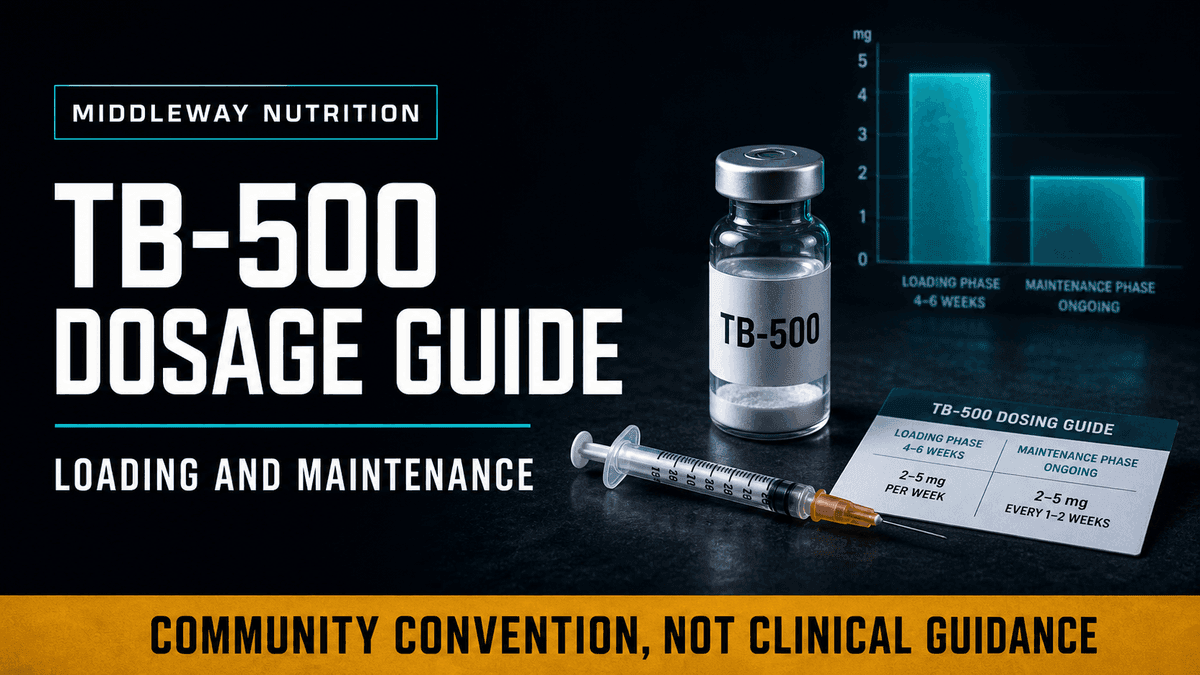
The TB-500 dosage pattern quoted almost everywhere is a loading phase of roughly 4 to 6 mg per week split across two injections for four to six weeks, followed by maintenance at around 2 to 2.5 mg per week. What no TB-500 dosage guide can tell you is where those numbers came from, because they were not established in a human trial: they are convention, derived from animal work and repeated until they became standard.
That is worth stating up front rather than burying. Everything below describes what appears in research protocols and vendor literature, not validated human dosing.
TB-500 Dosage Guide: Commonly Reported Protocols
| Tier | Loading phase | Maintenance | Typically used for |
|---|---|---|---|
| Conservative | 2 mg twice weekly for 4 weeks | 2 mg per week | General recovery models, minor soft tissue |
| Standard | 2.5 mg twice weekly for 4 to 6 weeks | 2 to 2.5 mg per week | Tendon and ligament models |
| Higher load | 3 mg twice weekly for 6 weeks | 2.5 mg per week | Acute or severe injury models |
The structure is consistent across sources: a saturation phase followed by a lower ongoing dose. The rationale offered is that thymosin beta-4 acts on cell migration and tissue remodelling, processes said to benefit from reaching tissue concentration before dropping to a sustaining level.
Whether that rationale is correct in humans has not been tested. It is a reasonable inference from the mechanism, and an inference is what it remains.
Why Twice Weekly Rather Than Daily
TB-500 is dosed far less frequently than most research peptides, and the reason is duration of action. Short peptides such as sermorelin need daily or twice-daily administration because they are cleared within minutes. TB-500 is described as maintaining tissue-relevant levels over days, which is why non-consecutive twice-weekly dosing, for example Monday and Thursday, is the standard loading pattern.
Maintenance typically drops to a single weekly injection.
The practical advantage is real: fewer injections means fewer injection sites, fewer opportunities for contamination and better adherence over a protocol lasting months.
Subcutaneous or Intramuscular
Both routes appear in protocols. Subcutaneous is more common, simpler and less uncomfortable.
The argument sometimes made for intramuscular injection near an injury does not apply well to TB-500 specifically, because it is described as acting systemically rather than locally. If the compound circulates and reaches tissue throughout the body, injecting it next to the sore knee offers no clear advantage over injecting it into the abdomen. That argument has more force for compounds described as locally acting.
Reconstitution Maths
This is where mistakes actually happen, and getting it wrong is a much bigger practical risk than choosing between 2 mg and 2.5 mg.
| Vial size | Bacteriostatic water added | Resulting concentration | Volume for a 2.5 mg dose |
|---|---|---|---|
| 5 mg | 2 mL | 2,500 mcg per mL | 1.0 mL, meaning 100 units on a standard insulin syringe |
| 5 mg | 2.5 mL | 2,000 mcg per mL | 1.25 mL, more than one full insulin syringe |
| 10 mg | 3 mL | 3,333 mcg per mL | 0.75 mL, meaning 75 units |
| 10 mg | 5 mL | 2,000 mcg per mL | 1.25 mL |
Practical points that matter:
- Add the water slowly down the side of the vial rather than directly onto the powder, and swirl gently rather than shaking. Peptides are proteins and mechanical stress degrades them.
- Store reconstituted solution refrigerated. Lyophilised powder is stable at room temperature for far longer than solution is.
- Label the vial with the concentration and the date. A vial with no label is a dosing error waiting to happen.
- Insulin syringe units are volume, not milligrams. On a 2,500 mcg per mL solution, 100 units is 2.5 mg. On a 2,000 mcg per mL solution, the same 100 units is 2 mg.
Our peptide reconstitution calculator handles the arithmetic if you would rather not do it by hand.
Cycle Length
Two patterns dominate. The first runs a loading phase followed by indefinite maintenance. The second runs a fixed block of around twelve weeks and then stops.
There is no evidence favouring either, and no established basis for a required break. The argument for a fixed block is simply that a compound with no long-term human safety data is better used for a defined period with a defined goal than taken indefinitely because nothing bad has happened yet.
Setting a specific endpoint before you start is the useful discipline here: what should be better, by when, and how will you tell?
What This Guide Cannot Tell You
There is no established human therapeutic dose, because TB-500 has not completed human trials for any indication. The figures above are a convention that formed in the research chemical market.
Animal dosing does not translate directly. Interspecies scaling for larger peptides is genuinely complicated, and simple body-weight conversion overstates equivalence.
Product identity is uncertain. Vendors sell different molecules under the TB-500 name, and a dose only means something if you know what is in the vial. A batch-specific third-party certificate of analysis is the only way to check. Which vendors publish those certificates is covered in our TB-500 sourcing comparison.
For broader context, see the TB-500 guide, our side effects overview, and our article on peptides for recovery and where the evidence gets thin.
Frequently Asked Questions
How much TB-500 per week is standard?
Commonly reported protocols use 4 to 6 mg per week during a loading phase of four to six weeks, split across two injections, then 2 to 2.5 mg per week for maintenance. These figures come from convention in research protocols rather than from human trials, so they should be read as what people do, not as an established therapeutic dose.
How often should TB-500 be injected?
Twice weekly on non-consecutive days during loading, then once weekly during maintenance. The infrequent schedule reflects its longer duration of action compared with short-acting peptides, which need daily dosing to maintain any signal at all.
Subcutaneous or intramuscular for TB-500?
Subcutaneous is more common and simpler. Because TB-500 is described as acting systemically rather than locally, injecting near the site of an injury has no clear advantage, which removes the usual argument for the intramuscular route.
How do you reconstitute a 5 mg TB-500 vial?
Adding 2 mL of bacteriostatic water to a 5 mg vial gives 2,500 mcg per mL, so a 2.5 mg dose is 1 mL, or 100 units on a standard insulin syringe. Add the water slowly down the vial wall, swirl rather than shake, refrigerate the solution and label it with the concentration and date.
How long should a TB-500 cycle run?
Reported protocols either run loading followed by ongoing maintenance, or a fixed block of around twelve weeks. There is no evidence supporting a particular length or a required break. Given the absence of long-term human safety data, defining a fixed period with a specific goal is the more defensible approach.