The TB-500 peptide is a synthetic version of a short active region of thymosin beta-4, a repair protein present in almost every cell in the body and concentrated in platelets and wound fluid. What separates the TB-500 peptide from most recovery compounds is that it is described as acting systemically rather than only where it is injected, which is why it attracts interest for injuries that cannot be reached with a needle.
It is also, as of now, a compound with no completed human trials. That combination, a plausible mechanism and an empty clinical file, defines the whole subject.
TB-500 Peptide: What It Is and How It Works
Thymosin beta-4 is a 43 amino acid protein. TB-500 corresponds to a short sequence within it, the region containing the actin-binding motif, synthesised on its own.
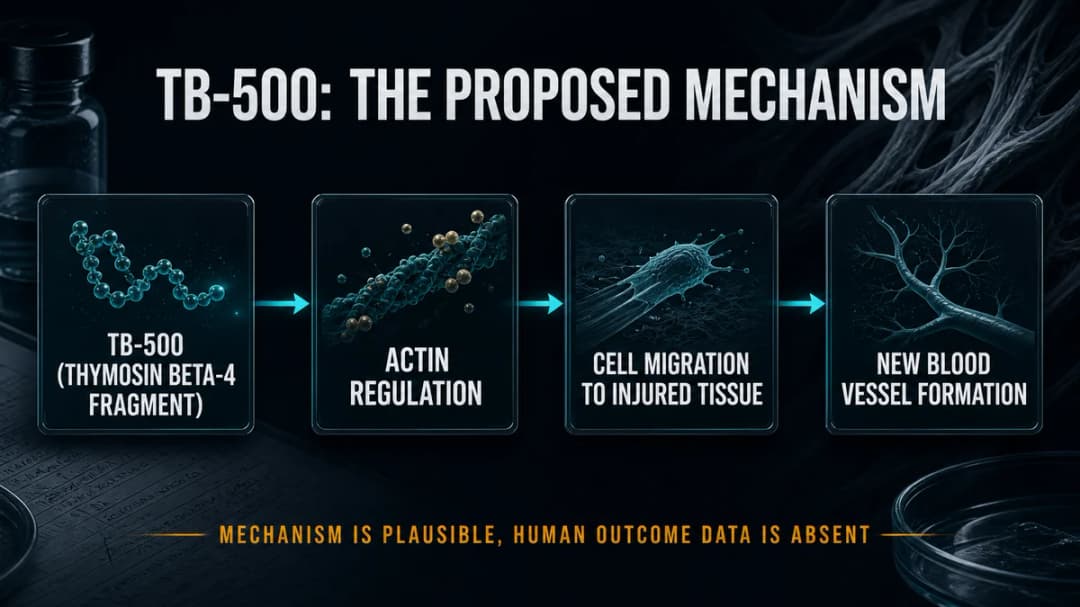
The mechanism runs through actin, one of the most abundant proteins in the cell and the structural basis of cell movement. Thymosin beta-4 binds monomeric G-actin and regulates its availability for assembly into filaments. That control over actin dynamics is what allows cells to migrate, which matters for repair because healing requires cells to move into damaged tissue.
Three consequences follow in the preclinical literature:
Cell migration. Repair cells reach the injury site more readily.
Angiogenesis. New blood vessel formation supports tissue that has lost its supply.
Inflammation modulation. Reduced inflammatory signalling in several animal injury models.
Animal work covers tendon, ligament, skeletal muscle, cardiac tissue, skin wounds and peripheral nerve. The full-length protein has been taken into clinical development for wound and ocular surface indications, which is a meaningful signal that the biology is taken seriously. It is not the same as evidence that the injectable fragment repairs a torn tendon in a person.
What People Use It For
| Use | Mechanistic plausibility | Evidence available |
|---|---|---|
| Tendon and ligament injury | High, based on animal tendon models | Animal only |
| Muscle strain recovery | High | Animal only |
| Post-surgical healing | Moderate | Animal only |
| Joint discomfort | Moderate | Animal only |
| Hair regrowth | Low to moderate, from follicle work in animals | Animal only, weak |
| Cardiac tissue repair | High in animal models | Not applicable to self-administration |
The pattern is consistent. Every row has an animal literature behind it and no controlled human trial.
A Realistic Timeline
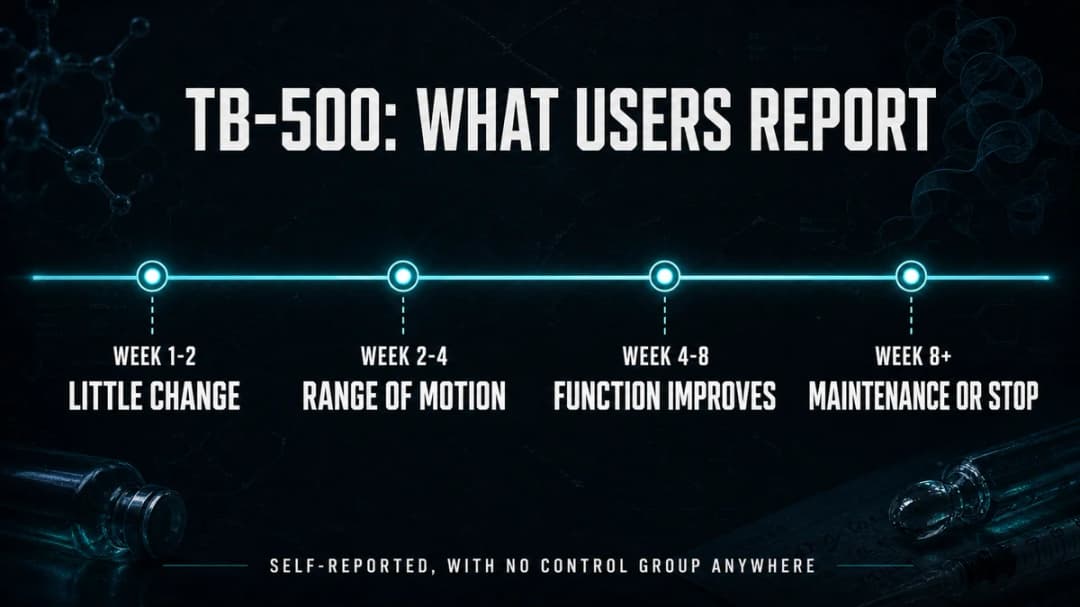
What follows describes what users commonly report. It is not trial data, and the reported effects are all subjective.
| Window | Commonly reported |
|---|---|
| Week 1 | Nothing, or brief fatigue after the first injections |
| Week 2 to 4 | Early reports of reduced discomfort in the target area |
| Week 4 to 8 | Better tolerance of loading, improved range of movement |
| Week 8 to 12 | Whatever the protocol was going to produce has usually appeared |
| After stopping | No withdrawal, no rebound described |
The confounder is unavoidable and worth naming: most soft tissue injuries improve over eight to twelve weeks anyway, particularly when someone is also resting appropriately and doing rehabilitation. Distinguishing the compound from the natural course of healing is exactly what a controlled trial exists to do, and none has been run.
Dosing in Brief
Commonly reported protocols use a loading phase of roughly 4 to 6 mg per week split over two injections for four to six weeks, followed by maintenance around 2 to 2.5 mg weekly. Subcutaneous injection is standard, and since the compound is described as systemic, injecting near the injury offers no clear advantage.
Our TB-500 dosage guide covers the protocols and reconstitution maths in full, including the caveat that these figures are convention rather than validated human doses.
Safety and the Angiogenesis Question
Reported side effects are mild and mostly local: injection site redness, brief fatigue in the first week, occasional headache. There is no described hormonal, appetite or cardiovascular effect, which is consistent with the mechanism.
The one substantive concern is theoretical and worth taking seriously. TB-500 promotes angiogenesis, and tumours require blood supply to grow. There is no evidence that it causes cancer, and no documented case of it accelerating one. It is nonetheless the reason anyone with an active malignancy or a recent cancer history should not use it, and the reason this should be discussed with an oncologist rather than settled by reading forums.
TB-500 is also prohibited in tested sport.
How It Compares With BPC-157
These two are constantly paired, and the rationale offered is that they act through different mechanisms: TB-500 through actin and cell migration, BPC-157 through angiogenesis and growth factor signalling.
The practical distinction usually drawn is reach. BPC-157 is described as acting more locally, so injection placement matters; TB-500 is described as systemic, so it does not. That makes TB-500 the option people choose for deep or inaccessible injuries.
Both have the same evidentiary problem. Combining them is a reasonable-sounding idea with no human data behind it, and it doubles the number of unknowns rather than resolving any. Our TB-500 alternatives comparison and the BPC-157 guide cover the differences in more detail.
What Would Make This More Convincing
Worth being clear about what is missing, because it explains why a careful reader should stay sceptical.
There is no human pharmacokinetic data establishing what dose produces what tissue concentration. There is no randomised trial comparing it against placebo for any injury. Product identity is inconsistent between vendors, with some supplying the short fragment and others full-length thymosin beta-4 under the same name. And nearly all reported benefit is self-reported by people who paid for the compound and rested the injury at the same time.
None of that makes the mechanism wrong. It means the honest position is interest rather than confidence.
For the wider picture on this category, see our article on peptides for recovery and where the evidence gets thin.
Frequently Asked Questions
What does the TB-500 peptide actually do?
It corresponds to the actin-binding region of thymosin beta-4, a protein involved in cell migration, blood vessel formation and inflammation control. In animal models it accelerates repair across tendon, muscle, skin and cardiac tissue. Whether it does the same in humans has not been tested in a controlled trial.
How long does TB-500 take to work?
Users commonly report changes from around week two to four, with most of whatever happens appearing by week eight to twelve. Since most soft tissue injuries improve over a similar period on their own, that timeline is genuinely difficult to attribute to the compound.
Is TB-500 the same as thymosin beta-4?
Not quite. Thymosin beta-4 is the full 43 amino acid protein; TB-500 is a synthetic version of a short active region within it. The complication is that vendors are inconsistent, and some products sold as TB-500 are full-length thymosin beta-4. A batch-specific certificate of analysis is the only way to know what you have.
Does TB-500 help with hair growth?
There is some animal work on hair follicle activity, which is where the claim comes from, but it is weak and there is no human evidence. It should be treated as a speculative use rather than an established one.
Is TB-500 safe to use long term?
Nobody knows. There is no long-term human safety data for it in any indication. The known theoretical concern is its angiogenic activity, which is why it is contraindicated in anyone with an active or recent cancer diagnosis.