The short version of this Wolverine Stack Review: BPC-157 and TB-500 are paired for a defensible reason, the animal data behind each is genuinely interesting, and there is no human trial of the combination at all. Anyone reading a Wolverine Stack Review looking for proof that two peptides fix a stubborn tendon will not find it here, because that proof does not exist in the published literature. What exists is a coherent mechanism, a large body of rodent work, and a lot of self-reported experience that cannot separate the compounds from the rehabilitation people do alongside them.
Both peptides are sold as research chemicals. Neither is approved for human use anywhere.
What the Wolverine Stack is
Two compounds, usually as two separate lyophilised vials, sometimes bundled under the stack name.
BPC-157 is a 15-amino-acid sequence derived from a protein in gastric juice. Its studied mechanisms are vascular and local: promoting new blood vessel formation through VEGF signalling, interacting with the nitric oxide system, activating fibroblasts, and protecting gastric and intestinal mucosa. The gut activity is unique to it among the common repair peptides.
TB-500 is a synthetic peptide related to thymosin beta-4, generally corresponding to the protein's actin-binding region. Its studied mechanisms are about movement rather than plumbing: actin regulation, migration of repair cells toward damaged tissue, and dampening of inflammatory signalling. It also has a cardiovascular research strand that BPC-157 mostly lacks.
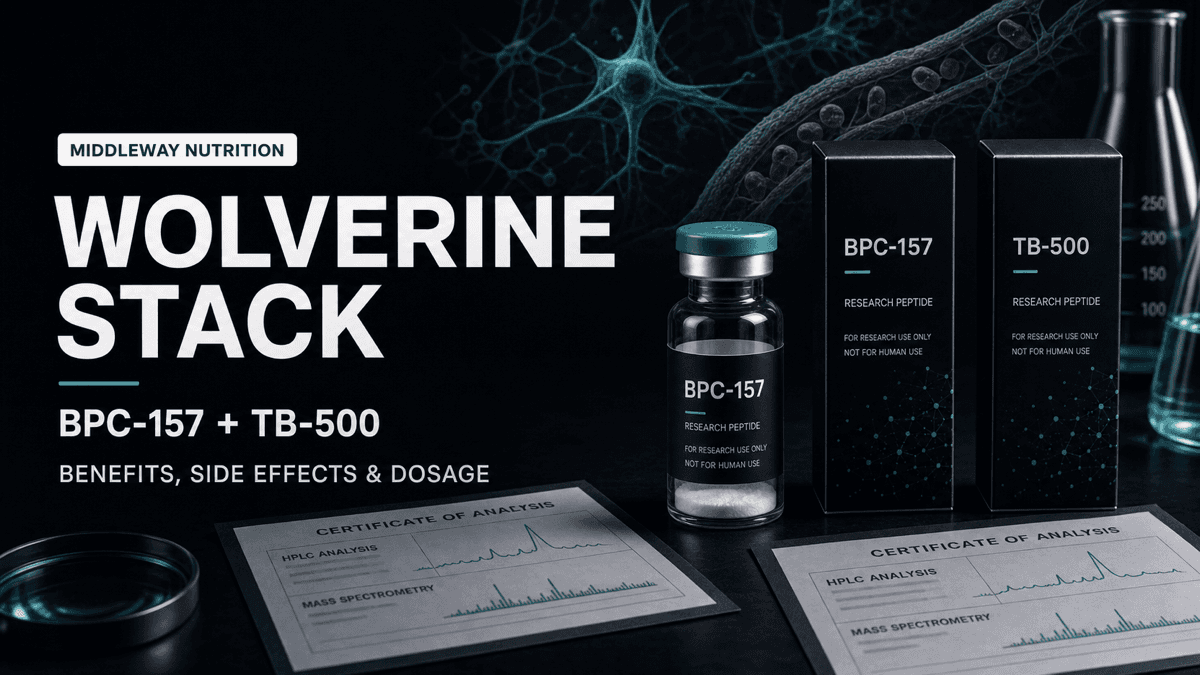
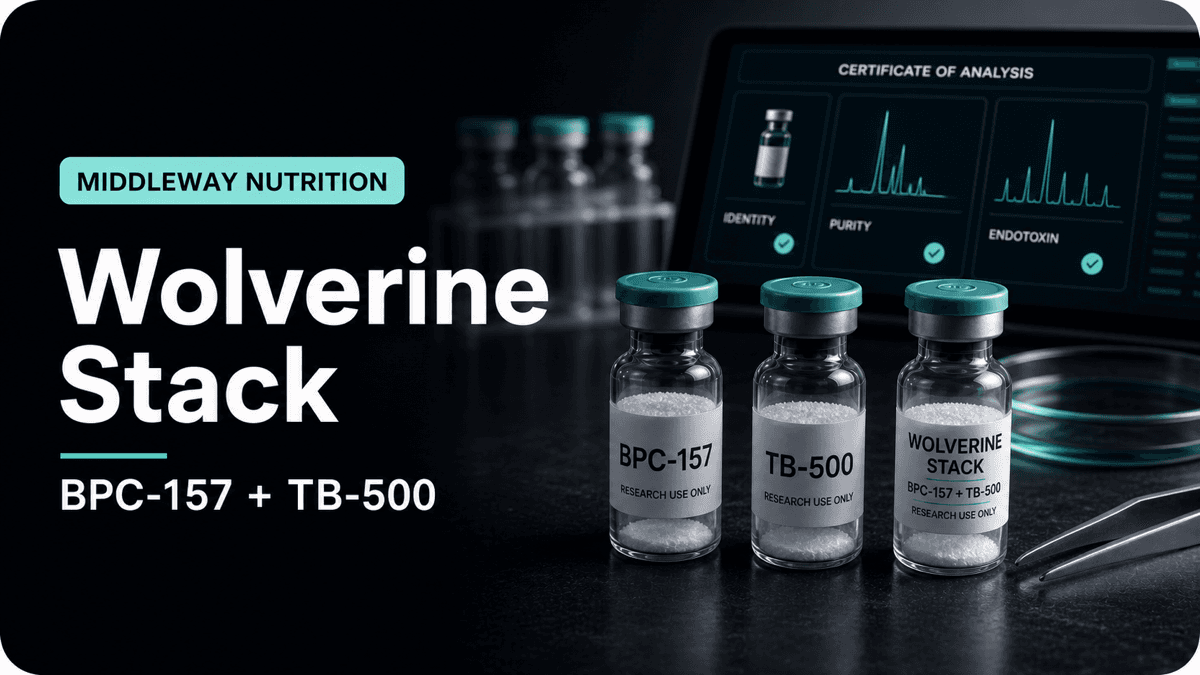
One caution before buying anything: product descriptions sometimes name a different, shorter thymosin-derived peptide as the active ingredient. These are not the same molecule. Check the sequence on the certificate of analysis rather than trusting the product name.
Why the two get paired
The combination is not marketing invention. The two address different rate-limiting steps in repair.
| Property | BPC-157 | TB-500 |
|---|---|---|
| Where it acts | More local | More systemic |
| Core mechanism | Angiogenesis, nitric oxide, fibroblasts | Actin regulation, cell migration |
| Gut effects | Yes, distinctive | Minimal |
| Cardiovascular research | Limited | More developed |
| Typical dosing frequency | Daily | Twice weekly, then weekly |
| Onset in reports | Days to weeks | Weeks |
Tendon heals slowly largely because it is poorly vascularised. BPC-157 addresses blood supply. Repair also depends on getting the right cells to the damage. TB-500 addresses migration. Combining a supply mechanism with a delivery mechanism is a reasonable bet.
It remains a bet. No study has compared the pair against either alone in humans, so the claim that the combination outperforms each component is inference, not a finding.
Wolverine Stack review of reported results, week by week
The table below reflects what users report, not measured outcomes. Nothing here comes from a controlled trial in people.
| Period | What people commonly report |
|---|---|
| Week 1 | Little musculoskeletal change. Some report digestive changes, which is the most plausible early BPC-157 effect. |
| Weeks 2 to 3 | Reduced soreness after training, first reports of easing tendon pain. |
| Weeks 4 to 6 | The window most people describe as the turning point for chronic tendon or joint complaints. |
| Weeks 8 to 12 | Reports of function returning rather than pain simply reducing. Also where most protocols end. |
| After stopping | Mixed. Some report holding gains, others report symptoms returning within weeks. |
The honest reading of that pattern is that it overlaps almost exactly with the natural timeline of tendinopathy improving under sensible loading. That does not mean the peptides do nothing. It means personal experience cannot tell you whether they did.
What the underlying evidence actually shows
For BPC-157, the research base is large but almost entirely preclinical, much of it from one long-running research group, and heavily concentrated in rats with surgically created injuries. Achilles tendon transection models have reported faster healing and better tensile strength on testing. Gut models are the most consistent strand. Human outcome data is close to nonexistent.
For thymosin beta-4, the parent protein of TB-500, there is real wound healing research including some early human work in dermal contexts. Whether a synthetic fragment injected subcutaneously reproduces the parent protein's activity is a separate question that the fragment's own literature does not fully answer.
Neither compound has a published pharmacokinetic profile in humans that would let anyone design a dose rationally. The ranges circulating in the community were not derived from human dose-finding studies.
Reported research ranges
Given as description of what appears in the literature and in community protocols, not as a protocol to follow.
- BPC-157: roughly 250 to 500 mcg per day, subcutaneous, sometimes split into two doses.
- TB-500: roughly 2 to 2.5 mg twice weekly for an initial four to six weeks, then around 2 mg weekly.
- Duration: four to six weeks for an acute problem, eight to twelve for a chronic one.
- Reconstitution: bacteriostatic water, refrigerated after mixing, generally treated as usable for around 28 days.
Because the dosing schedules differ, the two are usually kept in separate vials and administered separately rather than combined in one syringe. Our Wolverine Stack dosage page goes through the arithmetic.
Who the stack does not suit
Being clear about this matters more than the upside.
A complete tendon or ligament rupture is a surgical problem and no peptide changes that. Mechanical problems, such as an impingement caused by how a joint moves, are not chemistry problems. Anyone with an active or recent cancer should treat the angiogenic mechanism shared by both compounds as a genuine reason for caution. Anyone pregnant or breastfeeding has zero safety data to work from. And competitive athletes should note that both compounds appear on prohibited lists, so a stack marketed for recovery can end a season.
For general background, see what is the Wolverine Stack and the individual BPC-157 guide.
The verdict
The Wolverine Stack is the most reasonable of the popular peptide combinations, which is a lower bar than it sounds. Its logic is sound, its component research is real, and its human evidence is missing. Treat it as an experiment with unknown odds rather than a treatment, keep doing the loading rehabilitation that does have evidence behind it, and do not let a vial become the reason you skip the physiotherapy.
FAQ
How long does the Wolverine Stack take to work?
Users most commonly describe a change between weeks two and six, with function improving later than pain. No trial has measured this in humans, and the same timeline describes tendinopathy improving on its own under proper loading, so self-reported onset is weak evidence.
Can BPC-157 and TB-500 be injected together?
They can be drawn into the same syringe, but the schedules do not align: BPC-157 is typically daily and TB-500 twice weekly. Keeping them separate is simpler and preserves the ability to stop one without stopping the other.
Is the Wolverine Stack safe?
Reported side effects are mild and mostly local, such as injection site redness and occasional nausea. The important limitation is that no long-term human safety data exists for either peptide, so rare or delayed effects would not have been observed.
Does the stack work better than BPC-157 alone?
Nobody has tested that comparison in people. The argument for the pair is mechanistic rather than empirical. For gut-related purposes, BPC-157 alone has the clearer rationale, since TB-500 has no comparable gastrointestinal research.
Will the Wolverine Stack show up on a drug test?
Both compounds are prohibited in tested sport and detection methods exist for them. Anyone subject to anti-doping testing should assume a positive result is possible.