Adipotide (FTPP) is a peptidomimetic that targets prohibitin on the blood vessels supplying white fat tissue, triggering their destruction and, with them, the death of the fat cells they feed. Obese primates lost roughly 11% of body weight in 28 days. Development stopped because the same mechanism damaged the kidneys, and no human clinical trial has been completed.
Adipotide (FTPP) turns up regularly in lists of experimental weight loss compounds, usually with the primate result quoted and the reason it stopped omitted. Both belong in the same sentence, because the mechanism that produced the weight loss is the mechanism that produced the toxicity.
How It Works
The compound is bipartite: a homing sequence attached to a cell-killing sequence.
The homing portion binds prohibitin, a protein expressed on the endothelial cells lining the blood vessels that supply white adipose tissue. The second portion is a proapoptotic sequence that disrupts mitochondrial membranes and triggers programmed cell death, but only once it has been delivered inside a cell.
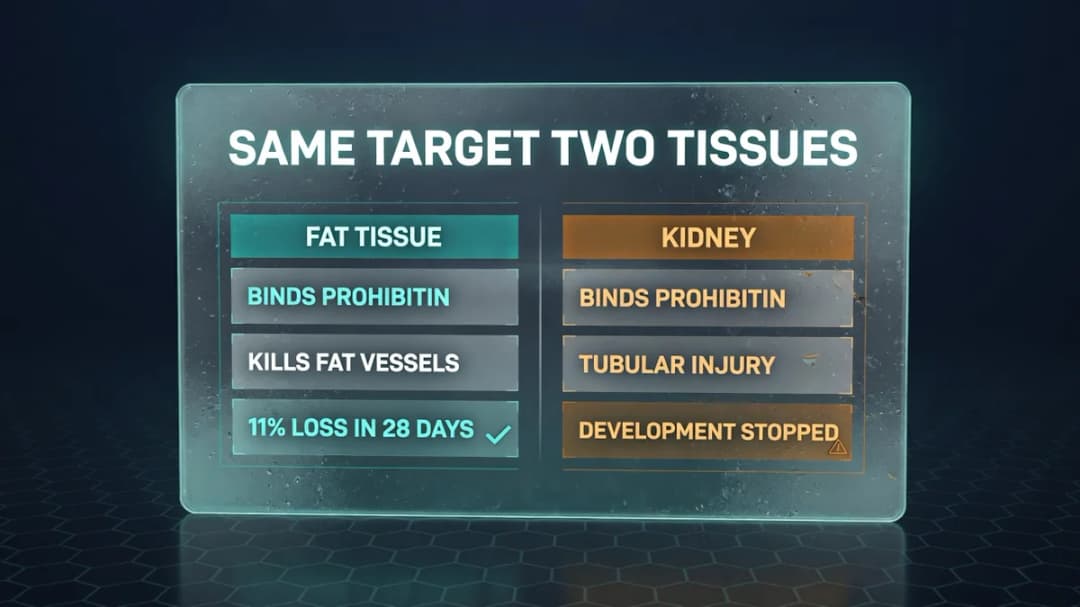
Put together, the compound circulates, docks onto fat tissue vasculature, and kills those vessels. The fat cells they supplied lose their blood supply and die.
That is genuinely different from everything else in the weight loss space. GLP-1 receptor agonists reduce appetite. Thermogenics raise energy expenditure. Adipotide removes fat tissue directly, by cutting its supply lines.
What the Animal Data Showed
Work in mice and then in rhesus monkeys produced the results that made the compound famous. Obese primates treated over 28 days lost approximately 11% of body weight, with imaging confirming that the loss was fat mass rather than lean tissue or water.
For a four week intervention, that is a large effect. It is also worth putting in context: the modern incretin drugs achieve larger losses over longer periods with an established safety profile and regulatory approval, which is a comparison that did not exist when Adipotide was making headlines.
Why Development Stopped
Prohibitin is not expressed exclusively on fat tissue vasculature. It is also present in renal vasculature, and the compound went where the target was.
Treated primates showed elevated creatinine and structural changes in renal tubular cells, consistent with tubular injury. The damage was reported as reversible, which is better than the alternative and is not the same as acceptable. The toxicity signal was most pronounced at the doses that produced the strongest fat loss, which is the worst possible relationship between effect and harm.
There is no dose that has been shown to separate the two. That is why no Phase 1 or Phase 2 human trial data has been published, and why the compound sits where it does.
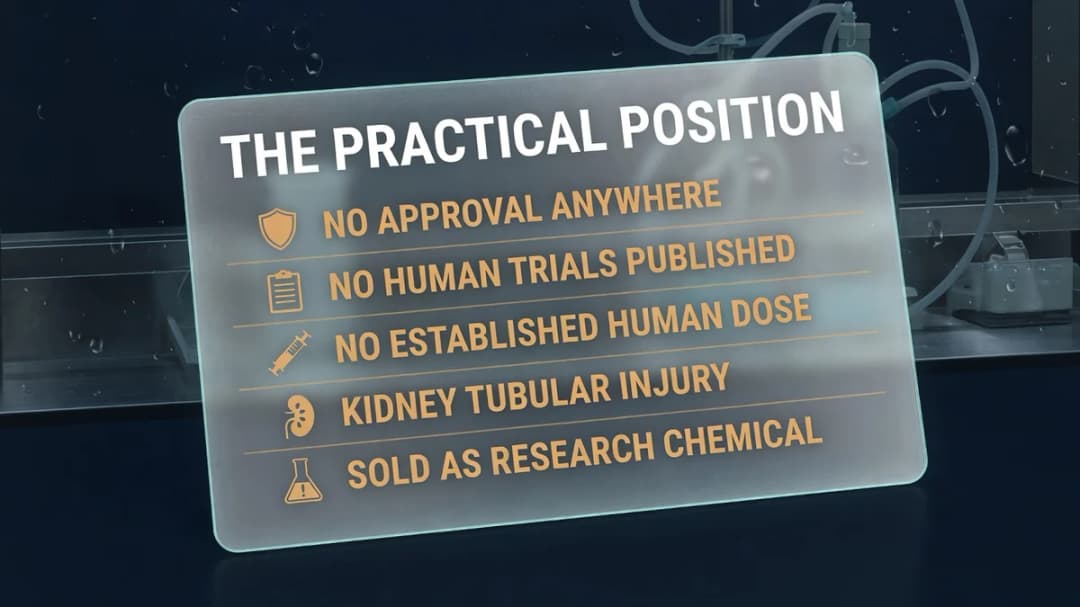
The Practical Position Today
| Question | Answer |
|---|---|
| Approved anywhere | No |
| Human trials completed | None published |
| Established human dose | None |
| Route studied | Subcutaneous, in animals |
| Known dose-limiting toxicity | Kidney, renal tubular injury |
| Available to buy | Yes, as a research chemical |
That last row is the uncomfortable one. A compound whose development was halted for organ toxicity, with no human dosing data of any kind, is nonetheless sold online. There is no protocol to follow, because none was ever established, and the toxicity was identified in the species most similar to us.
Anyone extrapolating a human dose from the primate figures is extrapolating from studies whose main finding was that the compound damaged kidneys.
What Adipotide (FTPP) Is Actually Useful For
As a scientific idea, it remains genuinely interesting. Vascular targeting, delivering a payload to a specific tissue by binding a marker on its blood supply, is a strategy with real applications, particularly in oncology where the same logic underpins several approaches.
The lesson from Adipotide is about target selectivity. The homing sequence was good enough to concentrate the compound in fat tissue and not good enough to keep it away from the kidney. Solving that problem is a real research goal. Buying the unsolved version is not.
What Is Known About Dosing
There is no human dose. That is not an oversight in the literature, it is the literature.
All dosing data comes from preclinical work in mice and rhesus monkeys, using subcutaneous administration over a 28 day period. At lower doses, in the region of 100 mcg per kilogram, the fat loss effect was attenuated, while the kidney signal was most pronounced where the effect was strongest. No human equivalent dose has been established, and no Phase 1 study defining a tolerable dose in people has been published.
That has a specific consequence for anyone reading a protocol online. Any figure presented as an Adipotide dose for a person has been derived by someone converting an animal dose using standard scaling assumptions. Those conversions are a legitimate starting point for designing a trial with monitoring in place. They are not a protocol, and the organ at risk here gives very little warning before damage is significant, because a rise in creatinine is not something you feel.
If Weight Loss Is the Goal
The comparison is not close in 2026. Approved incretin medicines have randomised trial evidence, documented safety profiles, defined dosing and regulatory oversight, and they produce larger losses than the Adipotide primate figure over a longer period. Our GLP-1 medications overview covers what is available, and which GLP-1 is best for weight loss compares them.
The reason to be direct about this is that Adipotide's appeal is precisely that it works without requiring appetite change or dietary effort. That appeal is real, and the compound that delivered it also damaged kidneys in primates.
FAQ
Does Adipotide work for weight loss?
In obese primates, treatment over 28 days produced around 11% body weight loss, confirmed as fat mass by imaging. It has never been tested in a completed human trial, so whether it works in people is unknown.
Why was Adipotide discontinued?
Kidney toxicity. Prohibitin, the protein the compound targets, is also present in renal vasculature, so the compound damaged renal tubular cells alongside fat tissue vessels. The toxicity was reported as reversible, and it was most pronounced at the doses producing the greatest effect.
Is Adipotide safe at low doses?
There is no established safe dose, because no human study has been done. Animal data suggested weaker fat loss at lower doses, which is what you would expect, and does not establish that the kidney signal disappears.
Can you buy Adipotide?
It is sold as a research chemical, which is legal for the vendor and says nothing about whether using it is sensible. There is no human dosing protocol to follow and the known dose-limiting toxicity affects an organ that gives little warning before damage is significant.
How does Adipotide compare to GLP-1 drugs?
They work in entirely different ways, and the comparison favours the approved drugs on every practical measure: larger weight loss over longer periods, randomised trial evidence, documented safety, defined dosing and a prescriber involved. Adipotide's distinction is its mechanism, not its results.