LL-37 peptide benefits cluster almost entirely around wound repair, the side effects on record are mild and local, and the dosage numbers worth quoting came from topical research rather than from a syringe. That last detail reframes the entire compound, and most buyers never hear it.
- LL-37 is not a designed research chemical. Your neutrophils and epithelial cells already produce it, released from a larger precursor protein called hCAP18. A vial holds a synthetic copy of something you make yourself.
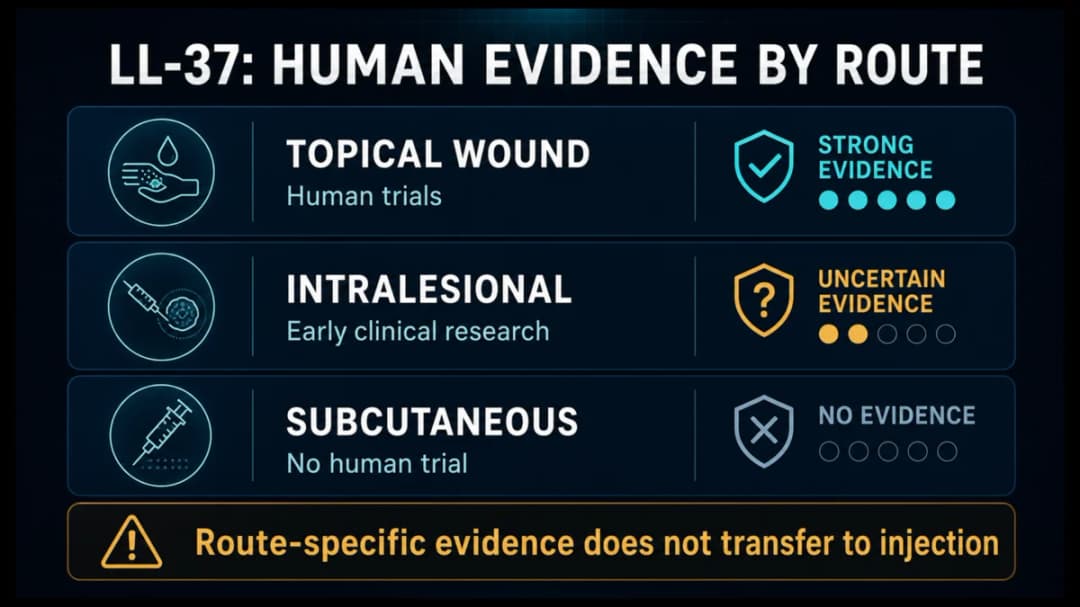
- Human dosing on record was either painted onto a wound bed or placed into a tumor by a clinician. No trial has ever tested a subcutaneous shot, so the injectable numbers traded in forums are guesswork dressed up as protocol.
- The clearest efficacy signal is topical. In leg ulcer research, the weaker formulations outperformed the strongest one, which is an unusual and instructive result.
- Whether this peptide calms inflammation or fuels it depends on how much of it is present. More is measurably worse past a certain point.
- The molecule is cleared quickly by proteolytic breakdown, so claims of all-day systemic coverage from one dose do not match its chemistry.
LL-37 Benefits
Any honest benefits list for this compound has to sort claims into tiers, because the gap between what humans have been given and what a petri dish has shown is enormous. Most write-ups collapse the two. Sorted properly, the list is short at the top and long at the bottom.
| Claimed benefit | Strongest evidence behind it | Where that evidence came from |
|---|---|---|
| Chronic wound repair in venous leg ulcers | Early-phase human trials | Applied to the wound surface |
| Killing bacteria, fungi, and some enveloped viruses | Culture assays | Direct exposure in a dish |
| Faster skin closure | Animal models, including cathelicidin-deficient animals | Topical application |
| New blood vessel growth | Cell and animal work | Local exposure |
| Making antibiotics work harder | Laboratory combination studies | In vitro |
| Gut repair, chronic Lyme protocols, immune boosting, sinus clearance | None. Extrapolated from the antimicrobial mechanism | No human route tested |
Backed by human trial data
Chronic wound repair. This is the single benefit with clinical footing. Early-phase work in hard-to-heal venous leg ulcers applied the peptide directly to the wound surface on a twice-weekly schedule across roughly a month. The weaker formulations shrank ulcer area meaningfully, with the lowest concentration performing best of all. A larger follow-up trial then reproduced the tolerability finding but delivered an ambiguous efficacy result, with whatever benefit there was concentrated among participants carrying bigger wounds. A 2023 randomized, double-blind trial of an LL-37 cream applied twice weekly for four weeks to mildly infected diabetic foot ulcers found a consistently greater rise in granulation index than placebo, without lowering inflammatory markers or bacterial counts (PMID 37480520). Separately, an open-label 2023 trial of an oral recombinant LL-37 product in 238 hospitalized Omicron patients reported faster viral RNA clearance (about 9.8 versus 14.0 days) with no severe adverse events (PMID 37605995); that is a swallowed bacterial-delivered product for infection, not an injectable vial.
Treat that as a real signal with limits attached: one indication, one route, one strong result and one muddy one.
Backed by laboratory and animal work
Broad antimicrobial reach. Culture work shows activity against gram-positive organisms including MRSA, gram-negative species such as Pseudomonas aeruginosa and E. coli, several Candida strains, and certain enveloped viruses. Inhibitory concentrations typically land in the low microgram-per-milliliter range and vary widely by organism and assay. Those are exposures at a membrane in a dish, not blood levels anyone has reached from a vial.
Quicker skin closure. Animals engineered without cathelicidin repair wounds sluggishly, and applying the peptide topically speeds closure in normal animals, mostly by pushing keratinocytes to migrate across the gap faster.
New vessel growth. The peptide encourages endothelial cells to proliferate and organize into vessels, which plausibly explains part of the wound result.
Working alongside antibiotics. Laboratory combination studies report improved bacterial killing when the peptide is paired with several antibiotic classes, occasionally allowing less antibiotic to do the same job. That remains a research direction, not an available therapy.
Where marketing outruns evidence
Gut repair, chronic Lyme regimens, general immune boosting, and sinus infection clearance all show up in promotional copy. Each is an extrapolation from the antimicrobial mechanism rather than a tested outcome. The biology is genuine; nobody has done the clinical translation. If a documented human immune record is what you are after, thymosin alpha-1 is considerably further along, and for gut-directed anti-inflammatory research KPV carries the better preclinical case.
LL-37 Side Effects
The baseline is reassuring. Because this sequence is native to humans, the kind of allergic sensitization a foreign peptide can provoke is unlikely. The reassurance is narrower than it sounds, though, since any therapeutic dose floods a site with far more peptide than the body would ever put there.
Observed in human trials
Across the topical leg ulcer work, the formulations that were studied proved well tolerated. Reported problems skewed mild, nothing serious was attributed to the peptide, and no deaths were linked to treatment. A subset of participants noticed short-lived redness or warmth where the peptide was applied, which reads as the immune-recruiting activity doing exactly what it does rather than as tissue damage.
Note the boundaries on that record: a defined topical preparation, applied by clinicians, at known strengths, over about four weeks. None of it transfers to a self-reconstituted injection.
Plausible on mechanism, driven by dose
Cytotoxicity when concentrated. Preference for bacterial membranes over human ones is relative rather than absolute. Push the concentration high enough in cell culture and keratinocytes, fibroblasts, and immune cells take damage too. Whatever kills a bacterium is capable of harming host tissue at the wrong exposure.
The inflammatory flip. This is the safety idea that matters most and gets discussed least. The peptide is not reliably anti-inflammatory. In some ranges it mops up endotoxin and quiets cytokine output; in others it pulls immune cells inward, degranulates mast cells, and drives inflammation upward. Elevated natural levels of this cathelicidin are part of the disease process in psoriasis and rosacea, which is direct evidence that a surplus in skin is a problem, not a bonus.
Autoimmune signaling. The peptide can bind self-DNA into complexes that plasmacytoid dendritic cells read as a threat, triggering type I interferon output. That pathway is implicated in psoriasis and has been raised in discussions of lupus. Anyone already living with an autoimmune or interferon-driven condition sits in a category nobody has studied.
The gaps, stated plainly
No long-term human safety data exists for this peptide by any route. None exists for subcutaneous use at all, because no trial has used that route. There is no established medication interaction profile. Accounts of injection site reactions, flushing, or brief malaise from self-directed use are anecdotal and uncounted. Reading an absence of documented harm as proof of safety would be the wrong conclusion here.
LL-37 Dosage Chart
No approved human dose exists. The table below collects the concentrations and schedules that appear in published research, arranged so the strength of evidence behind each row is visible at a glance. It is reference material rather than a protocol, and the community row appears only because readers will run into it elsewhere, not because it holds up.
| Setting | Reported amount | How often | Duration |
|---|---|---|---|
| Leg ulcer research, applied to the wound surface | Weaker topical formulations, roughly half to under two mg/mL | Two applications weekly | Around one month |
| The strongest topical formulation tested, which underperformed | Roughly twice the effective concentration | Two applications weekly | Around one month |
| Melanoma work, injected into the lesion (unverified here, treat as indicative only) | Microgram amounts per nodule | Weekly | Several weeks |
| Antimicrobial assays in culture | Low microgram-per-milliliter range | Continuous exposure in the assay | Not applicable |
| Biofilm inhibition in culture | Below the concentration needed to kill | Continuous exposure in the assay | Not applicable |
| Cell migration assays | Low microgram-per-milliliter range | Continuous exposure in the assay | Not applicable |
| Topical wound models in animals | Microgram amounts per wound | Per application | Varies by study |
| Injectable amounts traded online, unvalidated | Small microgram amounts | Frequently daily | Short blocks with breaks |
Two observations deserve weight. The strongest topical concentration tested performed worst, which is better read as a genuine dose-response finding than as noise. And every laboratory figure describes a local exposure at a membrane surface, which says nothing about what belongs in a syringe.
The arithmetic behind a vial is ordinary division. Divide the peptide mass by the volume of bacteriostatic water you add and you have your concentration: a 5 mg vial taken up in 5 mL sits at 1 mg/mL, which is 1,000 mcg in every milliliter. A U-100 insulin syringe marks 1 mL as 100 units, so 5 units of that particular solution carries 50 mcg. Knowing this is a labeling and handling skill. It is not a reason to inject the result.
Inside the Molecule
Most of the research peptide market consists of analogs, fragments, and constructs with no natural counterpart. This one runs the other way. It is a native human protein, and the only cathelicidin our species makes.
The body stores it inactive as hCAP18, an 18 kDa protein loaded into neutrophil granules and expressed throughout epithelial tissue. Enzymatic cleavage frees the mature 37-residue fragment, which opens with a pair of leucine residues and takes its name from them. Vendor labels and forum posts split between LL-37 and LL37 without the hyphen, and both refer to the same molecule.
Written out, the sequence reads LLGDFFRKSKEKIGKEFKRIVQRIKDFLRNLVPRTES, with a molecular weight near 4,493 Da. Count the lysines and arginines in that string and you have the source of its strong positive charge, which is where the entire mechanism starts.
How the mechanism works
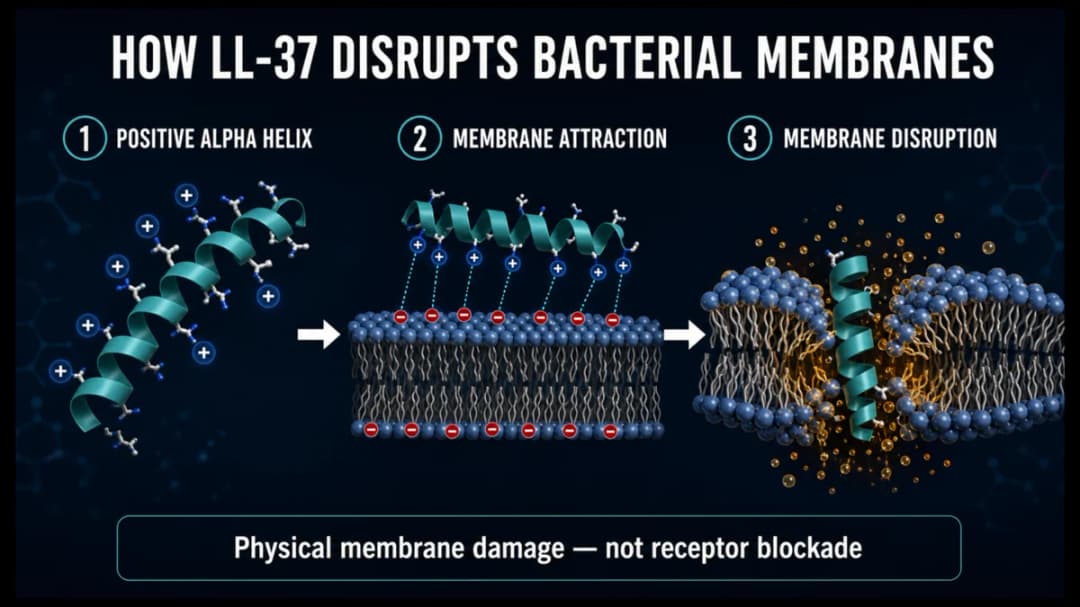
Inside a membrane environment the chain folds into an amphipathic alpha helix, one face attracted to water and the other to lipid. Bacterial membranes carry more negative surface charge than ours and contain no cholesterol. Electrostatics pull the positively charged peptide toward that surface, the greasy face slides into the lipid bilayer, and enough copies gathering in one place cost the membrane its integrity.
That is physical demolition rather than biochemical interference, which is why resistance is difficult to evolve. A bacterium would have to rebuild its own membrane charge, and that redesign costs it fitness.
Three secondary mechanisms accompany the membrane work.
Endotoxin capture. Dying gram-negative bacteria shed lipopolysaccharide, the trigger behind septic inflammatory cascades. This peptide binds LPS directly and dampens its signaling.
Biofilm interference. Bacterial communities sheltered in a protective matrix resist clearance far better than free-swimming cells do. The peptide can block biofilm formation at exposures beneath what outright killing requires.
Immune traffic control. It draws neutrophils, monocytes, and T cells toward infection, shapes cytokine output, and nudges macrophages toward repair-oriented behavior.
One contextual note is worth keeping. Vitamin D directly upregulates production of this peptide, because the vitamin D receptor binds response elements in the hCAP18 gene. Poor vitamin D status likely means you make less of it than you otherwise would.
Everything here is framed for research context. The compound holds no FDA approval for any indication and is sold for laboratory use.
Handling, Reconstitution, and Storage
The peptide ships as a white lyophilized powder. There are no disulfide bonds holding it together, but its size and heavy charge still make it more delicate in solution than a short sequence would be.
Keep the sealed dry vial cold and shielded from light. Minus 20 degrees Celsius is the usual standard for lyophilized material, and colder helps for long storage.
To reconstitute, let both vials warm to room temperature, wipe the stoppers, and run the bacteriostatic water gently along the vial wall so it pools rather than striking the powder head-on. Swirl if you must, but never shake. Agitation shears peptide chains, and foam on the surface is a warning sign.
Refrigerate the finished solution between 2 and 8 degrees Celsius. Sources disagree: some handling references cite about a week as a conservative window, others 28 days to six weeks, and no stability study of reconstituted LL-37 exists, so treat any figure as a guess rather than a tested shelf life. Some sources extend it for material portioned out and frozen. Cloudiness or floating particles mean the vial is finished. Repeated freezing and thawing degrades peptides silently, with nothing visible to warn you.
Stacking
Documented stacking for this compound barely exists, and most pairings discussed online are reasoning rather than research. The one combination with published backing is the peptide alongside conventional antibiotics, demonstrated in laboratory work across several drug classes, and that belongs in a clinical setting rather than a home protocol.
Within the peptide world, the pairing raised most often puts it beside KPV. The logic at least holds together, since the two operate through unrelated routes, one attacking microbial membranes while the other suppresses inflammatory signaling through NF-kB. No human study has tested the pair. Similar reasoning drives curiosity about combining it with VIP for mucosal and immune-regulatory research, or with thymosin alpha-1 for wider immune modulation. Every one of these is a hypothesis, not a finding.
The better-evidenced adjacent move is far less exciting: keep vitamin D status adequate, since it raises your own production of this peptide directly.
How to Verify What You Buy
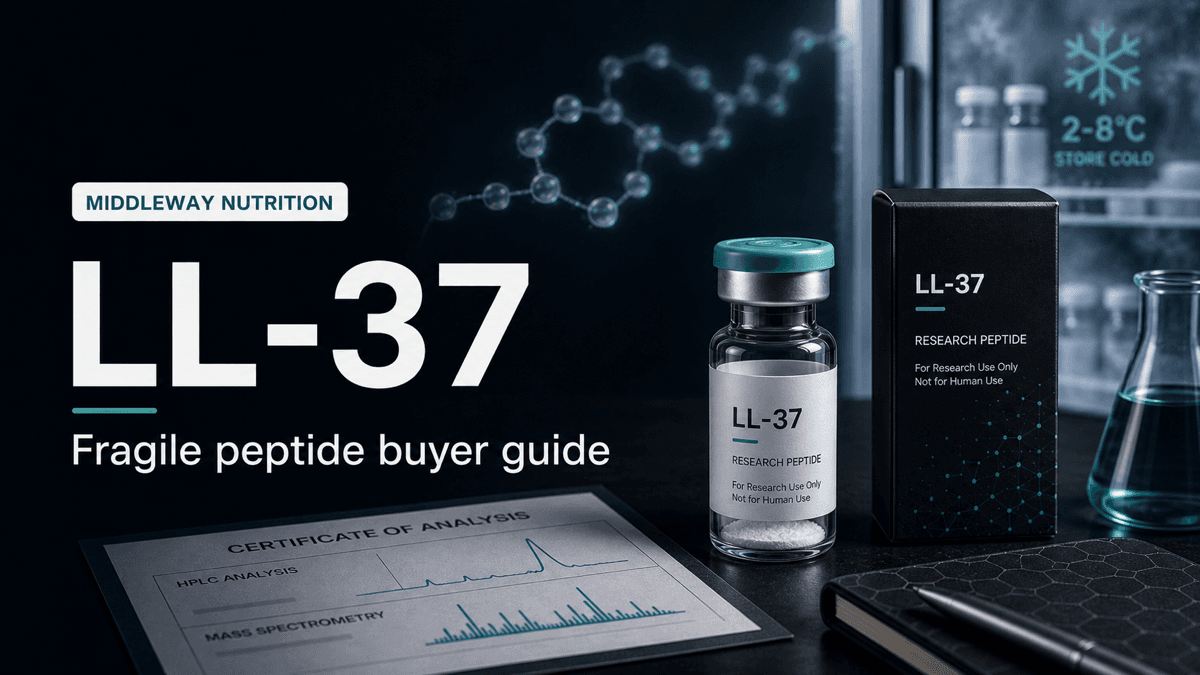
Thirty-seven residues is a long chain to synthesize cleanly, which makes this peptide costlier and more error-prone to manufacture than the short sequences filling most catalogs. Bargain listings should raise your eyebrows immediately. Ask for third-party analysis covering both mass spectrometry, where the measured weight should land near 4,493 Da, and HPLC for purity, then confirm the paperwork names your actual product instead of a generic reference standard. Our guide to where to buy LL-37 breaks down which vendors publish per-batch results and which recycle one document across every lot.
Looking for the numbers behind this guide? Our LL-37 dosage chart sets label and trial doses beside what Reddit users report taking.
Frequently Asked Questions
What does LL-37 peptide do?
It is a human antimicrobial peptide that destroys bacteria, fungi, and some viruses by physically breaking their membranes, while simultaneously steering immune activity. It neutralizes bacterial endotoxin, blocks biofilm formation, calls immune cells toward infection, and supports keratinocyte migration and vessel growth during wound repair.
Is LL-36 the same as LL-37?
The number is a residue count, not a product code. The mature human cathelicidin runs exactly 37 amino acids, LLGDFFRKSKEKIGKEFKRIVQRIKDFLRNLVPRTES, and it opens with two leucines, which is the whole origin of the name. Search the peptide literature for LL-36 and nothing comes back, so anyone typing it is looking for LL-37 with one digit off. Genuinely shorter fragments do exist, but they are named for their end residues and length rather than by counting down from 37: KR-12, spanning residues 18 through 29 of the parent sequence (KRIVQRIKDFLR), is the smallest piece that still holds antimicrobial activity. It is a separate research molecule, not what a vial labeled LL-37 contains.
Is LL-37 peptide safe?
The topical wound research found it well tolerated at the concentrations studied, with mild local reactions and nothing serious tied to treatment. That is the whole human safety record. Concentrated enough, it turns cytotoxic toward human cells, its inflammatory effect can invert from calming to provoking, and it has been implicated in psoriasis and interferon-driven autoimmune signaling. For injected use in humans there is no safety data whatsoever.
How much LL-37 peptide is typically used?
The only human numbers come from topical formulations applied to wounds twice weekly for roughly four weeks, plus, reportedly, microgram-level injections into tumors administered weekly under clinical supervision (we have not verified that melanoma figure against a primary source). Laboratory antimicrobial work operates in the low microgram-per-milliliter range. Subcutaneous figures circulating in community protocols rest on nothing, and the evidence that does exist argues for restraint rather than escalation.
Is LL-37 peptide legal?
It carries no FDA approval for any indication and is not a controlled substance. Within the United States it is sold as a research chemical for laboratory use only, never for human consumption. That status hands quality control entirely to the buyer, which is why independent batch testing matters far more here than the regulatory question.
Medical Disclaimer: This article is for educational purposes only and is not medical advice. LL-37 is not approved by the FDA for the prevention, treatment, or cure of any disease, and is sold for laboratory research use only. The concentrations, routes, and schedules described here are drawn from published research and are reported for reference, not as recommendations or instructions to self-administer. Subcutaneous use of LL-37 has never been validated in a human clinical trial. Always consult a qualified healthcare professional before considering any peptide, particularly if you are pregnant, breastfeeding, immunosuppressed, managing an autoimmune condition, or taking other medications.