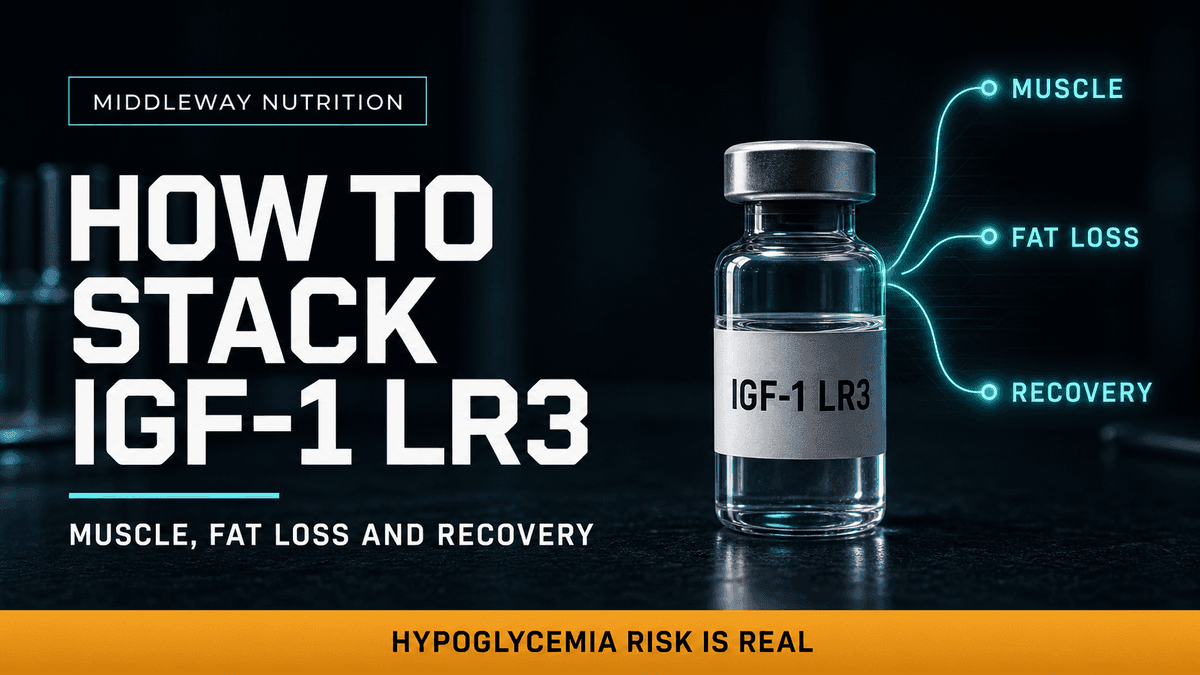
Anyone asking how to stack IGF-1 LR3 for muscle growth, fat loss & recovery should start with the constraint rather than the combination: this compound drops blood glucose, it is dosed in micrograms, and it is the one peptide in common use where a dosing error can put someone in an ambulance. The stacking logic that follows is real, but how to stack IGF-1 LR3 for muscle growth, fat loss and recovery is a much less interesting question than whether the risk is worth carrying, and most of the internet skips straight past that.
IGF-1 LR3 is a research chemical. It is not approved for human use, it is prohibited in tested sport, and everything below describes protocols that appear in the literature and in community documentation rather than anything a person should do.
Why it is almost never used alone
IGF-1 LR3 is a modified version of insulin-like growth factor 1. Substituting arginine at position 3 and adding a 13-amino-acid extension sharply reduces its binding to the IGF binding proteins that normally sequester circulating IGF-1. The practical consequence is that far more of it stays free and active. Free native IGF-1 is cleared within minutes; the LR3 analogue is commonly cited as persisting for the better part of a day.
That is the entire reason it is used, and also the entire reason it is dangerous. A long-lived, binding-protein-resistant IGF-1 signal drives the PI3K, Akt and mTOR pathway continuously rather than in pulses, and it carries insulin-like activity on glucose uptake for as long as it circulates.
Stacking enters the picture because IGF-1 sits at the bottom of the growth hormone axis. Compounds that raise growth hormone act upstream and produce IGF-1 through the liver; injecting the analogue acts downstream and directly. People combine the two to hit the axis from both ends.
How to Stack IGF-1 LR3 for Muscle Growth, Fat Loss & Recovery: three patterns
| Goal | Common pairing | What each part is meant to contribute |
|---|---|---|
| Muscle | CJC-1295 plus ipamorelin, or MK-677 | Upstream growth hormone elevation alongside a direct downstream signal |
| Fat loss | A GHRH analogue such as sermorelin, in a calorie deficit | Growth hormone for lipolysis, IGF-1 LR3 to spare lean mass |
| Recovery | BPC-157 plus TB-500 | Blood supply and cell migration alongside satellite cell activation |
For muscle growth
The most commonly described combination pairs a GHRH analogue such as CJC-1295 with a selective growth hormone secretagogue such as ipamorelin, then adds IGF-1 LR3 after training. Reported ranges are roughly 100 to 200 mcg each of CJC-1295 and ipamorelin twice daily, with IGF-1 LR3 in the region of 20 to 50 mcg post-workout.
The oral alternative substitutes MK-677 at roughly 12.5 to 25 mg before bed for the injected secretagogues, which raises growth hormone across the day rather than in discrete pulses.
The asymmetry in cycle length is the important detail. Growth hormone peptides are typically run eight to twelve weeks or longer. IGF-1 LR3 is capped at four to six weeks in essentially every documented protocol, because sustained high-level receptor signalling is expected to produce downregulation. The off period is treated as the same length as the on period.
For fat loss
The rationale is nutrient partitioning: IGF-1 LR3 pushes glucose into skeletal muscle and away from fat storage while a calorie deficit does the actual work. It is paired with a GHRH analogue such as sermorelin at roughly 200 to 300 mcg before sleep.
This is also where the compound is most dangerous, and the reason is arithmetic rather than pharmacology. A calorie deficit means lower glycogen and lower circulating glucose. Adding a compound with insulin-like activity to that state is how people end up hypoglycaemic. Every serious protocol treats post-injection carbohydrate as mandatory rather than optional. Injecting and then fasting or training fasted is the specific mistake that causes harm.
For recovery
The recovery combination adds BPC-157 and TB-500 to cover different layers of tissue repair: BPC-157 for local blood vessel formation, TB-500 for cell migration, IGF-1 LR3 for satellite cell activation and muscle protein synthesis. Reported ranges are roughly 250 to 500 mcg daily for BPC-157, 2 to 2.5 mg twice weekly for TB-500 during loading, and 20 to 40 mcg of IGF-1 LR3.
The mechanisms genuinely do not overlap much, which is the strongest version of the stacking argument. It remains an argument from mechanism, not from any trial that tested the combination. Our BPC-157 guide and TB-500 guide cover those two individually.
Rules that apply to every IGF-1 LR3 stack
- Eat after injecting. Carbohydrate and protein within about half an hour, every time, without exceptions for rest days or fasting protocols.
- Never combine with insulin. The hypoglycaemic effects add, and this combination has killed people in the bodybuilding world.
- Start at the bottom. Around 20 mcg is the conservative reference point. Higher doses raise hypoglycaemia risk and accelerate receptor downregulation without any evidence of proportional benefit.
- Cap the cycle. Four to six weeks, then an equal break. This is convention rather than an evidence-based schedule, but the reasoning behind it is sound.
- Have glucose available. Fast carbohydrate within reach for the first hours after a dose, not in a cupboard downstairs.
- Do not train fasted on dosing days. Combining exercise-driven glucose uptake with insulin-like signalling and no substrate is the worst version of this.
The risks people skip past
Peptide articles tend to list side effects as if IGF-1 LR3 belonged in the same category as BPC-157. It does not.
Hypoglycaemia is the acute problem: sweating, shaking, confusion, and at the extreme, loss of consciousness. It can arrive an hour or more after injection and it does not wait for convenience.
Mitogenic signalling is the chronic one. IGF-1 drives cell proliferation, which is the point. Elevated IGF-1 levels have been associated in epidemiological work with increased risk of several cancers, and deliberately raising IGF-1 signalling for weeks is not a neutral act. Nobody has quantified what a course of the LR3 analogue does to that risk, and the honest position is that nobody knows.
Tissue changes at the acromegalic end of the spectrum, including organ growth and joint changes, are the recognised consequence of chronic growth hormone and IGF-1 excess. Short cycles are presumably why this is rarely reported, not evidence that it cannot happen.
Everything else in the stack. Growth hormone secretagogues carry their own effects, including water retention, carpal tunnel symptoms and impaired glucose tolerance. MK-677 in particular raises appetite substantially and has been reported to worsen insulin sensitivity, which is an awkward pairing with a compound that already stresses glucose control.
For background on the compound itself, see our IGF-1 LR3 page, and for the oral secretagogue the MK-677 guide. If you are still choosing a supplier, our where to buy IGF-1 LR3 guide covers how to verify a source before you pay.
The honest bottom line
The stacking logic is coherent and the human evidence for any of it is absent. What exists is IGF-1 physiology, which is well understood, plus community protocols, which are not evidence. If the goal is muscle or recovery, the interventions with actual trial support remain unglamorous: progressive loading, adequate protein, sleep, and time. IGF-1 LR3 is a high-variance addition to that, with a real acute risk and an unquantified long-term one.
FAQ
How long should an IGF-1 LR3 cycle run?
Documented protocols cap IGF-1 LR3 at four to six weeks with an equal break, on the reasoning that continuous high-level receptor signalling causes downregulation. Companion compounds such as CJC-1295, ipamorelin, BPC-157 or TB-500 are typically run longer. None of these schedules comes from a human trial.
When is IGF-1 LR3 usually injected?
Most protocols place it within roughly 30 to 60 minutes after training, followed immediately by carbohydrate and protein. The timing argument is about muscle blood flow and nutrient partitioning; the food is about not becoming hypoglycaemic.
What happens if you inject IGF-1 LR3 and do not eat?
Blood glucose can fall enough to cause sweating, shaking, confusion and in severe cases loss of consciousness. This is the most common serious problem with the compound and it is entirely preventable by eating.
Can IGF-1 LR3 be combined with insulin?
No. Both lower blood glucose and the effects add together unpredictably. This combination is responsible for documented deaths in the bodybuilding world and there is no protocol that makes it acceptable.
Do women use different doses?
Community protocols for women typically use the lower end, around 10 to 20 mcg, on the basis of body size and reported sensitivity. The same cycle limits and post-injection nutrition rules apply, and the same absence of safety data applies.
Is IGF-1 LR3 detectable in drug testing?
Yes. It is prohibited by anti-doping authorities and detection methods exist. Anyone in tested competition should treat use as a positive result.