A BPC-157 before and after is measured in function, not in photographs: less pain on a specific movement, more range at a specific joint, fewer symptoms after a specific meal. Anyone searching for BPC-157 before and after images of a changed physique is searching for something the compound does not do, because it is a repair peptide with no established effect on body composition. The change, if it comes, is that a thing you could not do in week zero becomes possible in week six.
BPC-157 is a research compound, not an approved medicine, and the timelines below come from animal studies and self-report rather than from human trials.
Set the baseline before you start
The single most useful thing anyone can do is record a starting point, because memory reconstructs pain badly and almost everyone underestimates how much they hurt six weeks ago.
Record, before the first dose:
- Pain on a 0 to 10 scale for the specific tissue, at rest and under load
- Range of motion on one or two movements that currently fail
- A functional benchmark you actually care about: stairs without pain, a full squat, a mile time
- For gut issues, symptom frequency per week rather than an impression
Then repeat weekly. The week four minus week zero difference is the only before and after that means anything. Without it you will end up comparing a feeling to a memory.
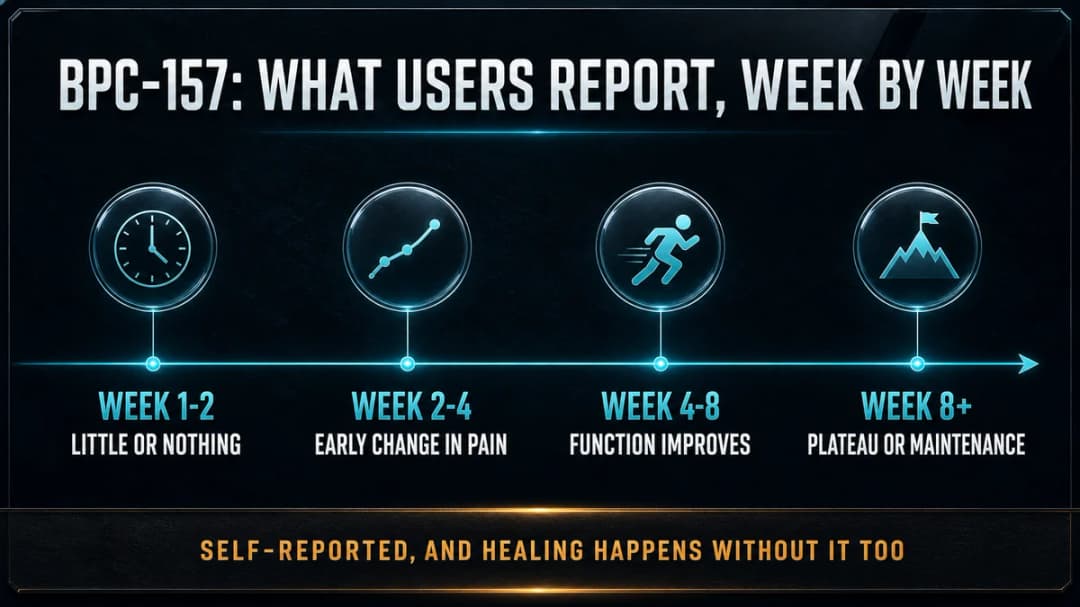
BPC-157 before and after: what happens week by week
This describes the pattern reported across animal studies and community use. It is not a promise and it is not from a human trial.
| Period | What tends to change | What has not changed yet |
|---|---|---|
| Weeks 1 to 2 | Inflammatory pain settles. Constant ache becomes intermittent. Gut symptoms often shift first. | The tissue itself. Range of motion is largely unchanged. |
| Weeks 3 to 4 | Function starts returning. Movements that failed become possible. Food tolerance improves for gut cases. | Structural remodelling is incomplete. Re-injury risk is still elevated. |
| Weeks 6 to 8 | The window where connective tissue work shows most clearly in animal models, with better collagen organisation and tensile strength. | Nerve-related complaints. Those are still early. |
| Weeks 8 to 12 | Most musculoskeletal cases plateau here. Protocols usually end. | Nothing much. Continuing past healing has no demonstrated benefit. |
The most important line in that table is week one to two. Pain falling early is easy to over-read. Inflammatory pain frequently exceeds the mechanical damage causing it, so pain can drop substantially while the tissue underneath is unchanged. People who treat week two pain relief as permission to return to full load are the people who re-injure at week three.
Results by condition
Tendon and ligament
The strongest strand of evidence, and still entirely preclinical. Rodent models of Achilles transection, tendon-to-bone healing and medial collateral ligament injury have repeatedly shown faster healing with better collagen architecture than untreated controls.
What people report is improvement over six to eight weeks in complaints that had persisted far longer. What nobody can tell you is how much of that is the peptide, because tendinopathy also responds to load management, and almost everyone starting a peptide also changes their training.
A full-thickness tear is a different problem and remains a surgical one.
Gut
The most biologically coherent application, since BPC-157 was isolated from gastric juice. Animal models of colitis, ulceration and NSAID damage consistently show accelerated repair and restored barrier integrity.
Symptom change is often the fastest of any category, commonly reported inside two to four weeks: less bloating, fewer urgency episodes, better tolerance of foods that had been problematic. The important caveat is that BPC-157 is not addressing why the gut was damaged. If the diet, medication or stressor that caused the problem is still present, the tissue is being repaired while it is still being injured. Our BPC-157 for gut healing page covers this.
Muscle
Muscle is well vascularised and heals faster than tendon, and BPC-157's angiogenic mechanism has less of a bottleneck to remove. A grade one or two strain that would take four to eight weeks is often reported to resolve in three to six. That is a modest and plausible acceleration rather than a dramatic one.
Nerve
The slowest and least certain. Peripheral nerve regrows at a rate measured in millimetres per day and no compound overrides that biological ceiling. Rodent sciatic crush models suggest BPC-157 may improve the quality of recovery rather than its speed. Expect eight to sixteen weeks if anything happens at all, expect partial recovery rather than complete, and understand this is the thinnest evidence of the four categories.
Comparison at a glance
| Condition | Usual unaided course | Commonly reported with BPC-157 | Confidence |
|---|---|---|---|
| Tendon or ligament | Months | 6 to 8 weeks to functional | Moderate, animal data only |
| Gut symptoms | Variable, often chronic | 2 to 4 weeks to symptom change | Moderate |
| Muscle strain, grade 1 to 2 | 4 to 8 weeks | 3 to 6 weeks | Low to moderate |
| Peripheral nerve | Months, sometimes permanent | 8 to 16 weeks, partial | Low |
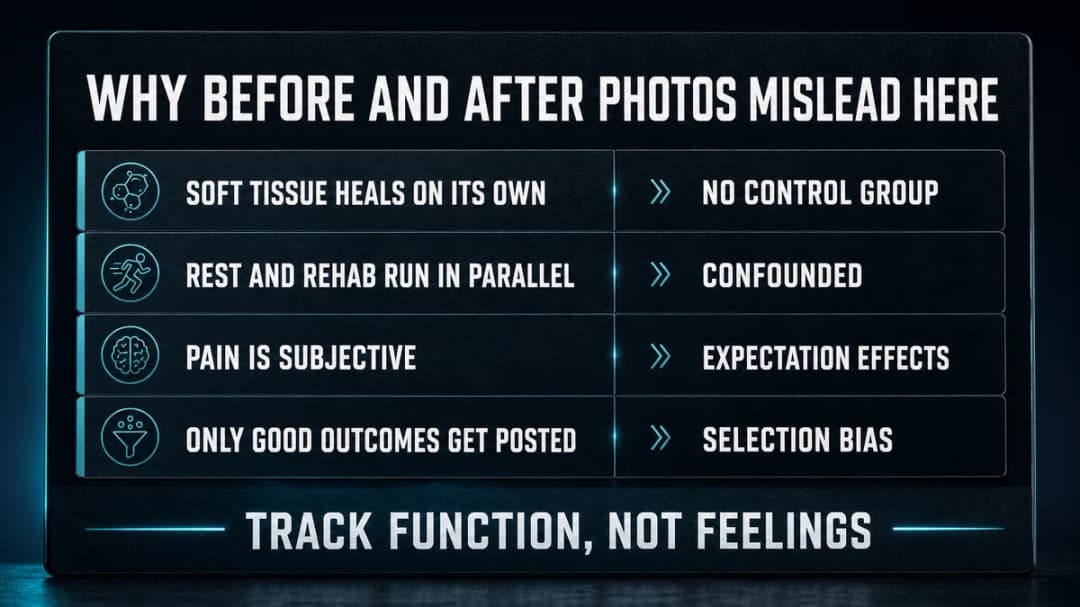
Why before and after photos are misleading here
Three types of image circulate under this search term, and none of them shows what people think.
Wound healing time-lapses show faster skin closure and less redness, which is real but narrow. Tendon ultrasound or MRI comparisons at week zero and week eight do show structural change, but they require clinical context to interpret and are easy to present selectively. And body composition photos are simply the wrong compound: anyone leaner in the second photograph was training and eating differently, and often running something else entirely.
If a vendor is showing you physique transformations for a repair peptide, that tells you something about the vendor.
Cycle length and what happens after
Protocols in the literature and in community use run four to twelve weeks, matched to the healing target rather than to a calendar. Acute problems tend to get six to eight weeks, chronic ones ten to twelve, gut cases four to eight, nerve cases longer.
Two points matter more than the numbers. First, symptom relief runs ahead of structural repair, so stopping the week the pain goes is how people end up with a partially remodelled tendon that fails again. Second, there is no human safety data beyond short cycles, and running continuously without a defined endpoint is not supported by anything. Animal work has not turned up clear toxicity, but absence of a finding in rats over a few weeks is not evidence of safety in a person over a year.
For dose arithmetic and background, see our BPC-157 guide, and for the common pairing with TB-500 the Wolverine Stack guide.
When nothing happens
Non-response is real and worth planning for. If you are eight weeks in with a properly logged baseline and nothing has moved, the plausible explanations in order are: the product was not what the label said, the problem is mechanical rather than inflammatory, the dose or route was wrong, or the compound does not do this in humans. That last possibility is the one the peptide community discusses least and should discuss most, because no human trial has ruled it out.
FAQ
How long does BPC-157 take to show results?
Pain often changes in the first one to two weeks, function in weeks three to four, and structural improvement between weeks six and eight in animal models. Gut symptoms tend to move fastest and nerve symptoms slowest. None of these timings comes from a human trial.
Are there real BPC-157 before and after photos?
Not for physique. Genuine images are limited to wound closure time-lapses and imaging comparisons of tendon, both of which need context to interpret. Body transformation photos attributed to BPC-157 reflect training and diet, not the peptide.
Can BPC-157 help an injury that is years old?
Chronic injuries respond more slowly than fresh ones because scar tissue is established and the healing environment has shifted. Improvement over eight to twelve weeks is what people report, rather than the faster changes described for acute injuries. Evidence for either scenario in humans is absent.
Should I keep taking BPC-157 after I feel better?
Feeling better arrives before tissue is finished remodelling, so most protocols continue for a set period rather than stopping at symptom relief. There is no evidence of benefit from continuing once healing is complete, and no human safety data for continuous use beyond a few months.
Does BPC-157 build muscle or burn fat?
No. It has no established effect on muscle protein synthesis or fat metabolism, and it is not a hormone. Any body composition change during a protocol is coming from training and diet.
Is oral BPC-157 as effective as injection?
For gut targets the oral route is reasonable because the peptide contacts the tissue directly. For tendon, joint or systemic targets, oral absorption of a peptide is poor and the case is much weaker.