The claimed BPC-157 benefits cluster around tissue repair, and the honest summary is that the animal evidence is broad and fairly consistent while the human evidence is close to absent. Anyone weighing BPC-157 benefits should hold those two facts at the same time rather than picking whichever one suits them. Rodent studies show faster healing across tendon, gut, muscle and nerve models. What almost nobody has is a controlled human trial telling us whether any of that reproduces in a person, at what dose, or for how long it is safe.
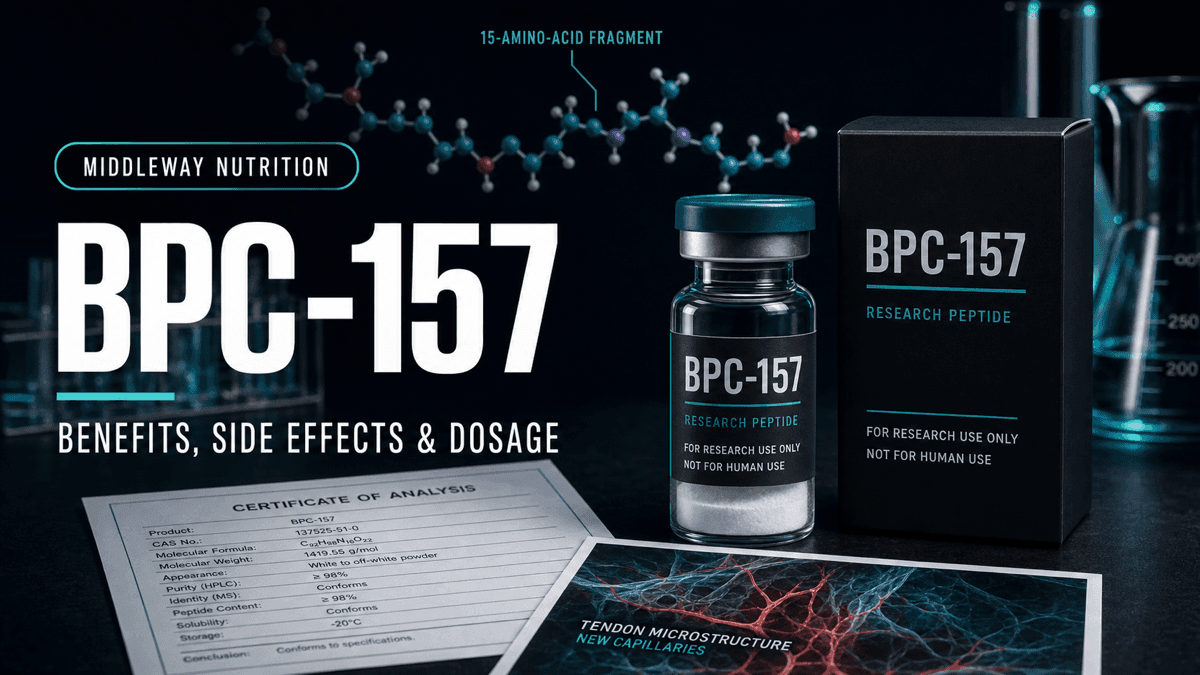
BPC-157 is a 15-amino-acid sequence taken from a protein found in gastric juice. It is sold as a research chemical, not as a medicine, and it has not been approved by the FDA or by regulators in the UK or EU for any use.
What are the main BPC-157 benefits?
Sorted by how much you can actually lean on the evidence, not by how loudly each is marketed.
| Claimed benefit | Where the evidence comes from | How confident should you be |
|---|---|---|
| Gastrointestinal protection and ulcer healing | Largest body of animal work, plus early clinical interest in a gut formulation | Strongest case, still preclinical |
| Tendon and ligament healing | Multiple rodent transection and injury models | Reasonable animal signal, no human trials |
| Muscle injury recovery | Rodent crush and transection models | Plausible, thin |
| Systemic anti-inflammatory effect | Animal models, mechanistic work | Plausible, poorly quantified |
| Wound and skin healing | Animal wound models | Plausible, thin |
| Nerve regeneration and neuroprotection | Small number of rodent studies | Speculative in humans |
| Cardiovascular protection | Isolated animal models | Speculative, do not rely on it |
| Mood, anxiety and cognition | Mostly extrapolation from rodent behavioural work | Weakest, treat as unproven |
The pattern worth noticing is that the list gets longer as the evidence gets weaker. That is a familiar shape in supplement marketing and it should raise, not lower, your guard.
The mechanism, and why it explains the breadth
BPC-157 does not appear to act on one receptor. The pathways described in the literature are general repair pathways, which is why the same peptide keeps turning up in unrelated injury models.
- Angiogenesis. BPC-157 promotes new blood vessel formation at damaged tissue, apparently through upregulation of vascular endothelial growth factor signalling. Tissues that heal slowly, such as tendon and ligament, heal slowly largely because they are poorly supplied with blood, so this is the most plausible route to the tendon findings.
- Nitric oxide system interaction. Much of the animal work involves the nitric oxide pathway, which governs vascular tone and inflammatory signalling. Several of the protective effects disappear when that system is blocked.
- Growth factor upregulation. Increased activity of repair-associated growth factors has been reported in treated tissue.
- Local anti-inflammatory signalling. Reduced inflammatory cytokine activity at the injury site, without the broad immune suppression that comes with corticosteroids.
A compound that supports general repair infrastructure will look effective in almost any injury model you test. That is genuinely interesting. It is also exactly what a non-specific effect looks like, and non-specific effects in rodents often fail to survive contact with human trials.
Gut repair: the best-supported claim
If any BPC-157 benefit deserves attention, it is this one. The peptide was isolated from gastric juice, and the earliest and densest research concerns the gastrointestinal tract: protection against NSAID-induced stomach and intestinal damage, healing of experimentally induced ulcers, restoration of intestinal barrier integrity, and protection against alcohol-related gastric lesions.
A gut-targeted formulation of the peptide has attracted early clinical interest for inflammatory bowel disease, but published human outcome data is scarce and none of it establishes routine efficacy. What can be said is that the biological rationale for the gut is stronger than for anything else on the list, and that the oral route, which is otherwise a poor choice for a peptide, makes more sense here because the target tissue is the tissue the capsule passes through.
Our BPC-157 for gut healing page goes further into that evidence.
Tendon, ligament and muscle
The second cluster of research covers connective tissue. Rodent studies report faster healing of severed Achilles tendon, damaged medial collateral ligament and crushed muscle, with better tensile strength on testing than untreated controls.
This is the most common reason people buy BPC-157, and it is the area where expectation most outruns evidence. Two cautions matter:
First, rodent tendon heals differently and faster than human tendon, and a rat with a surgically standardised injury is not a person with a six-month-old tendinopathy of unclear origin.
Second, tendinopathy improves on its own with load management. Most people who start a peptide also change their training, and any recovery gets credited to the vial. Without a control group, personal experience cannot separate the two.
Realistic timelines, with the caveat attached
People ask how fast BPC-157 benefits appear. There is no trial that answers this in humans, so the figures below reflect what users commonly report rather than measured outcomes. Treat them as a description of expectations circulating in the community, not as a prediction.
| Reported effect | Commonly reported onset | Commonly reported plateau |
|---|---|---|
| Digestive comfort, bloating | Within the first week | 2 to 4 weeks |
| Tendon or joint pain | 1 to 2 weeks | 4 to 8 weeks |
| Training recovery | 1 to 2 weeks | Ongoing while used |
| Visible wound healing | Under a week | 2 to 4 weeks |
| Nerve-related symptoms | 3 weeks or more | 8 to 12 weeks, if at all |
Anything reported to work within days across every category at once is more likely describing expectation than pharmacology.
What BPC-157 does not do
Worth stating plainly, because the marketing rarely does.
It does not regrow cartilage. It does not repair a full-thickness tendon rupture, which is a surgical problem. It is not a substitute for rehabilitation loading, which remains the intervention with the best evidence for tendinopathy. It has no established performance-enhancing effect on strength or endurance in healthy tissue. And it will not fix a joint problem whose cause is mechanical.
Safety, and the one mechanism-based concern
Reported side effects at commonly used research doses are mild: injection site redness, occasional nausea, sometimes light-headedness. There is no long-term human safety data at all, which is the more important sentence.
The theoretical concern that deserves respect is the angiogenic mechanism. A compound that encourages new blood vessel growth is a compound that should give pause to anyone with an active malignancy or a recent cancer history, because tumours also depend on blood supply. No human cases have been documented, but no human surveillance exists either, so silence here is not reassurance.
Routes and typical research ranges
Two routes appear in the literature and in community use. Subcutaneous injection in the range of roughly 200 to 500 mcg per day is the most commonly cited research range for systemic work, usually run for four to eight weeks. Oral dosing, in the region of 500 mcg per day and up, is used for gut-directed purposes, since systemic absorption of an oral peptide is poor and the gut lining is the target anyway.
These are reported research ranges, not doses anyone should self-administer. For the wider picture on the compound, see our BPC-157 guide, and for the common pairing with TB-500 see the Wolverine Stack guide.
FAQ
How long does BPC-157 take to work?
There is no trial that measures this in humans. Users most often report digestive changes inside a week and connective tissue changes over two to eight weeks. Because tendon problems also improve with rest and graded loading, self-reported timelines cannot separate the peptide from natural recovery.
Is BPC-157 proven to heal tendons in people?
No. The tendon evidence is from animal studies, mainly rats with surgically created injuries. Those results are consistent enough to be interesting, but no controlled human trial has tested whether BPC-157 accelerates tendon healing in people.
Are oral BPC-157 capsules as good as injections?
For gut-related purposes the oral route is defensible, because the target tissue is in the digestive tract. For tendon, joint or systemic purposes, an oral peptide faces poor absorption and the case is much weaker.
Does BPC-157 have side effects?
Commonly reported effects are mild and local: redness at the injection site, occasional nausea, sometimes brief light-headedness. The real limitation is that no long-term human safety study exists, so rare or delayed harms would not have been detected.
Should anyone avoid BPC-157?
Anyone with an active or recent cancer should treat the angiogenic mechanism as a genuine reason for caution and discuss it with an oncologist. The same applies during pregnancy or breastfeeding, where there is no safety data whatsoever.
Why is BPC-157 not an approved drug if the animal data looks good?
Because animal data is where most drug candidates stop. Running the human trials required for approval is expensive, and a peptide sequence with limited patent protection gives little commercial incentive to fund them. Absence of approval reflects economics as well as evidence, but it also means the human questions remain genuinely unanswered.