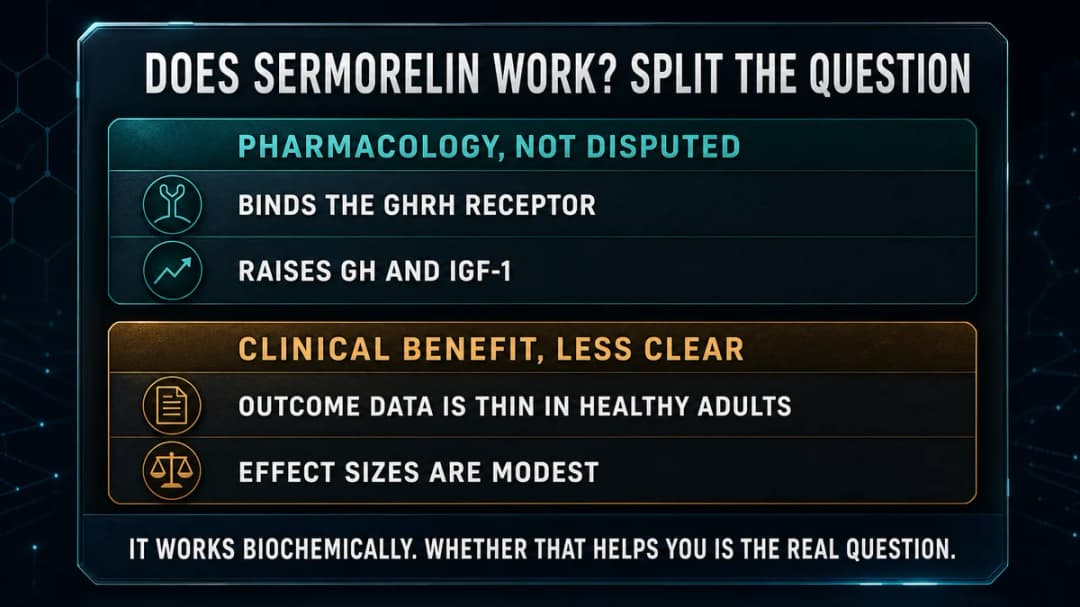
Does sermorelin work? On the narrow pharmacological question, yes: it binds the pituitary GHRH receptor and produces a measurable growth hormone pulse, which is why it was originally approved as a diagnostic agent. Asking does sermorelin work in the sense people usually mean, meaning does it change how you look, sleep and recover, gets a much more qualified answer, because the outcome data in healthy adults is thin and the response depends heavily on where your growth hormone axis starts.
Two questions are being collapsed into one. Separating them makes the whole subject clearer.
Does Sermorelin Work? The Pharmacology Is Not in Dispute
This part is settled. Sermorelin reproduces the receptor-binding portion of growth hormone releasing hormone, and injecting it triggers GH release from the anterior pituitary within minutes. The effect was reliable enough that clinicians used it to test whether a child's pituitary was capable of responding at all.
Downstream, that GH pulse drives hepatic IGF-1 production. In people with a suppressed GH axis, consistent nightly dosing generally moves IGF-1 upward over weeks, and that rise is measurable in a standard blood test. This is the part of the claim that holds up.
Does Sermorelin Work Clinically?
Here the picture thins considerably.
There is no large, long-duration, placebo-controlled trial of sermorelin in healthy adults measuring body composition, sleep architecture or recovery with objective instruments. What exists is a body of small studies, its history as a diagnostic and paediatric agent, and a large volume of clinic-reported experience that carries all the biases you would expect from people who paid for the treatment and want it to work.
That does not make the reported effects false. It means the effect size is unestablished. Anyone quoting a precise number of pounds lost or a percentage of body fat reduced from sermorelin alone is extrapolating well beyond published data.
The related compound tesamorelin does have imaging-endpoint trial data for visceral fat, but in a specific clinical population and with a structurally different, longer-acting molecule. Borrowing those results for sermorelin is not legitimate.
Who Actually Responds
The single best predictor of whether sermorelin does anything noticeable is your starting point.
Likely to notice something: adults past 40 with low IGF-1 for their age, poor sleep quality, and a genuine decline from where they were a decade ago. There is room to move, and the axis is still capable of responding.
Unlikely to notice much: anyone in their twenties or thirties with IGF-1 already in the upper part of the age-adjusted range. The pituitary has a ceiling on what it can release per pulse, and a GHRH signal cannot push output past it.
Will not respond regardless of dose: anyone whose pituitary cannot secrete GH, for example after pituitary surgery or radiation. Sermorelin only works if there is a functioning gland to ask.
Two conditions blunt the response in anyone. Untreated hypothyroidism impairs the liver's conversion of a GH signal into IGF-1, so GH can rise while IGF-1 barely moves. And high circulating insulin suppresses GH release directly, which is why injecting shortly after a meal undermines the injection.
A Realistic Timeline
The table below describes what people commonly report and what can actually be verified at each stage. Treat the reported column as anecdote, not as an expected outcome.
| Window | Commonly reported | What is objectively verifiable |
|---|---|---|
| Week 1 to 2 | Deeper sleep, vivid dreams | Nothing yet, too early for IGF-1 to shift meaningfully |
| Week 3 to 6 | Better recovery, steadier daytime energy | IGF-1 beginning to move in responders |
| Week 8 to 12 | First body composition changes noticed | IGF-1 clearly changed or clearly not, the key decision point |
| Month 4 to 6 | Waist and lean mass changes, skin quality | Body composition measurable by DEXA if you are tracking it |
| After stopping | Effects fade over weeks | IGF-1 returns toward baseline |
The twelve week mark is the one that matters. If IGF-1 has not moved by then, the compound is not doing what it is supposed to do, and the explanation is usually dose, product quality, thyroid status or injection timing rather than bad luck. If the product itself is the suspect, our sermorelin vendor comparison is the place to start.
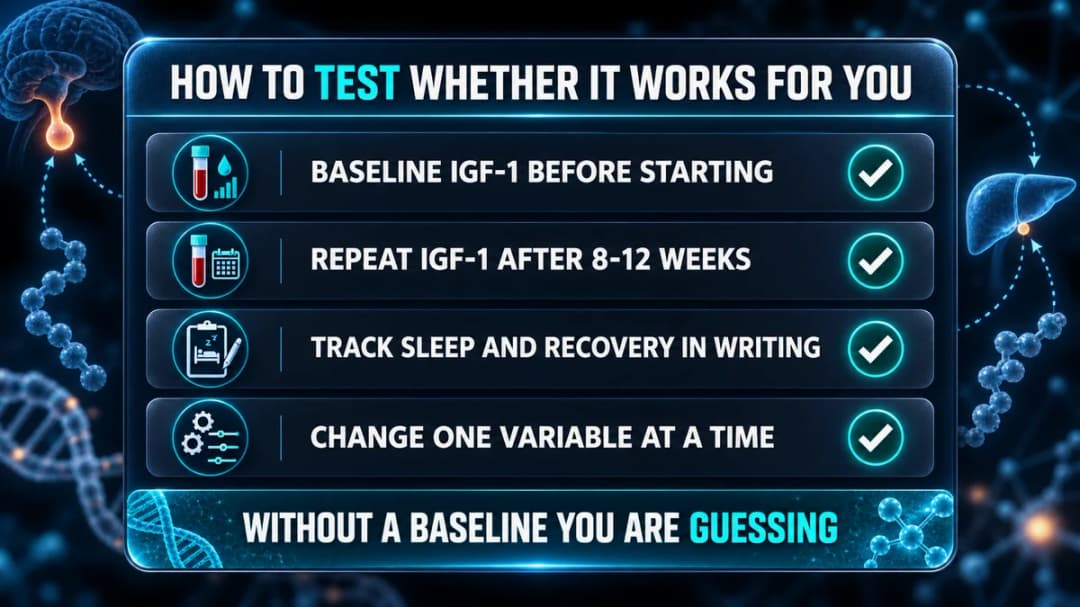
How to Actually Test Whether It Works for You
This is where most people go wrong, because they evaluate on feel alone across a period in which they also changed their training and sleep.
Measure IGF-1 before you start. Without a baseline, a later result is uninterpretable.
Change one thing at a time. Starting sermorelin, a new training block and a diet in the same week guarantees you will not know what caused any change.
Retest at eight to twelve weeks. Same lab, ideally similar time of day.
Track something objective for the physical claims. Waist circumference, a set of progress photos in consistent lighting, or a DEXA scan if you want the precise version. Bodyweight alone is close to useless here, because the mechanism shifts fat and lean mass in opposite directions.
Give it three months before deciding. Every reported physical effect operates on a timescale of months. Evaluating at week four measures expectation, not physiology.
What It Will Not Do
It will not act like injected growth hormone. Sermorelin works within the pituitary's own capacity and under intact somatostatin feedback, which caps the total GH exposure it can produce. That is a safety advantage and a potency limitation at the same time.
It will not raise testosterone, increase adult height, or replace hormone therapy of any kind.
It will not overcome the basics. GH stimulation amplifies the response to training and adequate protein intake; it does not substitute for either.
For how sermorelin compares with the rest of this class, see our growth hormone secretagogue comparison and the sermorelin guide. If injection frequency is the sticking point, CJC-1295 covers a longer-acting GHRH analog with a different set of trade-offs.
The Honest Summary
Sermorelin does what it says at the receptor level. In an older adult with a genuinely low GH axis, consistent nightly dosing over several months plausibly produces modest changes in body composition, sleep and recovery, and IGF-1 testing can confirm the axis is responding.
In a healthy person with normal IGF-1, expecting a visible transformation is expecting more than the mechanism can deliver. The compound is not a fraud, but it has been marketed well beyond what has been demonstrated, and the gap between those two things is where most disappointment comes from.
Frequently Asked Questions
How long does sermorelin take to work?
Sleep changes are reported within the first couple of weeks, though that is the most subjective endpoint. IGF-1 usually shifts measurably by week eight to twelve in responders, and physical changes take three to six months. Anyone judging results at week four is looking far too early.
What results are realistic on sermorelin?
In an older adult starting with low IGF-1, realistic expectations are modest: gradual reduction in abdominal fat, better retention of lean mass alongside training, and improved sleep quality. Specific figures circulating online for pounds lost are not drawn from controlled trials and should not be treated as expected outcomes.
Why is sermorelin not working for me?
The usual explanations are dose too low, injecting too close to a meal, untreated hypothyroidism blunting IGF-1 conversion, poor product quality, or an IGF-1 baseline that was already normal and left no room to improve. An IGF-1 test tells you which of these applies far faster than guessing does.
Do I need to keep taking it for the effects to last?
Yes. The GH axis returns toward its own set point once the stimulus stops, and reported effects fade over weeks. Sermorelin is an ongoing intervention rather than a correction, which is a relevant point when working out what it costs over a year.
Is sermorelin better than HGH?
Different, not better. HGH produces a much larger and more reliable GH exposure but suppresses your own production and carries more side effect risk. Sermorelin is gentler, cheaper and self-limiting, and it is correspondingly less potent. The right comparison depends on whether the axis is failing or simply declining with age.