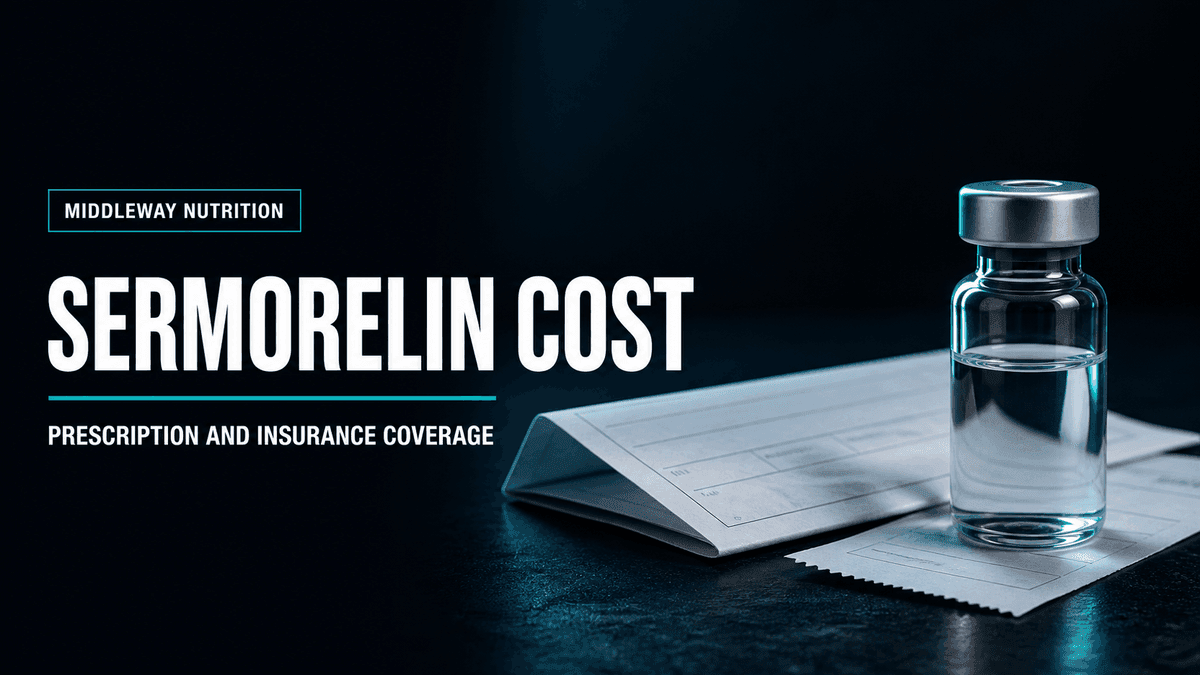
Sermorelin Cost, Prescription & Insurance Coverage break down simply: expect roughly $150 to $400 a month through a clinic, $80 to $200 through a compounding pharmacy with a prescription, and $40 to $100 through a research vendor with no prescription at all. On insurance coverage, the realistic answer for sermorelin is no, unless you have a documented growth hormone deficiency, and even then reimbursement is uncommon because the branded product no longer exists.
That last point drives most of the confusion around pricing, so it is worth understanding before comparing quotes.
Why There Is No Standard Price
Sermorelin acetate was approved by the FDA and sold under the brand name Geref for assessing growth hormone deficiency in children. The manufacturer discontinued it in 2008. That was a commercial decision, not a safety withdrawal, but the effect on pricing was permanent: with no branded product on the market, there is no list price, no formulary entry and no insurer-negotiated rate.
What exists instead is a set of parallel supply routes, each with its own economics. The compound is cheap to synthesise. Almost everything you pay above that reflects who is handling it and what oversight comes with it.
Sermorelin Cost, Prescription & Insurance Coverage by Route
| Route | Typical monthly cost | Prescription | What you get for the money |
|---|---|---|---|
| Anti-aging or hormone clinic | $150 to $400 | Yes | Consultation, labs, dose adjustment, pharmacy-grade product |
| Telehealth prescriber | $150 to $250 | Yes | Remote assessment, shipped medication, lighter monitoring |
| Compounding pharmacy with an outside prescription | $80 to $200 | Yes | The medication only, no clinical oversight |
| Research peptide vendor | $40 to $100 | No | Lyophilised powder sold for laboratory use, no oversight at all |
Ranges vary by region, dose and vial size. A clinic quoting a flat monthly programme fee is usually bundling labs and follow-ups into the number, which makes direct comparison with a pharmacy price misleading. Ask what the medication alone costs and what the monitoring costs, separately.
Clinic and telehealth pricing
The premium here buys supervision. A prescriber checks IGF-1 at baseline and again after a couple of months, adjusts the dose, and screens for the reasons someone should not be on a GH secretagogue at all. If you have never used an injectable peptide, that is worth something concrete.
The weakness is that quality varies enormously. Some clinics do genuine endocrine workups. Others run a single questionnaire and ship a vial. The price does not reliably tell you which one you are dealing with.
Compounding pharmacies
Compounding pharmacies can legally prepare sermorelin under a valid prescription, and this is the route that produces a pharmacy-labelled vial with a stated concentration and beyond-use date. Costs sit well below clinic programme fees because you are paying for the drug rather than the service around it.
One caveat worth knowing: rules governing which peptides compounding pharmacies may prepare have tightened in recent years, and availability has shifted more than once. A pharmacy that supplied a given peptide two years ago is not a reliable indicator of what it can supply now. Check current availability before assuming a price.
Research vendors
This is the cheapest route and the one with the fewest guarantees. Peptides sold as research chemicals are not prepared for human use, carry no prescription, and come with no clinical oversight. Purity is entirely a function of who you buy from.
If you go this way, the single thing that matters is third-party analytical documentation. Look for batch-specific certificates of analysis from an independent lab, published before you order rather than after. Vendors that cannot produce a batch-matched COA are not worth the saving.
Will Insurance Cover Sermorelin?
In almost all cases, no. The reasons are structural rather than arbitrary:
- There is no approved product to reimburse. Insurers pay against approved indications and NDC codes. Geref is gone, so compounded sermorelin has no approved indication attached to it.
- Anti-aging and body composition are excluded categories. Even where a plan covers growth hormone therapy for diagnosed deficiency, it covers approved GH products, not GHRH analogs used off-label.
- Compounded medications are frequently excluded outright. Many plans exclude compounded preparations as a class regardless of what is in them.
The narrow exception is adult growth hormone deficiency confirmed by stimulation testing, usually following pituitary disease, surgery or radiation. In that situation a plan may cover treatment, but the covered treatment is normally recombinant growth hormone rather than sermorelin.
Two partial workarounds that do apply:
HSA and FSA funds can often be used for a prescribed compounded medication. This does not reduce the price, but it pays for it with pre-tax money.
The consultation and labs may be billable separately even when the medication is not. If a visit is coded for fatigue, weight change or endocrine assessment, the office visit and bloodwork can be covered on their own terms.
Do You Need a Prescription?
For legitimate human use, yes. Sermorelin prepared for injection by a compounding pharmacy requires a valid prescription from a licensed prescriber, and that is the only route where the product is intended for a person.
Research vendors sell without a prescription because the product is labelled for laboratory research and not for human consumption. The sale itself is legal. Using a research-labelled compound on yourself sits outside that framing, and it is worth being clear-eyed rather than pretending the label is a formality.
Cost Compared With Other GH-Axis Options
| Option | Typical monthly cost | Prescription | Notes |
|---|---|---|---|
| Sermorelin, compounded | $80 to $200 | Yes | Short-acting GHRH analog |
| Sermorelin, research vendor | $40 to $100 | No | Quality depends entirely on the source |
| Tesamorelin | Several hundred and up | Yes | Approved for a specific indication, far more expensive |
| Recombinant HGH | $500 to $2,000+ | Yes | Approved product, suppresses endogenous GH output |
| MK-677, oral | $30 to $80 | No approved product | Different mechanism, appetite and glucose effects |
The cost argument for sermorelin is genuinely strong. The evidence argument is weaker, and price should not be the reason to choose it. Our growth hormone secretagogue comparison sets out what each option has actually demonstrated, and the sermorelin guide covers mechanism and expectations in more detail.
What Drives the Number Up or Down
Dose. A 300 mcg nightly protocol consumes roughly three times what 100 mcg does. Most vials are priced by total milligrams, so the dose sets the real monthly cost more than the sticker price does.
Vial size. Larger vials cost less per milligram. They also sit reconstituted in the fridge for longer, which matters for stability.
Bundled monitoring. Baseline IGF-1, fasting glucose and a follow-up panel add somewhere in the low hundreds if billed separately. Some programmes include them, some do not.
Cycling. Protocols that run five days on and two off, or three months on and one off, cut annual cost proportionally.
Frequently Asked Questions
How much does sermorelin cost per month?
Between roughly $40 and $400 depending on the route. Research vendors sit at the bottom, compounding pharmacies in the middle at $80 to $200, and full clinic programmes at the top because the price includes consultation and lab work. Dose matters as much as source, since a 300 mcg nightly protocol uses three times the material of a 100 mcg one.
Does insurance ever cover sermorelin?
Rarely. There is no approved sermorelin product to reimburse, and anti-aging or body composition use is excluded by most plans. Documented adult growth hormone deficiency is the one scenario where GH-axis treatment may be covered, and in that case insurers typically cover recombinant growth hormone rather than a compounded GHRH analog.
Is sermorelin cheaper than HGH?
Substantially. Recombinant growth hormone commonly runs several hundred to a few thousand dollars a month, while compounded sermorelin usually sits between $80 and $200. They are not equivalent treatments, though: HGH supplies the hormone directly, while sermorelin only stimulates whatever your pituitary is still capable of producing.
Can I buy sermorelin without a prescription?
Research peptide vendors sell it without one, because it is labelled for laboratory use rather than human consumption. That is not the same as a legal supply for personal use, and there is no clinical oversight, no pharmacy labelling and no guaranteed purity unless the vendor provides a batch-matched third-party certificate of analysis.
Is compounded sermorelin the same as the original Geref?
It is the same molecule, prepared by a licensed pharmacy rather than a pharmaceutical manufacturer. Concentration and sterility depend on that pharmacy's standards rather than on a manufacturer's approved process, which is why the choice of pharmacy matters more than it would for an off-the-shelf drug.