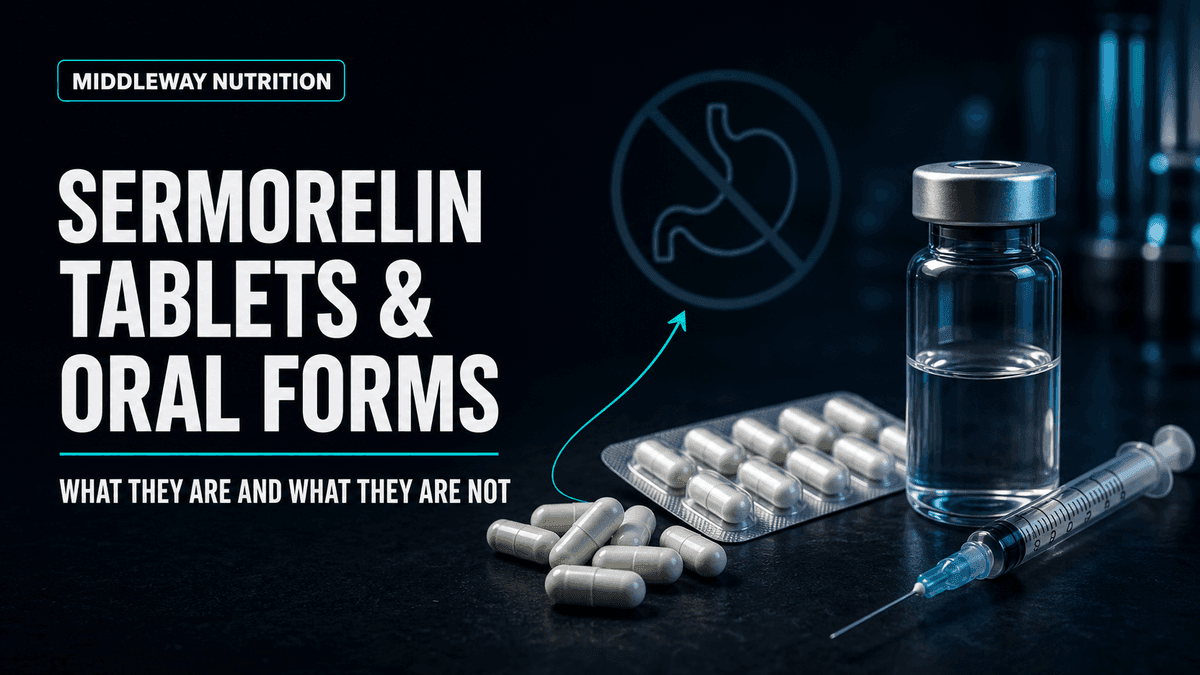
Sermorelin Tablets, Pills & Oral Forms exist in quantity, but the swallowed ones are close to useless: a 29 amino acid peptide does not survive the stomach. Among Sermorelin Tablets, Pills & Oral Forms, only the routes that bypass digestion entirely, meaning sublingual and nasal delivery, have any mechanistic case at all, and even those have never been measured against injection in a controlled human study.
That is the short version. The longer version is worth reading, because the difference between "absorbs poorly" and "does not absorb" changes what you should pay for.
Why Swallowing a Peptide Rarely Works
Sermorelin is a chain of 29 amino acids held together by 28 peptide bonds. Digestion is the process of breaking exactly those bonds. Pepsin in the stomach, then trypsin and chymotrypsin in the small intestine, cut proteins into fragments and single amino acids so they can be absorbed.
A swallowed peptide is not protected from that. It is treated as food. What crosses the intestinal wall is a handful of amino acids, which are nutritionally fine and pharmacologically inert. The molecule that binds the GHRH receptor no longer exists by that point.
Even if some intact peptide survived, there is a second barrier: molecules of this size cross the intestinal epithelium poorly. Sermorelin weighs roughly 3,350 daltons, well above the range where passive absorption happens readily.
This is not a sermorelin-specific problem. It is why insulin has never been a pill. It is also why oral semaglutide required a dedicated absorption enhancer to work at all, and why its bioavailability still lands around one percent, meaning the oral tablet dose has to be many times the injected dose to achieve comparable exposure. That is what a serious pharmaceutical effort at oral peptide delivery looks like, and no sermorelin product has anything comparable behind it.
Sermorelin Tablets, Pills & Oral Forms, Format by Format
| Format | Route | Bypasses digestion? | Realistic assessment |
|---|---|---|---|
| Subcutaneous injection | Under the skin | Yes | The only route with a real clinical track record |
| Sublingual troche or tablet | Oral mucosa | Partially | Plausible mechanism, unquantified delivery, depends on holding it correctly |
| Nasal spray | Nasal mucosa | Yes | Best of the needle-free options in principle, still unmeasured for sermorelin |
| Swallowed capsule or tablet | GI tract | No | No credible mechanism for intact delivery |
| Transdermal cream | Skin | Yes | Molecule is far too large to cross intact skin meaningfully |
Swallowed capsules and standard tablets
There is no mechanism here worth defending. If the product is designed to be swallowed and does not include a serious absorption enhancer system, the peptide is digested. Products in this category are the clearest case of paying for something that cannot do what it claims.
Sublingual troches and tablets
Sublingual delivery has a real rationale. The tissue under the tongue is thin, richly vascularised, and drains directly into systemic circulation, skipping both the stomach and first-pass liver metabolism. Some peptides and hormones are delivered this way successfully.
The problems are size and time. Sermorelin is large for mucosal absorption, and the window for absorption is short because saliva carries the dose toward the throat, at which point it is swallowed and digested. A troche held correctly under the tongue for several minutes delivers something. How much is genuinely unknown, because nobody has published controlled pharmacokinetic data for sublingual sermorelin in humans.
Treat any specific bioavailability percentage you see quoted for a sublingual sermorelin product as marketing, not measurement.
Nasal sprays
Nasal delivery is the strongest of the needle-free options on mechanism. The nasal mucosa is thin, well vascularised, and has been used successfully for peptide drugs, including some that are considerably larger than a small molecule.
Again, the absence of data is the problem. There is no published human pharmacokinetic study for intranasal sermorelin establishing what fraction reaches circulation or what GH response it produces. The delivery route is credible; the specific product is unverified.
Transdermal creams
Intact skin is a very effective barrier, and molecules above roughly 500 daltons do not cross it in meaningful amounts without active assistance. Sermorelin is roughly seven times that. A transdermal sermorelin cream is not a delivery system with a plausible mechanism.
What This Means in Practice
If the reason for avoiding injection is needle aversion, nasal is the option with the most defensible mechanism, understanding that you are accepting unknown delivery in exchange for convenience.
If the reason is cost, oral forms are usually a false economy. A product that delivers a fraction of an unknown amount is not cheaper per unit of effect, it is simply cheaper per unit of nothing much. What the injectable route costs, and whether insurance touches it, is covered in our sermorelin cost guide.
If the goal is to actually raise IGF-1 and be able to confirm it, subcutaneous injection is the only route where you can reasonably expect a measurable change and interpret the result. That is the practical test worth applying to any format: if you cannot measure a response, you cannot tell whether the product works.
There is also a testing angle worth using. IGF-1 at baseline and again after eight to twelve weeks is inexpensive and objective. Anyone using a non-injectable form who has never checked it is relying entirely on how they feel, which is the least reliable instrument available.
For broader context on how oral peptide formats perform generally, our peptide capsules guide covers the same absorption problem across the category, and the sermorelin guide covers the injectable form in detail. If oral administration is the requirement rather than a preference, MK-677 is worth understanding: it is not a peptide, it is a small molecule designed for oral use, which is precisely why it survives digestion. Once you know what you want, where to buy sermorelin sets out how to vet a seller and what to check on the certificate of analysis.
Frequently Asked Questions
Do sermorelin pills work at all?
Swallowed pills and capsules have no credible route to the bloodstream, because digestive enzymes break peptide bonds before absorption and the molecule is too large to cross the gut wall intact. There is no published evidence that a swallowed sermorelin product raises growth hormone or IGF-1.
Are sublingual sermorelin troches better than tablets you swallow?
Mechanistically yes, because sublingual tissue drains straight into systemic circulation and bypasses the stomach. How much sermorelin actually crosses is unknown, since no controlled human pharmacokinetic study has been published. It is a plausible route with unquantified delivery, which is different from a proven one.
Is nasal spray sermorelin effective?
Nasal delivery is the most defensible of the needle-free options on mechanism, and it is used successfully for other peptide drugs. There is still no published human data establishing what fraction of an intranasal sermorelin dose reaches the bloodstream or what GH response it produces.
Why can semaglutide be a pill but not sermorelin?
Oral semaglutide only works because it is co-formulated with an absorption enhancer that transiently protects it and helps it cross the stomach lining, and even then only around one percent of the dose is absorbed. That took years of pharmaceutical development. No sermorelin product has an equivalent system behind it.
How would I know if an oral form is working?
Test IGF-1 before starting and again after eight to twelve weeks of consistent use. It is the standard marker for GH-axis activity, it is inexpensive, and it does not care how convinced you are. A flat IGF-1 after three months is a clear answer.