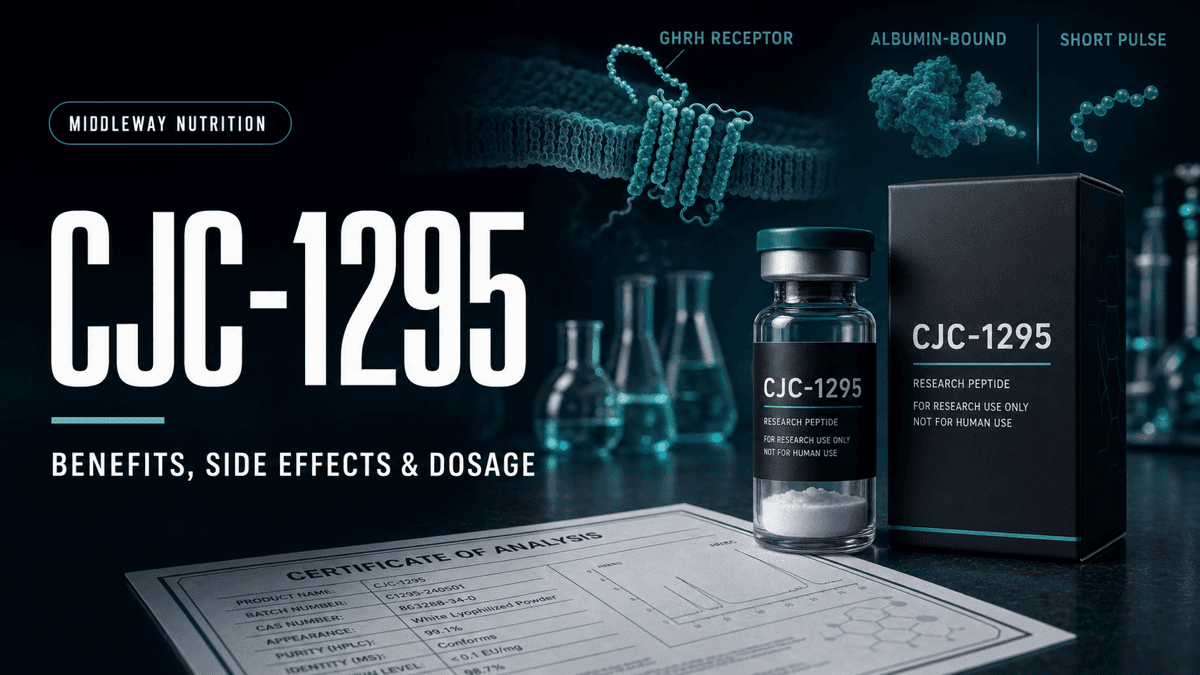
CJC-1295 peptide benefits are almost entirely downstream of growth hormone, the side effects cluster around fluid retention, and dosage in the literature splits sharply by version. That last point is the one most buyers miss. Two chemically distinct products are sold under the same four characters and a number, and they are not interchangeable at any dose.
- CJC-1295 is a modified 29 amino acid fragment of growth hormone releasing hormone (GHRH). It does not supply growth hormone. It signals the pituitary to release more of its own.
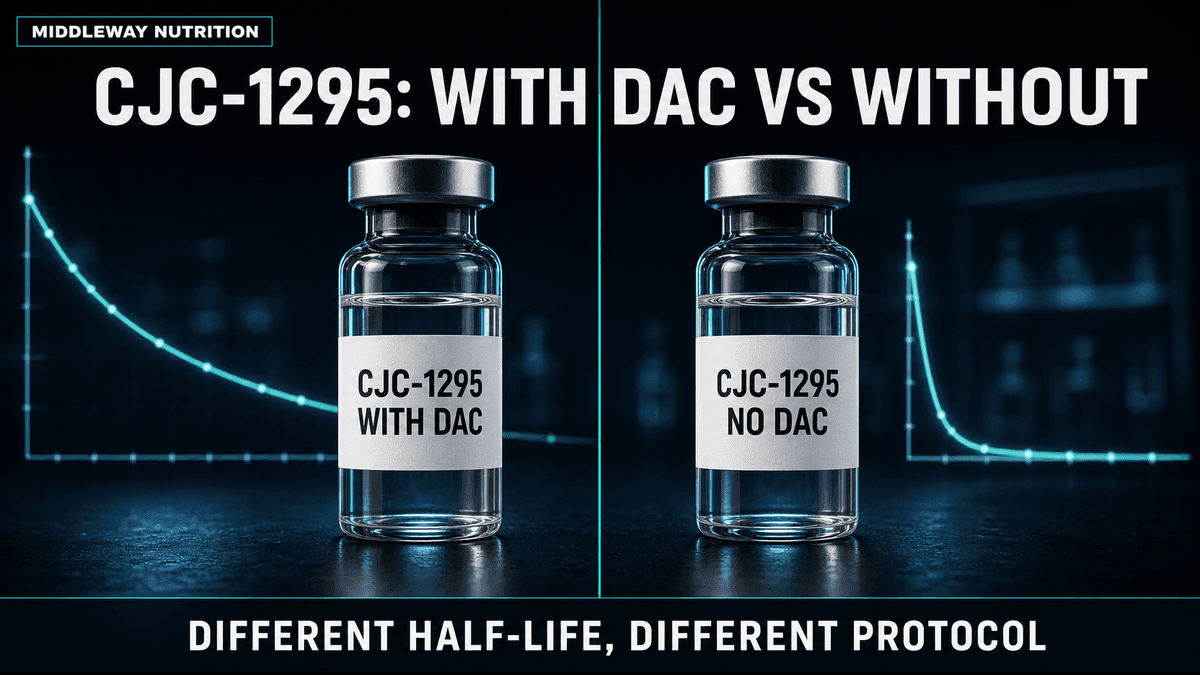
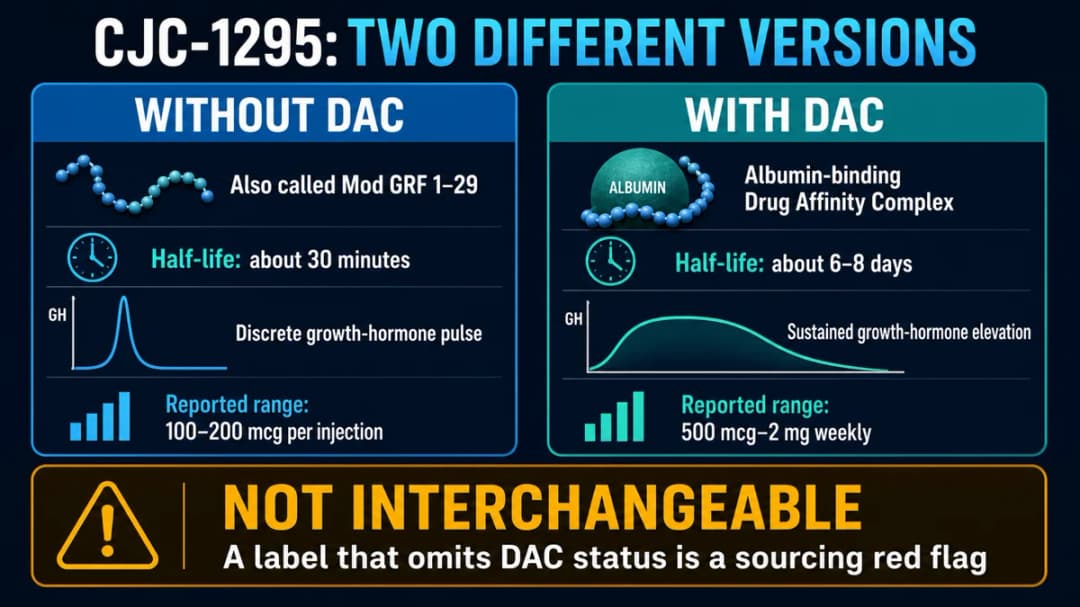
- The DAC and no-DAC versions differ by roughly three orders of magnitude in half-life, about 30 minutes versus 6 to 8 days, which is why their reported dosing ranges look nothing alike.
- Human evidence is thin but real: early phase trials in healthy adults recorded dose dependent rises in growth hormone and IGF-1, with IGF-1 staying elevated for well over a week after a single injection of the DAC form.
- The most consistently reported adverse effects are water retention, transient flushing after injection and local injection site reactions. Long term safety data does not exist for this compound.
- Because CJC-1295 was never approved and never completed late stage trials, product identity depends entirely on the seller. Independent analysis matters more here than with almost any other research peptide.
- FDA lists CJC-1295 among the bulk substances that may present significant safety risks, citing immunogenicity and impurity concerns alongside reports of increased heart rate and systemic vasodilatory reaction.
What CJC-1295 Actually Is
CJC-1295 is a synthetic analog of GHRH, the hypothalamic signal that instructs pituitary somatotroph cells to synthesize and release growth hormone. Native GHRH is functionally useless as a therapy because enzymes in plasma degrade it within a couple of minutes. CJC-1295 solves that with four amino acid substitutions, at positions 2, 8, 15 and 27 of the GHRH 1-29 fragment, which block the enzymatic cleavage sites without disabling receptor binding.
The resulting molecule has a formula weight of about 3,368 daltons in its unconjugated form and the sequence Tyr-D-Ala-Asp-Ala-Ile-Phe-Thr-Gln-Ser-Tyr-Arg-Lys-Val-Leu-Ala-Gln-Leu-Ser-Ala-Arg-Lys-Leu-Leu-Gln-Asp-Ile-Leu-Ser-Arg-NH2. It was developed by the Canadian biotech firm ConjuChem, which ran it through early human trials before shelving the program in the mid 2000s.
The two versions, and why the distinction is load bearing
Without DAC. Often labeled Modified GRF 1-29 or Mod GRF 1-29. This is the tetrasubstituted peptide on its own, with a plasma half-life around 30 minutes. It produces a discrete pulse of growth hormone and then clears, which is closer to how the endocrine system normally behaves.
With DAC. DAC stands for Drug Affinity Complex, a maleimidopropionic acid linker that covalently binds the peptide to circulating albumin. Albumin is a long lived carrier protein, so the conjugate persists for roughly 6 to 8 days. One injection produces a sustained elevation rather than a pulse.
| Property | CJC-1295 without DAC (Mod GRF 1-29) | CJC-1295 with DAC |
|---|---|---|
| Molecule | The tetrasubstituted GHRH 1-29 peptide on its own | The same peptide plus a maleimidopropionyl group that latches onto circulating albumin |
| Half-life | Roughly 30 minutes, a figure inherited from GHRH 1-29 chemistry rather than measured in a published human pharmacokinetic study of this product | 5.8 to 8.1 days, measured directly in healthy adults |
| Growth hormone pattern | One discrete pulse, then clearance | Sustained elevation, driven mainly by a higher floor between pulses |
| Peer-reviewed human trials | None. A 2026 review in Frontiers in Endocrinology put it in the lowest evidence tier, with no controlled human studies of the compound itself | Randomized, placebo-controlled, double-blind ascending dose trials in healthy adults |
| Reported dosing | 100 to 200 mcg per injection, one to three times daily | 1 to 2 mg once weekly |
| Fluid retention reports | Less frequent | More frequent, since exposure never drops |
That difference is not cosmetic. Pulsatile and sustained growth hormone exposure produce different receptor dynamics, different IGF-1 curves and different side effect profiles. A vial labeled only "CJC-1295" without specifying DAC status cannot be dosed rationally, and that ambiguity is common enough in the gray market to treat as a sourcing red flag.
CJC-1295 Benefits
The evidence here is a narrow base of direct human data supporting the biochemical effect, sitting under a much wider set of claims borrowed from the general growth hormone literature. The two layers deserve separating.
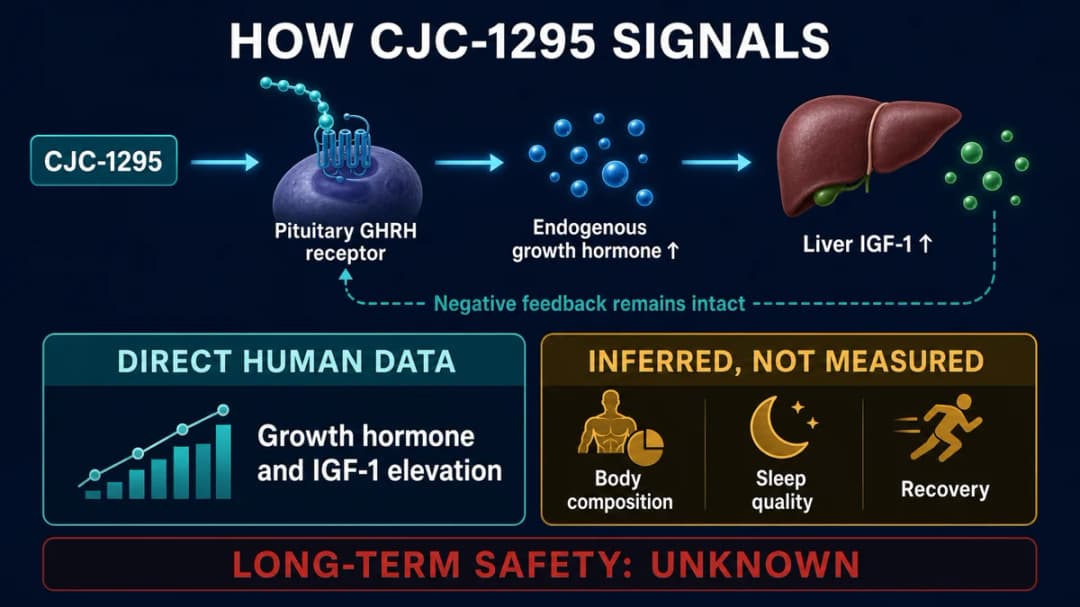
Growth hormone and IGF-1 elevation (directly demonstrated in humans). The one claim with primary support. Early phase human work showed that CJC-1295 with DAC produced dose dependent increases in circulating growth hormone and in IGF-1, and that the IGF-1 elevation persisted for well over a week following a single administration. That the compound does what it is supposed to do biochemically is not in dispute.
Body composition changes (inferred, not directly measured). Growth hormone promotes lipolysis, with a recognized preference for visceral and abdominal fat, and IGF-1 supports amino acid uptake and protein synthesis in muscle. Raising both signals should therefore shift body composition in that direction. No CJC-1295 trial measured fat mass or lean mass as an endpoint, so the reasoning is mechanistic rather than demonstrated, and the fat loss outcomes often quoted in marketing come from other GHRH analogs entirely.
Sleep quality (mechanistically coherent, evidentially anecdotal). The largest natural growth hormone pulse coincides with slow wave sleep, so amplifying the nocturnal pulse plausibly deepens it. This is the effect users report first and most consistently, usually within a week or two, but no CJC-1295 trial has measured it with polysomnography.
Recovery and connective tissue (indirect). Growth hormone and IGF-1 both stimulate collagen synthesis and tissue repair, and faster resolution of training soreness is a common user report. No CJC-1295 study has measured recovery endpoints.
Skin and general aging markers (weakest tier). Claims about skin thickness, elasticity and hair density come from growth hormone physiology generally, largely from studies in genuinely deficient adults. Correcting a deficiency produces changes that healthy adults raising an already normal signal should not expect to replicate.
One structural point is worth stating plainly. Because CJC-1295 acts upstream, on the pituitary rather than in place of it, negative feedback from somatostatin and IGF-1 remains intact. The system can still throttle itself. That ceiling is a real safety feature relative to injected growth hormone, and it is also why the compound will not produce dramatic outcomes quickly.
What the published human data actually showed
Two studies carry almost the entire human evidence base, and both of them tested the DAC form.
| Measurement | Finding | Study |
|---|---|---|
| Mean plasma growth hormone after a single subcutaneous dose | Up 2 to 10 fold, dose dependent, for 6 days or more | Teichman et al., J Clin Endocrinol Metab, 2006 |
| Mean plasma IGF-1 after a single dose | Up 1.5 to 3 fold for 9 to 11 days | Teichman et al., 2006 |
| IGF-1 after repeated weekly or biweekly doses | Still above baseline at 28 days | Teichman et al., 2006 |
| Estimated half-life | 5.8 to 8.1 days | Teichman et al., 2006 |
| Trough growth hormone one week after one 60 or 90 mcg/kg dose | 7.5 fold higher, with pulse frequency and pulse size unchanged | Ionescu and Frohman, J Clin Endocrinol Metab, 2006 |
| Mean overnight growth hormone and IGF-1 at that same point | Up 46 percent and 45 percent | Ionescu and Frohman, 2006 |
The second result is the more interesting one. Continuous GHRH signalling did not flatten the body's own rhythm. Pulses kept arriving at the same frequency and size, and the entire gain came from lifting the baseline between them. Tolerability in the ascending dose work was described as most favourable at 30 and 60 mcg/kg, with no serious adverse reactions reported.
Nothing equivalent exists for the no-DAC form. No controlled human trial has measured growth hormone, IGF-1, fat mass or anything else after a dose of Mod GRF 1-29, which means every claim made for that version is an extrapolation from the DAC data or from sermorelin. The recent literature has not moved that line either: reviews published in 2026 in the American Journal of Sports Medicine and in JBJS Reviews both examined CJC-1295 alongside other injectable peptides and concluded that the claimed recovery and body composition benefits remain unsupported by human trials.
CJC-1295 Side Effects
Most of what people experience on CJC-1295 is not toxicity from the peptide. It is the predictable consequence of raising growth hormone and IGF-1, which is why the side effect list overlaps heavily with the known profile of GHRH analogs as a class.
Commonly reported
- Fluid retention. The most frequent complaint. Growth hormone and IGF-1 both drive renal sodium retention and expand extracellular fluid volume. Presents as facial puffiness and mild swelling in the hands and feet, typically in the first two to four weeks, and is reported more often with the DAC version because the elevation is continuous.
- Flushing after injection. A warm, reddened sensation appearing within about half an hour and resolving within an hour. Transient flushing was among the adverse events recorded in the early human trials, so this one has documentation behind it rather than forum consensus alone.
- Local reactions where the needle went in. Redness, soreness or minor swelling at the site. Also documented in trial data. Rotating sites is the standard mitigation.
Less commonly reported
- Paresthesia in the hands. Tingling or numbness with a carpal tunnel character, generally attributed to fluid pressure on the median nerve rather than to nerve injury. Dose related, and reported to resolve on dose reduction.
- Headache, most often in the opening weeks.
- Daytime grogginess following an evening dose, usually described as dose dependent.
- Blood glucose shifts. Growth hormone antagonizes insulin action, so a rise in fasting glucose or a reduction in insulin sensitivity is biologically expected at higher exposures. Anyone with existing glycemic dysregulation faces a real, if modest, risk here.
- Raised heart rate and vasodilatory reactions. FDA states that it has identified serious adverse events associated with CJC-1295, specifically increased heart rate and systemic vasodilatory reaction. That is a regulator describing its own safety review rather than a forum report, and it is one reason the compound sits where it does with the agency, covered further below.
- Digestive complaints. Indigestion is not a documented CJC-1295 finding and no published trial flagged it. The FAQ below covers what the class level data does and does not show.
Where the data is genuinely thin
Two gaps deserve explicit statement rather than reassurance.
Cardiovascular outcomes are unmeasured. No trial of CJC-1295 was designed or powered to detect changes in blood pressure, cardiac structure or rhythm. The plausible concerns come from fluid volume expansion and from acromegaly, the disease of lifelong growth hormone excess, in which hypertension, ventricular thickening and valve changes are well documented. Decades of uncontrolled hormone exposure is a poor model for a short peptide course, but it is why the only approved GHRH analog, tesamorelin, carries labeling stating that long term cardiovascular safety has not been established. The correct summary is "unknown," not "safe."
Duration is unstudied. The existing human trials ran for weeks, and nobody has followed users for years. Sustained IGF-1 elevation and proliferative risk is a theoretical concern the available data can neither confirm nor rule out, which is why any history of hormone sensitive malignancy is treated as a firm contraindication across this class. Pregnancy, breastfeeding and pediatric use fall outside anything the evidence can speak to.
CJC-1295 Dosage Chart
The ranges below are mostly community and vendor convention rather than doses from a published human protocol. They describe what is commonly reported, not a recommendation, and there is no regulator approved dosing standard for this compound in any jurisdiction.
| Context | Reported range | Frequency | Typical cycle |
|---|---|---|---|
| CJC-1295 no-DAC, single daily use | 100 mcg per injection | Once daily, commonly 30 to 60 min pre-sleep | 8 to 12 weeks, then 4 weeks off |
| CJC-1295 no-DAC, multi-dose | 100 to 200 mcg per injection | 2 to 3x daily, fasted | 8 to 12 weeks, then 4 weeks off |
| CJC-1295 no-DAC, weight scaled (community figure, unsourced) | approx. 1 mcg per kg body weight | Per injection, 1 to 3x daily | 8 to 12 weeks |
| CJC-1295 with DAC, conservative entry | 500 mcg | Once weekly | 8 to 12 weeks |
| CJC-1295 with DAC, standard (community figure, below trial doses) | 1 to 2 mg (1,000 to 2,000 mcg) | Once weekly, or split into two doses | 8 to 12 weeks, then 4 weeks off |
| CJC-1295 no-DAC + ipamorelin | 100 mcg CJC with 100 to 300 mcg ipamorelin | 2 to 3x daily | 8 to 12 weeks |
Three points give that table its meaning.
100 mcg is often described as the saturation point for the no-DAC form, but no published source supports that. The claim is community convention: no trial we found shows growth hormone release stopping scaling at that amount, so treat it as unverified. The 1 mcg per kg weight-scaled row is likewise unsourced. The 1 to 2 mg weekly DAC figure is also a community figure and sits below the trial doses: the 60 or 90 mcg/kg doses in the table above work out to roughly 4.8 to 7.2 mg for an 80 kg adult (simple arithmetic, not a dosing recommendation).
Insulin blunts the response. Elevated blood glucose and insulin suppress growth hormone release, so no-DAC protocols are consistently described as fasted, with a window of a couple of hours before and roughly 20 to 30 minutes after.
Confusing the versions is the dangerous error. A weekly DAC quantity administered on a daily no-DAC schedule would produce sustained supraphysiological exposure. Cycling, commonly 8 to 12 weeks on with a 4 week break, is the usual approach to limiting receptor desensitization; continuous receptor occupancy makes this more of a concern with the DAC form.
Handling, Mixing and Shelf Life
CJC-1295 ships as a lyophilized powder, white to off white, and is not orally active. Peptide bonds do not survive gastric acid and digestive proteases intact, so anything marketed as an oral CJC-1295 product is not delivering the molecule described on the label.
Reconstitution uses bacteriostatic water run slowly down the vial wall rather than shot into the powder, followed by gentle swirling, since shaking shears peptide chains. The arithmetic is worth doing before the first injection rather than after. Divide the vial quantity in micrograms by the millilitres of water added to get concentration, then read the dose off a U-100 insulin syringe, on which 100 units equals 1 mL. A 10 mg vial taken up in 5 mL sits at 2,000 mcg per mL, which puts 100 mcg on the 5 unit mark. Add only 2 mL to that same vial and the concentration jumps to 5,000 mcg per mL, moving 100 mcg down to 2 units, where small errors in plunger position matter a great deal more.
Storage: lyophilized vials keep at -20 C for long term stability. Once reconstituted, refrigerate at 2 to 8 C and use within about 21 days. Reconstituted peptide degrades steadily at room temperature, and a solution that has gone cloudy or thrown visible particulate should not be used.
Stacking
The only CJC-1295 combination with real mechanistic support is the pairing with a growth hormone releasing peptide, and in practice that means ipamorelin. The rationale is genuine rather than marketing: CJC-1295 occupies the GHRH receptor while ipamorelin acts on GHS-R1a, the ghrelin receptor, and additionally suppresses somatostatin, the brake on growth hormone release. Two independent inputs plus removal of the inhibitory signal produce a larger pulse than either compound alone. Work on GHRH and GHRP combinations generally has reported peaks several fold above either agent used by itself. Our ipamorelin peptide guide covers that side of the pairing in detail.
Ipamorelin is chosen over older GHRPs for selectivity, since it does not meaningfully raise cortisol or prolactin at typical doses and causes far less appetite stimulation than GHRP-6. Its half-life of roughly two hours also pairs sensibly with the short acting no-DAC form, and the two are chemically compatible in a single syringe.
Stacking two GHRH analogs together makes no sense, since they compete for the same receptor, so comparison is the more useful exercise. Sermorelin is the unmodified GHRH 1-29 fragment with a half-life of only 10 to 20 minutes, covered in our sermorelin peptide guide. Tesamorelin is a 44 amino acid analog with a half-life in the region of half an hour and the only member of the group with FDA approval and a real clinical evidence base, discussed in the tesamorelin peptide guide.
How to Verify What You Buy
Because CJC-1295 has no approved manufacturer, the label is the only claim you get, and label accuracy varies widely. Vendors write it as CJC-1295, CJC 1295 or CJC1295, and none of those spellings tells you which of the two versions is inside the vial. Insist on batch specific third party analysis covering both identity and purity, confirm the certificate names the exact form you are ordering rather than "CJC-1295" alone, and check that the analysis date corresponds to the lot you receive. Our guide to where to buy CJC-1295 covers what documentation to demand and which sourcing patterns to walk away from, and the CJC-1295 for sale page compares current listings on verification standards rather than price alone.
Where CJC-1295 Stands With US Regulators
The regulatory record is more specific than "not approved," and the specifics matter to anyone deciding whether to buy.
CJC-1295 sits on FDA's Category 2 roster, the list of bulk drug substances nominated for use in compounding that the agency considers may present significant safety risks. The entry was added on 29 September 2023 under section 503A and is still there. It names three problems: possible immunogenicity depending on the route of administration, complexities around peptide related impurities and characterization of the active ingredient, and serious adverse events the agency says it has identified with the compound, specifically increased heart rate and systemic vasodilatory reaction. FDA closes the entry by noting that available clinical data are limited.
The question also went to FDA's outside experts. On 4 December 2024 the Pharmacy Compounding Advisory Committee met to consider five CJC-1295 related bulk substances, covering the plain peptide and the DAC forms, for possible addition to the 503A bulks list, with growth hormone deficiency as the use under evaluation. That list, codified at 21 CFR 216.23, still names six substances, none of them peptides and none of them CJC-1295. There is consequently no legitimate compounding pathway for it in the United States.
Two practical consequences follow. Everything reaching consumers moves through the research chemical channel, where nobody verifies identity or purity on your behalf, and the heart rate and vasodilatory signal FDA describes deserves weight from anyone who already runs a fast resting pulse or stacks stimulants.
Looking for the numbers behind this guide? Our CJC-1295 dosage chart sets label and trial doses beside what Reddit users report taking.
Frequently Asked Questions
What does CJC-1295 peptide do?
It binds the GHRH receptor on pituitary somatotroph cells and increases release of the body's own growth hormone, which in turn raises hepatic IGF-1 production. Everything attributed to it downstream, fat mobilization, protein synthesis, collagen turnover, sleep depth, follows from that single upstream action. It does not supply growth hormone directly and does not override feedback control, which caps how far the effect can go.
Is CJC-1295 safe?
No evidence base exists that can answer that properly. The published human trials were small, ran for weeks, and reported the compound as generally well tolerated, with flushing and injection site reactions the common adverse events. No study assessed cardiovascular endpoints and nobody has been followed for years, so the honest position is that short term tolerability looks acceptable in a small dataset while long term safety is unknown. Anyone with hormone sensitive cancer history, diabetes or prediabetes, uncontrolled hypertension, cardiac disease, or who is pregnant or breastfeeding falls outside what the data covers.
How much CJC-1295 is typically used?
Reported ranges depend entirely on version. Protocols using the no-DAC form describe 100 to 200 mcg per injection, one to three times daily in a fasted state, with 100 mcg often cited, without a published source, as the point of diminishing returns. Protocols using the DAC form describe 1 to 2 mg once weekly, with 500 mcg weekly noted as a more cautious entry. Those are community ranges rather than documented protocols or guidance, the DAC figure sits below the doses used in trials, and no clinical standard exists to anchor any of them.
What is the difference between CJC-1295 and CJC-1295 with DAC?
The same peptide backbone plus one extra chemical group. The DAC version carries a linker that binds it to albumin, which stretches the measured half-life to 5.8 to 8.1 days and turns a single injection into more than a week of raised growth hormone and IGF-1. Without DAC, sold as Mod GRF 1-29, the molecule clears in roughly half an hour and produces one pulse. Every published human trial of the CJC peptide used the DAC form. Dosing does not transfer in either direction: weekly milligram quantities belong to the DAC version, daily microgram quantities to the other, and swapping them is the error with real consequences.
How long does CJC-1295 take to work?
Biochemically, straight away. In the ascending dose trials growth hormone rose after a single injection and stayed elevated for six days or more, IGF-1 climbed across 9 to 11 days, and after repeat dosing IGF-1 was still above baseline at 28 days. Anything a user can feel is slower and far less documented. Deeper sleep is the effect reported earliest, usually inside the first two weeks, while body composition claims rest on a mechanistic argument that no CJC-1295 trial has ever tested with a body scan.
Does CJC-1295 cause indigestion or other digestive side effects?
No trial evidence says it does. The published human studies reported no serious adverse reactions and flagged flushing and injection site reactions rather than anything gastrointestinal. The nearest hard data comes from tesamorelin, the one approved GHRH analog, whose FDA label records dyspepsia in 2 percent of treated patients against 1 percent on placebo and vomiting in 3 percent against none over 26 weeks, so a small class level effect is plausible without being large. Where digestive symptoms do show up in practice, the stack is usually the better explanation than the GHRH analog: ipamorelin and the older growth hormone releasing peptides act on the ghrelin receptor, which governs gastric motility and appetite directly, and ipamorelin was trialed as a prokinetic for postoperative ileus, though it failed to beat placebo. One point is settled. No oral CJC-1295 product survives digestion intact, so a capsule that upsets your stomach is telling you about its excipients rather than about the peptide.
Is CJC-1295 legal?
In the United States it is not an approved drug and is not a controlled substance. It is sold legally as a research chemical, not for human consumption, and marketing it for human use is what regulators act against. Unlike sermorelin, it is not available through compounding pharmacies. WADA prohibits growth hormone secretagogues, so any tested athlete should treat it as disqualifying. Rules and import restrictions differ by country.