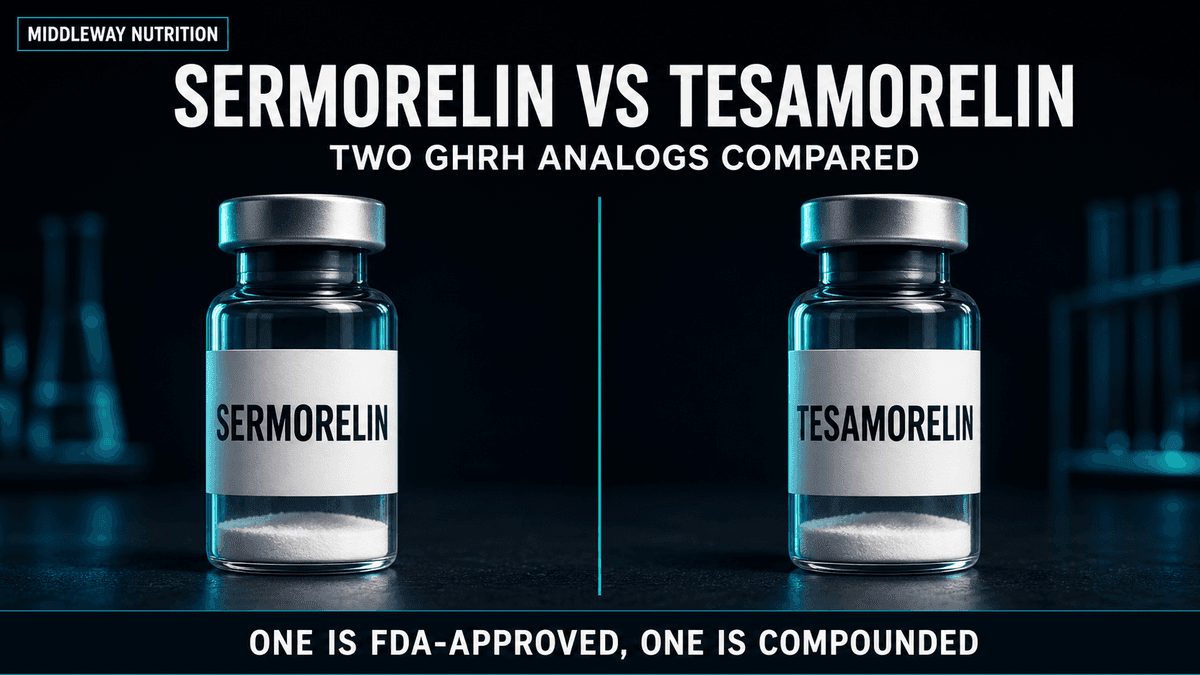
Sermorelin vs Tesamorelin comes down to one uncomfortable fact: only one of them has phase 3 human trial data behind a specific outcome. Tesamorelin is an approved prescription drug with measured visceral fat reduction; Sermorelin is a short-acting GHRH fragment whose adult use rests on a much thinner evidence base. Both push the same pituitary receptor, but they are not interchangeable, and the gap between them is regulatory and clinical rather than mechanistic.
Both belong to the GHRH analog class. They bind the growth hormone releasing hormone receptor on the anterior pituitary and prompt the gland to secrete its own growth hormone, rather than supplying GH from outside the body. That distinction matters, because pituitary feedback through somatostatin stays intact and GH output remains pulsatile.
Sermorelin vs Tesamorelin at a Glance
| Sermorelin | Tesamorelin | |
|---|---|---|
| Class | GHRH analog, first 29 amino acids of GHRH | Stabilised GHRH analog, full 44 amino acid sequence with an N-terminal modification |
| Receptor | GHRH receptor | GHRH receptor |
| Half-life | Roughly 10 to 20 minutes | Roughly 25 to 40 minutes |
| Regulatory status | Former FDA-approved diagnostic (Geref), discontinued; now compounded or sold for research | FDA approved as Egrifta for excess visceral abdominal fat in HIV-associated lipodystrophy |
| Strongest human data | Small studies, mostly GH-deficiency diagnostics and short adult trials | Phase 3 trials measuring visceral adipose tissue by CT |
| Typical reported dose | 100 to 500 mcg, subcutaneous, once daily | 2 mg subcutaneous daily in the approved indication |
| Cost | Low | High |
What Each Compound Actually Is
Sermorelin reproduces the first 29 amino acids of endogenous GHRH. Those 29 residues carry essentially all of the receptor-binding activity of the full 44 amino acid hormone, which is why the truncated version works at all. Its weakness is stability: circulating enzymes clear it within minutes, so each injection produces one brief signal and then nothing.
Tesamorelin solves the stability problem differently. It keeps the full GHRH sequence and adds a trans-3-hexenoic acid group at the N-terminus, which slows enzymatic degradation. The result is a longer window of receptor activation per dose and a stronger downstream IGF-1 response than a bare GHRH fragment produces.
The practical implication is that Tesamorelin delivers a larger total GH signal per injection. Whether a larger signal is desirable depends entirely on what you are trying to do.
Where the Clinical Evidence Actually Sits
This is the part most comparisons skip.
Tesamorelin was approved on the strength of trials in people with HIV-associated lipodystrophy, where visceral adipose tissue was measured directly by CT scan rather than inferred from waist circumference. Across that programme, roughly 15 to 18 percent reductions in visceral fat were reported over about six months of daily dosing. Two points deserve emphasis. First, the effect reversed when treatment stopped, which tells you it is a maintenance therapy rather than a one-time correction. Second, the population studied had a specific metabolic problem, and extrapolating those numbers to a healthy 45-year-old with a soft midsection is not something the data supports.
Sermorelin has a longer history but a shallower one. It was studied and approved as a diagnostic agent for evaluating pituitary function, chiefly in children with suspected GH deficiency, and it was withdrawn from the market for commercial reasons rather than safety findings. Adult use for body composition, sleep and recovery has produced small studies and a great deal of clinic-reported experience, but nothing resembling the imaging-endpoint trials behind Tesamorelin. Honest framing: Sermorelin reliably raises GH acutely, and the downstream clinical outcomes in healthy adults remain poorly quantified.
Dose Ranges Reported in Research
These are figures that appear in published work and clinical use. They are not dosing advice, and neither compound should be self-administered without a clinician involved.
| Parameter | Sermorelin | Tesamorelin |
|---|---|---|
| Common reported dose | 100 to 500 mcg per injection | 2 mg per injection |
| Frequency | Once daily, usually at night | Once daily |
| Route | Subcutaneous | Subcutaneous |
| Typical assessment window | 3 to 6 months | 6 months, with imaging follow-up |
| Monitoring commonly used | IGF-1, fasting glucose | IGF-1, fasting glucose, HbA1c |
Night dosing is conventional for both, because the largest natural GH pulse occurs during early slow-wave sleep and a GHRH signal delivered into that window rides an existing rhythm rather than fighting it. Food raises insulin, and insulin blunts GH release, so injections are generally separated from meals.
Side Effects and What to Watch
The side effect profiles overlap, with Tesamorelin showing more of everything because the GH signal is stronger.
Injection site reactions are the most common complaint for both: redness, itching, a small welt that resolves over a day or two. Fluid retention, joint stiffness and carpal tunnel type tingling in the hands are classic GH-mediated effects and show up more often at higher exposures.
The effect that deserves real attention is glucose. Growth hormone opposes insulin, and sustained elevation can nudge fasting glucose and HbA1c upward. This was documented during the Tesamorelin trials and is a reasonable concern for anyone with prediabetes or existing insulin resistance. Baseline and periodic glucose testing is sensible with either compound.
Anyone with an active malignancy is generally excluded from GH-axis stimulation, because IGF-1 is a growth signal. That is a theoretical concern rather than a demonstrated harm at these doses, but it is the standard contraindication and worth respecting.
Which One Fits Which Goal
If the target is visceral abdominal fat and you want a measured outcome: Tesamorelin is the only option in this class with imaging-endpoint evidence. It is also expensive and, outside its approved indication, difficult to obtain legitimately.
If the goal is a gentle, physiological nudge to the GH axis over months: Sermorelin's short action and preserved feedback loop make it the lower-intensity choice. Expect subtle changes and give it a full three months before judging anything.
If sleep quality is the main interest: the GHRH pathway is genuinely tied to slow-wave sleep, and this is the effect people report earliest with either compound. It is also the effect most vulnerable to placebo, so treat self-reports, including your own, with some scepticism.
If cost is the deciding factor: the gap is large. Tesamorelin runs into the hundreds of dollars per month through legitimate channels. Sermorelin is a fraction of that.
For a wider view of this compound class, our growth hormone secretagogue overview covers how GHRH analogs compare with ghrelin-pathway peptides, and the sermorelin guide and tesamorelin guide go deeper on each one individually.
The Regulatory Reality
Tesamorelin is a prescription medicine with a narrow approved indication. Sermorelin currently reaches most users either through compounding pharmacies and telehealth clinics or through vendors selling it as a research chemical. Peptide compounding rules in the United States have tightened in recent years and availability has shifted more than once, so what a clinic could supply two years ago is not a reliable guide to what it can supply now.
Neither compound is approved for anti-aging, athletic performance or general body composition use. Both are prohibited in tested sport.
Frequently Asked Questions
Is Tesamorelin just a stronger version of Sermorelin?
Functionally it behaves that way, but the difference is structural rather than a simple dose step. Tesamorelin uses the full GHRH sequence with a stabilising modification, so it survives longer in circulation and produces a larger IGF-1 response per injection. It also carries the side effect burden that goes with a stronger signal.
Can Sermorelin and Tesamorelin be used together?
There is no sensible rationale for combining them. Both act on the same receptor, so stacking two GHRH analogs mostly means competing for the same binding sites rather than adding effects. Pairing a GHRH analog with a ghrelin-pathway peptide is the combination that has an actual mechanistic argument behind it.
How long before either one shows results?
Changes in sleep are reported earliest, often within two to four weeks, though that is the least objective endpoint. Body composition changes are slow: the Tesamorelin trials measured their visceral fat effect at 26 weeks. Anyone evaluating either compound over three or four weeks is looking too early.
Does Sermorelin have any FDA approval today?
No. It held approval as a diagnostic agent under the Geref brand, and that product was discontinued. There is no current FDA-approved sermorelin product for adult body composition, sleep or longevity use.
Do the effects persist after stopping?
Not in any lasting way. In the Tesamorelin trials, visceral fat returned toward baseline after treatment stopped. The GH axis reverts to its own set point once the stimulus is removed, which makes both compounds ongoing interventions rather than corrections.