Sermorelin peptide benefits come from one mechanism, pituitary GH release; side effects are mostly mild and local, and dosing clusters in a narrow reported band. What follows separates the parts of that picture with real evidence behind them from the parts that do not have it.
- Sermorelin is GHRH(1-29): the working end of the hypothalamic hormone that drives growth hormone output, cut down to 29 residues without losing what makes it act on the pituitary.
- It does not supply growth hormone. It asks the pituitary to release its own, which means the response depends entirely on whether that pituitary can still respond.
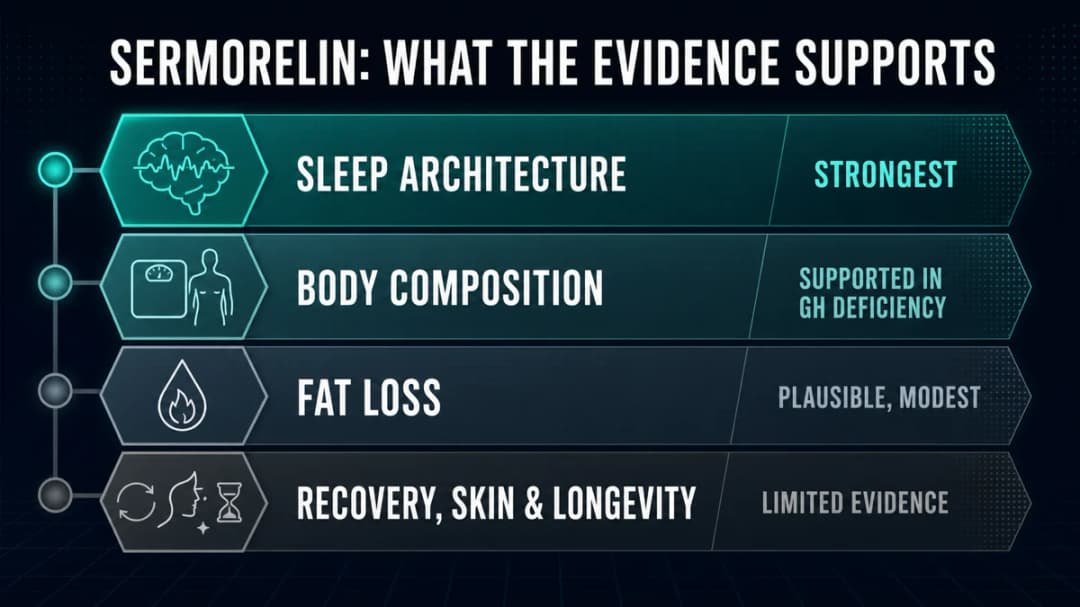
- The best supported outcomes are on sleep architecture and, in genuinely GH deficient adults, body composition. Claims about skin, longevity, and athletic performance rest on much thinner evidence.
- Reported research ranges sit between roughly 200 and 500 mcg subcutaneously, given at night, with a half-life of only 10 to 20 minutes.
- Sermorelin held FDA approval as Geref from 1990 until the applications were withdrawn in 2009, and FDA later determined on the record that neither Geref product left the market for reasons of safety or effectiveness.
- Sermorelin is sold in the research chemical market with no enforced quality standard, so third party testing is the only meaningful check on what is actually in a vial.
What Sermorelin Actually Is
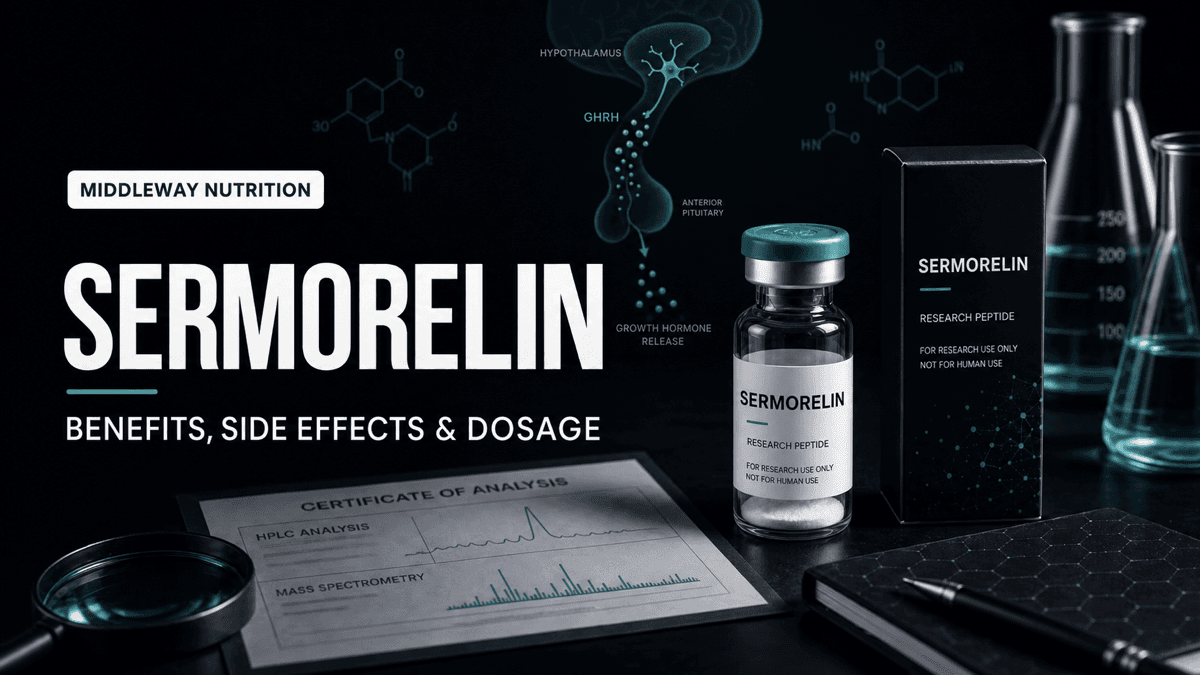
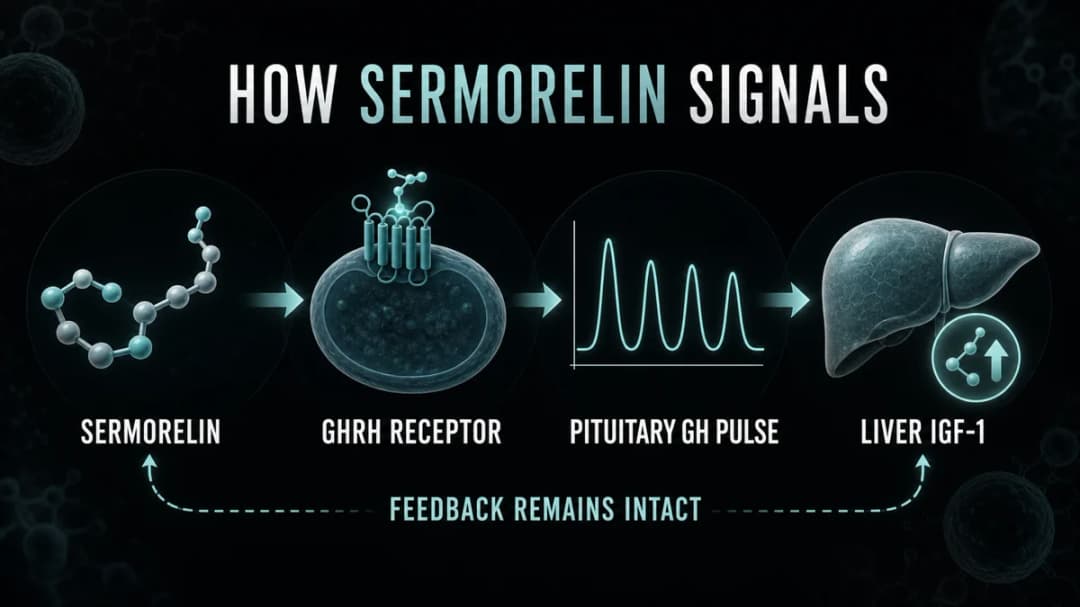
Growth hormone releasing hormone is a 44 residue hypothalamic peptide with one narrow job. It travels the short portal route into the anterior pituitary, docks onto GHRH receptors carried by somatotroph cells, and the cell answers by making and discharging growth hormone in a pulse. When the molecule was mapped, the chemistry turned out to be front-loaded: chop off everything past residue 29 and the shortened chain still does the job.
That fragment is sermorelin. Its sequence is Tyr-Ala-Asp-Ala-Ile-Phe-Thr-Asn-Ser-Tyr-Arg-Lys-Val-Leu-Gly-Gln-Leu-Ser-Ala-Arg-Lys-Leu-Leu-Gln-Asp-Ile-Met-Ser-Arg-NH2, with a molecular weight near 3,358 Da and CAS number 86168-78-7. It ships as a lyophilized white to off-white powder. The C terminal amide is not decoration; it is part of what keeps receptor affinity intact in the shortened form.
The regulatory history is unusual, and it is documented down to the date. Sermorelin reached the US market twice, both times as Geref. The 0.05 mg ampule was approved on December 28, 1990 under NDA 19-863, indicated for evaluating whether the somatotrophs of the pituitary could still secrete growth hormone at all. The 0.5 mg and 1 mg vials followed on September 26, 1997 under NDA 20-443, indicated for idiopathic growth hormone deficiency in children with growth failure. EMD Serono notified FDA that it was discontinuing the ampule in July 2008 and the vials that December, and FDA withdrew approval of both applications effective June 18, 2009.
None of that was a safety action, and FDA has said so on the record. A Federal Register notice published March 4, 2013 formally determined that neither Geref product had been withdrawn from sale for reasons of safety or effectiveness, a determination the agency makes specifically so that generic versions can be approved. The result is a strange status today: a compound with real trial history and a clean withdrawal record behind it, no approved product on any shelf, prescriptions filled by compounding pharmacies, and heavy availability through research chemical vendors.
The mechanistic point that matters most is where the brake sits. Recombinant growth hormone skips the gland altogether and delivers a flat elevation the body has no way to moderate. Sermorelin works one step upstream, so the somatotroph is still listening to somatostatin while it responds, and the ceiling on output ends up set by the axis rather than by the syringe. That is the strongest argument in sermorelin's favor and also its sharpest limitation. A GHRH signal is worth very little to a pituitary that has lost the capacity to answer it.
Half-life is short, roughly 10 to 20 minutes. GH rises within about half an hour and returns toward baseline within a few hours. Nothing about sermorelin creates a sustained elevation, which is why timing carries so much weight in reported protocols.
Sermorelin Benefits
The honest summary is that sermorelin's benefits are all downstream of GH and IGF-1, so the evidence is only as strong as the evidence that a modest, pulsed GH increase changes the outcome in question. That varies a lot by outcome.
Here are the sermorelin benefits people actually go looking for, ranked by how much evidence sits behind each one rather than by how often the claim gets repeated.
| Claimed benefit | What has to be true for it to work | Evidence tier | Where reports place the timeline |
|---|---|---|---|
| Deeper slow wave sleep | A GHRH signal reinforces the GH pulse that already fires after sleep onset | Strongest. GHRH has been studied in humans specifically for its effect on sleep stages, including in older adults | 2 to 4 weeks |
| Lean mass up, fat mass down | Restored GH pulsatility shifts body composition | Supported, but in adults with documented GH deficiency rather than in healthy adults | 2 to 3 months |
| Abdominal fat reduction | GH raises hormone sensitive lipase activity in fat cells | Mechanism is sound, effect size is modest and inseparable from diet and training | 3 months or more |
| Faster recovery and tissue repair | IGF-1 drives cell proliferation and differentiation | Thin. Mechanistic reasoning plus subjective report, no controlled sermorelin data | Not established |
| Skin quality and collagen | GH and IGF-1 stimulate collagen synthesis in fibroblasts | Weakest tier. Not demonstrated in good human trials | 3 to 6 months of self report |
| Bone mineral density | GH supports bone remodeling and mineral density | Weakest tier. Never shown to change fracture risk with sermorelin | Not established |
| Longevity and anti-aging | General GH biology transfers to lifespan or healthspan | No supporting human data at all | Not applicable |
Each row is unpacked below, with the reasoning attached.
Sleep architecture. Reasonably well supported in humans. The largest natural GH pulse occurs during early slow wave sleep, and GHRH administration has been studied specifically for its effect on sleep stages in human subjects, including older adults with reduced slow wave sleep. Increased deep sleep duration is one of the more consistent findings in the GHRH literature and one of the earliest reported effects, often within the first two to three weeks. This is the benefit with the least distance between mechanism and measured result.
Body composition in GH deficient adults. Supported, but in a specific population. In adults with documented growth hormone deficiency, restoring GH pulsatility has been associated with increased lean mass and reduced fat mass. The relevant caveat is that most of this work was done in people who were actually deficient. Extrapolating those results to a healthy 35 year old with normal GH output is not something the data supports, and the incremental benefit in that group is likely small.
Fat loss. Mechanistically sound, clinically modest. GH upregulates hormone sensitive lipase activity in fat cells, which favors the breakdown of stored triglycerides, and GH elevation has been linked to reductions in abdominal fat. What the mechanism does not tell you is the effect size. Sermorelin is not a weight loss agent in the sense that a GLP-1 receptor agonist is, and any reported fat loss in the research literature occurred alongside diet and training rather than instead of it.
Recovery and tissue repair. Plausible, thinly documented. IGF-1 drives cell proliferation and differentiation, and faster recovery is a commonly reported subjective effect. Controlled human data specifically on sermorelin and injury recovery is scarce, so treat this as mechanistic reasoning rather than proven outcome.
Skin quality, bone density, and anti-aging. Weakest tier. GH and IGF-1 do stimulate collagen synthesis in fibroblasts and do support bone mineral density, which is why these claims appear everywhere. The leap from that biochemistry to visible skin change or measurable fracture risk reduction has not been demonstrated in good human trials. Most of what circulates here is self report over three to six months, which is exactly the window in which people also change their diet, sleep, and training.
Compared with related compounds, sermorelin's profile is unremarkable in potency and notable in feedback safety. Tesamorelin is a stabilized full length GHRH analog with far stronger clinical data on visceral fat specifically. CJC-1295 is the same GHRH pathway with a modification that stretches the half-life enormously. Ipamorelin works through the ghrelin receptor instead and is not a GHRH analog at all.
Sermorelin Side Effects
Sermorelin's tolerability record is better than most research peptides, largely because it accumulated real clinical use during its approved years. That record is not the same as a clean bill of health, and several of the entries below are extrapolated from GH physiology rather than observed in sermorelin trials.
Documented and common. Injection site reactions are the most frequently reported effect: redness, swelling, or brief pain that typically settles within an hour. Facial and upper body flushing shortly after administration is also common and short lived. Headache appears in a subset of subjects, usually early and often fading. Drowsiness after injection is frequently noted, which is unsurprising given the compound's relationship to sleep onset.
Reported less often. Mild nausea, particularly toward the upper end of dose ranges. Fluid retention and mild edema in the extremities, generally described as easing after the first month. Tingling or numbness in hands and feet, which is a recognized GH mediated effect and appears more often at higher doses. Postural dizziness. Modest appetite increase. Altered taste sensation has also been noted. Rare reports from the clinical trial era included hyperactivity and somnolence.
Where the data is genuinely thin. Three areas deserve honesty rather than reassurance:
- Long term IGF-1 elevation. Chronically raised IGF-1 has a contested relationship with cancer risk in the literature. There is no long term sermorelin cohort that settles this question, and anyone claiming otherwise is filling a gap with confidence.
- Glucose handling. GH is counter-regulatory to insulin. The effect of sustained GHRH stimulation on glucose tolerance, especially in people who are already insulin resistant, has not been well characterized at these doses.
- Multi-year use. Almost all sermorelin data covers weeks to months. Continuous use over years is essentially undocumented, so claims that it is safe indefinitely are not evidence based statements.
The often repeated line that sermorelin cannot cause acromegaly because feedback is intact is directionally reasonable and probably true at typical doses, but it is a mechanistic argument rather than a finding from long term safety studies.
Sermorelin Dosage Chart
Everything in this chart is a range reported in published protocols and research literature. It is a summary of what has been used, not a recommendation, and there is no established dosing standard for any non clinical use of sermorelin.
| Context | Reported range | Frequency | Typical cycle length |
|---|---|---|---|
| Diagnostic GH stimulation (historic clinical use) | 1 mcg/kg, intravenous | Single administration | Not applicable |
| Labeled pediatric GH deficiency (historic Geref) | 30 mcg/kg, subcutaneous | Once daily at bedtime | Clinician determined |
| General GH support in research protocols | 200 to 300 mcg, subcutaneous | 5 nights per week | 3 to 6 months |
| Body composition oriented protocols | 300 to 400 mcg, subcutaneous | 5 to 7 nights per week | 3 to 6 months |
| Upper end of reported research range | 400 to 500 mcg, subcutaneous | 5 to 7 nights per week | 3 to 6 months |
Three details explain why these numbers look the way they do.
First, the timing. Nocturnal administration is near universal because the compound is trying to amplify a pulse that already happens roughly an hour after sleep onset. Daytime administration produces a GH rise with no physiological pulse to reinforce. Reported protocols place the injection in the 15 to 60 minute window before sleep.
Second, the state of the stomach. Insulin and GH pull against each other, so a recent meal leaves circulating insulin high enough to flatten the GH response to an otherwise identical dose. Reported protocols therefore tend to leave a couple of hours between eating and injecting, and they avoid sugar around the injection window for the same reason.
Third, the intermittent schedules. The five nights on, two nights off pattern is intended to limit GHRH receptor desensitization, though it is a precaution grounded in receptor pharmacology rather than a schedule validated against continuous dosing in a trial. Longer protocols commonly build in a break for the same reason. Baseline and follow up IGF-1 measurement at around six to eight weeks is how response is assessed in clinical settings.
Stacking
One pairing has a coherent rationale behind it: sermorelin alongside a ghrelin receptor agonist such as ipamorelin or a member of the GHRP family. Two independent receptors feed the same somatotroph, and hitting both at once yields a bigger pulse than hitting either on its own. That is standard receptor pharmacology, not a vendor talking point.
What is not established is that the combination produces better outcomes. Larger GH pulses are an intermediate measure. No controlled trial has shown that a sermorelin plus ipamorelin protocol beats sermorelin alone on fat mass, lean mass, or anything else people actually care about.
Combining sermorelin with another GHRH analog is redundant by design. Stacking it with CJC-1295 or tesamorelin puts two compounds in competition for the same receptor, so the sensible move is choosing between them on half-life and potency rather than running both. Pairings with unrelated peptides for healing or sleep circulate widely but have no combination data behind them.
One regulatory fact changes what a stack looks like in practice. FDA maintains a category 2 list of bulk drug substances that it has flagged as presenting significant safety risks in compounding, and ipamorelin acetate, GHRP-2 and GHRP-6 were all added to it on September 29, 2023. CJC-1295 appears on the same FDA page among nominations that were later withdrawn. Sermorelin does not appear on FDA's Category 2 list (we did not verify its status on the other compounding categories, so check FDA's current pages). That is a statement about regulatory status rather than about relative potency, but the practical consequence is real: the sermorelin plus ipamorelin pairing that circulates freely in the research chemical market is not something a US compounding pharmacy is positioned to make, which is why the two markets look so different from each other.
Reconstitution and Storage
Sermorelin arrives lyophilized and requires bacteriostatic water before it is in solution. The handling notes below reflect standard laboratory practice for GHRH analogs.
Dilution volume determines concentration and nothing else. Adding 2 mL of bacteriostatic water to a 5 mg vial gives 2,500 mcg/mL; adding 1 mL to a 2 mg vial gives 2,000 mcg/mL. At 2,500 mcg/mL, a 300 mcg quantity corresponds to 0.12 mL, which is 12 units on a U-100 syringe.
Aim the needle at the glass, not the cake. Letting the diluent trickle down the side avoids the mechanical shear that a jet of water applies to a fragile chain, and the vial should then be rolled or swirled rather than shaken. Solution that has gone properly into suspension looks clear. Cloudiness or floating particulate means the vial gets discarded, not rescued.
Storage splits by state. As dry powder the peptide keeps for a long time in a freezer at roughly minus 20 degrees C. In solution it belongs in a normal refrigerator, in the 2 to 8 degrees C band. Figures for shelf life after reconstitution, usually quoted as two to four weeks, are unverified: we found no stability study, and sources disagree, so the shorter figure is the cautious one to work from. Freezing and thawing the same solution repeatedly degrades it.
How to Verify What You Buy
Sermorelin sold as a research chemical carries no enforced identity or purity standard, and a lyophilized powder gives you no visual information about whether the peptide inside is correct, degraded, or underfilled. The only meaningful check is a recent third party analysis, ideally by mass spectrometry for identity and HPLC for purity, matched to the specific batch rather than a generic document. Our guide to where to buy sermorelin covers which suppliers publish per batch testing and how to read the reports they provide.
Looking for the numbers behind this guide? Our sermorelin dosage chart sets label and trial doses beside what Reddit users report taking.
Frequently Asked Questions
What does sermorelin peptide actually do?
It binds GHRH receptors on the pituitary and prompts the gland to release its own growth hormone in a natural pulse. It does not supply growth hormone directly, so its effect is capped by how well the pituitary still responds. Elevated GH raises IGF-1, the mediator behind most attributed effects. Sleep depth is typically the first change reported, within two to four weeks, while body composition changes in the literature took two to three months or more.
What is the peptide sermorelin supposed to help with?
Four things, and they do not carry equal weight. Sleep depth has the most support, because GHRH administration has been studied in humans specifically for its effect on slow wave sleep. Body composition comes second, and the evidence behind it comes from adults with documented growth hormone deficiency rather than from healthy people with normal GH output. Fat loss is third, sound as a mechanism and modest in practice, and never separable from the diet running alongside it. Skin, joints, bone and longevity are fourth, which is to say they are claims built on general GH biology rather than on anything measured with sermorelin itself. In its approved years it was not a wellness product at all: it was a diagnostic agent for pituitary function, and then a treatment for children who were not growing.
Is sermorelin safe?
Short term tolerability is well characterized and generally mild, with injection site reactions, flushing, and headache accounting for most reported effects, and the intact feedback loop is a real structural advantage over exogenous growth hormone. But long term safety is not established, glucose handling and sustained IGF-1 elevation have not been well studied, and product quality in the unregulated market is an independent risk unrelated to the molecule itself.
How much sermorelin is typically used?
Reported research ranges run from about 200 to 500 mcg subcutaneously, given at night, with the labeled historic clinical dose being pediatric (30 mcg/kg subcutaneously at bedtime, per Prakash and Goa, PMID 18031173). No label or trial we found supports a flat 200 to 300 mcg adult dose, so those figures are community convention. The diagnostic protocol used a single 1 mcg/kg intravenous dose, which is a different application entirely. These are figures from documented protocols and there is no established dosing standard outside of clinical settings.
Is sermorelin legal?
Its status is unusual. Sermorelin held FDA approval as Geref from 1990, the products were discontinued in 2008, the applications were withdrawn in 2009, and FDA determined in 2013 that neither had left the market for safety or effectiveness reasons. US physicians still prescribe it off label using material made up by compounding pharmacies. Material sold as a research chemical without a prescription sits in a much grayer position, and the research use designation explicitly means the product is not intended for human administration. Rules differ substantially by country.
This guide is for informational and research reference purposes only. Sermorelin is not an approved medicine for the uses described here, and nothing above is medical advice, a treatment recommendation, or instruction for personal use. Dosing figures are ranges reported in research literature and historic clinical protocols, not directions. Consult a qualified healthcare professional before making any decision related to your health.