GHK-Cu Capsules Efficacy: Dosage, Forms & Evidence
Direct answer: GHK-Cu capsules can deliver measurable systemic benefits for skin density, wound healing, and tissue remodeling, but their efficacy is constrained by oral bioavailability. Standard capsules lose a significant portion of peptide activity to digestion. Liposomal or enteric-coated formulations perform better. If your goal is localized skin improvement, topical GHK-Cu has the strongest direct evidence. If you want systemic support, well-formulated oral capsules are a practical option.
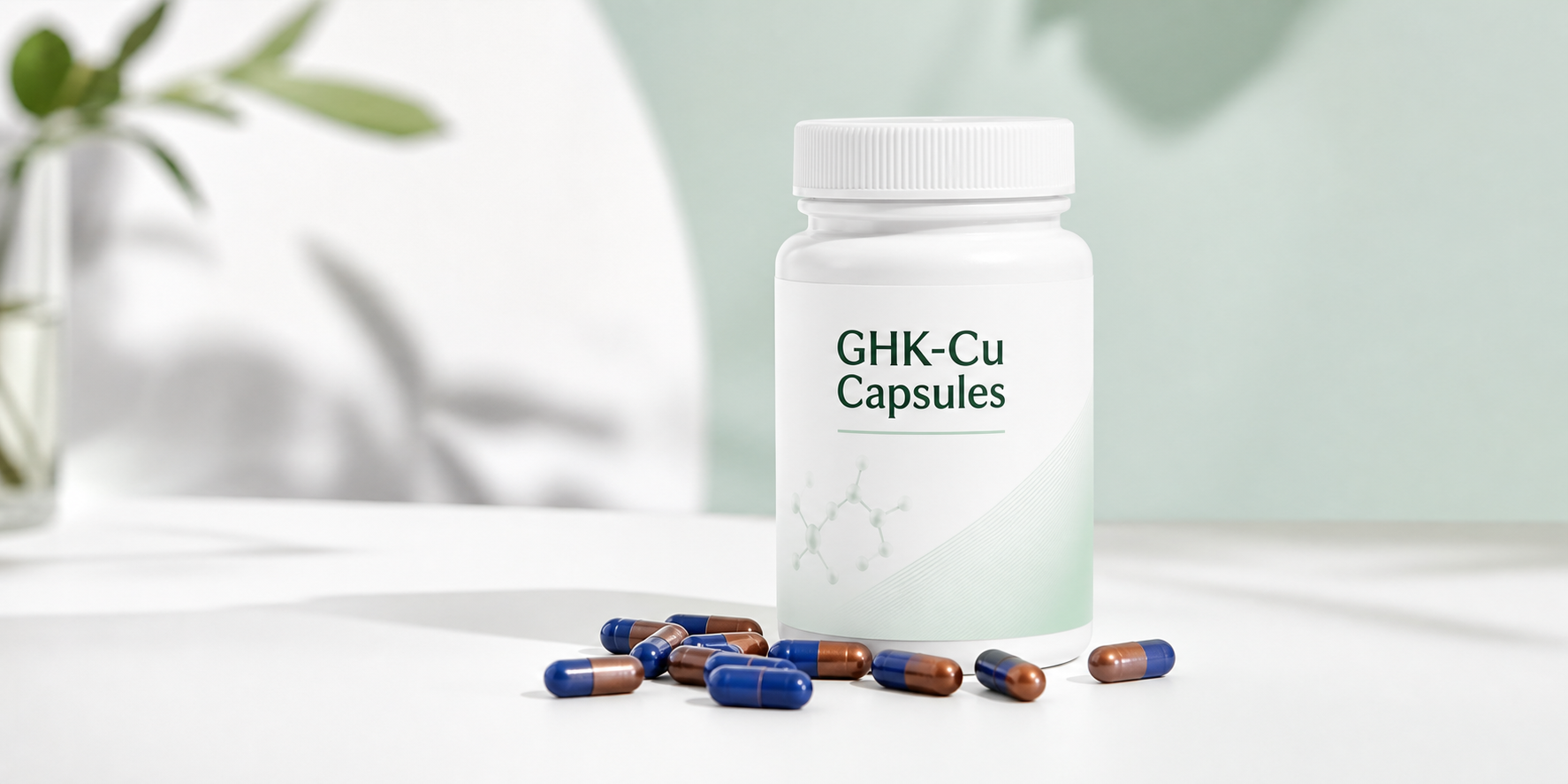
What GHK-Cu Is and Why the Copper Matters
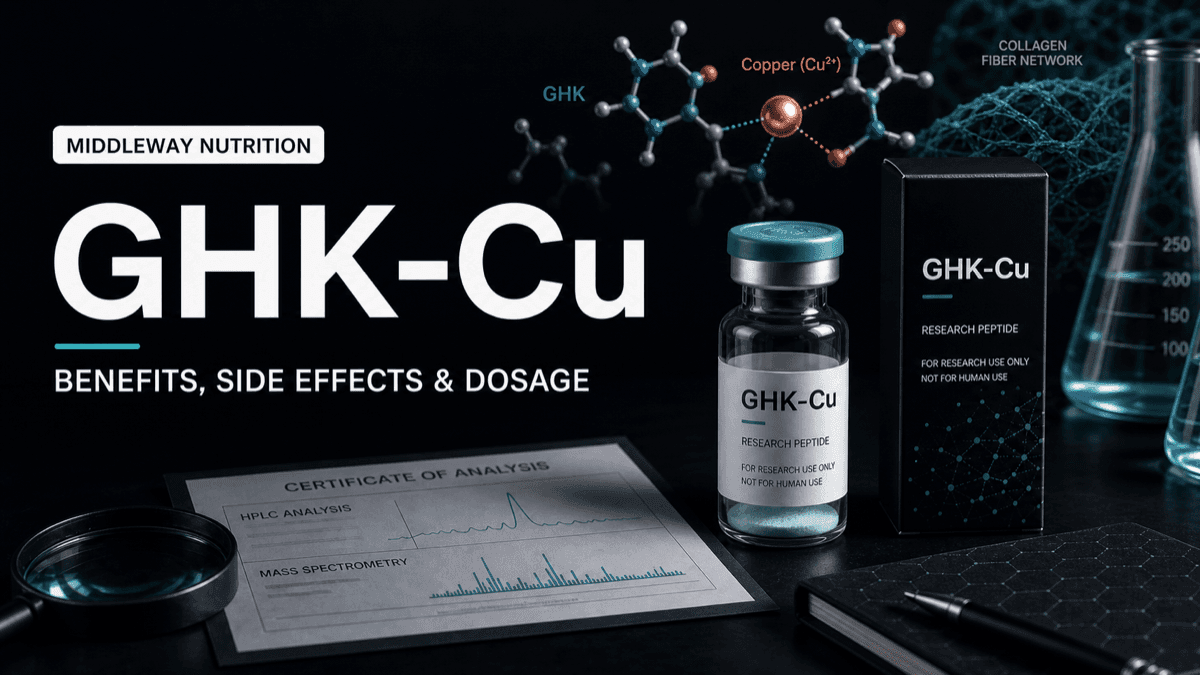
GHK-Cu is a copper-binding tripeptide: glycyl-histidyl-lysine complexed with a copper ion. Your body produces it naturally. Plasma concentrations sit around 200 ng/mL in your twenties and fall to roughly 80 ng/mL by sixty. That decline correlates closely with the slowdown in tissue repair most people notice in their thirties.
The copper component is not incidental. Copper acts as a cofactor for lysyl oxidase, the enzyme responsible for cross-linking collagen fibers. Without adequate copper, collagen does not mature properly. GHK alone is a signaling molecule. GHK complexed with copper is a signaling molecule paired with the structural cofactor that skin, connective tissue, and wound sites require for proper remodeling.
The scale of GHK-Cu's biological activity is substantial. Gene expression studies show it modulates a large share of human genes involved in tissue remodeling, antioxidant defense, and extracellular matrix production. That breadth explains why researchers have studied it for wound healing, skin aging, hair growth, COPD, and oncology.
Mechanism: How GHK-Cu Works in Tissue
GHK-Cu operates through several converging pathways:
- Fibroblast activation. GHK-Cu stimulates fibroblasts to produce collagen, elastin, and glycosaminoglycans — the structural proteins that give skin its density and elasticity.
- Angiogenesis. The peptide promotes new blood vessel formation, which is critical for wound repair and for maintaining follicle health in hair growth.
- Antioxidant upregulation. GHK-Cu increases superoxide dismutase activity and reduces oxidative stress in tissues.
- TGF-beta modulation. By inhibiting transforming growth factor beta, GHK-Cu limits excessive scar formation and prevents premature follicle miniaturization in androgenetic alopecia.
- Copper delivery. The bound copper is bioavailable to enzymatic pathways that depend on it, including lysyl oxidase for collagen maturation.
These mechanisms are not speculative. They are documented in peer-reviewed studies using in vitro models, animal models, and human skin trials.
Benefits: Wound Healing, Skin, and Hair
Wound Healing
Wound healing is where GHK-Cu has the most robust and clinically grounded evidence base.
A 2012 study in Wound Repair and Regeneration found that topical GHK-Cu accelerated wound contraction in animal models via increased fibroblast activity, enhanced angiogenesis, and elevated antioxidant enzyme output. Diabetic wound models showed particularly strong results when GHK-Cu was incorporated into collagen dressings.
A 2015 study demonstrated that GHK-Cu restored replicative capacity to fibroblasts from patients who had undergone radiation therapy — an application with direct clinical relevance, since radiation damages tissue at the cellular level and most interventions do not address the underlying fibroblast dysfunction.
GHK-Cu has since been investigated for burns, surgical wounds, and chronic ulcers. The evidence in this domain is the strongest of any GHK-Cu application.
Skin Anti-Aging
A 2018 review covering multiple clinical trials found that topical GHK-Cu increased skin density and thickness in women with photoaged skin. In one 71-person trial with daily GHK-Cu cream application over twelve weeks, researchers documented reduced sagging and diminished fine lines. A separate 41-person trial showed improvements in skin density and thickness that outperformed both placebo and vitamin K cream around the eye area.
A pilot study found increased skin thickness and elasticity, improved hydration, and boosted collagen synthesis — measurable outcomes, not subjective impressions.
What the evidence does not support: dramatic wrinkle reversal, replacement of surgical interventions, or the before-and-after photos common in supplement advertising. The research supports improved firmness, reduced fine lines, and better skin density over consistent multi-week use.
For oral capsules, the bioavailability question adds uncertainty to all of these outcomes. The skin data is overwhelmingly topical. Oral capsules work through systemic circulation, which means lower peak concentrations in skin tissue than direct topical application delivers.
Hair Growth
The hair growth data is biologically plausible but clinically thinner than the skin and wound healing evidence.
A 2023 review identified three mechanisms: fibroblast stimulation and angiogenesis around hair follicles, TGF-beta inhibition to prevent follicle miniaturization, and support for dermal papilla cells that drive hair formation. These mechanisms are sound. The human clinical evidence showing measurable hair regrowth from GHK-Cu specifically is more limited. Most compelling data comes from animal studies or in vitro work.
Practical expectation: users in the early stages of androgenetic alopecia, where follicles are shrinking but present, are the most likely candidates for benefit. If follicles have been absent for years, GHK-Cu capsules are unlikely to reverse that.
Capsule vs Injectable vs Topical: Form Comparison
Understanding delivery form is essential to understanding GHK-Cu capsules efficacy for your specific goal.
Topical GHK-Cu has the most direct evidence for skin outcomes. The peptide reaches fibroblasts in the dermis without passing through the digestive tract. Virtually all clinical data on skin aging and wound healing uses topical formulations. If the goal is skin improvement at a specific site, topical is the most evidence-backed route.
Injectable GHK-Cu produces systemic effects. Research on tissue regeneration, COPD fibroblasts, and anti-cancer properties comes from injectable or in vitro studies. Injections deliver GHK-Cu directly to systemic circulation, bypassing the gastrointestinal barrier entirely. This route requires a prescription in most jurisdictions and introduces injection-site and sterility risks.
Oral GHK-Cu capsules are the least studied delivery route. GHK-Cu is a tripeptide, and peptides are degraded by gastrointestinal enzymes unless protected. A 2015 rat study found measurable plasma GHK-Cu levels after oral administration, confirming that absorption occurs — but bioavailability was significantly lower than injectable forms.
The practical implication: oral capsules provide a convenient, lower-risk delivery method with plausible systemic benefits, but the effect size is smaller than injectable for systemic targets and smaller than topical for skin-specific targets.
| Route | Primary Evidence | Relative Bioavailability | Typical Use Case |
|---|---|---|---|
| Topical | Skin aging, wound healing | High (local) | Localized skin improvement |
| Injectable | Systemic regeneration, COPD | High (systemic) | Whole-body tissue effects |
| Oral (standard) | Limited direct human data | Low-moderate | Daily systemic baseline |
| Oral (liposomal/enteric) | Mechanistically supported | Moderate | Enhanced systemic delivery |
Bioavailability: What Capsule Formulation Actually Determines
Standard gelatin or HPMC capsules containing raw GHK-Cu powder will lose a significant proportion of peptide activity to stomach acid and digestive enzymes. Unless the label specifies enteric coating or liposomal encapsulation, assume you are absorbing less than half of the stated dose.
Products that claim high absorption without naming a delivery technology are making unsupported claims. When evaluating any oral GHK-Cu product, look for:
- Enteric coating — protects the peptide through stomach acid, releases in the small intestine
- Liposomal encapsulation — phospholipid shell protects the peptide and improves membrane permeability
- Sublingual delivery — bypasses digestion entirely, though less common in commercial products
- Third-party testing — verifies peptide content and purity, not just label claims
LVLUP Health and Quicksilver Scientific have developed liposomal GHK-Cu formulations specifically to address this problem. These cost more than standard capsules and justify the premium with a documented delivery mechanism.
The copper component has separate absorption considerations. Copper competes with zinc for absorption via metallothionein pathways. If you are combining GHK-Cu with zinc supplementation, space the doses several hours apart to avoid competitive inhibition.
Dosage: What the Research Used
Human clinical data for oral GHK-Cu capsules is sparse. The dosage evidence comes primarily from topical and injectable studies.
Topical protocols studied:
- 0.5–2% GHK-Cu cream applied twice daily in skin density and thickness trials
- 2 mg per application was common in wrinkle reduction studies
Injectable protocols studied:
- 1–5 mg subcutaneously, administered 2–3 times per week in tissue regeneration studies
- Some protocols used daily lower-dose injections
Oral capsule protocols in commercial use:
- Most products contain 2 mg per capsule; 1–2 capsules daily is the standard recommendation
- Neurogan's 120 mcg tablets represent a lower-dose strategy that may account for reduced oral bioavailability
- Without enhanced delivery, effective tissue-level dose is unknown
A reasonable starting point for oral capsules is 2 mg daily on an empty stomach. With a documented enhanced-delivery product, up to 4 mg daily is within the range of mechanistically plausible dosing. Above 4 mg daily orally, there is no human data.
| Route | Studied Dose | Frequency | Evidence Strength |
|---|---|---|---|
| Topical | 0.5–2% cream | Twice daily | Strong for skin benefits |
| Injectable | 1–5 mg | 2–3x per week | Moderate for systemic effects |
| Oral (standard) | 2 mg | Daily | Limited direct evidence |
| Oral (enhanced) | 2–4 mg | Daily | Mechanistically plausible |
Side Effects and Copper Toxicity Risk
Copper toxicity is real and dose-dependent. The National Academy of Medicine sets the tolerable upper intake level for copper at 10 mg daily for adults. A typical 2 mg GHK-Cu capsule contains approximately 0.3–0.5 mg of copper from the bound complex. At standard doses, that is well within safe limits.
The risk materializes when copper from supplementation is added to dietary copper (oysters, liver, nuts), copper-contaminated water, or other copper supplements. Monitor total daily copper intake, not just the GHK-Cu dose.
Symptoms of copper excess include nausea, vomiting, abdominal pain, and in severe cases, hepatotoxicity. Wilson's disease patients should avoid copper supplementation entirely. Anyone with hepatic impairment should consult a physician before use.
Additional interaction notes:
- High-dose vitamin C may reduce copper absorption, potentially blunting GHK-Cu benefits
- Glutathione supplementation may affect copper metabolism
- High-dose zinc competitively inhibits copper absorption
None of these interactions are acutely dangerous at typical doses. They are relevant if you are stacking multiple supplements and want to optimize rather than accidentally antagonize copper-dependent pathways.
Who Should (and Should Not) Take GHK-Cu Capsules
Reasonable candidates:
- Those targeting systemic skin aging support beyond what topical-only protocols provide
- People with a history of declining wound healing who want systemic tissue support
- Those already using topical GHK-Cu and want to complement it with a systemic baseline
- Anyone who has verified that their specific product uses a documented bioavailability-enhancing delivery method
Poor candidates:
- Pregnant or breastfeeding individuals (no adequate safety data)
- Those with Wilson's disease or any copper metabolism disorder
- Those on prescription copper supplementation
- Those expecting oral capsules alone to produce results equivalent to topical or injectable forms
- Those unwilling or unable to afford products with verified enhanced delivery
GHK-Cu capsules integrate well into broader peptide protocols. For those exploring the Wolverine Stack (GHK-Cu combined with KLOW, Thymosin Beta-4, and BPC-157), oral capsules provide a convenient daily systemic base alongside more targeted injectable components. For those using 5-Amino-1MQ for metabolic support, GHK-Cu complements it via a different tissue-remodeling mechanism.
Frequently Asked Questions
How long does it take to see results from GHK-Cu capsules?
Initial skin hydration improvements are reported within 2–4 weeks by most users. Changes in collagen density typically require 8–12 weeks of consistent use to become measurable. Hair results, where they occur, take 3–6 months to become visible.
Can I take GHK-Cu capsules with other peptides?
Yes. GHK-Cu works through distinct mechanisms from most other peptides. It stacks without known conflict with 5-Amino-1MQ, BPC-157, TB-4, and growth hormone secretagogues.
Are GHK-Cu capsules better than topical GHK-Cu for skin?
They are different tools. Topical GHK-Cu delivers higher local concentrations directly to skin tissue. Oral GHK-Cu produces systemic effects that benefit the entire body, including skin. For localized skin concerns, topical is more evidence-supported. For whole-body tissue maintenance, oral has practical advantages.
What is the difference between GHK-Cu and Copper Tripeptide-1?
Nothing. They are the same compound. GHK-Cu is the research and supplement industry name. Copper Tripeptide-1 is the INCI name used in cosmetic ingredient listings.
Can GHK-Cu capsules cause hair growth in unwanted locations?
The systemic hair growth effects appear limited to existing follicles, not new follicle formation. You will not grow hair in locations without follicles. Scalp follicles in early androgenetic alopecia may respond; established bald areas are unlikely to.
Is GHK-Cu safe for long-term use?
The peptide has been studied for decades without documented chronic toxicity, but most long-term safety data comes from topical formulations. For multi-month oral protocols, cycling (four weeks on, one week off) is a reasonable precaution. Monitor copper status if using consistently over long periods.
Do I need to supplement additional copper when taking GHK-Cu capsules?
No. The copper is already bound to the peptide in the capsule. Adding separate copper supplementation risks exceeding the tolerable upper intake limit. If you have a diagnosed copper deficiency, address it separately under medical guidance.
When taking GHK-Cu should you take extra zinc?
When taking GHK-Cu, you should not add separate copper supplementation — but zinc supplementation is generally fine and may be beneficial during longer protocols. Copper and zinc share absorption pathways and compete for binding; sustained high-dose copper intake can lower zinc levels, and the reverse is also true. If you're taking GHK-Cu capsules consistently for more than 8–12 weeks, 8–15 mg/day of supplemental zinc helps maintain balance. Avoid exceeding 25 mg/day of zinc, which can cause its own paradoxical copper depletion. The clearest indication you need extra zinc on GHK-Cu is a measured low serum zinc on bloodwork — don't supplement empirically without that signal.
GHK-Cu is one of the best-studied peptides in tissue maintenance, and the evidence base for wound healing and skin remodeling is solid. The gap between what that evidence shows and what oral supplement marketing claims is large. Evaluating GHK-Cu capsules efficacy for your specific situation requires understanding which delivery form was studied, which outcomes are directly documented, and whether the product you are considering uses a formulation that survives digestion.
One note on sourcing: Ascension Peptides does not sell GHK-Cu capsules. It sells GHK-Cu only as 100 mg vials, in 3 mL ($59.00) and 10 mL ($69.00) sizes, with every batch independently tested by a third-party lab and batch-specific certificates published. If you specifically want an oral capsule, you will need to look elsewhere and apply the same formulation and testing checks described above.
Explore GHK-Cu 100 mg vials at Ascension Peptides
Have thoughts on GHK-Cu or questions this article didn't answer? The research moves fast. Check back for updates as new human oral studies emerge.
References
- Pickart & Margolina — Regenerative and Protective Actions of the GHK-Cu Peptide in the Light of the New Gene Data (PubMed, 2018)
- The Human Tripeptide GHK-Cu in Prevention of Oxidative Stress and Degenerative Conditions of Aging (NIH/PMC)
- NIH Office of Dietary Supplements — Copper (tolerable upper intake level: 10 mg/day for adults)
Note on oral capsules: the strongest human GHK-Cu evidence is for topical (skin) and injectable/preclinical (systemic) use; controlled human efficacy data for oral capsules specifically remains limited, so capsule benefits should be treated as plausible rather than proven.