Most reported GHK-Cu side effects are local and short-lived: redness, a small bump or brief itching where the needle went in, all resolving within a few hours. The more useful framing for GHK-Cu side effects is that the majority of them are properties of subcutaneous injection rather than of the peptide, which means technique fixes most of them. The exceptions worth understanding are the copper-related ones, because those are specific to this compound.
GHK-Cu occurs naturally in human plasma and has decades of topical cosmetic use behind it. Injectable use is a research application, not an approved one.
GHK-Cu side effects that are expected and unremarkable
| Effect | Duration | What it is |
|---|---|---|
| Redness around the injection site | 1 to 2 hours | Ordinary injection response |
| Small bump or swelling | A few hours | Fluid volume, worse with repeated same-site use |
| Brief itching | Minutes to an hour | Local response to the puncture |
| Warmth at the site | Short | Local vasodilation |
None of these is a reason to stop, and all of them improve with better technique. If you rotate sites, inject slowly and let the alcohol dry, most of this disappears.
Less common, and specific to copper
Blue-green skin tint. Copper has a colour, and a very concentrated solution injected too shallowly, into the skin rather than into subcutaneous fat, can produce a visible tint. It resolves on its own. Proper dilution prevents it: 2 to 3 mL of bacteriostatic water into a 100 mg vial gives a sensible concentration to work from.
Headache in the first week. Reported by some users when starting, usually settling within five to seven days. Hydration is the standard suggestion, which is unglamorous but reasonable.
Increased skin sensitivity. Some people find their skin reacts more to other products in the first fortnight. Pulling back on other active skincare during that period is the practical response.
Temporary increase in shedding, weeks two to four. This one alarms people using it for hair, and it should not. Compounds that push follicles from a resting phase into a growth phase cause the old hair to be shed first. The shedding is a consequence of the mechanism working rather than a sign of hair loss, and it settles.
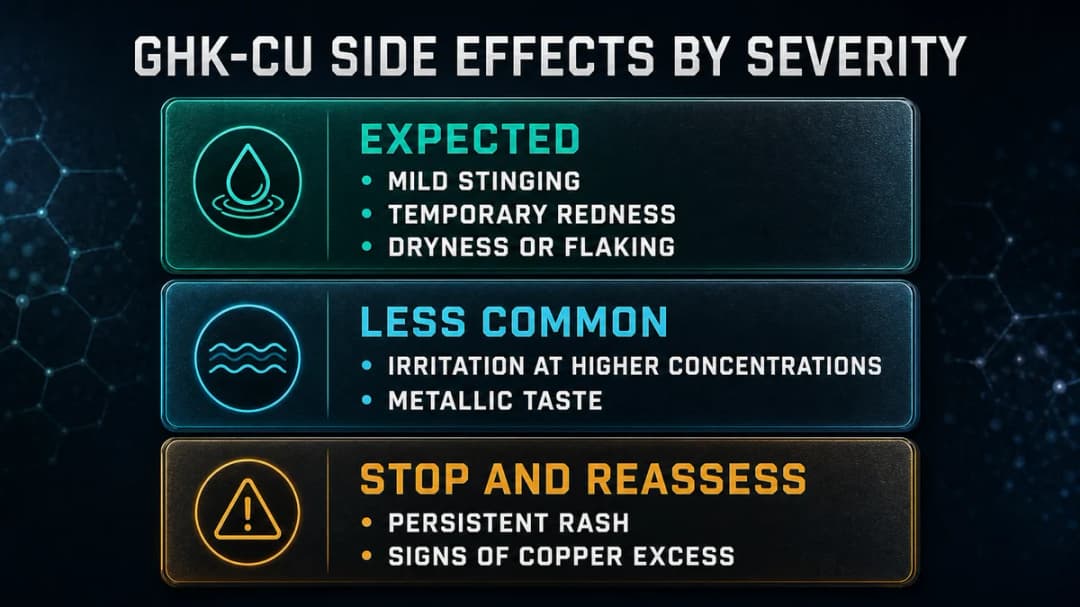
Rare, and reasons to stop
- Redness, swelling or pain at an injection site that is worse at 48 hours rather than better. This suggests infection and needs a doctor.
- Persistent itching, hives or rash spreading beyond the injection site, which may indicate copper sensitivity.
- Nausea, occasionally reported and generally associated with unusually high doses.
- Any systemic allergic reaction: hives, throat tightness, difficulty breathing. That is an emergency.
The copper question, taken seriously
Most articles on this topic wave at copper allergy and move on. Two points deserve more weight.
Copper sensitivity is real, if uncommon. People who react to copper jewellery or have a known sensitivity should treat this compound with caution and speak to a clinician first.
Copper metabolism disorders are a genuine contraindication. Wilson's disease is the clearest case, where the body cannot excrete copper properly and it accumulates in the liver and brain. Anyone with a diagnosed disorder of copper handling should not be injecting a copper-carrying peptide. This is not a theoretical caution.
For most people neither applies, and the amount of copper delivered at typical research doses is small. But "small" is a judgement that assumes normal copper regulation.
What is not caused by GHK-Cu
People attribute a lot to whatever they started most recently. GHK-Cu has no known effect on metabolism or appetite, no androgenic or oestrogenic activity, no established effect on sleep, and no recognised mechanism for mood change. If any of those shift during a protocol, the cause is more likely something else in the stack, or a lifestyle change that coincided with starting.

Topical is the gentler route
Topical GHK-Cu has a better safety profile than injection, which is unsurprising since it removes the needle entirely. What gets reported is mild irritation or redness on first use, usually settling after a few applications, and occasional tingling, which is normal for copper peptide serums. Contact dermatitis occurs rarely in people with sensitive skin, which is the argument for patch testing on the inner forearm before putting anything on your face. Which format to buy is a separate decision, covered in our GHK-Cu buyer's guide.
For skin purposes specifically, the topical route is also better evidenced, as covered in our GHK-Cu before and after page.
Technique fixes most of this
In rough order of how much difference each makes:
- Rotate sites. Repeated injection in one spot produces cumulative irritation that rotation prevents entirely.
- Inject slowly, taking five to ten seconds on the plunger. This does more for local irritation than anything else.
- Dilute properly. Around 2 mL of bacteriostatic water per 100 mg vial. Very concentrated solutions are what cause tinting and sting more.
- Use a fine needle, 29 to 31 gauge.
- Let the alcohol dry before the needle goes in, since wet alcohol stings and irritates.
- Do not inject straight from the fridge. Five to ten minutes at room temperature makes the injection noticeably more comfortable.
What is genuinely unknown
Topical GHK-Cu has a long track record. Injectable GHK-Cu does not. There is no long-term human safety data for repeated subcutaneous use, no established dose, and no monitoring of copper status in people who use it for months. The absence of reported problems reflects an absence of anyone looking as much as it reflects safety.
No significant drug interactions are known. Anyone on immunosuppressants, or on medication that affects wound healing, should raise it with their prescriber, since a compound that promotes tissue repair is acting in the same space.
For the compound overview, see our GHK-Cu guide.
FAQ
Is GHK-Cu safe?
It has a good tolerability record, and it is a peptide that occurs naturally in the body. Topical use has decades behind it. Injectable use has much less human data, no long-term safety studies, and no approved indication, so "well tolerated in reports" is the accurate description rather than "proven safe".
Can GHK-Cu turn your skin blue?
Only at high concentrations or if injected too shallowly, into the skin rather than the fat beneath it. Copper is coloured, so a concentrated solution in the wrong layer can show. Diluting properly and injecting subcutaneously prevents it, and any tint that does appear resolves.
Does GHK-Cu cause hair loss?
No. Some people notice more shedding in the first two to four weeks, which is what happens when resting follicles are pushed into a growth phase and old hairs are displaced. It settles, and it is not the same thing as hair loss.
Can you be allergic to GHK-Cu?
True copper allergy exists and is uncommon. Persistent itching, hives or a rash spreading beyond the injection site is a reason to stop and get advice. Anyone with a known copper sensitivity or a copper metabolism disorder such as Wilson's disease should avoid it.
Does GHK-Cu interact with medications?
No significant interactions are documented, though that reflects limited study rather than thorough investigation. Anyone taking immunosuppressants or drugs that affect wound healing should discuss it with their prescriber.
When should I stop using GHK-Cu?
If injection site pain is worse at 48 hours rather than improving, if redness and warmth are spreading, if a rash appears away from the injection site, or if you have any breathing difficulty or throat tightness, which needs emergency care.