In the GHK-Cu vs retinol question, retinoids win on evidence and GHK-Cu wins on comfort. Retinoids have decades of randomised trials, and prescription tretinoin is FDA-approved for fine facial wrinkles. Topical GHK-Cu (copper peptides) is much gentler and has a sensible biological rationale, but its facial studies are small, mostly short, and several were never published in full. The two work through different pathways, so most people who want both can use them in the same routine, as long as they are applied at different times.
This article compares them as topical skincare ingredients: how each one acts on skin, what the human data actually shows, how much irritation to expect, what changes in pregnancy, and how to layer copper peptides with retinol without wasting either. A short section at the end covers injectable GHK-Cu, which is a separate question.
GHK-Cu vs retinol at a glance
| GHK-Cu (copper tripeptide-1) | Retinol and other retinoids | |
|---|---|---|
| What it is | Copper-binding tripeptide found naturally in plasma | Vitamin A derivatives: retinyl esters, retinol, retinaldehyde, tretinoin (retinoic acid) |
| Main mechanism | Signalling to fibroblasts; shifts expression of repair and remodelling genes | Converted to retinoic acid, which binds nuclear retinoic acid receptors (RARs) |
| Best human evidence | Two 12-week studies of 71 and 41 women (conference abstracts), one 8-week controlled trial | Randomised vehicle-controlled trials since 1988, with biopsy data |
| Regulatory status | Cosmetic ingredient only | Tretinoin is a prescription drug approved for fine facial wrinkles; retinol is cosmetic |
| Irritation | Low; occasional redness or tingling | Common; a retinization period of dryness and peeling is expected |
| Sun sensitivity | None documented | Yes; daily SPF needed |
| Pregnancy | No human data | Avoid; tretinoin label says do not use |
| When to apply | Morning or evening | Evening |
How GHK-Cu works on skin
GHK is a three-amino-acid peptide (glycine, histidine, lysine) that binds copper tightly. It circulates in human plasma, and levels fall with age: Pickart and Margolina's 2018 review gives roughly 200 ng/mL at age 20 and 80 ng/mL by age 60. That decline is the main reason it is sold as an anti-ageing ingredient.
The mechanism is signalling, not stripping. In fibroblast and wound models, GHK-Cu increases collagen, elastin and glycosaminoglycan production. It also adjusts the enzymes that break down and rebuild the matrix, raising some metalloproteinases (MMPs) and their inhibitors (TIMPs) at the same time. That remodelling behaviour is why it is associated with wound healing and post-procedure recovery. It also has antioxidant and anti-inflammatory activity in lab work.
The gene-expression data is often quoted, so read it carefully. The same review reports that GHK changes the expression of 31.2% of human genes by 50% or more, raising 59% of them and lowering 41%. Those figures come from the Broad Institute's Connectivity Map, which tests compounds on cultured cell lines. They show that GHK has broad biological activity, not that a serum reshapes gene expression in facial skin to that degree.
Delivery is the practical weak point. GHK-Cu is highly water-soluble, and water-soluble peptides do not pass the outer skin barrier easily. Some does get through, but how much reaches the dermis depends on the formula. This is why the most impressive trial used a nano-lipid carrier rather than a simple serum.
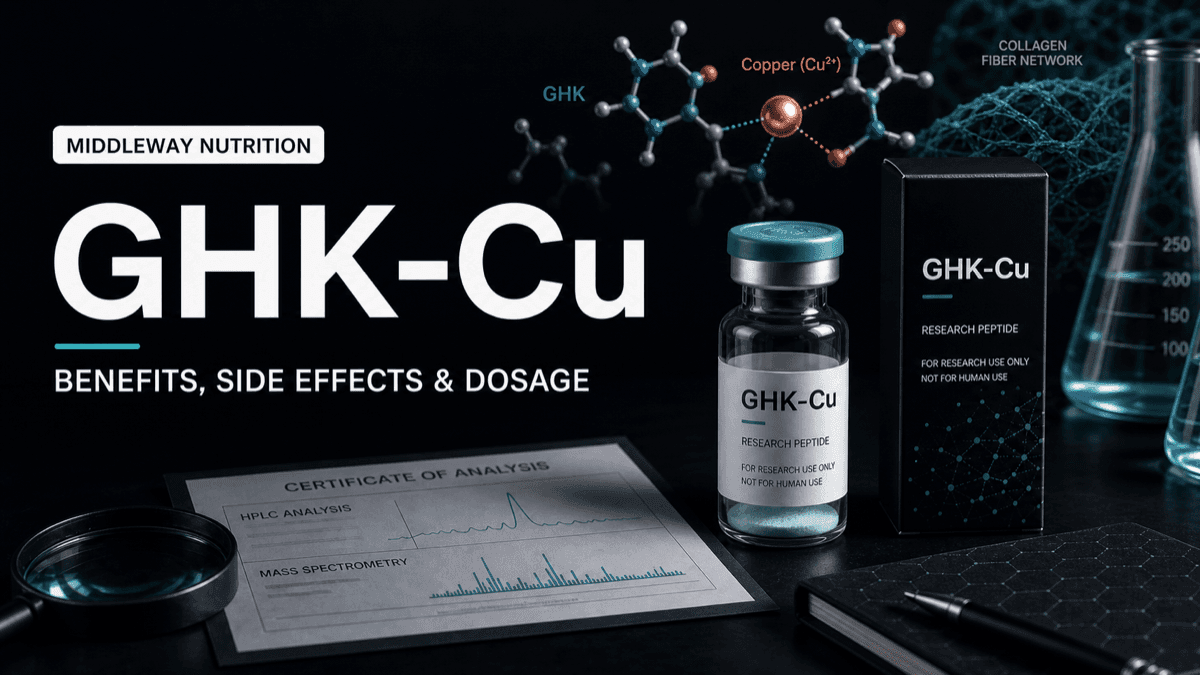
For the fuller account of its skin and hair data, see what the GHK-Cu skin and hair research shows.
How retinol and other retinoids work
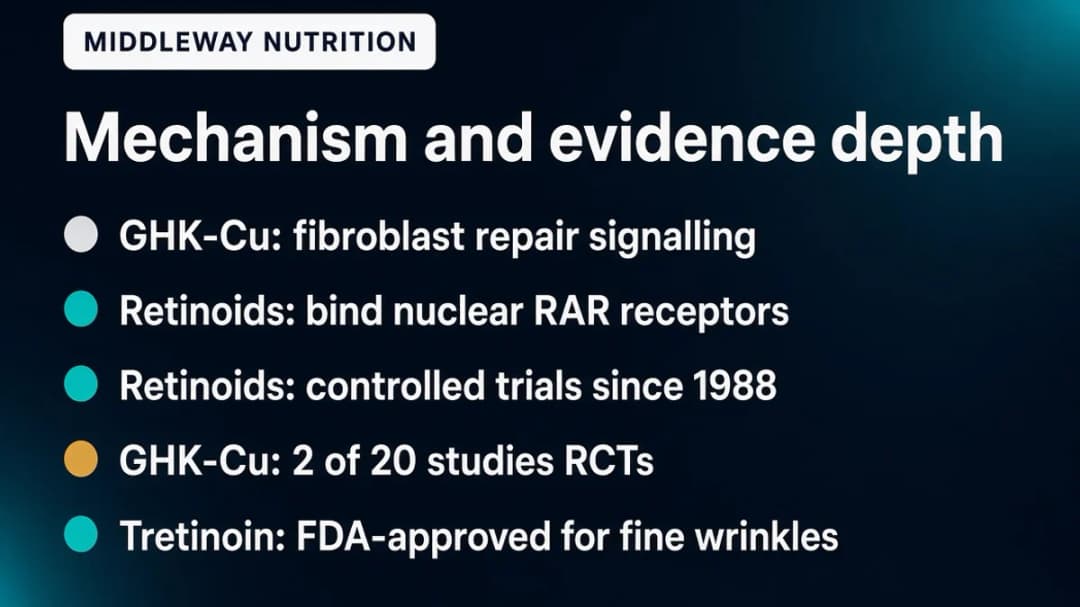
"Retinoid" is the family name. The forms in skincare sit on a conversion ladder: retinyl esters convert to retinol, retinol to retinaldehyde, and retinaldehyde to retinoic acid. Only retinoic acid is directly active. Tretinoin is retinoic acid itself and is prescription-only. Retinol is two conversion steps away, which makes it weaker and gentler at the same percentage, and is why OTC retinol needs higher concentrations than prescription tretinoin.
Retinoic acid enters the cell nucleus and binds retinoic acid receptors (RAR-alpha, beta and gamma; gamma dominates in the epidermis). These receptors pair with retinoid X receptors and switch target genes on or off directly. In practice this does three things:
- Speeds up and normalises keratinocyte turnover, which smooths texture and evens out pigment over time
- Increases dermal collagen formation, as shown in human biopsies
- Blunts the ultraviolet-triggered signalling that raises collagen-degrading MMPs
So both ingredients end up at collagen, but by different routes. Retinoids act on a defined receptor system with measured effects in human skin. GHK-Cu acts on broader repair signals that are well described in cells and animals and much less measured in human faces.
What the clinical evidence shows for each
Retinoids: decades of controlled trials
The retinoid evidence is deep enough that a few landmark studies tell the story.
- Weiss et al., 1988 (JAMA). In a 16-week randomised, double-blind, vehicle-controlled trial, all 30 patients who completed it improved on the tretinoin-treated forearm. On the face, 14 of the 15 patients using tretinoin improved, compared with none using vehicle. The only side effect was irritation.
- Griffiths et al., 1993 (NEJM). In biopsies from 29 patients treated for 10 to 12 months, daily 0.1% tretinoin cream produced an 80% increase in collagen I formation, compared with a 14% decrease with vehicle.
- Kafi et al., 2007 (Archives of Dermatology). Tretinoin is not the only form with data. In 36 elderly subjects with a mean age of 87, 0.4% retinol lotion applied up to three times a week for 24 weeks significantly improved fine wrinkling compared with vehicle on the opposite arm. It also raised glycosaminoglycan and procollagen I in the subgroups that were biopsied.
Tretinoin also has regulatory backing. Renova (tretinoin cream) is FDA-approved as an adjunct for mitigating fine facial wrinkles. The label is candid: it states that the 0.02% cream does not eliminate wrinkles or reverse photoageing, and it has not shown benefit for coarse wrinkling, laxity or mottled pigmentation. Even the gold standard is modest, which is useful context for any claim made about a serum.
GHK-Cu: small studies, several never fully published
The GHK-Cu facial evidence is thinner than most marketing suggests. The studies usually cited are:
- A 12-week facial cream study in 71 women with mild to advanced photoageing, reporting improved density, thickness, laxity, clarity and fine lines.
- A 12-week eye cream study in 41 women, reported as outperforming both placebo and a vitamin K cream.
- Badenhorst et al., 2016 (Journal of Aging Science). A randomised, double-blind trial in female volunteers using GHK-Cu in a nano-lipid carrier twice daily for 8 weeks. Compared with the carrier alone it reduced wrinkle volume by 55.8% and wrinkle depth by 32.8%. Compared with Matrixyl 3000 it reduced wrinkle volume by 31.6%.
The first two exist as abstracts from the American Academy of Dermatology's 2002 annual meeting, as listed in the 2018 review. They are not full peer-reviewed papers, so the methods and effect sizes cannot be checked. The third tested a specialised delivery system, so its results do not automatically apply to an ordinary copper peptide serum.
An independent 2026 systematic review in Aesthetic Surgery Journal found 20 eligible studies on GHK-Cu in aesthetic medicine. Only 2 were randomised controlled trials; the other 18 were preclinical. The authors concluded that the biological basis is reasonable but limited by methodological variability and too few well-designed trials. That is a fair summary.
The one head-to-head comparison
Nearly every page on copper peptides vs retinol cites the same figure: GHK-Cu improved collagen in 70% of women, compared with 50% for vitamin C and 40% for retinoic acid. It comes from Abdulghani et al., a 1998 pilot study in Disease Management and Clinical Outcomes. Its full title describes a pilot study on the ultrastructure of normal skin, and the creams were applied to the thigh, not the face.
Three caveats matter:
- The 70% is the share of women whose biopsy showed any increase, not a 70% increase in collagen.
- It was a small pilot on thigh skin that was not photodamaged, and the abstract is not indexed on PubMed.
- Reviews by GHK's discoverer describe the duration inconsistently: one month in a 2015 review and 12 weeks in the 2018 one.
It is an interesting signal. It is not evidence that GHK-Cu beats tretinoin on the face, and nobody has repeated the comparison with a proper trial.
Irritation and the retinization period
This is where the two differ most in daily use.
Retinoids irritate predictably. In the Renova label's controlled studies of 339 patients using the 0.02% cream, almost all reported at least one local reaction, such as peeling, dryness, burning, stinging, redness or itching. In 32% the irritation was severe, caused a temporary stop, or needed a mild steroid cream, and about 4% stopped treatment altogether. OTC retinol is milder, but the pattern is the same at a lower intensity.
That early phase is called retinization. It usually peaks in the first few weeks and settles as the skin adapts. The practical rules:
- Start two or three nights a week and increase only when the skin is calm
- Use a pea-sized amount for the whole face, on dry skin
- Keep the rest of the routine simple: a gentle cleanser, a plain moisturiser, and daily SPF
- Drop back a step if peeling becomes cracking or stinging lasts beyond application
- Do not add exfoliating acids during the adjustment period
GHK-Cu has no equivalent adjustment period and no photosensitivity. The reported problems are occasional redness or tingling, breakouts in some users, a temporary dull or rough patch that users call "copper uglies" (an anecdotal report, not a documented reaction), and rarely a contact reaction to copper. Our page on GHK-Cu side effects and the copper question covers these in detail.
Low irritation is not the same as proof of effect. GHK-Cu's comfort is a real advantage for sensitive skin, but it does not make up for the gap in evidence.
Retinol vs copper peptides in pregnancy
Retinoids are the clear no. Oral isotretinoin is a known cause of birth defects, and topical products follow cautious rules. The Renova label says not to use it during pregnancy or when trying to conceive. Most clinicians give the same advice for OTC retinol and retinaldehyde, even though far less reaches the bloodstream from skin.
The human data on topical exposure is reassuring but not permissive. A 2015 meta-analysis by Kaplan and colleagues compared 654 women exposed to topical retinoids in the first trimester with 1,375 unexposed women. It found no significant increase in major congenital malformations (odds ratio 1.22, 95% CI 0.65 to 2.29) or miscarriage. The authors stated that the result is useful for reassuring women exposed by accident, but that the data lacks the statistical power to justify using topical retinoids in pregnancy.
GHK-Cu is often suggested as the "pregnancy-safe retinol alternative". It has no pregnancy safety data at all: no teratology studies of the cosmetic ingredient, and no exposure registries. It is not a retinoid, so the specific retinoid risk does not apply, but "not studied" is not the same as "safe". Anyone pregnant or breastfeeding should ask their midwife, GP or dermatologist before adding a new active. Azelaic acid is a better-studied alternative that clinicians often suggest.
Can you use GHK-Cu and retinol together?
Yes. Nothing suggests the two antagonise each other biologically, and their mechanisms are complementary: a retinoid drives turnover and receptor-mediated collagen formation, while GHK-Cu supports repair signalling and tends to calm skin. What makes sense is applying them at different times, rather than stacking both in the same step.
The pH and copper-and-acid question
Much of the advice here is borrowed from vitamin C and applied to retinol without checking.
- Copper and low pH. GHK holds copper through its histidine and amino groups, and that binding weakens under strongly acidic conditions. The 2015 review describes GHK-Cu as stable in buffers from pH 4.5 to 7.4. L-ascorbic acid serums are usually formulated well below that, and exfoliating AHA and BHA products often are too. They are the real clash.
- Copper and vitamin C. Free copper also catalyses the oxidation of ascorbic acid, which is a second reason to keep strong vitamin C and copper peptides apart.
- Retinol itself. Retinol serums are not usually strongly acidic, so the low-pH argument applies weakly, if at all. The better reasons to separate them are that retinol is sensitive to oxidation (and metal ions can speed that up inside a mixed layer) and that two actives in one layer make irritation harder to trace. Neither interaction has been measured on skin.
An AM/PM split that works
The simplest routine puts each one in its own slot.
- Morning: cleanse, GHK-Cu serum, moisturiser, SPF 30 or higher. If you use L-ascorbic acid, use it on alternate mornings or in the evening on non-retinoid nights, not in the same layer as the copper peptide.
- Evening: cleanse, retinoid, moisturiser.
If your skin is still going through retinization, alternating nights works too: retinoid one night, GHK-Cu and a barrier-supporting moisturiser the next. Some people apply both on the same night by putting on the peptide first and waiting until it has fully absorbed. That can work, but it gives up the clarity of separate steps for no proven gain.
One more practical point: copper peptide serums vary widely in concentration and stability. A blue-tinted serum that turns green or brown has probably degraded. If you mix your own, how long GHK-Cu lasts once reconstituted is worth checking first.
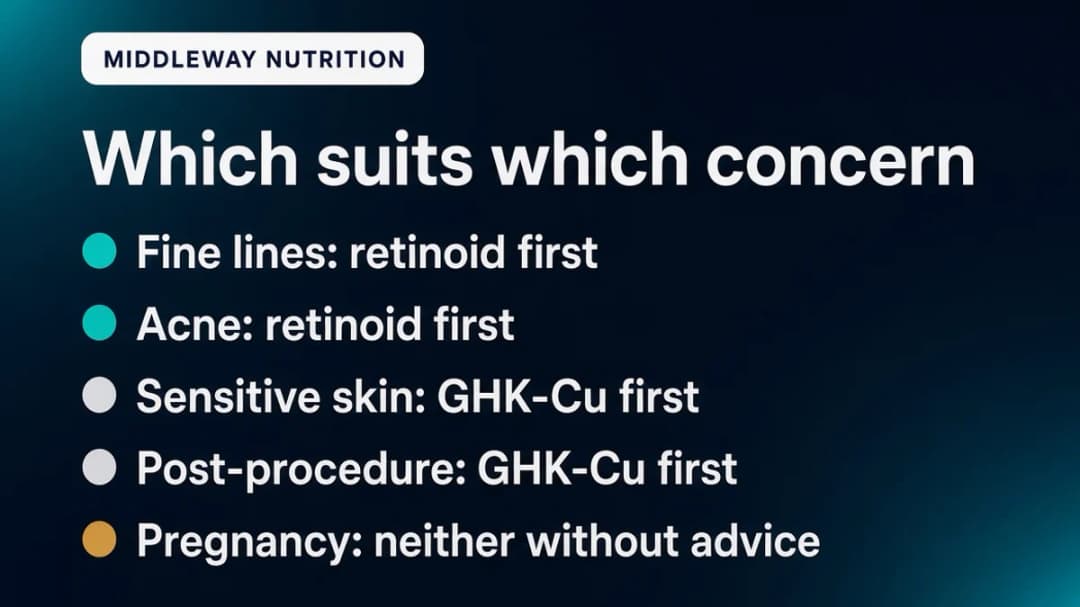
Which is better for your skin concern?
| Skin concern | Better first choice | Why |
|---|---|---|
| Fine lines and photoageing | Retinoid | Controlled trials and biopsy data; tretinoin is FDA-approved for fine wrinkles |
| Acne and clogged pores | Retinoid | Normalises follicular turnover; GHK-Cu has no meaningful acne data |
| Uneven tone and sun spots | Retinoid | Gradual evening of pigment with turnover; GHK-Cu evidence is indirect |
| Sensitive or rosacea-prone skin | GHK-Cu | Far lower irritation; retinoids often poorly tolerated |
| Post-procedure recovery (lasers, peels, microneedling) | GHK-Cu | Wound-healing profile; the 2026 review found improved patient-reported satisfaction after laser resurfacing |
| Firmness and thinning, crepey skin | Either, or both | Both raise matrix components; retinoid data is stronger, GHK-Cu is easier to tolerate |
| Pregnancy or trying to conceive | Neither without advice | Retinoids should be avoided; GHK-Cu is unstudied |
If you can tolerate a retinoid, it is the ingredient with the evidence, and prescription tretinoin is the version with the most data. GHK-Cu makes most sense in three situations: as the main active for skin that cannot tolerate retinoids, as a recovery step alongside them, or after procedures. Anyone expecting dramatic changes from either should read a realistic GHK-Cu before-and-after timeline, because photographed results online are rarely taken under controlled conditions.
How injectable GHK-Cu differs from topical
Everything above concerns creams and serums. Injectable GHK-Cu is a different product with a different evidence base. The controlled human skin data is all topical. Injected GHK-Cu has animal and cell studies behind it, and no published human clinical trial, so claims that injecting it improves facial skin more than a serum are untested. It is also not an approved medicine. The vials sold as lyophilised powder are labelled for research use only.
Synthro Lab sells GHK-Cu as a 50mg lyophilised vial, listed at A$44.88 (about US$32) on its Australian-dollar store when we checked on 26 September 2026 (Synthro Lab). Prices change, so check at the time of purchase. The reported ranges, reconstitution and what does and does not transfer from topical to injected use are covered in our full GHK-Cu peptide guide, and every related page is gathered on the GHK-Cu hub.
This section describes research use and is not medical advice.
FAQ
Is GHK-Cu better than retinol?
Not on the evidence. Retinoids have decades of randomised trials and biopsy data, while GHK-Cu's facial studies are small and several exist only as conference abstracts. GHK-Cu is better tolerated, so for skin that cannot handle a retinoid it may be the better practical choice.
Can I use copper peptides and retinol together?
Yes, but in separate steps. The easiest routine is GHK-Cu in the morning and the retinoid at night, or alternating nights while your skin adjusts to the retinoid. Keep strong L-ascorbic acid and exfoliating acids out of the same layer as the copper peptide.
Should copper peptides go before or after retinol?
If you apply both on the same night, the water-based peptide serum usually goes first, then the retinoid once it has absorbed, then moisturiser. Using them at different times of day avoids the question and makes any irritation easier to trace.
Does GHK-Cu cause purging like retinol?
No. Purging comes from faster cell turnover, which is a retinoid effect. Some people report breakouts or a temporary rough, dull phase when they start copper peptides, but this is anecdotal and there is no recognised adjustment period like retinization.
Is GHK-Cu safe during pregnancy?
It has not been studied in pregnancy, so nobody can say it is safe. It is not a retinoid, so the known retinoid concern does not apply. Anyone pregnant or breastfeeding should check with a clinician before using it.
Does GHK-Cu make skin sensitive to the sun?
No photosensitivity has been documented for GHK-Cu, unlike retinoids, where daily SPF is part of the treatment. Sunscreen still matters for anyone concerned about skin ageing, whichever active they use.
How long does each take to show results?
Retinoid trials measure changes over months: 16 weeks in the 1988 tretinoin trial and 24 weeks in the 2007 retinol study. The GHK-Cu studies ran for 8 to 12 weeks. For either, judge results at around three months of consistent use, not after a few weeks.