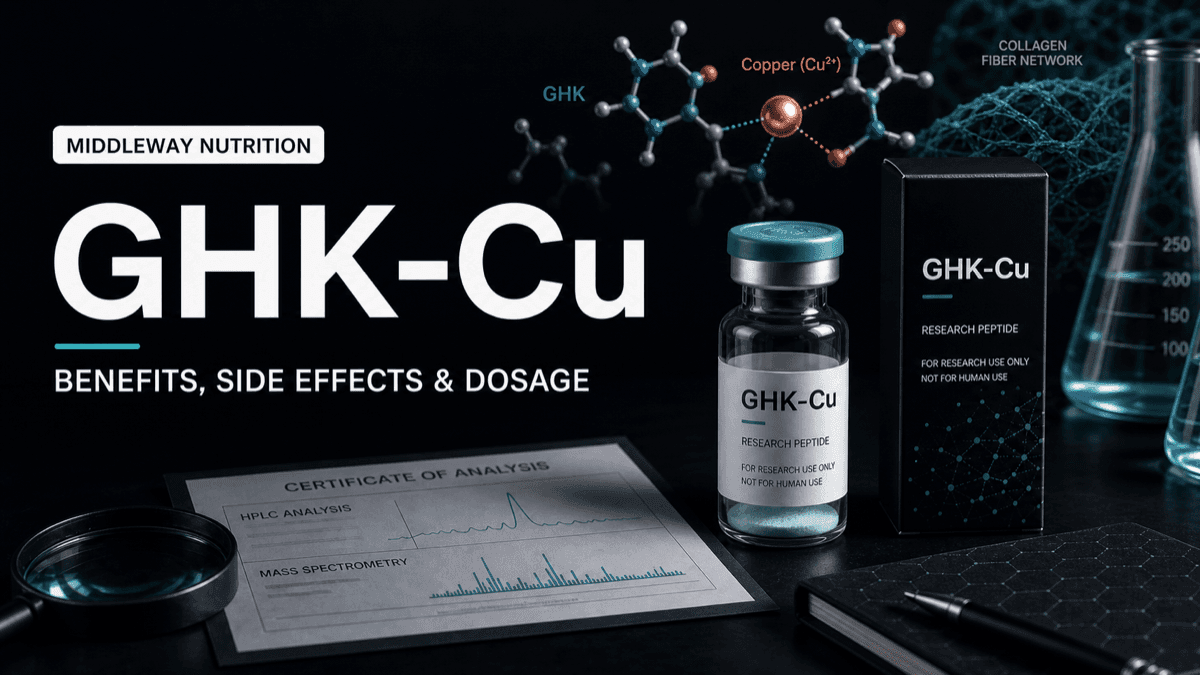
GHK-Cu peptide benefits are best documented for skin and wound repair, side effects are mostly local and mild, and reported dosage ranges are narrow and well described. What is less well understood is that the name covers two very different products.
- GHK-Cu is a naturally occurring tripeptide (glycyl-L-histidyl-L-lysine) carrying a bound copper ion. Circulating levels are described as falling substantially from early adulthood onward, which is the usual rationale given for supplementing it.
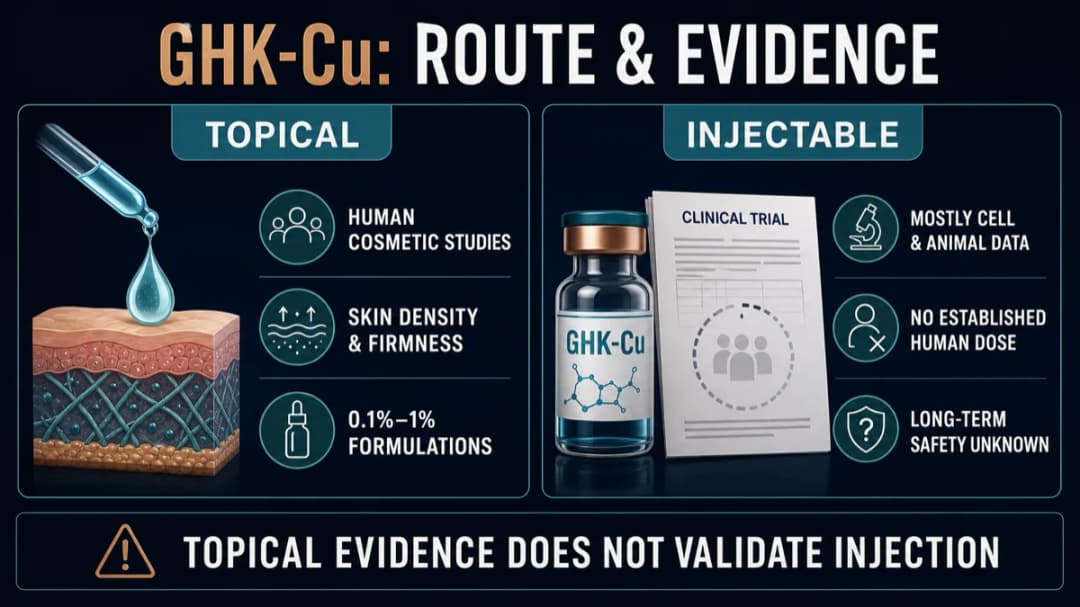
- The strongest human evidence is topical and cosmetic. Injectable and systemic claims rest mostly on cell and animal work, so treat them as research territory rather than settled.
- Reported side effects cluster at the application or injection site. The main systemic concern is copper handling, which is why copper metabolism disorders are a hard exclusion.
- Reported research doses run 1 to 3 mg subcutaneously per injection, with topical formulas typically 0.1% to 1%. Cycles are commonly described as 8 to 12 weeks with a break after.
- Because copper peptide is cheap to imitate and hard to eyeball, third-party identity and purity testing matters more here than with most peptides.
What GHK-Cu Actually Is
Strip away the branding and GHK-Cu is a very small molecule: a three-residue sequence of glycine, histidine, and lysine, holding one copper ion. Skincare labels rarely print that. They print copper tripeptide-1, the ingredient name used across the cosmetics industry, which is why the same compound can look like two unrelated products depending on which shelf it sits on. Search listings scatter the name further still: GHKCu without the hyphen, GHK Cu with a space, GHK copper peptide, or copper peptide GHK-Cu. Those are all the same molecule. The one label that genuinely means something else is bare GHK, the tripeptide with no copper ion attached, though in loose usage people write GHK when they mean the complex. The peptide dissolves readily in water, and that solubility is the practical reason it behaves well both in a serum base and in a reconstituted vial.
The compound has been studied since the 1970s, when Loren Pickart identified it in human plasma while investigating why aged tissue in culture behaved more youthfully in certain plasma fractions. Wound repair became the dominant research theme from there. The important point for a reader today is that this is not a synthetic novelty: humans produce GHK endogenously, and the accepted rationale for supplementing it is that endogenous output declines as we age, alongside the visible markers of slower repair.
Three mechanisms explain the breadth of what gets claimed for it.
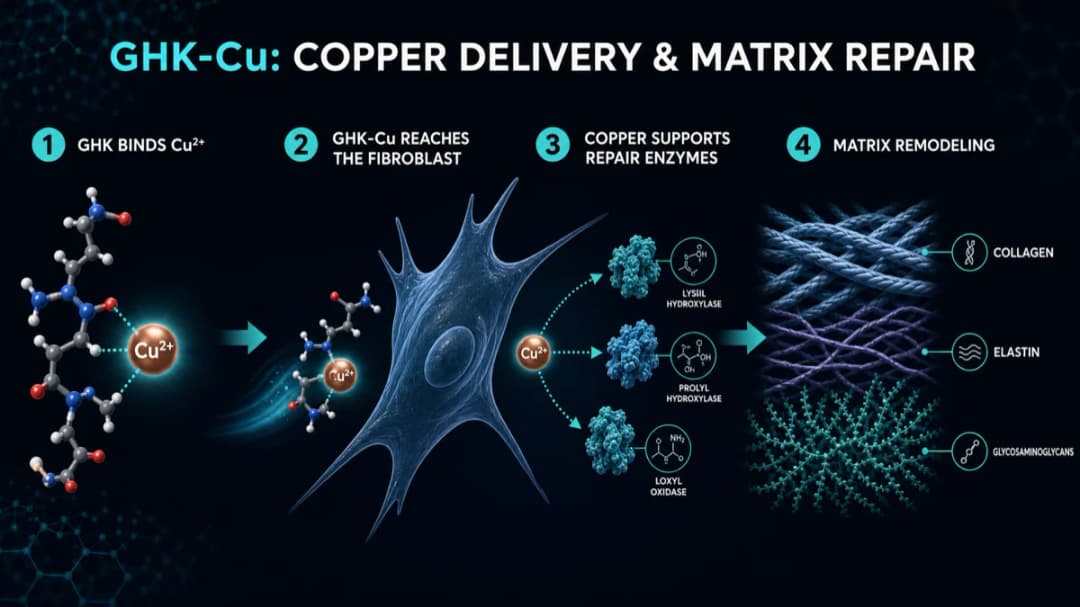
Copper as cargo, not as a loose ion. Unbound copper is chemically reactive and damaging. GHK holds copper tightly enough to quiet that reactivity while still handing it off inside the cell, where copper is required by enzymes that crosslink collagen and by antioxidant enzyme systems. Think of the peptide as a delivery vehicle rather than an active ingredient in the ordinary sense.
Wide-ranging transcriptional activity. In cultured fibroblasts, GHK-Cu exposure has been reported to shift the expression of a broad set of genes rather than acting on a single narrow pathway. The reported direction is consistent: more activity in repair-associated pathways, less inflammatory cytokine signaling. This is cell-culture work. It explains why researchers keep returning to the molecule, and it does not establish any clinical outcome in a person.
Rebuilding the scaffold. The peptide prompts fibroblast activity and supports synthesis of the structural and water-binding components that give skin its density. It also influences the enzymes that break matrix down. That balance between building and degrading is the likely reason repair under GHK-Cu is described as organized rather than fibrotic.
Nothing here is an approved drug indication. GHK-Cu sold as a lyophilized vial is a research chemical, not a medicine, and there is no regulatory dosing standard for injection.
GHK-Cu Benefits
The honest version requires separating what has been measured in people from what has been measured in a dish or a rodent.
Well supported in humans (topical)
Skin is where the clinical evidence sits. Topical studies running roughly three months have reported reductions in measured wrinkle depth and improvements in skin density and firmness. Laboratory comparisons against other cosmetic signal peptides have generally favored GHK-Cu on collagen stimulation, though bench comparisons and real faces are not the same thing. Treat that human evidence cautiously: a 2025 review of topical GHK-Cu and Pal-GHK noted a surprising absence of clinical studies. Elastin and the water-binding matrix components also increase, and that is the part users tend to register as plumpness and hydration rather than as fewer lines.
Barrier repair is an underrated use. Skin compromised after retinoids, laser resurfacing, microneedling, or peels tends to tolerate GHK-Cu well, and some dermatology practices use it in that post-procedure window.
Moderately supported (hair, wound healing)
On hair, the described effects are follicle enlargement and a longer active growth phase before a hair sheds. Preclinical comparisons against topical minoxidil have been reported as favorable, but there is no reliable head-to-head human regrowth data, and treating the two as interchangeable is not supported. The mechanism does not involve androgen signaling at all, which is the meaningful contrast with finasteride and the reason it gets considered by people who will not take a hormonal drug.
Wound repair is the oldest research thread and remains largely an animal literature. Models of poorly perfused and diabetic wounds have reported faster closure under GHK-Cu than under vehicle or no treatment, with more collagen laid down and better new vessel formation supporting the repair. Controlled human wound trials are considerably thinner than the volume of preclinical work would lead you to expect.
Early stage, do not build expectations on it
Anti-inflammatory and antioxidant activity shows up consistently across models without having produced a defined clinical indication. Newer work extends into gut inflammation, lung tissue, and neuroprotection, all of it at the cell-culture or animal stage. These are directions of investigation, not reasons to buy. Any seller leaning on these categories is well out in front of the evidence.
If your interest is soft tissue and tendon repair specifically, the evidence base is different and arguably deeper for other compounds. Our BPC-157 peptide guide and TB-500 peptide guide cover those separately.
GHK-Cu Injection Benefits vs Topical: What Actually Transfers
The most common question about this peptide is what injecting it buys you over rubbing it on, and the honest answer is that nobody has measured it in a person. The human studies of GHK-Cu that exist are topical and small. The injectable route rests on animal work, some of it not even using a route a human would use.
| Claimed benefit | Strongest evidence behind it | Route in that evidence | Human injection data |
|---|---|---|---|
| Wrinkle depth, skin density, firmness | Reported 12-week cream studies in 71 women (facial) and 41 women (eye area); a 2025 review found a surprising absence of clinical studies, so treat as limited and not independently confirmed here | Topical | None |
| Post-procedure barrier recovery | Cosmetic and dermatology practice use | Topical | None |
| Hair follicle size and growth phase | Macaque and rodent models, follicle enlargement comparable to minoxidil in those models | Topical | None |
| Graft and ligament healing | Rat ACL reconstruction, 72 animals, weekly dosing for four weeks | Injection into the joint | None |
| Lung inflammation and fibrosis | Bleomycin-injured mice, GHK and GHK-Cu | Intraperitoneal injection | None |
| Anxiety, learning, cognition | Rats and aged mice | Intraperitoneal injection and intranasal | None |
Read the last column again before spending money. A PubMed search for injected GHK-Cu in humans returns cell studies, animal models, hydrogel and dermal filler formulation work, and reviews. It does not return a clinical trial.
The case for injecting is reasonable in principle: a serum only reaches the skin you spread it on, so anything systemic, meaning connective tissue you cannot get to, lung, joint, brain, needs another route. Reasonable in principle is not the same as demonstrated, and the animal doses give you no shortcut to a number. The rat anti-anxiety result used 0.5 micrograms per kilogram intraperitoneally, which the authors themselves scaled to roughly 35 micrograms for a human, some 30 to 85 times below the 1 to 3 mg that gets injected. The aged-mouse cognition work runs the opposite way, at 10 mg per kilogram of body weight, which straight-converted is around 700 mg for a 70 kg person. Neither figure was derived for human use, and the 1 to 3 mg convention did not come from either of them.
Two findings from that table are worth pulling out. In the rat ACL study the treated animals had less knee laxity than saline controls at six weeks, and that difference was gone by twelve weeks once dosing stopped, which suggests the effect lasts about as long as the exposure does. And the outcome with the best human documentation, visible skin change, is the one you can get topically, for less money and with none of the sterility questions that come with a vial and a syringe.
GHK-Cu Side Effects
GHK-Cu is generally well tolerated, and the reason is structural: it is an endogenous molecule and the copper it carries is chelated rather than free. That said, tolerability is not the same as a complete safety file, and the injectable route in particular lacks long-term human data.
Commonly reported, local, self-limiting
- Redness, tingling, or brief stinging at the application site with topical use, usually in the first one to two weeks
- Temporary dryness or light peeling as turnover increases
- Injection site redness, a small bump, warmth, or brief itching that resolves within a couple of hours
- Increased hair shedding in the first two to four weeks of scalp use, consistent with hairs moving out of the resting phase
Less common
- The so-called copper uglies, a temporary purge or breakout reported with higher-concentration topicals. It typically settles within two to three weeks; if it does not, the concentration is probably too high for that skin
- A transient blue-green skin tint, reported when concentrated solution is deposited intradermally rather than into subcutaneous fat. Copper is colored, and this is a delivery artifact rather than a toxicity sign
- Mild headache in the first week of injectable use, generally resolving on its own
- Heightened reactivity of the skin to other actives during the first couple of weeks
Rare, and reason to stop
- Persistent redness, swelling, or worsening pain at an injection site beyond 48 hours, which raises the possibility of infection
- Genuine copper hypersensitivity, presenting as hives or rash beyond the treated area
- Any systemic allergic response, which is an emergency rather than a dose adjustment
Where the data is thin. Long-term injectable safety in humans is not well characterized, and most of the reassurance in circulation is extrapolated from decades of topical cosmetic use. There is no reliable human data on high-dose or multi-year injectable use.
Exclusions worth taking seriously: any inherited or acquired disorder of copper handling, Wilson's disease being the obvious one, where copper accumulation is a documented rather than hypothetical risk; active cancer, because GHK-Cu promotes angiogenesis; pregnancy and breastfeeding, where safety data is simply absent; and anyone under 18. Patch test topicals for 48 hours if you have a history of contact dermatitis.
GHK-Cu Dosage Chart
The injectable and most topical figures below are community or cosmetic-industry convention, not figures taken from a human trial or label. They are not instructions, and there is no established human dosing standard for injectable GHK-Cu.
| Goal or context | Reported range | Frequency | Typical cycle |
|---|---|---|---|
| Topical, facial skin and lines | 0.1% to 1% serum or cream (cosmetic formulas often 0.1% to 0.5%) | Once daily at night, or twice daily if tolerated | Ongoing; peak effects reported around 8 to 12 weeks |
| Topical, scalp and hair | 0.5% to 1% leave-in treatment | Daily on dry scalp | 3 to 6 months before assessing |
| Injectable, general skin and anti-aging | 1 to 3 mg per injection | Once daily, or 2 to 4 times weekly | 8 to 12 weeks, then a 4 week break |
| Injectable, wound and post-procedure recovery | 2 mg per injection | Twice daily | 4 to 8 weeks |
| Combined hair protocol | 1 mg injectable plus topical scalp application | Daily | 12 to 16 weeks minimum |
| Post-cycle maintenance | 1 mg per injection | Three times weekly or every other day | Ongoing |
A few points of context. Higher is not better here. The commonly cited 1 to 3 mg window is intended to sit near physiological signaling levels, and there is no evidence that pushing well past it produces proportionally more effect. Reported topical concentrations vary widely between cosmetic products (often 0.1% to 0.5%) and peptide-market serums (sometimes marketed at 2% to 4%), and the higher end is where purge reports concentrate.
Cycling is precautionary rather than protective against a known harm. The rationale given is maintaining responsiveness over time, not avoiding toxicity. Injection route matters too: published protocols are consistently subcutaneous, using a 29 to 31 gauge insulin needle into abdomen, outer thigh, or the back of the upper arm, with site rotation each time. Intramuscular delivery is not described in the literature and adds local reaction risk with no stated benefit.
Timelines are slow because the underlying process is collagen remodeling. Skin changes are usually described from weeks 3 to 4 and clearest at 8 to 12 weeks, while hair moves on follicle cycle time, making 12 weeks the floor for assessment.
GHK-Cu Pros and Cons
| Pros | Cons |
|---|---|
| An endogenous human molecule with a research trail running back to the 1970s, not a novel synthetic | The injectable form is a research chemical with no approved indication and no dosing standard |
| The skin evidence is the only human data, limited and mostly topical, and a 2025 review notes few clinical studies | Everything systemic, meaning lung, joint, brain, and whole-body anti-aging, is cell and animal work |
| Reported side effects are overwhelmingly local and self-limiting | Long-term injectable safety in humans is uncharacterized |
| Copper is delivered chelated rather than as a loose reactive ion | Copper metabolism disorders, active cancer, and pregnancy are hard exclusions |
| Topical versions are cheap, legal, and sold in ordinary retail skincare | Purity cannot be eyeballed, and the blue-green color proves nothing on its own |
| No androgen pathway involvement, so none of the tradeoffs that come with hormonal drugs | No head-to-head human data against minoxidil or any established treatment |
How to Verify What You Buy
Copper peptide is inexpensive to underfill or substitute, and the pale blue-green color that people use as a visual check can be produced by copper salts alone, so appearance proves nothing. Ask for a batch-matched third-party certificate of analysis showing identity by mass spectrometry and purity by HPLC, and confirm the vial is lyophilized rather than pre-mixed. Our where to buy GHK-Cu breakdown covers which suppliers publish testing that actually matches the lot in the box, and the GHK-Cu for sale page tracks current listings and pricing.
Stacking
Two stacking questions come up, and they have different answers.
Topical actives. The one real conflict is ascorbic acid. Most vitamin C serums sit at a low enough pH to destabilize the copper complex, so the two belong in different routines rather than layered minutes apart. High-strength retinoids are better on alternating nights than stacked, which is slightly ironic given that repairing a retinoid-stressed barrier is one of the situations GHK-Cu handles well. Humectants, niacinamide, and daily sunscreen present no problem, and the sunscreen is not a throwaway line: continued UV exposure dismantles the collagen you are spending months trying to build.
Peptide combinations. The documented pairing is GHK-Cu with BPC-157 and TB-500 in a tissue repair context, which is the basis of the blends sold as KLOW and similar formulations. The rationale is complementary rather than synergistic in any proven sense: GHK-Cu supplies matrix and collagen signaling while the others act on cell migration and soft tissue repair. Blended cosmetic-focused products follow the same logic, and our glow peptide stack guide covers how those combinations are actually put together. Combinations with growth hormone secretagogues are commonly discussed but not documented as a studied combination, so treat that as user practice rather than evidence. Suppliers also sell GHK-Cu premixed into a single vial with compounds such as MOTS-c, epithalon, or KPV, listing a milligram figure for each. None of those combinations has a published study behind it, and a blend vial takes away your ability to change one variable at a time or to drop the single component you reacted to.
Reconstitution and Storage
Lyophilized GHK-Cu is reconstituted with bacteriostatic water, not saline and not plain sterile water. Bacteriostatic water contains 0.9% benzyl alcohol, which is what permits repeated entries into the same vial over weeks.
Take a 100 mg vial as the worked example. Two milliliters of diluent puts you at 50 mg/mL, and on a U-100 insulin syringe that makes a 1 mg dose 2 units (0.02 mL) and a 2 mg dose 4 units. Halve the diluent to 1 mL and the concentration doubles to 100 mg/mL, so a 1 mg dose becomes 1 unit; go to 3 mL and the marks rise accordingly, to about 3 units for 1 mg. Doses this small are hard to measure on a syringe, which is a reason to use more diluent. Whatever volume you choose, run the water down the inner wall of the vial instead of jetting it onto the powder, and rotate the vial gently rather than shaking it. The resulting solution should look clear to faintly blue-green, which is simply the copper showing.
Storage rules are straightforward. Unreconstituted powder is stable refrigerated for 12 to 24 months. Once reconstituted, keep it at 2 to 8 degrees Celsius, away from light, and use it within roughly four weeks. Never freeze reconstituted peptide, because ice crystal formation physically damages the peptide structure. Label the vial with the date and concentration when you mix it, since guessing later is how dosing errors happen.
Looking for the numbers behind this guide? Our GHK-Cu dosage chart sets label and trial doses beside what Reddit users report taking.
Frequently Asked Questions
What does GHK-Cu peptide do?
It delivers copper into cells in a bound, non-reactive form and signals fibroblasts to rebuild extracellular matrix. Practically, that shows up as increased collagen, elastin, and glycosaminoglycan production, reduced inflammatory signaling, and support for wound repair and follicle activity. The skin effects are the best documented in humans.
Is GHK-Cu safe?
Topical GHK-Cu has a long cosmetic track record with mostly mild, local reactions. Injectable GHK-Cu is well tolerated in reported use but lacks long-term human safety data, and it remains a research compound rather than an approved product. It should be avoided outright in copper metabolism disorders, active cancer, and pregnancy.
How much GHK-Cu is typically used?
Reported research ranges are 1 to 3 mg per subcutaneous injection, dosed anywhere from three times weekly to twice daily depending on the protocol, over cycles of roughly 8 to 12 weeks. Topical formulations are typically 0.1% to 1%. These are reported ranges, not recommendations, and no regulatory dosing standard exists.
Is GHK-Cu legal?
Copper tripeptide-1 is a permitted cosmetic ingredient and appears in ordinary retail skincare. GHK-Cu sold as a lyophilized vial is sold for research purposes and is not an approved drug for human injection in the US, which is a different legal category from the cosmetic form despite being the same molecule.
What are the benefits of GHK-Cu injections?
The benefits attributed to injection are mostly borrowed from topical research. What is documented in humans is skin: wrinkle depth, density, firmness, and post-procedure recovery, all measured on creams. What is documented for the injectable route is animal work, namely joint injections improving graft healing in rats, intraperitoneal dosing reducing lung fibrosis and inflammation in mice, and behavioral changes in rodents. Injection is the only way to reach tissue a serum cannot, which is why people use it, but the systemic benefits are inferred rather than measured.
Are there GHK-Cu injection benefits specific to women?
No sex-specific benefit, dose, or protocol has been established for injected GHK-Cu, because there is no human injection trial to establish one. Two things are still worth knowing. The limited human evidence reported was generated almost entirely in women: a 12-week facial cream study in 71 women and an eye-area study in 41, both topical, which we could not independently verify. And GHK-Cu does not act on androgen pathways, which is the reason it comes up for female pattern hair loss at all, given that finasteride is not an option for anyone who could become pregnant. Pregnancy and breastfeeding are a flat exclusion for GHK-Cu in any form, topical or injected, on absent data rather than known harm.
Is injectable GHK-Cu good for the brain?
There is no human data, and nothing in the animal literature used a route or a dose that maps onto a 1 to 3 mg subcutaneous injection. What exists: a gene ontology analysis found GHK shifting 408 neuron-related genes up and 230 down in cultured cells; rats given 0.5 micrograms per kilogram intraperitoneally spent more time exploring the open areas of a maze within 12 minutes; aged mice (20 to 21 months) given 15 mg/kg intraperitoneally for 5 days or intranasally for 8 weeks showed improved escape learning in a 2026 preprint; and a 2023 study delivered GHK to aging mice intranasally rather than by injection and reported better spatial memory. That is a fair case for continued research and no case for injecting yourself for cognition.
What is the difference between GHK and GHK-Cu?
GHK is the bare tripeptide. GHK-Cu is the same tripeptide carrying a copper ion, and the copper is the part doing most of the work, with the peptide acting as the carrier that keeps it usable and non-reactive. The two names get used interchangeably because copper affinity is GHK's defining property, and it was identified in human plasma as a copper-binding factor in the first place. Spellings blur the same way: GHKCu, GHK Cu, GHK copper peptide, and copper tripeptide-1 all point to the copper complex.
Sources
- Regenerative and Protective Actions of the GHK-Cu Peptide in the Light of the New Gene Data — International Journal of Molecular Sciences (2018)
- The Potential of GHK as an Anti-Aging Peptide — Aging Pathobiology and Therapeutics
- Tripeptide-Copper Complex GHK-Cu (II) Transiently Improved Healing Outcome in a Rat Model of ACL Reconstruction — Journal of Orthopaedic Research (2015)
- GHK Peptide Inhibits Bleomycin-Induced Pulmonary Fibrosis in Mice by Suppressing TGFb1/Smad-Mediated Epithelial-to-Mesenchymal Transition — Frontiers in Pharmacology (2017)
- Protective Effects of GHK-Cu in Bleomycin-Induced Pulmonary Fibrosis via Anti-Oxidative Stress and Anti-Inflammation Pathways — Life Sciences (2020)
- Intranasal GHK Peptide Enhances Resilience to Cognitive Decline in Aging Mice — PubMed (2023)